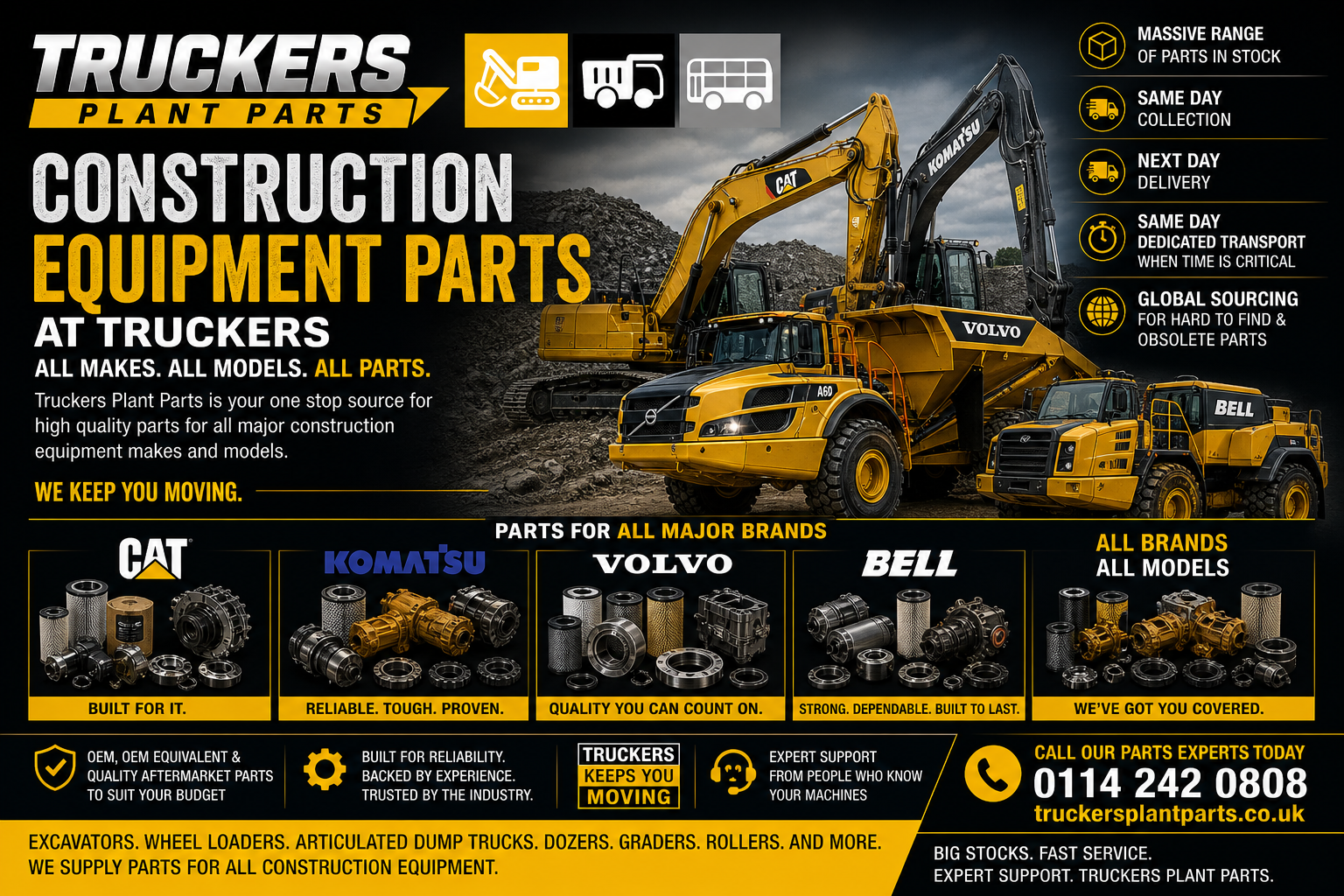
Heavy Plant Parts, Construction Equipment Parts & Demolition Machinery Spare Parts From Truckers Plant Parts
Heavy machinery keeps the modern world moving. From major infrastructure projects and quarry operations to demolition sites, mining support, recycling facilities, civil engineering works, road construction, waste handling, forestry, ports, aggregates, bulk earthmoving, utilities installation, and industrial material processing, today’s construction and demolition industries rely entirely on machines capable of operating continuously under immense pressure.
When those machines stop unexpectedly, entire operations can slow down instantly.
Production targets are missed. Operators stand idle. Contracts fall behind schedule. Transport chains become disrupted. Critical infrastructure projects stall. Revenue stops moving while costs continue rising.
That is why fast, reliable access to heavy plant parts and construction equipment spare parts has become one of the most important areas within the entire heavy machinery industry.
Truckers Plant Parts was built around solving exactly that problem.
Supplying high quality OEM, OEM-equivalent, and quality aftermarket parts for heavy plant machinery across virtually every major manufacturer, every major machine category, and every major component system used throughout construction, demolition, quarrying, mining support, recycling, earthmoving, and industrial operations.
Whether you operate one machine or manage an entire fleet, downtime costs money. In many industries, it costs enormous amounts of money extremely quickly.
That is why Truckers focuses heavily on rapid-response parts supply, technical understanding, difficult-to-source components, obsolete machinery support, emergency VOR assistance, and real heavy equipment expertise built through decades working directly within the plant machinery sector.
Modern construction equipment is more advanced, more powerful, and more technically demanding than ever before.
Excavators now integrate advanced hydraulic management systems, electronic machine control systems, emissions technology, telematics platforms, automated traction systems, complex driveline electronics, onboard diagnostics, intelligent fuel management, and predictive operational software. Demolition excavators operate with highly specialised hydraulic attachments under enormous structural stress. Articulated dump trucks haul massive payloads continuously across severe terrain. Wheel loaders operate under aggressive loading cycles in abrasive environments. Material handlers process scrap and waste under extreme hydraulic loads. Crushers, screeners, shredders, and recycling systems operate continuously under severe contamination and vibration.
Every machine category creates its own unique parts demands.
Truckers Plant Parts support all major construction equipment categories including crawler excavators, wheeled excavators, mini excavators, micro excavators, demolition excavators, high reach demolition machinery, articulated dump trucks, rigid dump trucks, wheel loaders, dozers, graders, rollers, material handlers, telehandlers, compact track loaders, skid steers, backhoe loaders, crushers, screening plants, recycling machinery, aggregate handling systems, and specialist demolition attachments.
The company supports equipment from major manufacturers including Volvo, Caterpillar, Komatsu, Bell Equipment, Liebherr, Hitachi, Hyundai, Develon, Doosan, JCB, CASE, Terex, FUCHS, Sennebogen, Kobelco, Sumitomo, Takeuchi, Kubota, Yanmar, Mecalac, New Holland, John Deere, Sandvik, Powerscreen, Finlay, McCloskey, Atlas Copco, Epiroc, and many others.
One of the biggest challenges facing heavy equipment operators today is the sheer complexity of modern machinery.
Older plant equipment was largely mechanical. Repairs were often straightforward. Components were simpler. Electronic systems were minimal.
Today’s machines are entirely different.
Modern excavators rely on electronically controlled hydraulic systems, advanced ECU management, integrated telematics, emissions systems, DEF systems, sensors, onboard diagnostics, camera systems, machine automation platforms, electro-hydraulic joysticks, digital displays, and complex software integration.
Construction equipment parts supply therefore requires far more than simply stocking filters and bearings.
It requires understanding how complete machine systems interact under severe operating conditions.
Truckers supports complete machine systems across all major equipment categories.
Engine systems form one of the largest support areas because engines remain the heart of every machine. Modern heavy equipment engines operate under enormous stress while balancing fuel efficiency, emissions compliance, reliability, and power delivery simultaneously.
Truckers support complete engine systems including cylinder heads, crankshafts, pistons, liners, injectors, turbochargers, intercoolers, cooling systems, EGR systems, DPF systems, SCR systems, DEF components, exhaust systems, alternators, starter motors, engine wiring harnesses, sensors, fuel systems, oil pumps, water pumps, belts, filters, seal kits, gaskets, bearings, valve systems, rocker assemblies, camshafts, flywheels, ECUs, and complete replacement engines.
Hydraulic systems represent another critical area throughout construction and demolition equipment.
Virtually every heavy machine relies heavily on hydraulic performance. Excavators depend on hydraulics for digging, lifting, attachment operation, slew control, travel systems, and auxiliary functions. Wheel loaders rely on hydraulic lift systems, steering systems, and attachment operation. Demolition machinery operates under extremely high hydraulic pressures continuously.
Truckers support hydraulic pumps, hydraulic motors, valve blocks, spool valves, accumulators, hoses, swivel joints, cylinders, seal kits, hydraulic tanks, pipework, hydraulic coolers, filtration systems, joystick controls, pressure sensors, hydraulic ECUs, auxiliary hydraulic systems, travel motors, final drives, and complete hydraulic rebuild components.
Demolition equipment parts have become an especially important sector within modern heavy machinery industries.
Demolition excavators and attachments operate under some of the harshest conditions anywhere within heavy industry. Hydraulic shears, pulverisers, breakers, crushers, grapples, selector grabs, magnets, and demolition booms absorb enormous impact loading, vibration, contamination, and structural stress continuously.
Truckers support demolition machine parts including shear blades, crusher teeth, pulveriser pivots, breaker pistons, rotators, cylinders, attachment bearings, demolition boom systems, quick couplers, wear plates, heavy-duty pins and bushes, structural repair components, slew systems, undercarriage systems, and specialised hydraulic systems designed specifically for severe demolition applications.
Undercarriage systems remain one of the highest wear categories throughout heavy equipment ownership.
Crawler excavators, dozers, crushers, screeners, and tracked recycling machinery all operate on undercarriage systems exposed continuously to abrasive environments, impact loading, contamination, and severe terrain conditions.
Truckers support track chains, rollers, sprockets, idlers, recoil systems, carrier rollers, track pads, track tensioners, slew rings, slew bearings, travel motors, planetary systems, final drives, and complete undercarriage rebuild solutions across all major tracked machine categories.
Drivetrain systems become especially important within articulated dump trucks, wheel loaders, quarry machinery, and heavy haulage equipment.
Modern articulated haulers such as Volvo A25, A30, A35, A40, A45, and A60 machines rely on highly sophisticated driveline systems including transmissions, torque converters, drop boxes, differentials, axle systems, planetary reductions, suspension systems, hydro-mechanical steering systems, and advanced traction management technology.
Truckers support transmissions, differentials, final drives, axle shafts, prop shafts, torque converters, driveline couplings, suspension cylinders, steering systems, brake systems, hub reductions, bearings, seals, and complete driveline rebuild components.
Wheel loader parts also represent a major support category.
Machines such as Volvo L20, L30, L35, L45, L60, L70, L90, L110, L120, L150, L180, L220, and L350 wheel loaders operate under severe loading cycles continuously throughout quarries, recycling plants, ports, waste transfer stations, and industrial stockyards.
Truckers support loader arms, articulation joints, steering systems, axle systems, braking systems, hydraulic lift systems, buckets, wear edges, cutting systems, cooling packages, transmission systems, cab systems, electrical systems, and complete service kits.
Mini excavator parts and micro excavator parts have also become increasingly important as urban construction, utilities work, landscaping, and compact site operations continue expanding.
Truckers support compact excavators including Volvo EC15, EC18, EC27, EC37, ECR series machines, along with Kubota, Takeuchi, Yanmar, JCB, Bobcat, CAT, Komatsu, and many other compact equipment manufacturers.
Mini excavator support includes rubber tracks, track rollers, hydraulic pumps, slew motors, cylinders, quick couplers, buckets, filters, engine components, electrical systems, cab parts, glass, control systems, service kits, and wear components.
One of Truckers Plant Parts’ biggest strengths is supporting obsolete, rare, discontinued, and difficult-to-source components.
Heavy machinery fleets often contain older machines still operating successfully decades after production ended. Many operators continue running older Volvo A25D, A30D, Caterpillar 769, Komatsu HM series, Liebherr quarry equipment, older Bell dump trucks, and legacy demolition excavators because they remain productive, dependable, and cost-effective.
However sourcing parts for older machinery has become increasingly difficult.
Truckers specialise in locating obsolete stock, rebuilding legacy systems, sourcing international components, cross-referencing part numbers, and helping operators keep valuable machinery working long after official dealer support becomes limited.
That capability alone often separates genuine heavy equipment specialists from ordinary parts suppliers.
Because real heavy equipment knowledge matters enormously.
Understanding the difference between a hydraulic issue and an electrical control issue matters.
Understanding how driveline failures develop matters.
Understanding articulation wear, undercarriage stress, slew system fatigue, demolition boom cracking, attachment wear, cooling system failures, and contamination problems matters.
Truckers Plant Parts built its reputation by helping operators solve difficult machine problems where others fail.
That includes sourcing rare parts quickly, supporting VOR breakdowns, arranging same-day transport, providing OEM and budget-friendly alternatives, and helping customers minimise downtime during critical operational failures.
Massive stockholding capability supports same-day collection and next-day delivery across a huge range of machine categories and component systems. Dedicated transport solutions can also be arranged for emergency breakdown situations where time becomes critical.
Ultimately, heavy plant machinery exists for one reason.
To keep industries moving.
Construction projects.
Demolition contracts.
Quarry production.
Infrastructure development.
Mining support.
Recycling operations.
Waste handling.
Bulk earthmoving.
Industrial processing.
Everything depends on machines working reliably every day.
And behind every working machine is a supply chain capable of supporting it properly when parts fail, components wear out, or unexpected breakdowns occur.
That is where Truckers Plant Parts continues to stand apart.
Not simply as another machinery parts supplier.
But as a specialist heavy equipment support partner capable of supplying parts, knowledge, experience, sourcing capability, technical understanding, and rapid-response solutions across virtually every major construction, demolition, quarrying, recycling, mining support, and heavy plant machinery sector operating today.
Heavy Plant Parts & Construction Equipment Spare Parts FAQ – Excavator, Demolition, Quarry & Heavy Machinery Parts Explained
1. What are heavy plant parts?
Heavy plant parts are replacement components used to repair, service, maintain, and rebuild construction, demolition, quarrying, mining, and earthmoving machinery.
2. What types of machines use heavy plant parts?
Excavators, dump trucks, wheel loaders, dozers, crushers, screeners, rollers, graders, telehandlers, material handlers, and demolition equipment all require heavy plant parts.
3. What are construction equipment parts?
Construction equipment parts are components used within machinery operating across construction and infrastructure industries.
4. What are demolition machine parts?
Demolition machine parts are heavy-duty components specifically designed for demolition excavators and demolition attachments operating under severe conditions.
5. Why are heavy machinery parts important?
Without reliable parts supply, construction and industrial machinery cannot remain operational.
6. Why does downtime matter so much in heavy industry?
Machine downtime can stop entire operations and create major financial losses quickly.
7. What industries rely heavily on construction equipment parts?
Construction, demolition, quarrying, mining, recycling, infrastructure, waste handling, aggregates, forestry, ports, and earthmoving industries all rely heavily on spare parts supply.
8. Why do heavy machinery parts wear out?
Machines operate under constant load, vibration, contamination, pressure, and stress.
9. What are OEM parts?
OEM stands for Original Equipment Manufacturer parts produced to original factory specifications.
10. What are aftermarket parts?
Aftermarket parts are replacement components manufactured outside the original equipment manufacturer network.
11. What are OEM-equivalent parts?
OEM-equivalent parts are designed to match original equipment specifications and performance standards.
12. Why do operators choose aftermarket parts?
Aftermarket options can reduce operating costs while maintaining reliable performance.
13. Are quality aftermarket parts reliable?
High-quality aftermarket parts can provide excellent durability and value when sourced correctly.
14. Why are cheap low-quality parts risky?
Poor-quality parts often fail quickly and can damage expensive machinery systems.
15. What manufacturers does Truckers Plant Parts support?
Volvo, Caterpillar, Komatsu, Bell, Liebherr, Hitachi, Hyundai, Develon, Doosan, JCB, CASE, Terex, FUCHS, and many more are supported.
16. Does Truckers support all machine ages?
Yes. Older, newer, discontinued, and current production machinery are all supported.
17. Can Truckers source obsolete heavy equipment parts?
Yes. Rare and obsolete components can often be sourced internationally.
18. Why are obsolete parts difficult to locate?
Many older machines are no longer fully supported by manufacturers.
19. What are excavator parts?
Excavator parts include hydraulic, structural, electrical, driveline, cooling, and wear components used within excavators.
20. What excavator systems commonly require replacement parts?
Hydraulics, undercarriage systems, engines, slew systems, cylinders, pumps, and electrical systems commonly require support.
21. What are mini excavator parts?
Mini excavator parts are components used in compact excavators operating on smaller construction sites.
22. What are micro excavator parts?
Micro excavator parts support ultra-compact machines designed for restricted access work.
23. Why are mini excavators popular?
They provide excellent maneuverability and access in confined spaces.
24. What are crawler excavator parts?
Crawler excavator parts support tracked excavators operating in construction, quarrying, and demolition environments.
25. What are wheeled excavator parts?
Wheeled excavator parts support road-going excavators designed for mobility and urban work.
26. What are demolition excavator parts?
Demolition excavator parts support high-reach and severe-duty demolition machinery.
27. Why are demolition machines heavily stressed?
Demolition creates extreme vibration, impact loading, contamination, and structural stress.
28. What demolition attachments commonly require parts?
Shears, pulverisers, crushers, breakers, grapples, selector grabs, and magnets commonly require support.
29. What are hydraulic shears?
Hydraulic shears are demolition attachments designed for cutting structural steel.
30. What are pulverisers?
Pulverisers crush reinforced concrete structures and separate rebar.
31. What are hydraulic breakers?
Breakers deliver impact force into concrete and rock structures.
32. What are demolition grapples?
Grapples handle scrap, waste, steel, and demolition debris.
33. Why do demolition attachments wear heavily?
They operate continuously under high pressure and severe impact conditions.
34. What attachment parts commonly wear?
Blades, teeth, pivots, cylinders, hoses, bearings, pins, bushes, and rotators commonly wear.
35. What are hydraulic parts?
Hydraulic parts include pumps, motors, cylinders, valves, hoses, filters, and hydraulic controls.
36. Why are hydraulic systems important?
Hydraulics power nearly every major movement within heavy machinery.
37. What hydraulic components commonly fail?
Pumps, hoses, seal kits, cylinders, and hydraulic motors commonly fail.
38. Why are hydraulic pumps critical?
Hydraulic pumps generate the pressure and oil flow needed to operate machinery.
39. What are hydraulic cylinders?
Hydraulic cylinders convert oil pressure into mechanical movement.
40. Why do hydraulic hoses fail?
Pressure, heat, abrasion, contamination, and vibration gradually weaken hoses.
41. Why is hydraulic contamination dangerous?
Contamination can destroy pumps, valves, motors, and entire hydraulic systems.
42. What are undercarriage parts?
Undercarriage parts support tracked machine movement and stability.
43. What undercarriage components commonly wear?
Track chains, rollers, sprockets, idlers, and recoil systems commonly wear.
44. Why do undercarriages wear heavily?
Tracked machinery operates constantly over abrasive and uneven surfaces.
45. What are slew systems?
Slew systems allow excavators to rotate their upper structures.
46. What slew components commonly fail?
Slew rings, slew motors, bearings, and pinions commonly wear.
47. What are final drives?
Final drives transfer power from travel motors to the tracks.
48. Why are final drives expensive?
They contain complex planetary gearing and heavy-duty bearing systems.
49. What are driveline parts?
Driveline parts transfer engine power through the machine.
50. What driveline systems commonly require repair?
Transmissions, differentials, prop shafts, torque converters, axles, and final drives commonly require support.
51. What are articulated dump truck parts?
ADT parts support articulated haulers used in quarrying and earthmoving.
52. What articulated dump truck brands are commonly supported?
Volvo, Bell, Caterpillar, Komatsu, and Deere articulated haulers are commonly supported.
53. Why are articulated haulers heavily stressed?
They haul massive payloads continuously over rough terrain.
54. What wheel loader parts commonly wear?
Buckets, articulation joints, axles, steering systems, hydraulics, and braking systems commonly wear.
55. What are wear parts?
Wear parts are sacrificial components designed to absorb operational wear.
56. What wear parts commonly require replacement?
Bucket teeth, cutting edges, blades, liners, bushes, and wear plates commonly require replacement.
57. Why are filters important?
Filters protect machinery from contamination and premature wear.
58. What filters are used in heavy machinery?
Fuel filters, air filters, hydraulic filters, breather filters, and oil filters are commonly used.
59. Why are cooling systems important?
Cooling systems prevent overheating and protect major components.
60. What cooling components commonly fail?
Radiators, hoses, hydraulic coolers, intercoolers, and fan systems commonly fail.
61. Why is overheating dangerous?
Overheating damages engines, hydraulics, seals, and electrical systems.
62. What electrical parts are used in heavy machinery?
ECUs, sensors, joysticks, wiring harnesses, displays, switches, alternators, and cameras are commonly used.
63. Why are modern machines heavily electronic?
Electronic systems improve efficiency, diagnostics, emissions compliance, and machine control.
64. What are machine ECUs?
Electronic Control Units manage machine functions electronically.
65. Can electrical faults immobilise machinery?
Yes. Modern heavy machinery depends heavily on electronic systems.
66. What are telematics systems?
Telematics monitor machine performance remotely.
67. Why are telematics valuable?
They improve fleet management, diagnostics, maintenance planning, and operational efficiency.
68. What are quarry machine parts?
Quarry machine parts support machinery operating within aggregate and extraction industries.
69. Why are quarry environments difficult on machinery?
Dust, abrasion, heavy loading, and continuous operation accelerate wear heavily.
70. What are crusher parts?
Crusher parts support crushing plants used in aggregate and recycling industries.
71. What crusher components commonly wear?
Jaw plates, blow bars, liners, bearings, shafts, and screens commonly wear.
72. What are screening plant parts?
Screening plant parts support aggregate and material separation systems.
73. What recycling equipment parts are commonly supported?
Shredders, conveyors, crushers, material handlers, and sorting systems commonly require support.
74. What are material handler parts?
Material handler parts support scrap and recycling machines.
75. What are telehandler parts?
Telehandler parts support lifting and material handling machinery.
76. What are dozer parts?
Dozer parts support crawler bulldozers used in earthmoving and quarry work.
77. What grader parts are commonly supported?
Blade systems, steering systems, articulation systems, and driveline components commonly require support.
78. What are roller parts?
Roller parts support compaction machinery used in road construction and infrastructure.
79. Why is preventative maintenance important?
Preventative maintenance reduces catastrophic failures and downtime.
80. What maintenance items commonly require replacement?
Filters, oils, seals, hoses, belts, bearings, bushes, and wear parts commonly require replacement.
81. Why are service kits important?
Service kits simplify scheduled maintenance and reduce downtime.
82. What are VOR situations?
VOR stands for Vehicle Off Road or machine downtime due to failure.
83. Why are VOR situations expensive?
Idle machinery can halt production and increase operational costs rapidly.
84. Does Truckers offer emergency support?
Yes. Emergency parts sourcing and rapid delivery support are available.
85. Does Truckers offer same-day collection?
Yes. Many stocked parts are available for same-day collection.
86. Does Truckers offer next-day delivery?
Yes. Next-day delivery is available across a huge range of components.
87. Can Truckers arrange dedicated transport?
Yes. Dedicated same-day transport can be arranged for urgent breakdowns.
88. Why does real industry experience matter in heavy machinery parts supply?
Correct diagnostics and accurate parts sourcing reduce downtime and expensive mistakes.
89. Why do operators trust specialist suppliers?
Specialists understand machine systems and real-world operational demands.
90. What makes heavy machinery parts sourcing difficult?
Complex systems, obsolete machines, international supply chains, and urgent downtime pressures all create challenges.
91. Why are construction projects highly dependent on machinery uptime?
Most modern infrastructure work relies almost entirely on machine productivity.
92. Why do fleet operators focus heavily on reliability?
Reliable machinery reduces downtime, operating costs, and contract disruption.
93. Why are OEM specifications important?
Correct specifications ensure proper fitment, performance, and durability.
94. Can poor-quality parts damage machines?
Yes. Incorrect or low-quality parts may create secondary failures.
95. What heavy machinery brands are most commonly searched for online?
Volvo, Caterpillar, Komatsu, Bell, Liebherr, Hitachi, JCB, CASE, and Hyundai are among the most searched brands.
96. Why are heavy plant parts highly competitive online?
Operators urgently search for reliable suppliers during breakdown situations.
97. Why is fast delivery important in construction equipment parts supply?
Machine downtime often costs far more than the actual parts themselves.
98. Why are international sourcing networks valuable?
Rare or obsolete parts may only exist within specialist global supply channels.
99. Why does Truckers Plant Parts stand out?
Because of technical understanding, rapid support, extensive stockholding, and specialist heavy equipment experience.
100. What best describes Truckers Plant Parts overall?
Truckers Plant Parts are specialist suppliers of heavy plant parts, construction equipment spare parts, demolition machinery parts, quarry equipment components, excavator parts, articulated dump truck parts, hydraulic systems, driveline components, undercarriage systems, wear parts, OEM and aftermarket solutions, and difficult-to-source heavy machinery components for virtually every major make, model, year, and machine category operating across construction, demolition, quarrying, mining, recycling, infrastructure, and industrial sectors.