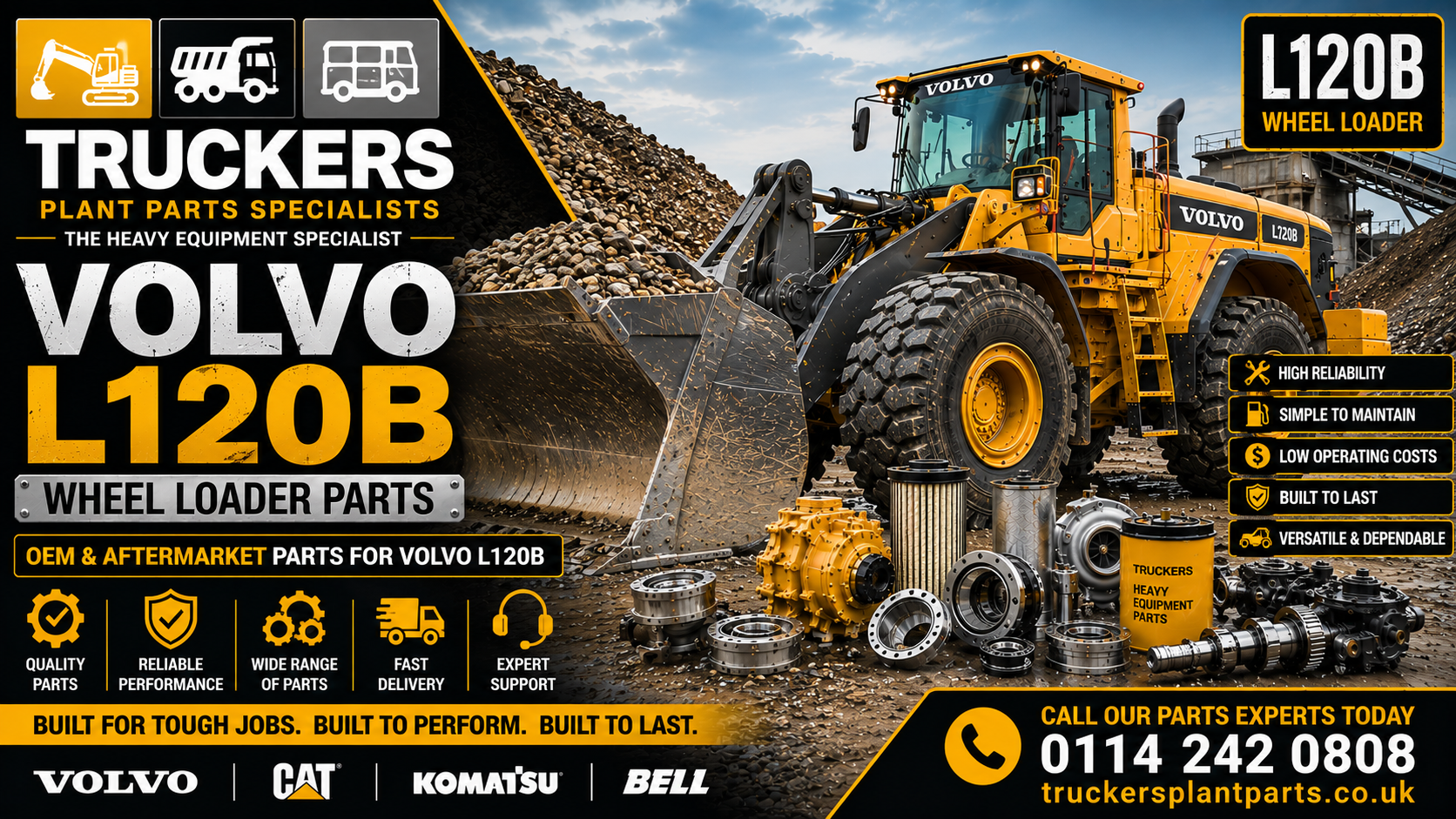
Volvo L120B Wheel Loader Parts Supply, Machine Guide, Reliability, Performance, Model Comparisons & Complete Support
The Volvo L120B wheel loader remains one of the most respected and dependable machines from Volvo Construction Equipment’s early wheel loader generations. Built during an era when durability, mechanical simplicity, ease of maintenance, and long service life were considered fundamental design principles, the L120B established a reputation for reliability that continues decades after production ended.
Many Volvo L120B wheel loaders remain operational today across farms, waste facilities, recycling centres, construction sites, quarries, timber yards, scrap operations, industrial plants, municipal fleets, and agricultural businesses. While newer machines offer greater fuel efficiency, advanced electronics, and improved operator environments, the L120B continues to be valued for its straightforward engineering, low ownership costs, and ability to keep working in demanding environments.
The Volvo L120B occupies an important position in Volvo’s wheel loader history. It helped establish the brand’s reputation for producing durable, productive machines capable of handling a wide range of loading applications. Operators often describe the L120B as a machine that simply gets on with the job without unnecessary complexity.
Unlike larger production loaders such as the L180, L220, or L350 series, the L120B offers excellent versatility. It is large enough to undertake serious loading work while remaining compact enough for general site duties. This makes it popular among operators who need one machine capable of performing multiple roles throughout the working day.
The L120B is commonly found loading aggregate, soil, sand, recycled materials, timber products, grain, waste materials, scrap metal, construction materials, and industrial bulk products. It can be used for stockpile management, truck loading, yard maintenance, material transport, site clearance, agricultural support, and general loading duties.
One of the biggest advantages of the Volvo L120B is mechanical simplicity. Many owners appreciate the fact that much of the machine can be maintained, repaired, and serviced without requiring advanced electronic diagnostic equipment. For independent operators and smaller fleets, this can significantly reduce maintenance costs and minimise downtime.
Hydraulic performance remains one of the machine’s strongest characteristics. The Volvo L120B delivers dependable lifting power, predictable bucket control, responsive steering, and reliable attachment operation. While later generations improved efficiency and refinement, the basic hydraulic system design remains highly respected for its durability and ease of maintenance.
The Volvo L120B is also a highly adaptable attachment carrier. Depending on specification, it can operate with general-purpose buckets, grain buckets, light material buckets, pallet forks, timber grapples, snow blades, sweepers, waste handling attachments, and specialist industrial tools. This versatility allows a single machine to support multiple business activities.
Truckers Plant Parts supports Volvo L120B wheel loaders with OEM, OEM-equivalent, rebuilt, and quality aftermarket replacement components. Support includes engines, hydraulic pumps, hydraulic cylinders, hydraulic hoses, steering systems, transmissions, torque converters, axle components, differentials, brake systems, articulation assemblies, cooling systems, radiators, electrical components, starter motors, alternators, service kits, filters, bearings, seals, cab parts, glass, buckets, cutting edges, tyres, wheel rims, and emergency VOR support.
Hydraulic systems remain one of the most important maintenance areas on ageing L120B machines. Pumps, cylinders, hoses, valves, and seals naturally wear over time. Common symptoms include reduced lifting performance, slower cycle times, hydraulic leaks, overheating, or inconsistent machine response. Early intervention often prevents larger failures and keeps operating costs under control.
The transmission and driveline should also receive regular attention. The transmission, torque converter, differentials, propshafts, axle assemblies, and braking systems are subjected to constant loading and directional changes throughout their working lives. Proper servicing and quality replacement components help maximise longevity.
Articulation systems are another critical inspection area. Centre pivots, articulation pins, bushes, bearings, and steering cylinders carry significant loads while allowing the machine to manoeuvre efficiently. Excessive wear can affect steering precision, tyre life, machine stability, and overall productivity.
Cooling system maintenance becomes increasingly important as machines age. Blocked radiators, contaminated cooling packs, worn hoses, damaged fan systems, and neglected coolant changes can quickly lead to overheating and unnecessary engine wear.
Volvo L120B vs Volvo L120C
The L120C introduced improvements in operator comfort, cab refinement, hydraulics, and overall machine management.
Advantages of the L120C:
Improved operator environment
Refined hydraulic performance
Better visibility
Enhanced productivity
Advantages of the L120B:
Greater mechanical simplicity
Lower purchase costs
Easier maintenance
Reduced electronic complexity
Many operators continue to favour the L120B because of its straightforward design and proven reliability.
Volvo L120B vs Volvo L120D
The D-Series represented a significant technological step forward.
Advantages of the L120D:
Improved fuel efficiency
Enhanced diagnostics
Greater operator comfort
Higher productivity
Advantages of the L120B:
Lower acquisition costs
Simpler maintenance
Less dependence on electronic systems
Excellent long-term durability
Volvo L120B vs Volvo L180 Series
Compared to machines such as the L180C, L180D, L180E, L180F, L180G, and L180H, the L120B is smaller and more versatile.
Advantages of the L120B:
Lower fuel consumption
Reduced tyre costs
Easier transport
Greater manoeuvrability
Suitable for mixed-use operations
Advantages of the L180 range:
Higher payloads
Greater production capacity
Larger bucket options
Improved truck-loading performance
For operators needing maximum production, the L180 series is often the preferred choice. For versatility and lower operating costs, the L120B remains highly attractive.
Common Volvo L120B Applications
Agricultural loading
Farm grain handling
Construction support
Aggregate loading
Recycling operations
Scrap handling
Industrial material movement
Municipal services
Timber yard operations
Waste handling
Snow clearance
General site maintenance
Buying a Used Volvo L120B
When evaluating a used L120B, buyers should inspect:
Service history
Hydraulic performance
Transmission operation
Articulation wear
Brake performance
Cooling system condition
Tyre wear
Electrical systems
Cab condition
Bucket wear
Loader arm condition
Frame integrity
Evidence of major repairs
A well-maintained L120B can continue providing productive service many years after its original working life expectations.
Overall, the Volvo L120B remains one of Volvo’s most durable and respected wheel loaders. Combining mechanical simplicity, dependable performance, versatility, and low ownership costs, it continues to earn its place across a wide range of industries. Supported by Truckers Plant Parts, the Volvo L120B can continue loading, lifting, transporting, stockpiling, clearing, and supporting business operations for years to come while maintaining the rugged reliability that made the machine famous.
FAQ: Volvo L120B Wheel Loader Parts
1. What is the Volvo L120B wheel loader?
The Volvo L120B is a versatile wheel loader designed for construction, agriculture, recycling, waste handling, aggregate loading, and industrial material movement.
2. Is the Volvo L120B still a popular machine?
Yes, many L120B loaders remain in service due to their durability and mechanical simplicity.
3. What makes the L120B reliable?
Its robust construction, straightforward systems, and proven Volvo engineering contribute to its reputation for reliability.
4. Does Truckers Plant Parts supply Volvo L120B parts?
Yes, Truckers Plant Parts supplies a wide range of Volvo L120B replacement parts.
5. Are OEM parts available?
Yes, OEM and OEM-equivalent parts can be supplied.
6. Are aftermarket parts available?
Yes, quality aftermarket parts are available for many systems.
7. Do you supply service kits?
Yes, complete service and maintenance kits are available.
8. Can you supply engine parts?
Yes, engine repair and maintenance components are available.
9. Are complete engines available?
Yes, complete engines may be sourced subject to availability.
10. Can you supply hydraulic pumps?
Yes, hydraulic pumps are available.
11. Are hydraulic hoses available?
Yes, hydraulic hoses can be supplied.
12. Do you stock hydraulic cylinders?
Yes, lift, tilt, and steering cylinders are available.
13. Can you supply steering cylinders?
Yes, steering cylinder assemblies and repair kits are available.
14. Are hydraulic valves available?
Yes, hydraulic control valves can be supplied.
15. Do you stock hydraulic filters?
Yes, hydraulic filtration products are available.
16. Can you supply transmission parts?
Yes, transmission components are available.
17. Are complete transmissions available?
Yes, complete transmissions may be sourced.
18. Can you supply torque converters?
Yes, torque converters are available.
19. Are axle parts available?
Yes, axle assemblies and components can be supplied.
20. Do you stock differential parts?
Yes, differential assemblies and repair parts are available.
21. Can you supply brake components?
Yes, braking system parts are available.
22. Are hub assemblies available?
Yes, hub components can be supplied.
23. Do you stock wheel bearings?
Yes, wheel bearings and bearing kits are available.
24. Are articulation pins available?
Yes, articulation pins can be supplied.
25. Can you supply articulation bushes?
Yes, articulation bushes are available.
26. Are centre pivot components available?
Yes, centre pivot parts can be sourced.
27. Can you supply steering system parts?
Yes, steering components are available.
28. Are seals available?
Yes, seal kits are available for numerous applications.
29. Can you supply bearings?
Yes, bearings for multiple systems are available.
30. Do you stock radiators?
Yes, radiators can be supplied.
31. Are hydraulic coolers available?
Yes, hydraulic coolers are available.
32. Can you supply oil coolers?
Yes, oil coolers can be sourced.
33. Are coolant hoses available?
Yes, coolant hoses are available.
34. Can you supply thermostats?
Yes, thermostats are available.
35. Do you stock fan assemblies?
Yes, cooling fan systems are available.
36. Are alternators available?
Yes, alternators can be supplied.
37. Can you supply starter motors?
Yes, starter motors are available.
38. Are sensors available?
Yes, various machine sensors can be sourced.
39. Do you stock wiring components?
Yes, electrical components are available.
40. Can you supply switches?
Yes, control switches can be supplied.
41. Are cab glass panels available?
Yes, replacement cab glass is available.
42. Can you supply mirrors?
Yes, mirrors and mirror assemblies can be sourced.
43. Are seats available?
Yes, operator seats are available.
44. Do you stock work lights?
Yes, lighting systems are available.
45. Can you supply warning beacons?
Yes, safety lighting products are available.
46. Are cab components available?
Yes, a variety of cab parts can be supplied.
47. Can you supply fuel system parts?
Yes, fuel pumps, filters, and injectors are available.
48. Are injectors available?
Yes, injectors can be supplied.
49. Do you stock turbochargers?
Yes, turbochargers are available.
50. Can you supply exhaust components?
Yes, exhaust system parts are available.
51. Are buckets available?
Yes, a range of bucket options can be supplied.
52. Can you supply general-purpose buckets?
Yes, GP buckets are available.
53. Are light material buckets available?
Yes, light material buckets can be supplied.
54. Can you supply pallet forks?
Yes, pallet fork attachments are available.
55. Are grapples available?
Yes, grapples for timber and waste handling are available.
56. Can you supply quick couplers?
Yes, quick coupler systems are available.
57. Are cutting edges available?
Yes, cutting edges can be supplied.
58. Can you supply side cutters?
Yes, side cutters are available.
59. Are wear plates available?
Yes, wear parts are available.
60. Can you supply tyres?
Yes, tyres for various applications can be sourced.
61. Are wheel rims available?
Yes, wheel rims are available.
62. What is VOR support?
VOR stands for Vehicle Off Road and provides urgent breakdown parts support.
63. Does Truckers offer emergency parts supply?
Yes, emergency parts support is available.
64. Can parts be identified from serial numbers?
Yes, serial numbers help ensure accurate parts identification.
65. What industries use the Volvo L120B?
Construction, farming, recycling, waste handling, aggregates, forestry, and industry.
66. Is the L120B suitable for agriculture?
Yes, it is widely used on farms and agricultural businesses.
67. Is the L120B suitable for recycling?
Yes, many recycling facilities use the L120B.
68. Can it be used in waste handling?
Yes, it performs well in waste management applications.
69. Is the L120B suitable for timber yards?
Yes, especially when fitted with grapple attachments.
70. Can it load trucks?
Yes, truck loading is a common application.
71. What are common hydraulic problems?
Pump wear, leaking hoses, worn seals, and valve issues.
72. What causes hydraulic overheating?
Blocked coolers, contamination, low oil levels, or worn components.
73. What causes reduced lifting power?
Hydraulic wear, pressure loss, or leaking cylinders.
74. Why is articulation wear important?
It affects steering, stability, tyre life, and machine control.
75. What are common transmission issues?
Wear, overheating, oil contamination, and neglected servicing.
76. What are common axle problems?
Bearing wear, seal leaks, and differential failures.
77. What are common brake issues?
Worn brake components and hydraulic system faults.
78. Why are service records important?
They provide evidence of proper maintenance and repairs.
79. What should buyers inspect first?
Hydraulics, transmission, articulation, brakes, tyres, and cooling systems.
80. Can contaminated hydraulic oil damage components?
Yes, contamination significantly reduces component life.
81. Why is cooling system maintenance important?
It prevents overheating and premature engine wear.
82. Can blocked radiators affect performance?
Yes, cooling efficiency is reduced when radiators become blocked.
83. What affects tyre life?
Ground conditions, maintenance, articulation wear, and operator technique.
84. Can worn bushes increase tyre wear?
Yes, excessive movement can accelerate tyre wear.
85. Is the L120B smaller than an L150?
Yes, the L150 offers greater capacity and payload.
86. Is the L120B smaller than an L180?
Yes, the L180 range is significantly larger and more productive.
87. Is the L120B easier to transport than an L180?
Yes, its smaller size generally makes transportation easier.
88. Does the L120B have fewer electronics than modern loaders?
Yes, it is mechanically simpler than later generations.
89. Is maintenance generally simpler on the L120B?
Yes, many operators appreciate its straightforward maintenance requirements.
90. Why do operators still buy L120B machines?
They are durable, affordable, versatile, and easy to maintain.
91. Is fuel consumption lower than larger loaders?
Yes, operating costs are generally lower than larger production machines.
92. Can the L120B operate in confined areas?
Yes, its size makes it more manoeuvrable than larger loaders.
93. Is it suitable for mixed-use operations?
Yes, versatility is one of the machine’s biggest strengths.
94. Can rebuilt components be supplied?
Yes, selected rebuilt components are available.
95. Can Truckers source hard-to-find parts?
Yes, sourcing difficult and obsolete parts is a core service.
96. Do older Volvo loaders still have good parts availability?
Yes, many parts remain available through specialist suppliers.
97. Why choose Volvo wheel loaders?
They are known for reliability, comfort, productivity, and durability.
98. Why choose Truckers Plant Parts?
Extensive industry experience, fast sourcing, quality parts, and specialist support.
99. Can Truckers help identify the correct part?
Yes, model and serial number identification support is available.
100. How can I order Volvo L120B parts?
Contact Truckers Plant Parts with your machine serial number and parts requirements for fast and accurate assistance.