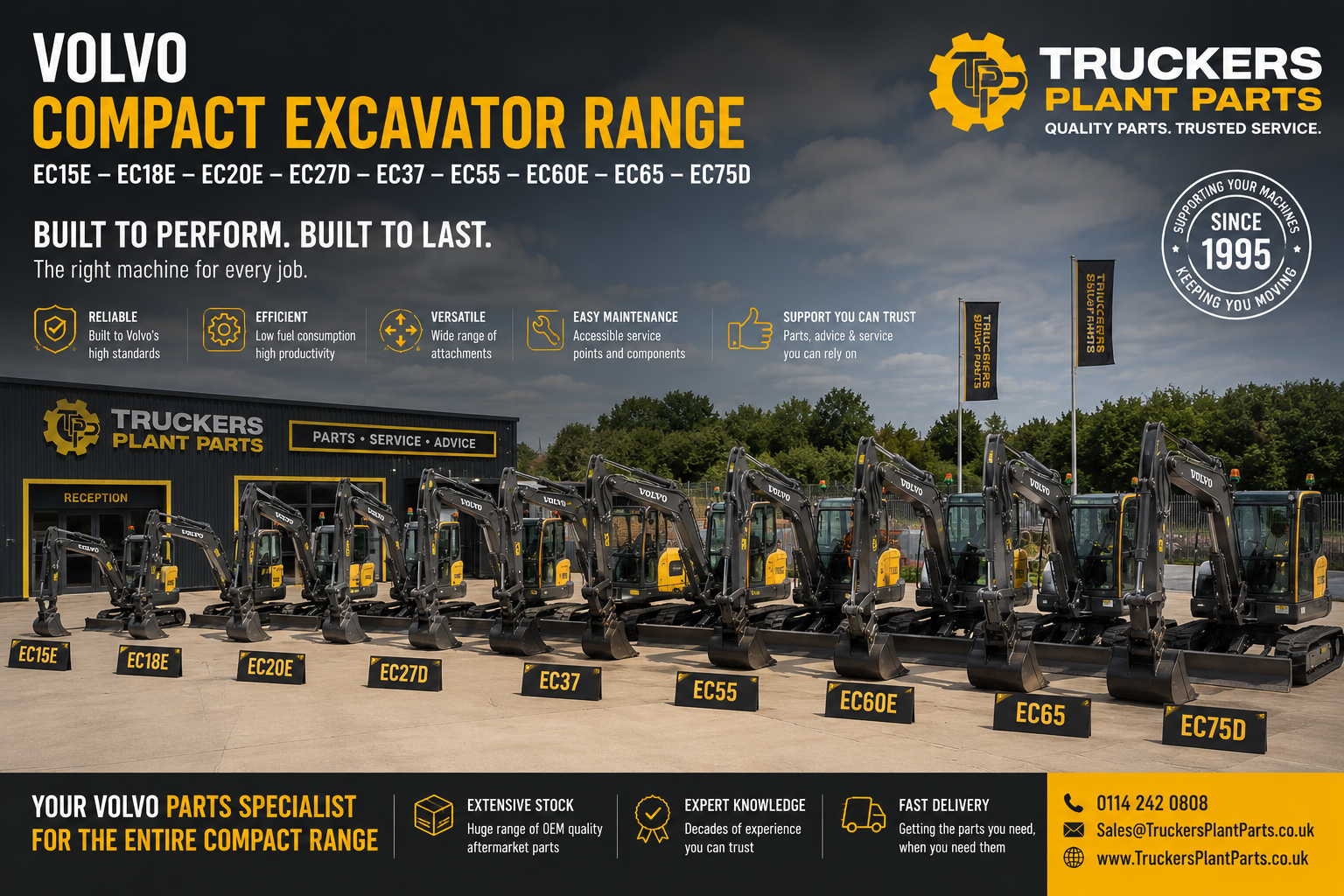
Volvo Compact Excavator Parts Supply, Machine Guide, Reliability, Performance & Complete Support
Everything You Need to Know About the Volvo EC15E, EC18E, EC20E, EC27D, EC37, EC55, EC60E, EC65 and EC75D
Few types of construction equipment have transformed the building industry quite as dramatically as the compact excavator. Once considered specialist machines for small jobs and confined spaces, compact excavators have evolved into some of the most versatile and productive pieces of equipment found on modern construction sites. Today they are used by everyone from landscaping businesses and utility contractors to national house builders, civil engineering firms and plant hire companies, with thousands of machines working every day across the United Kingdom and throughout the world.
Among the manufacturers competing in this highly demanding sector, Volvo Construction Equipment has earned a reputation for producing compact excavators that combine exceptional build quality, outstanding reliability and industry-leading operator comfort. The Volvo EC Series has become a familiar sight on projects of every size, with machines trusted to deliver dependable performance in applications ranging from domestic garden landscaping through to large infrastructure developments.
Volvo Compact Excavator Range Specifications
| Specification | EC15E | EC18E | EC20E | EC27D | EC37 | EC55 | EC60E | EC65 | EC75D |
|---|---|---|---|---|---|---|---|---|---|
| Machine Class | Micro Excavator | Mini Excavator | Mini Excavator | Compact Excavator | Compact Excavator | Compact Excavator | Compact Excavator | Compact Excavator | Compact Excavator |
| Operating Weight | 1.5–1.8 tonnes | 1.8 tonnes | 2.0 tonnes | 2.7 tonnes | 3.7 tonnes | 5.5 tonnes | 6.0 tonnes | 6.5 tonnes | 7.5 tonnes |
| Engine Power | 16 hp (12 kW) | 16 hp (12 kW) | 16 hp (12 kW) | 21 hp (15.6 kW) | 31 hp (23 kW) | 54 hp (40 kW) | 59 hp (44 kW) | 62 hp (46 kW) | 59 hp (44 kW) |
| Engine Type | Volvo Diesel | Volvo Diesel | Volvo Diesel | Volvo Diesel | Volvo Diesel | Volvo Diesel | Volvo Diesel | Volvo Diesel | Volvo Diesel |
| Bucket Capacity | 0.01–0.05 m³ | 0.01–0.05 m³ | 0.03–0.08 m³ | 0.03–0.12 m³ | 0.05–0.18 m³ | 0.20–0.30 m³ | 0.09–0.35 m³ | 0.09–0.35 m³ | 0.13–0.39 m³ |
| Digging Force | Good | Good | Good | High | High | Very High | Very High | Very High | Excellent |
| Hydraulic System | Load Sensing | Load Sensing | Load Sensing | Load Sensing | Load Sensing | Advanced Hydraulic | Advanced Hydraulic | Advanced Hydraulic | Advanced Hydraulic |
| Travel Speed | Approx. 2.5 km/h | Approx. 2.5 km/h | Approx. 2.5 km/h | Approx. 4.5 km/h | Approx. 4.8 km/h | Approx. 4.8 km/h | Approx. 4.8 km/h | Approx. 5.0 km/h | Approx. 5.0 km/h |
| Swing Speed | Approx. 9 rpm | Approx. 9 rpm | Approx. 9 rpm | Approx. 10 rpm | Approx. 10 rpm | Approx. 10 rpm | Approx. 10 rpm | Approx. 10 rpm | Approx. 10 rpm |
| Fuel Tank Capacity | Approx. 20 L | Approx. 20 L | Approx. 24 L | Approx. 40 L | Approx. 50 L | Approx. 80 L | Approx. 110 L | Approx. 120 L | Approx. 135 L |
| Hydraulic Tank | Approx. 15 L | Approx. 15 L | Approx. 18 L | Approx. 25 L | Approx. 35 L | Approx. 55 L | Approx. 65 L | Approx. 70 L | Approx. 80 L |
| Track Type | Rubber / Steel Optional | Rubber / Steel Optional | Rubber / Steel Optional | Rubber or Steel | Rubber or Steel | Heavy Duty Steel | Heavy Duty Steel | Heavy Duty Steel | Heavy Duty Steel |
| Cab | Canopy / Optional Cab | Canopy / Optional Cab | Canopy / Optional Cab | Enclosed Cab Option | Enclosed Cab | ROPS/FOPS Cab | ROPS/FOPS Cab | ROPS/FOPS Cab | ROPS/FOPS Cab |
| Climate Control | Optional | Optional | Optional | Optional | Optional | Standard | Standard | Standard | Standard |
| Telematics | Optional | Optional | Optional | Optional | Volvo CareTrack (Optional) | Volvo CareTrack | Volvo CareTrack | Volvo CareTrack | Volvo CareTrack |
| Fuel Efficiency | Excellent | Excellent | Excellent | Excellent | Excellent | Outstanding | Outstanding | Outstanding | Outstanding |
| Best Applications | Landscaping | Residential Construction | Utilities | Groundworks | Civil Engineering | Construction | Utilities | Earthmoving | Heavy Groundworks |
| Ideal Partner ADTs | N/A | N/A | N/A | N/A | N/A | A20 | A20 / A25 | A25 | A25 |
Volvo Compact Excavator Comparison
| Model | Weight | Power | Maximum Bucket | Best Applications |
|---|---|---|---|---|
| EC15E | 1.5–1.8 t | 16 hp | 0.05 m³ | Landscaping, gardens, confined spaces |
| EC18E | 1.8 t | 16 hp | 0.05 m³ | Residential building, utilities |
| EC20E | 2.0 t | 16 hp | 0.08 m³ | Utility installation, drainage |
| EC27D | 2.7 t | 21 hp | 0.12 m³ | Groundworks, footings, drainage |
| EC37 | 3.7 t | 31 hp | 0.18 m³ | Landscaping, civil engineering |
| EC55 | 5.5 t | 54 hp | 0.30 m³ | General construction, utilities |
| EC60E | 6.0 t | 59 hp | 0.35 m³ | Infrastructure, roadworks |
| EC65 | 6.5 t | 62 hp | 0.35 m³ | Earthmoving, commercial construction |
| EC75D | 7.5 t | 59 hp | 0.39 m³ | Heavy groundworks, site preparation |
Typical Applications
| Model | Primary Applications |
|---|---|
| EC15E | Landscaping, fencing, gardens, indoor demolition, utilities and confined access work |
| EC18E | House extensions, drainage, utilities, landscaping and light construction |
| EC20E | Utility installation, trenching, drainage, groundwork and residential developments |
| EC27D | Groundworks, foundations, footpaths, driveways, drainage and local authority works |
| EC37 | Civil engineering, utilities, landscaping, road maintenance and commercial groundwork |
| EC55 | House building, commercial construction, drainage, loading dumpers and utility work |
| EC60E | Infrastructure projects, road construction, utility installation, earthmoving and commercial developments |
| EC65 | Bulk excavation, commercial construction, loading dump trucks, civil engineering and highways |
| EC75D | Heavy groundworks, road building, earthmoving, commercial developments and site preparation |
The popularity of the Volvo compact excavator range has not happened by accident. Every machine has been designed around a simple philosophy: maximise productivity while reducing operating costs. That philosophy extends beyond the machine itself and encompasses fuel efficiency, ease of maintenance, service accessibility, long component life and outstanding parts availability. As a result, many Volvo compact excavators remain productive for decades, making them some of the most economical construction machines to own over their entire working life.
This guide explores the complete Volvo compact excavator range, covering every model from the EC15E through to the EC75D. Along the way we will examine how each machine fits into the range, which applications it is best suited for, what makes Volvo excavators so highly regarded and why they continue to be one of the first choices for contractors who demand reliability, efficiency and long-term value.
The Rise of the Compact Excavator
Construction projects have changed significantly over the past thirty years. Modern developments are often built on tighter sites with restricted access, existing buildings, underground services and increasing environmental requirements. Contractors need machinery capable of delivering impressive digging performance while remaining compact enough to work safely and efficiently in confined spaces.
The compact excavator was developed to meet exactly these challenges.
Unlike larger crawler excavators that require substantial working areas, compact excavators can access narrow gateways, residential gardens, urban construction sites and utility trenches where larger machines simply cannot operate. Despite their smaller size, advances in hydraulic technology now allow compact excavators to perform tasks that would once have required considerably larger equipment.
Today’s compact excavators are expected to excavate foundations, install drainage systems, load dumpers, break concrete, lift heavy materials, landscape gardens, dig service trenches and complete countless other tasks throughout a typical working day. They have become true multi-purpose machines capable of replacing several different pieces of equipment on many projects.
Volvo recognised this growing demand early and invested heavily in developing a range that would meet the needs of both owner-operators and large fleet customers. The result is a family of excavators that offers impressive hydraulic performance, low fuel consumption and exceptional durability across every size category.
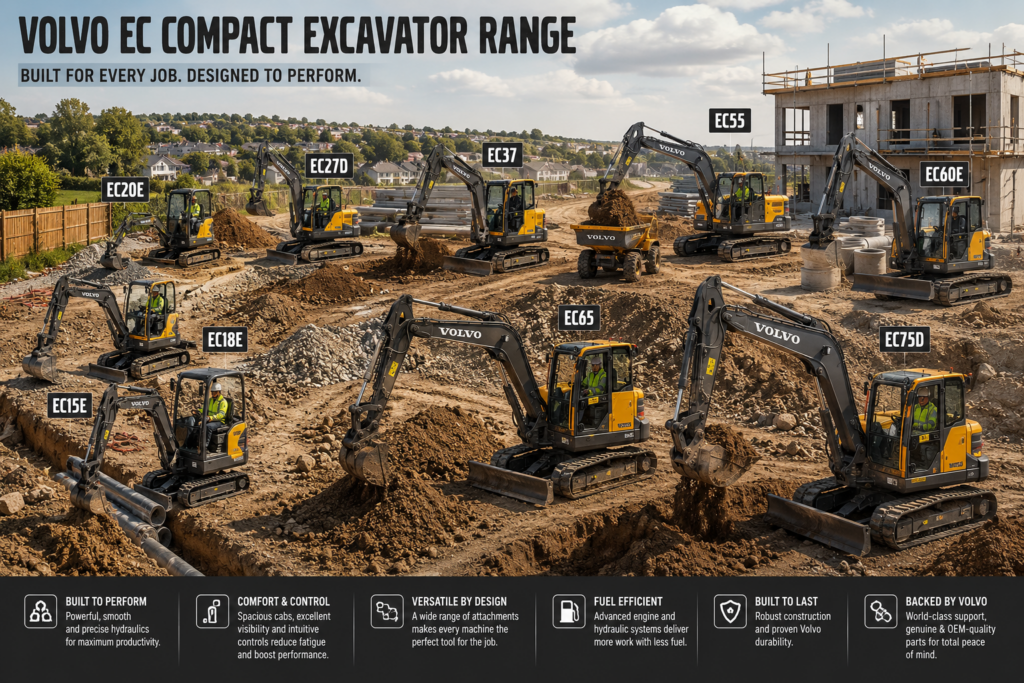
Why Contractors Choose Volvo
The compact excavator market is highly competitive, with numerous manufacturers offering machines in the one to eight-tonne class. Despite this competition, Volvo continues to attract loyal customers thanks to its emphasis on engineering quality rather than simply headline specifications.
One of the first things operators notice when stepping into a Volvo excavator is the attention given to the working environment. Spacious cabs, ergonomic controls, excellent visibility and low interior noise levels help reduce operator fatigue throughout long working days. Comfortable operators are more productive operators, and that philosophy has become central to Volvo’s design approach.
Hydraulic performance is another area where Volvo machines excel. Smooth, predictable controls make precision work easier while providing the power required for demanding excavation, lifting and attachment work. Whether using buckets, hydraulic breakers, augers, grapples or tilt rotators, Volvo excavators are designed to deliver responsive hydraulic performance without sacrificing fuel efficiency.
Reliability is equally important. Construction equipment often operates in harsh environments where downtime can quickly become expensive. Volvo excavators are engineered to withstand these demanding conditions, using robust structural components, high-quality materials and proven powertrains that continue working year after year with routine maintenance.
Built for Long-Term Ownership
For many businesses, purchasing an excavator represents one of the largest investments they will make. While purchase price is important, experienced contractors understand that the true cost of ownership extends far beyond the initial invoice.
Fuel consumption, servicing requirements, replacement parts, downtime, depreciation and resale value all contribute to the overall financial picture.
This is one area where Volvo compact excavators consistently perform exceptionally well.
Modern Volvo diesel engines are designed to deliver strong low-speed torque while maintaining impressive fuel economy. Efficient hydraulic systems ensure engine power is converted into productive digging performance rather than unnecessary fuel consumption. Long service intervals help reduce maintenance costs, while excellent access to daily service points minimises the time required for routine inspections.
Perhaps even more importantly, Volvo machines benefit from excellent parts availability. Genuine Volvo components remain widely available, while the growing market for OEM-quality aftermarket parts provides owners with additional flexibility when maintaining older machines. This mature aftermarket support means many excavators continue working reliably long after competing machines have become uneconomical to repair.
A Machine for Every Application
One of the strengths of the Volvo compact excavator range is the diversity of machines available.
At the smallest end of the range, the EC15E, EC18E and EC20E provide outstanding manoeuvrability for landscaping, domestic construction and utility work. Their compact dimensions allow them to pass through narrow access points while still delivering impressive digging performance.
Moving up through the range, the EC27D and EC37 introduce greater lifting capacity, increased hydraulic power and improved stability, making them ideal for contractors undertaking regular groundwork and civil engineering projects.
The larger EC55, EC60E, EC65 and EC75D bridge the gap between compact and medium-sized excavators. These machines are capable of handling demanding commercial construction, infrastructure work and large-scale landscaping projects while retaining the transportability and versatility that define the compact excavator class.
Together, these nine models provide solutions for virtually every type of compact excavation work encountered throughout the construction industry.
More Than Just Excavators
Modern Volvo compact excavators are no longer limited to digging alone. Thanks to sophisticated hydraulic systems and a wide range of available attachments, they have become highly versatile tool carriers capable of performing dozens of different tasks throughout the working day.
Buckets remain the most common attachment, but many contractors also fit hydraulic breakers for demolition work, augers for fencing and foundation projects, grading buckets for landscaping, grapples for forestry applications and tilt rotators that significantly increase productivity by allowing attachments to rotate and tilt without repositioning the machine.
This versatility reduces the need for multiple specialist machines while improving overall site efficiency. One excavator equipped with the right attachments can often replace several pieces of equipment, lowering ownership costs and simplifying fleet management.
Designed to Last
Perhaps the greatest testament to Volvo’s engineering is the number of older machines that continue working successfully throughout the world.
It is not unusual to find Volvo compact excavators with many thousands of operating hours still earning their keep on construction sites every day. Their longevity is the result of robust engineering, sensible maintenance schedules and excellent aftermarket support that allows owners to source high-quality replacement parts long after production has ended.
This combination of durability, serviceability and excellent parts availability means Volvo compact excavators frequently achieve exceptionally low lifetime ownership costs. For contractors seeking dependable machines capable of delivering years of productive service, this long-term value remains one of the strongest reasons to choose Volvo rebuilt and quality aftermarket parts covering hydraulics, final drives, rubber tracks, undercarriage, engines, cooling systems, electrical components, buckets, attachments, service kits and emergency VOR requirements to keep even the smallest Volvo excavators productive and reliable.
Volvo EC15E Compact Excavator
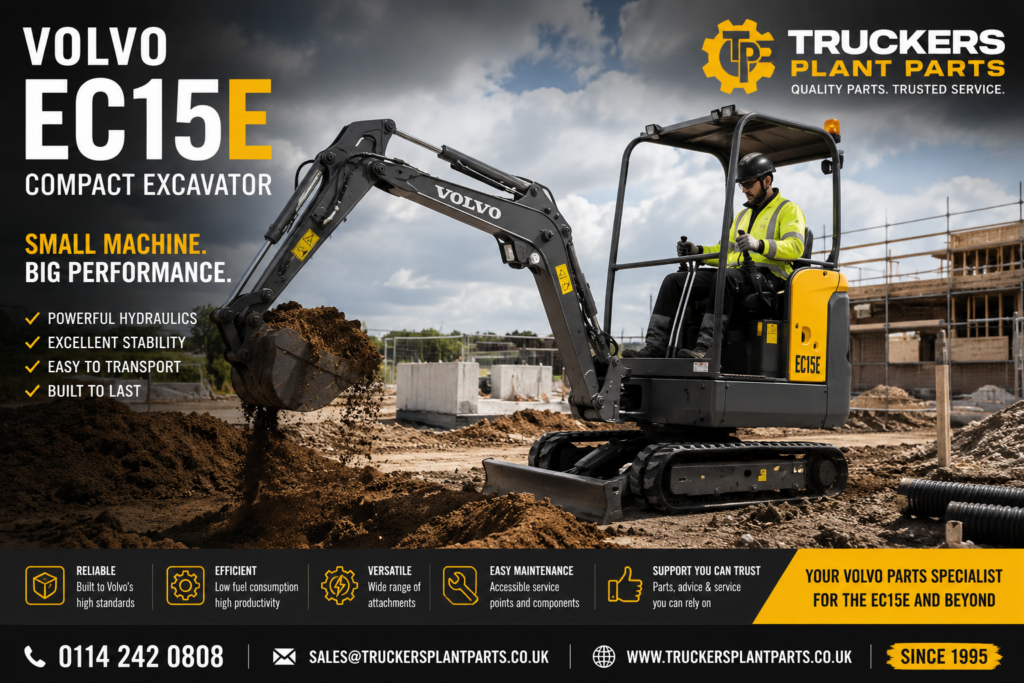
The Complete Guide to Volvo’s Smallest Compact Excavator
Every great machine range has to start somewhere, and within Volvo’s compact excavator family that starting point is the EC15E. Although it is the smallest machine in the modern Volvo compact excavator range, the EC15E represents far more than simply an entry-level excavator. It has been designed specifically for contractors who require exceptional manoeuvrability, outstanding reliability and surprisingly capable digging performance within an extremely compact footprint.
Machines of this size have become increasingly important as construction projects continue to move into urban environments where access restrictions often determine which equipment can be used. Housing developments, residential gardens, utility installations, indoor demolition projects and landscaping work frequently involve narrow gateways, confined working areas and limited transport options. In these situations, larger excavators are often impractical, while manual labour is simply too slow and expensive.
The EC15E fills this gap perfectly.
Despite weighing little more than one and a half tonnes, the machine is capable of performing an impressive range of excavation, loading and material handling tasks that dramatically reduce labour requirements while increasing productivity. It has become a favourite among landscapers, builders, fencing contractors, drainage specialists, utility companies and plant hire businesses looking for a dependable excavator that can work virtually anywhere.
Compact Dimensions, Professional Performance
One of the biggest misconceptions surrounding micro excavators is that they are only suitable for light domestic work. While the EC15E certainly excels in residential environments, it has also earned a reputation as a highly capable professional machine that regularly works on commercial projects throughout Europe.
Its compact dimensions allow it to pass through narrow gateways and restricted access points that would prevent larger excavators from entering a site. Once inside, the machine provides smooth hydraulic performance, precise controls and excellent stability, allowing operators to complete demanding excavation work quickly and efficiently.
Whether digging foundations for a house extension, installing underground services, preparing landscaping features or removing old concrete footings, the EC15E delivers impressive performance for a machine of its size.
Many contractors discover that the smallest excavator in their fleet often becomes one of the busiest because there are countless situations where larger machines simply cannot be used.
Designed Around the Operator
Volvo has always placed considerable emphasis on operator comfort, and that philosophy extends throughout the compact excavator range.
Although the EC15E is physically small, the operator’s working position has been carefully designed to maximise comfort throughout the working day. Controls are positioned ergonomically, visibility is excellent and the machine responds smoothly to operator inputs, reducing fatigue during prolonged operation.
For owner-operators who spend eight or ten hours each day inside the machine, these details make a significant difference. Comfortable controls improve accuracy, reduce physical strain and allow operators to work more productively throughout the day.
The intuitive layout also means that new operators can quickly become familiar with the machine, making it particularly popular within plant hire fleets where different users may operate the excavator on successive hires.
Built for Daily Professional Use
While the EC15E is compact, it has not been built as a lightweight domestic machine. Like every Volvo excavator, it has been engineered to withstand the demanding conditions found on professional construction sites.
Heavy-duty structural components provide excellent durability while protecting the machine against the knocks and impacts that inevitably occur during everyday use. The undercarriage has been designed to provide excellent stability despite the machine’s compact size, while high-quality hydraulic components ensure consistent performance throughout thousands of operating hours.
Routine servicing is straightforward thanks to easily accessible maintenance points, allowing operators to carry out daily inspections quickly before beginning work. This ease of maintenance contributes significantly to the machine’s reputation for reliability and helps reduce downtime throughout its working life.
Surprisingly Versatile
Although the EC15E is primarily an excavator, modern hydraulic systems allow it to perform far more than simple digging tasks.
With the correct attachments installed, the machine can break concrete, drill holes for fencing, carry out precision grading, remove tree stumps, prepare garden landscaping and perform many other specialised tasks.
This versatility transforms the EC15E into a true multi-purpose tool carrier capable of replacing several different pieces of equipment.
For smaller contractors especially, this flexibility represents excellent value. Rather than investing in numerous specialist machines, one excavator fitted with appropriate attachments can complete an impressive variety of work throughout the year.
Perfect Applications
The EC15E excels wherever compact dimensions are essential.
Residential landscaping remains one of its strongest markets, allowing contractors to excavate ponds, prepare patios, reshape gardens and install drainage systems without causing unnecessary damage to existing lawns or driveways.
Builders regularly use the machine for house extensions, conservatory foundations and small commercial developments where restricted access prevents larger equipment from reaching the work area.
Utility contractors appreciate the excavator’s ability to excavate narrow trenches for water pipes, electrical cables, fibre optic installations and drainage systems.
Local authorities frequently use machines of this size for pavement repairs, parks maintenance and urban improvement projects where minimal disruption to surrounding areas is essential.
Indoor demolition contractors also value the EC15E because its compact dimensions allow it to work inside buildings during renovation and refurbishment projects.
Easy Transportation
Transport is another major advantage of the EC15E.
Unlike larger excavators that require specialist low-loader transport, the EC15E can usually be transported using a standard plant trailer behind a suitable commercial vehicle.
This significantly reduces transportation costs while increasing flexibility. Contractors can move the machine between multiple jobs throughout the day without relying on external haulage companies, improving productivity and reducing operating expenses.
For plant hire businesses, this ease of transportation also makes the EC15E an extremely attractive rental machine because customers can often collect and return the excavator themselves.
Fuel Economy That Makes a Difference
Fuel costs remain one of the largest operating expenses faced by construction businesses.
Volvo has therefore focused heavily on efficiency throughout the EC15E’s design.
Its compact diesel engine provides sufficient power for demanding excavation work while maintaining remarkably low fuel consumption. Combined with an efficient hydraulic system that maximises available engine power, the machine delivers impressive productivity from every litre of diesel consumed.
Over several thousand operating hours, these fuel savings become substantial, helping contractors reduce operating costs while improving overall profitability.
Excellent Parts Availability
One of the greatest strengths of owning any Volvo excavator is the exceptional availability of replacement parts.
Routine service components such as filters, belts, seals and hoses are readily available, while OEM-quality aftermarket suppliers also provide an extensive range of engine components, hydraulic parts, electrical equipment, undercarriage components and service kits.
This mature aftermarket support means owners are not restricted to dealership supply alone. They have access to a competitive market offering high-quality replacement components that meet or exceed original equipment standards while often providing significant cost savings.
As a result, many EC15E excavators continue operating successfully for many years because repairs remain both practical and economical.
Why Contractors Continue Choosing the EC15E
The continued popularity of the Volvo EC15E is easy to understand. It combines Volvo’s renowned engineering quality with compact dimensions, impressive hydraulic performance, excellent fuel economy and outstanding reliability.
Its versatility allows it to tackle an enormous variety of tasks while remaining inexpensive to transport, maintain and operate. Combined with exceptional aftermarket support and strong resale values, the EC15E offers one of the lowest lifetime ownership costs in the compact excavator market.
For landscapers, builders, utility contractors, fencing specialists, drainage engineers, plant hire companies and owner-operators alike, the EC15E proves that the smallest machine in the Volvo excavator family is often capable of making one of the biggest contributions to productivity.
The EC15E may be the smallest member of the Volvo compact excavator range, but it perfectly demonstrates Volvo Construction Equipment’s philosophy of building machines that are reliable, efficient, durable and engineered to keep working year after year. For businesses seeking a professional compact excavator capable of delivering exceptional performance in confined working environments, it remains one of the finest choices available.
Volvo EC18E Compact Excavator
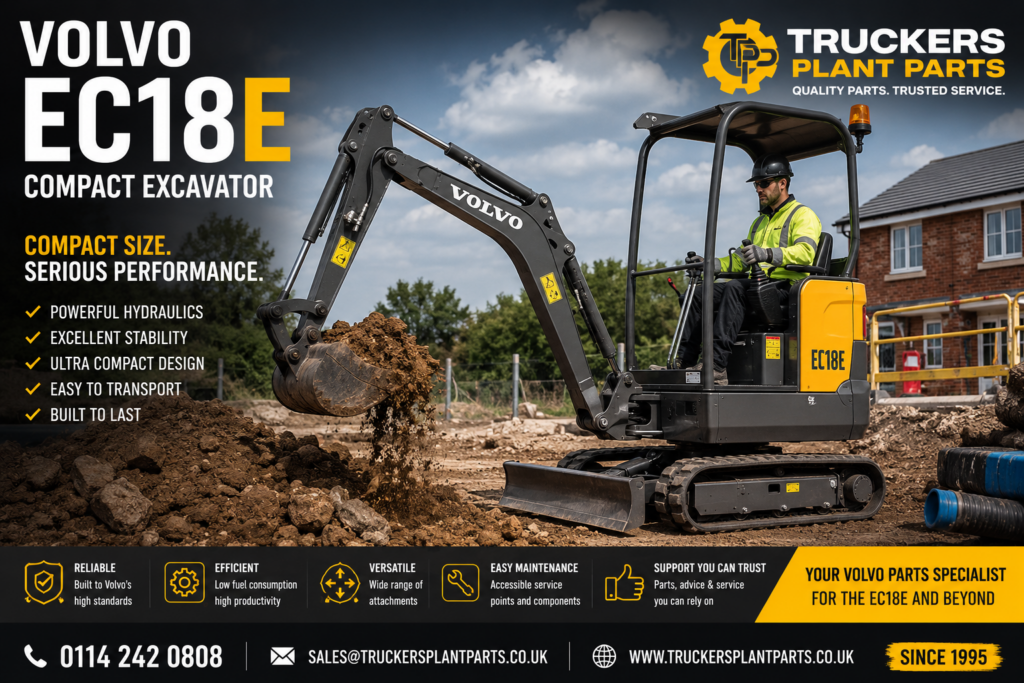
The Complete Guide to the Volvo EC18E Mini Excavator
Sitting just above the EC15E in Volvo’s compact excavator range, the EC18E has earned a reputation as one of the most versatile and dependable mini excavators available. Offering a modest increase in size, lifting capacity and digging performance over its smaller sibling, the EC18E provides contractors with additional capability while remaining compact enough to access areas that would be impossible for larger machines.
For many owner-operators, the EC18E represents the ideal balance between portability and productivity. It is large enough to undertake demanding commercial work yet small enough to be transported easily between sites and manoeuvred through narrow gateways, residential gardens and confined construction environments.
This versatility has made the EC18E a favourite among builders, landscapers, utility contractors, drainage specialists, fencing companies and plant hire businesses looking for a machine capable of handling a wide variety of jobs throughout the working year.
Built for Modern Construction
Construction sites today are very different from those of twenty or thirty years ago. Urban developments have become denser, access has become increasingly restricted and contractors are expected to complete projects more quickly while causing less disruption to surrounding properties.
Machines like the EC18E have evolved specifically to meet these challenges.
Its compact dimensions allow operators to work confidently in areas where larger excavators simply cannot reach, while its hydraulic performance provides the power required for professional excavation work. Whether preparing foundations for a house extension, installing underground utilities or carrying out landscaping work in a private garden, the EC18E delivers impressive productivity without occupying excessive space.
This ability to combine compact dimensions with genuine professional performance is one of the primary reasons why machines in this weight class continue to grow in popularity throughout the construction industry.
Compact Yet Surprisingly Powerful
Although weighing only around 1.8 tonnes, the EC18E is capable of much more than its size initially suggests.
Its efficient Volvo diesel engine and responsive hydraulic system provide smooth and predictable operation, allowing operators to dig accurately while maintaining excellent fuel economy. The machine delivers impressive breakout force for its class, making it capable of excavating foundations, service trenches and drainage systems even in more demanding ground conditions.
The hydraulic controls have been carefully tuned to provide both precision and power. Fine grading work can be completed with confidence, while heavier digging tasks benefit from strong hydraulic performance that allows the operator to work efficiently throughout the day.
This balance between precision and power is one of the defining characteristics of Volvo excavators and contributes significantly to their reputation among experienced operators.
Designed Around the Operator
Volvo understands that operator comfort directly influences productivity.
For this reason, the EC18E has been designed with an ergonomic operating position that allows users to remain comfortable during long working days. Controls are positioned naturally within easy reach, visibility around the machine is excellent and the hydraulic response is smooth and predictable.
The compact design does not compromise the operator’s working environment. Every aspect of the machine has been developed to reduce fatigue while increasing accuracy and confidence.
This is particularly important for owner-operators who spend many hours each week inside the cab. Comfortable machines encourage better working practices, improve efficiency and reduce physical strain over extended periods of operation.
An Ideal Machine for Builders
House builders and small construction companies have become some of the EC18E’s biggest supporters.
Residential construction often involves restricted access where larger excavators cannot operate. The EC18E is capable of passing through narrow entrances before carrying out excavation work that would otherwise require significant manual labour.
Foundation excavations, drainage trenches, service installations and landscaping preparation can all be completed quickly and efficiently.
Because the machine remains relatively lightweight, it also reduces the risk of unnecessary damage to finished driveways, paving and landscaped areas, an increasingly important consideration on domestic projects.
A Favourite Among Utility Contractors
Utility companies require excavators capable of working safely in congested environments filled with underground services.
The EC18E has become a popular choice because it provides excellent control during precision excavation work.
Water pipes, gas services, telecommunications cables, fibre optic networks and electrical infrastructure all require careful excavation techniques. The smooth hydraulic controls fitted to the EC18E help operators expose buried services safely while reducing the likelihood of accidental damage.
This level of precision has made the machine particularly valuable for contractors specialising in utility installation and maintenance.
Landscaping Excellence
Landscaping professionals appreciate machines that are compact enough to minimise ground disturbance while still providing meaningful excavation capability.
The EC18E excels in this role.
Garden remodelling, pond construction, retaining walls, tree planting, patios and drainage systems can all be completed efficiently using a machine that occupies very little working space.
Because the excavator can accept numerous hydraulic attachments, it becomes far more than simply a digging machine. Hydraulic breakers, augers, grading buckets and grapples greatly increase its versatility, allowing contractors to complete multiple stages of a landscaping project with a single machine.
Transport Made Simple
One of the practical advantages of the EC18E is its ease of transportation.
Its modest operating weight allows it to be transported behind many commercial vehicles using an appropriate plant trailer, eliminating the need for specialist haulage equipment in many situations.
For businesses operating across multiple sites, this flexibility significantly reduces transport costs while increasing productivity. Operators can move quickly between projects and respond rapidly to customer requirements without complex logistics.
This also makes the EC18E particularly attractive within the plant hire sector, where customers often value equipment that can be collected and transported easily.
Low Running Costs
Keeping operating costs under control has become increasingly important for contractors working within competitive markets.
The EC18E has been designed with this objective firmly in mind.
Its efficient Volvo diesel engine provides excellent fuel economy while maintaining sufficient hydraulic performance for demanding construction work. Routine servicing is straightforward, daily maintenance checks are simple to perform and major service points are positioned for easy access.
These design features reduce maintenance time while helping to maximise machine availability throughout the working year.
Over the lifetime of the excavator, lower fuel consumption, simplified servicing and excellent reliability combine to produce highly competitive ownership costs.
Outstanding Parts Availability
Like the rest of the Volvo compact excavator family, the EC18E benefits from exceptional aftermarket support.
Routine maintenance components are readily available from both Volvo dealers and independent heavy equipment specialists. Service kits, filters, hydraulic components, electrical parts, engine components and undercarriage assemblies can all be sourced quickly, helping minimise downtime whenever repairs become necessary.
The availability of OEM-quality aftermarket parts has become particularly important for long-term ownership. Contractors are no longer restricted to genuine dealer components alone but can choose from a wide selection of high-quality replacement parts that meet demanding engineering standards while often reducing maintenance costs.
This mature aftermarket ecosystem helps ensure the EC18E remains economically viable throughout many years of professional use.
Strong Residual Values
Volvo compact excavators have earned an excellent reputation in the used equipment market.
Because the EC18E is known for its durability, reliability and long service life, demand for well-maintained used examples remains consistently strong. Contractors purchasing new machines therefore benefit from attractive residual values when the time eventually comes to upgrade their fleet.
This strong resale performance significantly reduces the overall cost of ownership and is one of the reasons many businesses remain loyal to the Volvo brand when replacing equipment.
Why the Volvo EC18E Continues to Impress
The Volvo EC18E demonstrates that a compact excavator does not need to compromise on quality, performance or durability.
It offers the manoeuvrability required for confined working environments while delivering the hydraulic power and reliability expected from a professional construction machine. Combined with low operating costs, excellent fuel economy, outstanding aftermarket support and Volvo’s reputation for engineering excellence, it represents one of the strongest choices available in the mini excavator sector.
For builders, landscapers, utility contractors, drainage specialists, plant hire companies and owner-operators, the EC18E has proven itself to be a dependable partner capable of handling a remarkable variety of tasks. Its popularity continues to grow because it offers precisely what modern contractors demand: productivity, reliability, versatility and long-term value in a compact and highly capable package.
Volvo EC20E Compact Excavator
The Complete Guide to the Volvo EC20E Mini Excavator
The Volvo EC20E occupies one of the most important positions within Volvo Construction Equipment’s compact excavator range. Although only slightly larger than the EC18E, the EC20E offers noticeable improvements in stability, lifting performance and hydraulic capability while remaining compact enough to work in the confined environments that define the mini excavator sector.
For many contractors, the EC20E represents the point at which a compact excavator begins to feel like a much larger machine. It delivers the manoeuvrability expected from a two-tonne excavator while offering the digging performance, breakout force and lifting capacity needed for demanding professional applications.
This combination has made the EC20E extremely popular with builders, civil engineering contractors, landscapers, drainage specialists, utility companies, groundwork contractors and plant hire fleets across Europe. It is a machine that comfortably bridges the gap between micro excavators and larger compact models, providing impressive versatility without sacrificing transportability.
Built for Professional Contractors
Every construction project presents its own unique challenges. One day an excavator may be digging drainage trenches behind a row of terraced houses, while the next it could be preparing foundations for a commercial extension or installing underground utilities on a busy roadside.
The EC20E has been developed specifically to meet these changing demands.
Its compact footprint allows access through narrow entrances and restricted work areas, yet its hydraulic performance enables it to undertake surprisingly demanding excavation work. This flexibility makes the machine particularly attractive to contractors whose work varies from project to project and who require one excavator capable of handling numerous different applications.
Rather than specialising in one particular task, the EC20E has been engineered as a true all-round performer.
More Than Just a Mini Excavator
While officially classified as a two-tonne compact excavator, the EC20E performs well beyond what many operators expect from a machine of this size.
Modern hydraulic technology allows the excavator to develop impressive digging forces while maintaining exceptionally smooth and precise control. Operators benefit from responsive hydraulics that inspire confidence during both delicate precision work and more demanding excavation tasks.
Whether cutting narrow trenches for drainage, excavating service runs, preparing footings or carrying out landscaping work, the machine remains predictable and easy to control throughout every stage of the job.
This refined hydraulic performance has become one of Volvo’s defining characteristics and helps explain why experienced operators often develop strong loyalty to the brand.
Productivity in Restricted Spaces
Increasingly, construction work is taking place in environments where space is at a premium.
Urban regeneration projects, residential developments and infrastructure upgrades often require contractors to work within extremely confined areas while avoiding damage to surrounding buildings, gardens and existing services.
The EC20E thrives in these conditions.
Its compact dimensions allow operators to manoeuvre confidently around obstacles while maintaining excellent visibility of the working area. This improves both productivity and safety, allowing excavation work to be completed more efficiently without compromising precision.
For projects where every centimetre matters, this compact design can make the difference between completing a job with machinery or relying on costly manual labour.
Engineered for Everyday Reliability
Reliability is perhaps the single most important characteristic of any professional excavator.
A machine that cannot be relied upon quickly becomes an expensive liability, particularly for owner-operators whose livelihood depends upon maintaining productivity every day.
The EC20E has therefore been designed using proven Volvo engineering principles that prioritise durability, simplicity and ease of maintenance.
Its diesel engine provides dependable performance throughout long working days while operating at relatively low fuel consumption. Hydraulic components have been selected for durability under continuous professional use, while structural elements are built to withstand the demanding conditions encountered on construction sites.
This emphasis on long-term reliability helps explain why Volvo compact excavators maintain such an excellent reputation within both owner-operated businesses and large fleet operators.
Comfortable Operators Work More Efficiently
Volvo has always recognised that construction equipment should be designed around the people operating it.
The EC20E reflects this philosophy by providing a comfortable, ergonomic operating position that allows users to remain productive throughout extended working days.
Controls are positioned naturally, visibility around the machine is excellent and the hydraulic response is progressive and predictable. These characteristics reduce operator fatigue while improving precision during detailed excavation work.
The result is an excavator that feels intuitive from the moment an operator climbs aboard, encouraging greater confidence and higher productivity regardless of experience level.
Ideal for Utility Installation
Few machines are better suited to utility work than a compact excavator in the two-tonne class.
The EC20E is frequently used by contractors installing water mains, drainage systems, telecommunications infrastructure, electrical services and fibre optic networks.
Its ability to excavate accurately around existing underground services makes it particularly valuable in urban environments where precision is essential.
The smooth hydraulic controls allow operators to expose buried utilities carefully while minimising the risk of accidental damage, an increasingly important consideration given the complexity of modern underground infrastructure.
Landscaping and Garden Construction
Landscaping has become another major market for the EC20E.
Professional landscapers regularly use the machine to construct ponds, retaining walls, decorative gardens, patios, drainage systems and planting areas.
Because the excavator is relatively lightweight, it can often work on finished gardens with minimal ground disturbance while still providing sufficient digging performance for demanding excavation work.
Combined with a range of hydraulic attachments such as grading buckets, augers and hydraulic breakers, the EC20E becomes a highly versatile landscaping machine capable of undertaking almost every stage of a project.
Transport and Convenience
The practical advantages of the EC20E extend beyond its performance on site.
Its compact dimensions and modest operating weight allow the excavator to be transported quickly between projects using a suitable plant trailer behind many commercial vehicles.
This flexibility provides considerable benefits for smaller contractors who frequently move between multiple sites during the working week.
Reduced transportation costs, simplified logistics and faster mobilisation all contribute towards improved profitability while making the machine particularly attractive within the plant hire market.
Fuel Efficiency Without Compromise
Fuel economy has become an increasingly important consideration for every construction business.
The EC20E combines a highly efficient Volvo diesel engine with an intelligent hydraulic system that makes the most of available engine power. Rather than consuming unnecessary fuel during light-duty operations, the machine delivers hydraulic performance precisely when required.
This efficient design reduces daily fuel consumption while maintaining the digging performance expected from a professional excavator.
Over many thousands of operating hours, these savings contribute significantly to lower lifetime ownership costs.
Straightforward Maintenance
Volvo understands that maintenance should be as simple as possible.
The EC20E has therefore been designed with excellent service access, allowing operators to complete routine inspections and scheduled maintenance quickly.
Daily service checks are straightforward, filters are easily accessible and routine maintenance tasks can be completed efficiently without unnecessary dismantling.
This practical approach helps reduce workshop time while increasing machine availability throughout the working year.
Excellent Aftermarket Support
One of the strongest reasons to invest in a Volvo excavator is the extensive support available long after the machine leaves the factory.
The EC20E benefits from a mature global aftermarket that supplies an enormous range of replacement components including service kits, hydraulic pumps, hydraulic cylinders, engine parts, electrical components, undercarriage assemblies, bearings, seals, filters and wear parts.
Many of these components are available as OEM-quality aftermarket products that meet demanding engineering standards while offering significant cost savings compared with original equipment pricing.
This excellent parts availability allows contractors to maintain their excavators economically throughout many years of professional service.
Strong Resale Values
Well-maintained Volvo compact excavators continue to command strong prices within the used equipment market.
Their reputation for reliability, combined with excellent parts availability and durable engineering, means demand remains consistently high among contractors seeking quality used machinery.
This strong residual value helps reduce the overall cost of ownership and provides additional confidence when investing in a new Volvo excavator.
Why the Volvo EC20E Remains a Popular Choice
The EC20E perfectly demonstrates why Volvo has become one of the world’s most respected manufacturers of compact construction equipment.
It offers the versatility required by modern contractors, the hydraulic performance expected from a professional excavator and the durability needed for years of dependable service. Its compact dimensions make it ideal for restricted access work, while its engineering quality ensures it remains capable of handling demanding commercial applications every day.
Combined with low operating costs, excellent fuel efficiency, outstanding aftermarket support and Volvo’s long-standing reputation for reliability, the EC20E continues to be one of the most desirable compact excavators in the two-tonne class.
For builders, utility contractors, landscapers, drainage specialists, groundwork companies and plant hire businesses alike, the Volvo EC20E delivers exactly what professionals require from a modern compact excavator: dependable performance, impressive versatility and exceptional long-term value.
Volvo EC27D Compact Excavator
The Complete Guide to the Volvo EC27D Compact Excavator
The Volvo EC27D marks an important step forward within Volvo Construction Equipment’s compact excavator range. Sitting comfortably in the popular three-tonne class, it offers significantly more lifting capacity, digging force and hydraulic performance than the smaller EC15E, EC18E and EC20E, while still retaining the compact dimensions that make mini excavators so valuable on modern construction sites.
For many contractors, the EC27D represents the ideal balance between portability and capability. It remains easy to transport between jobs, can still work in confined environments and narrow access areas, yet delivers enough power to tackle substantial groundwork and civil engineering projects that would normally require a much larger machine.
This versatility has made the EC27D one of the most respected excavators in its class. Whether working for house builders, utility companies, local authorities, landscapers or commercial construction contractors, the EC27D has earned an outstanding reputation for reliability, productivity and exceptionally low operating costs.
Stepping Into Professional Groundworks
As construction projects become larger and more demanding, contractors often reach a point where a two-tonne excavator begins to feel too small for everyday work. Larger foundations, deeper drainage runs, increased lifting requirements and heavier attachments all demand additional hydraulic power and machine stability.
The EC27D has been developed specifically to meet these requirements.
With its increased operating weight and more powerful hydraulic system, it provides noticeably greater digging performance while maintaining the manoeuvrability expected from a compact excavator.
For many groundwork contractors, this makes the EC27D one of the most versatile machines in their fleet. It is equally capable of working on residential developments, commercial building projects and infrastructure schemes, allowing businesses to undertake a wide variety of contracts without investing in a significantly larger excavator.
More Power Means Greater Productivity
One of the first differences operators notice when moving from the EC20E to the EC27D is the increase in overall machine performance.
The larger hydraulic system delivers stronger breakout forces and improved lifting capacity, allowing the excavator to handle heavier buckets and more demanding excavation conditions with confidence.
Whether excavating clay, compacted stone or mixed ground conditions, the EC27D maintains smooth and predictable hydraulic performance while providing sufficient power for demanding construction applications.
This additional capability often results in faster cycle times, improved productivity and reduced project durations, helping contractors complete more work within the same operating day.
Ideal for Residential Developments
Modern housing developments require excavators capable of carrying out multiple tasks quickly and efficiently.
The EC27D is commonly seen preparing foundations, excavating drainage systems, installing service ducts, grading plots and landscaping completed developments.
Its compact dimensions allow it to work safely between completed properties while its increased stability makes lifting materials considerably easier than with smaller excavators.
Many national house builders choose machines in this size category because they provide excellent versatility throughout every stage of the construction process.
Excellent Utility Performance
Utility installation has become one of the EC27D’s strongest markets.
Contractors responsible for water, electricity, telecommunications, fibre optic networks and gas infrastructure require machines capable of working accurately around existing buried services.
The EC27D combines precision hydraulic control with sufficient digging force to excavate efficiently in a wide range of soil conditions.
Operators benefit from excellent visibility around the machine, allowing them to expose underground services carefully while maintaining high levels of productivity.
The excavator’s compact footprint also helps minimise disruption to roads, pavements and residential areas during utility installation projects.
A Favourite Among Groundworkers
Groundwork contractors often describe the EC27D as one of the most useful excavators available.
Its versatility allows it to undertake trenching, foundation excavation, grading, loading dumpers, preparing building plots and countless other tasks without requiring larger equipment.
Because the machine remains relatively compact, transportation between projects is straightforward while daily operating costs remain significantly lower than those associated with larger excavators.
This combination of capability and economy explains why many independent groundwork businesses choose machines within the three-tonne class as their primary excavator.
Hydraulic Performance That Inspires Confidence
Volvo has developed a reputation for producing hydraulic systems that feel smooth, progressive and exceptionally well balanced.
The EC27D continues this tradition.
Rather than delivering abrupt or unpredictable movements, the hydraulic controls provide precise response throughout every operating cycle. This allows experienced operators to carry out fine grading work with confidence while still having sufficient power available for demanding excavation tasks.
The result is an excavator that feels both powerful and refined, reducing operator fatigue while increasing productivity across a wide variety of applications.
Designed for Long Working Days
Professional contractors frequently spend entire days inside their excavators, making operator comfort an important consideration.
The EC27D features a well-designed operating environment with ergonomic controls, excellent visibility and a comfortable seating position that allows operators to remain productive throughout extended working hours.
Low interior noise levels and intuitive machine controls further contribute to reduced fatigue, allowing work to continue efficiently from the beginning of the day until the final bucket load.
This attention to operator wellbeing has become one of Volvo’s defining strengths and continues throughout the entire excavator range.
Compatible With Numerous Attachments
Like every Volvo compact excavator, the EC27D has been designed as far more than simply a digging machine.
Its hydraulic system supports an extensive range of attachments including grading buckets, hydraulic breakers, augers, grabs, tilt rotators and compaction equipment.
This versatility transforms the excavator into a multi-purpose construction tool capable of completing many different stages of a project without requiring additional specialist machinery.
For smaller contractors, this flexibility provides significant financial benefits by increasing machine utilisation throughout the year.
Fuel Economy That Reduces Ownership Costs
Fuel prices continue to represent one of the largest operating expenses faced by construction businesses.
The EC27D has therefore been engineered to maximise productivity while minimising fuel consumption.
Its efficient Volvo diesel engine delivers strong low-speed torque while the hydraulic system makes efficient use of available engine power. Rather than operating continuously at maximum output, the machine adjusts its performance according to the task being undertaken, helping reduce unnecessary fuel consumption during lighter operations.
These savings become increasingly significant over the lifetime of the excavator, contributing towards lower overall ownership costs.
Straightforward Maintenance
Routine servicing has been made as simple as possible.
Daily inspection points are easily accessible, allowing operators to carry out essential maintenance quickly before work begins. Engine components, filters and service items have been positioned to minimise maintenance time while improving workshop accessibility.
This practical design philosophy helps maximise machine availability while reducing the labour required for scheduled servicing.
Excellent Aftermarket Parts Support
The Volvo EC27D benefits from one of the strongest aftermarket support networks in the compact excavator industry.
Owners have access to a comprehensive range of genuine Volvo components alongside an extensive selection of OEM-quality aftermarket parts manufactured to demanding engineering standards.
Service kits, filters, hydraulic pumps, hydraulic cylinders, travel motors, swing motors, final drives, undercarriage components, electrical systems, engine parts and cab components are all widely available from specialist suppliers.
This excellent availability helps reduce downtime while allowing contractors to maintain their excavators economically throughout many years of professional service.
A Sound Long-Term Investment
Volvo excavators have long been recognised for their durability and strong resale values.
The EC27D is no exception.
Because the machine is built using high-quality structural components and proven mechanical systems, well-maintained examples continue working successfully for many thousands of operating hours.
Combined with outstanding aftermarket support and Volvo’s excellent reputation within the construction industry, this durability helps preserve resale values while reducing long-term ownership costs.
Why the Volvo EC27D Continues to Lead Its Class
The Volvo EC27D occupies one of the most competitive sectors of the compact excavator market, yet it continues to distinguish itself through engineering quality, reliability and everyday usability.
It combines the manoeuvrability required for confined working environments with the power, stability and hydraulic performance needed for demanding professional construction work. Whether digging foundations, installing utilities, preparing building plots or carrying out landscaping projects, the EC27D consistently delivers dependable performance day after day.
Supported by excellent fuel economy, straightforward maintenance, exceptional parts availability and Volvo’s long-established reputation for quality, the EC27D remains one of the finest compact excavators available in the three-tonne class. For contractors seeking a machine capable of handling a huge variety of projects while delivering excellent long-term value, the Volvo EC27D continues to be an outstanding investment.
Volvo EC37 Compact Excavator
The Complete Guide to the Volvo EC37 Compact Excavator
The Volvo EC37 represents one of the most versatile machines in Volvo Construction Equipment’s compact excavator line-up. Positioned within the highly popular four-tonne class, it bridges the gap between traditional mini excavators and larger construction machines, offering a combination of power, stability and versatility that makes it suitable for an enormous range of applications.
For many contractors, the EC37 is the point at which a compact excavator becomes a true all-round construction machine. It is large enough to undertake demanding groundwork, civil engineering and infrastructure projects while remaining compact enough to access sites where larger excavators simply cannot operate efficiently.
This unique balance has made the EC37 one of Volvo’s most desirable compact excavators. Whether working for house builders, utility providers, highways contractors, local authorities or landscaping specialists, the EC37 delivers exceptional productivity without sacrificing the manoeuvrability that defines the compact excavator category.
The Ideal Balance Between Size and Performance
Choosing the correct excavator is often a balancing act.
Machines that are too small may struggle with larger excavation projects, while larger excavators can become expensive to transport, difficult to manoeuvre and impractical on restricted sites.
The EC37 sits almost perfectly in the middle.
It is compact enough to work comfortably within residential developments, urban construction sites and confined commercial projects, yet powerful enough to undertake substantial excavation work throughout an entire working day.
This versatility means many contractors view the EC37 as one of the most useful machines in their fleet, capable of tackling almost any job without requiring a significant compromise in either performance or accessibility.
Designed for Professional Construction
Unlike the smallest compact excavators, which are often focused primarily on residential work, the EC37 has been engineered with professional construction in mind.
Its increased operating weight provides greater stability during lifting operations, while the more powerful hydraulic system delivers faster cycle times and greater breakout forces.
Whether excavating foundations for commercial buildings, preparing road formations or loading dumpers with excavated material, the EC37 maintains impressive productivity throughout demanding projects.
This additional capability allows contractors to undertake work that would normally require a much larger excavator while still benefiting from the lower operating costs associated with compact equipment.
Exceptional Hydraulic Performance
One of the defining characteristics of every Volvo excavator is its hydraulic system.
The EC37 continues this tradition by delivering hydraulic performance that is both powerful and exceptionally smooth.
Operators benefit from precise control during delicate grading work while retaining the power needed for more demanding excavation tasks. This balance allows the machine to perform equally well when installing drainage systems, trimming foundation trenches or breaking compacted ground.
Hydraulic responsiveness also makes attachment work considerably more effective, allowing operators to maximise productivity when using breakers, augers, grading buckets, grapples or tilt rotators.
A Favourite Among Civil Engineering Contractors
Civil engineering projects require machines that can adapt quickly to changing site conditions.
One day an excavator may be preparing drainage infrastructure, while the next it could be excavating road foundations or installing underground utilities.
The EC37 has become particularly popular within this sector because it offers the versatility needed to complete a wide variety of tasks without requiring multiple specialist machines.
Its lifting capacity also makes handling pipes, concrete rings, drainage chambers and construction materials considerably easier than with smaller excavators, improving overall site efficiency.
Perfect for House Building Developments
Modern housing developments demand machinery capable of working safely around completed properties while maintaining high levels of productivity.
The EC37 excels in this environment.
Its compact dimensions allow it to move easily between plots while its hydraulic performance enables rapid excavation of foundations, drainage systems and service trenches.
Once structural work has been completed, the same machine can be used for landscaping, grading and finishing operations, increasing utilisation throughout the duration of the project.
This versatility helps contractors maximise return on investment by keeping the machine productive throughout every stage of construction.
Infrastructure and Highway Projects
Infrastructure work often combines restricted working environments with demanding excavation requirements.
The EC37 performs exceptionally well during road widening, pavement reconstruction, drainage installation and utility upgrades.
Its ability to work efficiently alongside live roads and existing infrastructure makes it particularly attractive to highway maintenance contractors.
Because the excavator remains relatively compact, it also helps reduce traffic disruption while maintaining the productivity required to complete projects within tight deadlines.
Excellent Transportability
Despite its increased capability, the EC37 remains remarkably practical to transport.
Its operating weight allows the machine to be moved efficiently between sites without the complex logistics associated with larger excavators.
For contractors working across multiple projects, this flexibility represents a significant advantage.
The ability to mobilise quickly reduces downtime, lowers transportation costs and enables businesses to respond more effectively to customer requirements.
Plant hire companies also benefit because machines within this size category remain among the most requested excavators throughout the industry.
Operator Comfort Throughout the Working Day
Construction professionals often spend ten or more hours each day operating excavators.
Volvo therefore places considerable emphasis on creating comfortable working environments that minimise fatigue while maximising productivity.
The EC37 features an ergonomically designed operator station with excellent visibility, intuitive controls and a spacious working environment.
Every control has been positioned to allow natural movement, while the machine responds smoothly and predictably to operator inputs.
These characteristics help improve accuracy during precision work while reducing physical strain during long operating shifts.
Fuel Efficiency Without Compromising Performance
Running costs play an increasingly important role when selecting construction equipment.
The EC37 has been engineered to deliver maximum productivity from every litre of diesel consumed.
Its Volvo diesel engine provides excellent low-speed torque while maintaining impressive fuel economy across a wide range of operating conditions.
Combined with an efficient hydraulic system that intelligently distributes available power, the machine delivers strong excavation performance without excessive fuel consumption.
Over many thousands of operating hours, these savings contribute significantly to reduced operating costs.
Built for Long-Term Reliability
Volvo excavators have developed an excellent reputation for durability.
The EC37 continues this tradition through robust engineering, high-quality materials and carefully designed structural components intended to withstand demanding construction environments.
Routine maintenance has been simplified through excellent service access, allowing operators to complete daily inspections quickly and efficiently.
This practical approach reduces maintenance time while increasing machine availability throughout its working life.
With regular servicing, many EC37 excavators continue operating productively for many thousands of hours.
Outstanding OEM-Quality Aftermarket Parts Availability
One of the greatest advantages of owning a Volvo excavator is the strength of the global aftermarket support network.
The EC37 benefits from excellent availability of genuine Volvo parts alongside an extensive range of OEM-quality aftermarket components.
Owners can source service kits, filters, hydraulic pumps, hydraulic cylinders, travel motors, swing motors, undercarriage components, engine parts, electrical systems, sensors, bearings, seals and countless other replacement components quickly and economically.
This mature aftermarket significantly reduces downtime while helping contractors control maintenance costs throughout the lifetime of the machine.
Excellent Return on Investment
Every piece of construction equipment should ultimately contribute to the profitability of the business that owns it.
The EC37 achieves this by combining productivity, reliability, low fuel consumption and excellent resale values into one exceptionally well-balanced package.
Its versatility allows the machine to remain productive across a wide variety of projects throughout the year, increasing utilisation while reducing the need for additional specialist equipment.
Combined with Volvo’s strong reputation and outstanding aftermarket support, this makes the EC37 one of the smartest long-term investments available in the compact excavator market.
Why the Volvo EC37 Continues to Stand Out
The Volvo EC37 perfectly demonstrates why compact excavators have become indispensable throughout the modern construction industry.
It offers significantly greater capability than smaller mini excavators while retaining the compact dimensions that allow access to restricted sites. Its hydraulic performance, lifting capacity, fuel efficiency and operator comfort combine to create a machine capable of tackling an enormous variety of professional applications with confidence.
Whether working on civil engineering projects, commercial developments, infrastructure contracts, residential housing or utility installations, the EC37 consistently delivers dependable performance day after day.
Supported by Volvo’s renowned engineering quality and the excellent availability of OEM-quality aftermarket parts, the EC37 continues to be recognised as one of the finest compact excavators in the four-tonne class. For contractors seeking a machine that combines versatility, reliability and long-term value, the Volvo EC37 remains an outstanding choice and a worthy member of Volvo Construction Equipment’s highly respected EC Series.
Volvo EC55 Compact Excavator
The Complete Guide to the Volvo EC55 Compact Excavator
As construction projects become larger and more demanding, contractors often reach a point where they need more lifting capacity, greater digging performance and increased hydraulic power without moving into the considerably larger and more expensive medium excavator class. The Volvo EC55 was developed to fill exactly that role, offering the perfect balance between compact dimensions and genuine heavy-duty construction capability.
Occupying the highly popular five to six-tonne sector, the EC55 has become one of Volvo Construction Equipment’s most successful compact excavators. It is large enough to undertake demanding commercial projects while remaining compact enough for restricted access work, making it an exceptionally versatile machine that appeals to builders, groundwork contractors, utility companies, civil engineering firms, plant hire businesses and local authorities alike.
For many operators, the EC55 represents the point where a compact excavator truly begins to perform like a full-sized construction machine. It combines impressive breakout force, excellent hydraulic performance and outstanding lifting capability with the renowned build quality that has become synonymous with the Volvo name.
Designed for Serious Construction Work
The EC55 has been engineered for contractors who require a machine capable of working hard every single day.
Unlike smaller excavators that are often confined to lighter residential work, the EC55 has been designed to undertake commercial construction, infrastructure development, drainage installation, foundation excavation and bulk earthmoving projects with confidence.
Its additional operating weight provides excellent stability while digging or lifting heavy materials, and the more powerful hydraulic system delivers the breakout force required to work efficiently in compacted ground, clay and mixed construction materials.
Whether excavating foundations for commercial buildings or loading dumpers throughout a long working day, the EC55 has been designed to maximise productivity while keeping operating costs under control.
A Favourite of Groundwork Contractors
Groundwork companies demand machines that can adapt quickly to changing site conditions.
The EC55 excels in this environment because it is equally capable of excavating drainage trenches, preparing foundations, grading building plots, loading dumpers and carrying out finishing work around completed developments.
Its versatility allows contractors to rely on a single machine throughout multiple stages of a project rather than constantly changing equipment.
For many independent contractors, the EC55 becomes the machine that earns the greatest number of operating hours each year because it can successfully tackle such a wide variety of work.
Exceptional Hydraulic Performance
One of the defining features of every Volvo excavator is its smooth and responsive hydraulic system, and the EC55 continues that tradition.
Hydraulic movements are progressive, precise and easy to control, giving operators the confidence to carry out both delicate finishing work and demanding excavation tasks.
The machine develops impressive digging force while maintaining excellent controllability, making it equally comfortable when trimming foundation trenches or breaking through heavily compacted material.
This hydraulic refinement is particularly noticeable when operating attachments such as hydraulic breakers, augers or grading buckets, where precise oil flow control plays a major role in productivity.
Built for Modern Civil Engineering
Civil engineering projects often involve a combination of excavation, lifting, grading and utility installation.
The EC55 has become a common sight on these sites because it offers the flexibility required to move seamlessly between different tasks without compromising performance.
Drainage chambers, concrete rings, manholes, pipes and construction materials can all be handled safely thanks to the machine’s excellent lifting capability, while its compact footprint allows work to continue efficiently in restricted urban environments.
This combination of power and manoeuvrability has made the EC55 particularly attractive to contractors working within highways, utilities and local authority infrastructure projects.
Ideal for Utility Contractors
Utility installation has become increasingly complex as underground infrastructure continues to expand.
Water mains, electricity cables, telecommunications networks, fibre optic systems and gas pipelines all require careful excavation around existing buried services.
The EC55 provides operators with the precision needed to expose utilities safely while maintaining the hydraulic performance required to complete demanding excavation work quickly.
Its stability also makes it well suited to handling trench boxes, pipes and associated lifting operations that form part of modern utility installation projects.
The Perfect Machine for Plant Hire
Plant hire companies place particularly high demands on their equipment.
Machines must be reliable, easy to operate, economical to maintain and suitable for a wide variety of customers with differing experience levels.
The EC55 has become one of the most popular excavators within hire fleets because it satisfies each of these requirements exceptionally well.
Its intuitive controls allow operators to become productive quickly, while Volvo’s reputation for reliability helps minimise costly downtime between hires.
Because the machine is suitable for everything from domestic landscaping to commercial construction, utilisation rates remain consistently high throughout the year.
Comfortable Throughout the Working Day
Volvo has long recognised that operator comfort directly affects productivity.
The EC55 features a spacious operator environment designed to reduce fatigue during long working days.
Excellent visibility allows operators to monitor both the excavation area and surrounding site activity, improving safety while increasing confidence during precision work.
Ergonomically positioned controls reduce physical effort, while low interior noise levels create a more comfortable working environment.
For businesses where operators spend many hours inside their excavators, these seemingly small details contribute significantly to overall productivity.
Versatility Through Attachments
The EC55 has been designed as far more than simply an excavator.
Its advanced hydraulic system allows the machine to operate a wide range of attachments that greatly expand its capabilities.
Hydraulic breakers transform it into an effective demolition machine. Augers make fence installation and foundation drilling straightforward. Grading buckets allow accurate finishing work, while grapples and tilt rotators further increase versatility on construction and landscaping projects.
This adaptability allows contractors to complete multiple tasks using a single machine, reducing fleet costs while improving overall site efficiency.
Fuel Economy That Protects Profitability
Fuel costs represent a significant proportion of the overall operating expenses associated with construction equipment.
Volvo has therefore invested heavily in improving engine efficiency throughout its excavator range.
The EC55 combines an efficient Volvo diesel engine with a sophisticated hydraulic system that intelligently distributes available power according to workload.
The result is excellent fuel economy without compromising excavation performance.
For contractors operating hundreds or even thousands of hours each year, these savings translate directly into improved profitability.
Maintenance Made Easy
Routine maintenance has been carefully considered during the EC55’s design.
Daily inspection points are positioned for convenient access, while service components are arranged to minimise maintenance time.
This practical approach allows operators to complete routine servicing quickly, helping maximise machine availability while reducing labour costs associated with scheduled maintenance.
Simplified servicing also encourages regular inspections, helping identify potential issues before they develop into more significant repairs.
Outstanding OEM-Quality Aftermarket Parts Availability
One of the greatest strengths of the Volvo EC55 is the exceptional availability of replacement parts.
Routine service components, hydraulic systems, engine parts, cooling systems, electrical equipment, undercarriage assemblies and structural components are all widely supported by both Volvo dealerships and specialist aftermarket suppliers.
The availability of OEM-quality aftermarket parts provides owners with additional flexibility when maintaining their excavators. Many replacement components are manufactured to the same demanding engineering standards as original equipment while offering excellent value for money.
This mature aftermarket ecosystem ensures that repairs remain practical and economical throughout the machine’s working life.
Excellent Long-Term Value
Construction businesses increasingly evaluate machinery based on lifetime ownership costs rather than purchase price alone.
The EC55 performs exceptionally well in this regard.
Its combination of excellent reliability, low fuel consumption, straightforward maintenance, strong residual values and extensive aftermarket support helps minimise the total cost of ownership over many years of professional operation.
Many machines continue working productively well beyond ten thousand operating hours, demonstrating the durability that has become one of Volvo Construction Equipment’s defining characteristics.
Why the Volvo EC55 Continues to Be One of Volvo’s Most Popular Compact Excavators
The Volvo EC55 occupies one of the most important positions within the entire EC Series. It offers a substantial increase in capability over smaller compact excavators while avoiding the higher transport costs and operating expenses associated with larger machines.
Its outstanding hydraulic performance, impressive lifting capacity, excellent operator comfort and renowned Volvo reliability make it one of the most versatile excavators available in the compact construction sector.
Whether working on commercial developments, drainage schemes, highways, utility installations, housing projects or general earthmoving, the EC55 consistently delivers dependable performance day after day.
Supported by excellent fuel economy, straightforward maintenance and one of the strongest OEM-quality aftermarket parts networks in the industry, the Volvo EC55 remains a machine that contractors can invest in with confidence. It has earned its reputation as one of the most productive, economical and reliable compact excavators in its class, and continues to be a cornerstone of Volvo Construction Equipment’s globally respected compact excavator range.
Volvo EC60E Compact Excavator
The Complete Guide to the Volvo EC60E Compact Excavator
The Volvo EC60E occupies a unique position within Volvo Construction Equipment’s compact excavator range. Although officially classified as a compact excavator, it delivers levels of performance that begin to rival much larger machines. Combining the agility and transportability of the compact class with the hydraulic power, lifting capacity and stability expected from a medium-sized excavator, the EC60E has become one of the most versatile machines available to modern contractors.
For businesses that require one excavator capable of tackling almost every type of construction project, the EC60E represents an outstanding solution. It is equally comfortable working on residential developments, commercial construction sites, road projects, infrastructure schemes, utility installations and quarry support operations.
Many contractors consider the EC60E to be the “sweet spot” within the Volvo compact excavator family. It is large enough to undertake serious earthmoving and lifting duties while remaining compact enough to work efficiently on restricted sites and transport economically between projects.
This exceptional balance has made the EC60E one of Volvo’s most respected compact excavators throughout Europe and beyond.
Built for Contractors Who Demand More
As construction projects become increasingly complex, contractors require equipment capable of adapting quickly to changing site requirements.
One day the excavator may be excavating foundations for a commercial building. The next it could be loading dumpers, installing drainage systems, preparing road formations or carrying out precision grading around completed developments.
The EC60E has been engineered specifically to meet these varied demands.
Its larger operating weight provides excellent machine stability, while the powerful hydraulic system allows operators to work quickly without sacrificing precision. The result is a machine that feels considerably larger than its physical dimensions suggest, giving contractors greater confidence when tackling demanding projects.
A Serious Increase in Capability
Compared with smaller compact excavators, the EC60E represents a significant step forward in overall performance.
Its increased hydraulic capacity delivers faster digging cycles, stronger breakout forces and substantially greater lifting performance. This allows the machine to excavate harder ground conditions, handle larger buckets and move heavier materials throughout the working day.
For contractors regularly undertaking commercial groundwork or infrastructure projects, this additional capability can have a major impact on productivity.
Larger foundations can be completed more quickly.
Bulk excavation becomes more efficient.
Loading operations require fewer cycles.
Heavy lifting tasks become safer and more controlled.
These improvements combine to reduce project durations while increasing overall site efficiency.
A Favourite Among Civil Engineering Companies
Civil engineering remains one of the EC60E’s strongest markets.
Infrastructure projects require excavators capable of carrying out numerous different operations without compromising reliability or productivity. The EC60E has proven itself exceptionally well suited to these demanding environments.
Whether installing drainage systems, constructing highways, excavating utility corridors or preparing commercial developments, the machine consistently delivers dependable performance under challenging conditions.
Its lifting capability also allows contractors to position concrete rings, drainage chambers, pipes and construction materials safely, reducing reliance on additional lifting equipment.
Outstanding Hydraulic Precision
Volvo excavators have developed an excellent reputation for hydraulic refinement, and the EC60E is no exception.
Rather than feeling abrupt or overly aggressive, the machine delivers hydraulic power in a smooth and progressive manner that allows operators to work accurately even during complex excavation tasks.
Fine grading work can be completed confidently, while heavier digging applications benefit from impressive breakout force and responsive controls.
This predictable hydraulic behaviour not only improves productivity but also reduces operator fatigue, allowing consistent performance throughout long working days.
Perfect for Utility Installation
Utility contractors increasingly choose excavators in the six-tonne class because they offer an excellent compromise between compact dimensions and lifting performance.
The EC60E is particularly effective when installing water mains, gas pipelines, electrical services, telecommunications infrastructure and fibre optic networks.
Its hydraulic precision allows operators to expose existing buried services safely while maintaining sufficient digging force to excavate efficiently through a variety of ground conditions.
The machine also provides the lifting capacity needed to position heavier utility components, reducing manual handling and improving overall site safety.
Excellent Stability
One of the major advantages of the EC60E is its impressive stability.
The combination of increased operating weight, carefully balanced chassis design and robust undercarriage allows operators to work confidently when lifting or handling heavy loads.
This stability becomes particularly valuable when using hydraulic breakers, grabs, augers or tilt rotators, where additional machine control contributes directly to improved productivity.
Contractors frequently comment that the EC60E feels remarkably planted during operation, inspiring confidence regardless of the task being undertaken.
A Highly Versatile Tool Carrier
Modern excavators are expected to perform far more than simple digging operations.
The EC60E has therefore been designed as a highly capable hydraulic tool carrier.
With the appropriate attachments installed, the machine can undertake demolition work using hydraulic breakers, drill foundations with augers, handle waste using grapples, carry out precision grading with tilt buckets or perform complex earth shaping using tilt rotators.
This versatility significantly increases machine utilisation throughout the year, allowing contractors to complete multiple phases of construction projects using a single excavator.
The financial benefits of this flexibility are considerable, particularly for smaller businesses seeking to maximise return on investment.
Comfortable Operators Produce Better Results
Volvo has always understood that productivity begins with the operator.
The EC60E features a spacious, well-designed cab that provides excellent visibility, intuitive controls and a comfortable working environment throughout extended operating periods.
Ergonomic joystick positioning, low interior noise levels and responsive hydraulic controls all contribute to reduced operator fatigue.
These characteristics become particularly valuable during precision excavation work where concentration and control directly influence productivity and finished quality.
For owner-operators spending entire days inside the machine, the comfort provided by the EC60E represents a genuine competitive advantage.
Fuel Efficiency That Improves Profitability
Although considerably more capable than smaller compact excavators, the EC60E remains remarkably economical to operate.
Its Volvo diesel engine has been engineered to produce strong low-speed torque while maintaining impressive fuel economy across a wide range of operating conditions.
The intelligent hydraulic system distributes available engine power efficiently, ensuring fuel is consumed only where genuine productivity gains are achieved.
This combination of engine efficiency and hydraulic optimisation allows contractors to complete more work using less fuel, helping reduce operating costs over the lifetime of the machine.
Easy Maintenance and High Availability
Every hour spent in the workshop represents lost earning potential.
Volvo has therefore designed the EC60E with maintenance simplicity as a priority.
Daily inspection points are easily accessible, filters can be replaced efficiently and routine servicing has been simplified to minimise downtime.
This practical approach helps contractors maximise machine availability while reducing labour costs associated with scheduled maintenance.
Regular servicing also contributes significantly to the long-term durability for which Volvo excavators have become renowned.
Excellent OEM-Quality Aftermarket Parts Support
The EC60E benefits from one of the strongest aftermarket support networks in the compact excavator industry.
Owners have access to an enormous range of genuine Volvo parts alongside high-quality aftermarket alternatives manufactured to OEM standards.
Engine components, hydraulic pumps, hydraulic cylinders, travel motors, swing motors, final drives, cooling systems, electrical equipment, service kits, undercarriage assemblies, bearings, seals and structural components are all readily available through specialist suppliers.
This outstanding parts availability helps minimise downtime while giving contractors greater flexibility when planning maintenance budgets.
The growing Right to Repair movement has further strengthened this aftermarket ecosystem, making long-term ownership of Volvo excavators increasingly economical.
Excellent Residual Values
Machines that are reliable, well supported and widely respected tend to retain their value exceptionally well.
The EC60E is no exception.
Demand for used Volvo compact excavators remains consistently strong because buyers recognise their durability, serviceability and excellent parts availability.
This helps protect owners’ investment while reducing depreciation over the machine’s working life.
When combined with low running costs and excellent fuel economy, strong resale values further enhance the EC60E’s already impressive financial credentials.
Why the Volvo EC60E Continues to Be One of the Best Compact Excavators Available
The Volvo EC60E perfectly demonstrates how far compact excavator design has evolved.
It combines the manoeuvrability expected from a compact machine with the hydraulic performance, lifting capability and productivity traditionally associated with considerably larger excavators. Whether working on infrastructure projects, commercial developments, utility installations, road construction or heavy groundwork, the EC60E consistently delivers reliable, efficient performance in demanding professional environments.
Supported by Volvo’s renowned engineering quality, outstanding fuel economy, excellent operator comfort and one of the industry’s strongest OEM-quality aftermarket parts networks, the EC60E offers exceptional long-term value for contractors of every size.
For businesses seeking a compact excavator capable of handling serious construction work without the transport costs and operating expenses of a medium-sized machine, the Volvo EC60E remains one of the finest choices available. It continues to prove that compact dimensions and professional performance can exist together, making it one of the true stand-out models in the Volvo EC Series.
Volvo EC65 Compact Excavator
The Complete Guide to the Volvo EC65 Compact Excavator
The Volvo EC65 occupies one of the most important positions within Volvo Construction Equipment’s compact excavator range. Sitting comfortably in the six to seven-tonne class, it represents the point where compact excavators begin to rival much larger machines in both performance and capability while still retaining the transportability and versatility that have made compact excavators indispensable throughout the construction industry.
For many contractors, the EC65 is regarded as the ideal “do everything” excavator. It is powerful enough to undertake demanding commercial construction projects, infrastructure developments and large-scale earthmoving, yet compact enough to access restricted sites where larger excavators would struggle. This versatility has earned the EC65 an outstanding reputation among civil engineering contractors, groundwork specialists, utility companies, plant hire businesses and owner-operators who require one machine capable of handling virtually every type of excavation work.
The EC65 perfectly demonstrates Volvo’s philosophy of combining intelligent engineering, operator comfort and exceptional reliability into a machine that delivers impressive productivity while maintaining low lifetime ownership costs.
A Compact Excavator Built for Professional Contractors
As construction projects continue to evolve, so do the demands placed upon construction equipment.
Today’s contractors require machines that can excavate foundations in the morning, install drainage systems during the afternoon and finish a landscaping project before the end of the day. Flexibility has become just as important as outright performance.
The EC65 has been engineered specifically to meet these changing demands.
Its increased operating weight provides excellent stability during lifting operations, while the powerful hydraulic system delivers the breakout force and lifting capacity required for serious construction work. At the same time, its compact overall dimensions allow it to continue working in areas where medium-sized excavators may struggle.
This unique combination has made the EC65 one of the most versatile excavators in the Volvo range.
Serious Performance Without the Size Penalty
One of the greatest advantages of the EC65 is that it delivers the performance of a considerably larger excavator without many of the disadvantages associated with heavier machines.
Transport remains relatively straightforward, fuel consumption is highly competitive and the excavator can still operate efficiently within confined urban construction sites.
Despite these compact dimensions, the EC65 develops impressive digging forces that allow it to tackle heavy clay, compacted aggregates, mixed ground conditions and demanding excavation projects with confidence.
For contractors, this means faster cycle times, increased productivity and the ability to undertake larger contracts without investing in significantly heavier equipment.
Engineered for Heavy Groundworks
Groundwork remains one of the EC65’s strongest applications.
Whether preparing commercial building plots, excavating foundations, installing drainage systems or carrying out bulk earthmoving, the machine delivers consistent performance throughout demanding working days.
Its larger bucket capacity allows operators to move greater volumes of material with each cycle, while the increased lifting capacity improves productivity when positioning concrete rings, drainage chambers, pipes and construction materials.
Many groundwork contractors regard the EC65 as the ideal balance between productivity and operating costs, providing excellent earning potential without excessive ownership expenses.
Outstanding Hydraulic Performance
Volvo excavators have long been recognised for their refined hydraulic systems, and the EC65 continues this tradition exceptionally well.
Hydraulic controls remain smooth, predictable and highly responsive regardless of the application. Operators can carry out delicate grading work with remarkable precision before immediately switching to demanding excavation without compromising performance.
This versatility becomes particularly valuable when working on complex construction projects where multiple different tasks must be completed throughout the day.
The excavator feels equally comfortable trimming finished surfaces, excavating deep trenches or loading dump trucks, demonstrating the balanced hydraulic performance that has become synonymous with the Volvo brand.
A Natural Choice for Civil Engineering
Civil engineering projects require machines capable of adapting quickly to changing site conditions.
The EC65 excels because it combines strong digging performance with impressive lifting capability and excellent manoeuvrability.
Road construction, bridge approaches, drainage systems, utility corridors, commercial developments and infrastructure projects all benefit from the machine’s versatility.
Its compact footprint allows work to continue efficiently within restricted urban environments, while its increased operating weight provides the stability required for more demanding lifting operations.
For contractors working across multiple sectors, the EC65 often becomes one of the busiest machines within the fleet.
Utility Installation Made Easier
Modern utility installation demands accuracy as much as power.
The EC65’s responsive hydraulic system allows operators to excavate carefully around existing underground services while maintaining excellent productivity.
Whether installing water mains, electricity cables, telecommunications networks or gas infrastructure, the excavator delivers the precision needed to minimise the risk of accidental damage while completing work efficiently.
Its lifting performance also simplifies the installation of larger pipes, chambers and utility structures, reducing manual handling while improving overall site safety.
Excellent Attachment Compatibility
The EC65 has been designed as a highly capable hydraulic tool carrier.
While buckets remain the most common attachment, the excavator is equally effective when fitted with hydraulic breakers, augers, grabs, grading buckets, compaction equipment or tilt rotators.
This versatility allows contractors to complete numerous different construction tasks using a single machine, reducing fleet costs while increasing equipment utilisation.
Many businesses now rely upon the EC65 throughout every stage of a project, from initial site clearance and excavation through to finishing work and landscaping.
This adaptability contributes significantly to the machine’s excellent reputation for long-term value.
Operator Comfort Remains a Priority
Volvo continues to place operator wellbeing at the centre of every excavator design.
The EC65 features a spacious cab offering excellent visibility in every direction, allowing operators to monitor both the excavation area and surrounding site activity with confidence.
Ergonomically positioned controls reduce fatigue during prolonged operation, while intuitive hydraulic response allows operators to work accurately without unnecessary effort.
The comfortable working environment encourages greater productivity throughout long operating days while helping reduce physical strain over many years of professional use.
Fuel Efficiency That Protects Margins
Fuel prices remain one of the largest operating costs faced by construction businesses.
The EC65 addresses this challenge through an efficient Volvo diesel engine that combines strong low-speed torque with impressive fuel economy.
Rather than simply increasing engine power, Volvo has focused on optimising hydraulic efficiency so that available power is used more effectively.
This intelligent approach allows contractors to complete demanding excavation work while keeping fuel consumption under control.
Across thousands of operating hours, these savings become highly significant and contribute directly towards improved profitability.
Built for Long Service Life
Durability has always been one of Volvo Construction Equipment’s greatest strengths.
The EC65 has been designed using robust structural components capable of withstanding demanding construction environments year after year.
Heavy-duty boom and dipper assemblies, reinforced chassis construction and proven hydraulic components all contribute towards exceptional long-term reliability.
Routine servicing has also been simplified through excellent maintenance access, allowing operators to complete daily inspections and scheduled servicing quickly and efficiently.
These practical design features help maximise machine availability while reducing maintenance costs throughout the excavator’s working life.
Exceptional OEM-Quality Aftermarket Parts Availability
One of the major advantages of owning a Volvo excavator is the outstanding support provided by the global aftermarket.
The EC65 benefits from excellent availability of genuine Volvo parts alongside an extensive range of OEM-quality aftermarket components manufactured to demanding engineering standards.
Engine parts, hydraulic pumps, hydraulic cylinders, travel motors, swing motors, undercarriage assemblies, electrical components, cooling systems, filters, service kits, bearings, seals and structural parts are all readily available from specialist suppliers.
This mature aftermarket ensures repairs remain practical, economical and straightforward, allowing contractors to keep their excavators working productively for many years.
Excellent Investment Value
Construction equipment should generate income for far longer than its initial warranty period.
The EC65 has built an outstanding reputation for retaining its value thanks to its durability, reliability and excellent aftermarket support.
Well-maintained examples remain highly sought after within the used equipment market, helping owners protect their investment while reducing depreciation.
Combined with low fuel consumption, straightforward servicing and exceptional productivity, this strong resale performance makes the EC65 one of the most financially attractive compact excavators available.
Why the Volvo EC65 Continues to Be One of the Industry’s Favourite Compact Excavators
The Volvo EC65 occupies a unique position within the compact excavator market. It combines the accessibility and versatility expected from a compact machine with the hydraulic performance, lifting capability and durability normally associated with considerably larger excavators.
Whether working on commercial construction projects, infrastructure developments, civil engineering contracts, drainage schemes or utility installations, the EC65 consistently delivers dependable performance while maintaining low operating costs.
Supported by Volvo’s renowned engineering quality, outstanding fuel efficiency, exceptional operator comfort and one of the strongest OEM-quality aftermarket parts networks in the construction equipment industry, the EC65 continues to set the benchmark for compact excavators in the six-tonne class.
For contractors seeking one machine capable of handling an enormous variety of projects while delivering excellent long-term value, the Volvo EC65 remains one of the finest investments available. It is a machine built not simply to work, but to continue working productively for many thousands of hours, making it a true cornerstone of the Volvo EC compact excavator range.
Volvo EC75D Compact Excavator
The Complete Guide to the Volvo EC75D Compact Excavator
The Volvo EC75D stands proudly at the top of Volvo Construction Equipment’s compact excavator range. Although officially classified as a compact excavator, the EC75D delivers performance that many contractors would traditionally associate with a much larger machine. It combines exceptional hydraulic power, impressive lifting capacity and outstanding stability with dimensions that still allow it to operate efficiently on sites where medium-sized excavators would be restricted.
For many contractors, the EC75D represents the ultimate compact excavator. It has become the preferred choice for businesses that regularly undertake demanding groundwork, commercial construction, civil engineering, highway maintenance and infrastructure projects but still require the transportability and versatility offered by the compact excavator class.
This is a machine that has been engineered without compromise. Every component has been designed to maximise productivity, reduce downtime and provide operators with the confidence to tackle challenging excavation projects day after day. It is this combination of engineering excellence and practical usability that has made the EC75D one of Volvo’s most respected compact excavators.
The Flagship of the Compact Range
Every excavator range has a machine that represents the culmination of years of engineering development.
Within Volvo’s compact excavator family, that machine is undoubtedly the EC75D.
Occupying the upper end of the compact sector, it bridges the gap between compact and medium excavators, offering contractors an opportunity to benefit from increased power and lifting capability without moving into the considerably larger, heavier and more expensive machines found in the next size category.
For many businesses, this makes the EC75D the perfect fleet machine.
It is capable of undertaking the vast majority of everyday construction tasks while remaining economical to transport, fuel efficient to operate and remarkably versatile across numerous different industries.
Built for High Productivity
Construction businesses succeed by completing work efficiently.
Every improvement in digging speed, lifting performance or hydraulic efficiency contributes directly towards increased profitability.
The EC75D has therefore been designed to maximise production throughout every working day.
Its powerful Volvo diesel engine delivers impressive torque at low engine speeds, while the advanced hydraulic system ensures available power is converted into productive excavation rather than wasted fuel consumption.
Cycle times remain fast, hydraulic response is smooth and predictable, and the machine maintains excellent stability even when undertaking demanding lifting operations.
These characteristics allow contractors to complete projects more quickly while maintaining the precision expected from Volvo construction equipment.
Outstanding Performance on Commercial Projects
The EC75D has become particularly popular among commercial construction contractors.
Modern commercial developments require excavators capable of excavating foundations, preparing building platforms, installing drainage systems, loading dump trucks and carrying out finishing work throughout every phase of construction.
The EC75D performs exceptionally well in each of these roles.
Its larger bucket capacity allows greater volumes of material to be moved during every cycle, while its increased breakout force enables operators to excavate compacted materials with confidence.
This improved productivity often results in shorter project durations and lower operating costs, helping contractors remain competitive within increasingly demanding markets.
The Perfect Groundworks Machine
Few machines are better suited to professional groundwork than the EC75D.
Its combination of hydraulic performance, stability and versatility makes it ideal for preparing housing developments, commercial sites and infrastructure projects.
Contractors regularly rely upon the EC75D for foundation excavation, drainage installation, site clearance, bulk earthmoving, grading operations and loading articulated dump trucks.
Because the machine remains compact compared with medium excavators, it also offers greater flexibility when working around completed buildings, roads and existing infrastructure.
This adaptability has helped establish the EC75D as one of the most productive compact excavators available for groundwork businesses.
Excellent for Civil Engineering
Civil engineering projects demand machines capable of adapting quickly to changing site conditions.
The EC75D excels because it combines impressive hydraulic performance with excellent lifting capability and superb operator control.
Whether constructing highways, installing utilities, preparing industrial developments or carrying out flood defence works, the excavator consistently delivers dependable performance under demanding conditions.
Its robust design also makes it particularly well suited to continuous professional operation, where reliability is every bit as important as outright productivity.
Hydraulic Performance That Sets the Benchmark
Hydraulic refinement has long been one of Volvo Construction Equipment’s defining strengths.
The EC75D demonstrates this philosophy perfectly.
Operators benefit from exceptionally smooth hydraulic response that allows both precision grading and aggressive excavation to be completed with equal confidence.
Rather than feeling abrupt or unpredictable, hydraulic movements remain progressive and highly controllable throughout every operating cycle.
This balanced performance becomes particularly valuable when working with specialist attachments, where precise hydraulic control directly influences productivity.
Whether fitted with buckets, breakers, grabs, augers or tilt rotators, the EC75D provides the hydraulic performance required to maximise attachment efficiency.
Exceptional Stability
One of the first things operators notice about the EC75D is its outstanding stability.
The carefully engineered undercarriage, combined with increased operating weight and intelligent weight distribution, allows the machine to remain remarkably stable during lifting operations.
This improved stability inspires confidence when handling heavy construction materials, drainage components, concrete rings or large buckets of excavated material.
For contractors regularly undertaking lifting operations, this characteristic represents a significant productivity and safety advantage.
A Highly Versatile Tool Carrier
The EC75D has evolved far beyond the traditional role of an excavator.
Modern contractors increasingly rely upon hydraulic attachments to increase machine utilisation and reduce fleet costs.
The EC75D has been designed specifically to support this approach.
Hydraulic breakers transform the machine into an effective demolition tool.
Augers simplify piling and fencing projects.
Tilt rotators allow complex earth shaping without repositioning the excavator.
Grading buckets improve finishing work, while grapples expand capability into waste handling, forestry and material movement.
This versatility enables one machine to complete numerous specialist tasks that previously required multiple pieces of equipment.
Operator Comfort Designed for Long Days
Construction professionals frequently spend entire working days inside their excavators.
Volvo therefore places enormous emphasis on operator wellbeing.
The EC75D features a spacious cab with outstanding visibility, ergonomically positioned controls and intuitive hydraulic operation.
Noise levels have been reduced, vibration has been minimised and every aspect of the working environment has been designed to improve comfort.
These improvements reduce fatigue while increasing productivity, particularly during long shifts where operator concentration remains essential.
Comfort is not simply a luxury; it directly contributes towards safer operation and improved performance.
Fuel Efficiency That Lowers Operating Costs
Although the EC75D is the largest machine within Volvo’s compact excavator range, it continues to deliver impressive fuel economy.
The efficient Volvo diesel engine has been carefully matched to the hydraulic system, ensuring available power is used intelligently rather than wasted through unnecessary fuel consumption.
This efficient design allows contractors to complete demanding excavation work while maintaining competitive running costs.
Across several thousand operating hours, these savings become substantial and play an important role in reducing the machine’s overall lifetime ownership costs.
Easy Maintenance Maximises Uptime
Construction equipment generates income only when it is working.
The EC75D has therefore been designed with maintenance efficiency firmly in mind.
Routine inspection points are positioned for convenient access, allowing operators to complete daily checks quickly before beginning work.
Scheduled servicing has also been simplified, helping workshops minimise downtime while maintaining the excavator in peak operating condition.
This practical approach contributes significantly towards the exceptional reliability for which Volvo excavators have become renowned.
Outstanding OEM-Quality Aftermarket Parts Availability
One of the greatest advantages of investing in a Volvo excavator is the exceptional aftermarket support available throughout its working life.
The EC75D benefits from extensive availability of both genuine Volvo parts and OEM-quality aftermarket components manufactured to demanding engineering standards.
Everything from service kits, filters and cooling components through to hydraulic pumps, cylinders, travel motors, swing motors, undercarriage assemblies, engine parts and electrical systems can be sourced quickly through specialist suppliers.
This mature aftermarket gives contractors greater flexibility when maintaining their excavators while helping control long-term ownership costs.
Combined with the growing Right to Repair movement, this excellent parts availability ensures the EC75D remains economically viable throughout many years of professional service.
Built to Hold Its Value
Volvo excavators have developed a reputation for maintaining strong residual values throughout the used equipment market.
The EC75D is no exception.
Its proven reliability, durable construction and excellent aftermarket support make it highly desirable among contractors seeking quality used machinery.
As a result, owners often benefit from lower depreciation compared with many competing brands, further reducing the true cost of ownership over the machine’s working life.
Why the Volvo EC75D Represents the Pinnacle of Volvo’s Compact Excavator Range
The Volvo EC75D is much more than simply the largest compact excavator in Volvo’s portfolio. It represents the culmination of decades of engineering refinement, combining exceptional hydraulic performance, outstanding stability, impressive lifting capability and renowned Volvo reliability into one remarkably versatile construction machine.
It is equally at home preparing commercial developments, excavating major drainage systems, loading articulated dump trucks, constructing highways, installing utilities or carrying out precision grading on finished projects. Few compact excavators offer such a broad operating envelope while maintaining the manoeuvrability and transportability that define this class of machine.
Supported by industry-leading operator comfort, excellent fuel efficiency, straightforward maintenance and one of the strongest OEM-quality aftermarket parts networks in the construction equipment industry, the EC75D delivers outstanding long-term value for contractors of every size.
For businesses seeking the ultimate compact excavator—one capable of handling the widest possible range of professional applications while remaining economical to own and operate—the Volvo EC75D stands as one of the finest machines Volvo Construction Equipment has ever produced. It is a fitting flagship for the Volvo compact excavator range and continues to set the standard against which many competitors are measured.
Volvo EC75D Compact Excavator
The Complete Guide to the Volvo EC75D Compact Excavator
The Volvo EC75D stands proudly at the top of Volvo Construction Equipment’s compact excavator range. Although officially classified as a compact excavator, the EC75D delivers performance that many contractors would traditionally associate with a much larger machine. It combines exceptional hydraulic power, impressive lifting capacity and outstanding stability with dimensions that still allow it to operate efficiently on sites where medium-sized excavators would be restricted.
For many contractors, the EC75D represents the ultimate compact excavator. It has become the preferred choice for businesses that regularly undertake demanding groundwork, commercial construction, civil engineering, highway maintenance and infrastructure projects but still require the transportability and versatility offered by the compact excavator class.
This is a machine that has been engineered without compromise. Every component has been designed to maximise productivity, reduce downtime and provide operators with the confidence to tackle challenging excavation projects day after day. It is this combination of engineering excellence and practical usability that has made the EC75D one of Volvo’s most respected compact excavators.
The Flagship of the Compact Range
Every excavator range has a machine that represents the culmination of years of engineering development.
Within Volvo’s compact excavator family, that machine is undoubtedly the EC75D.
Occupying the upper end of the compact sector, it bridges the gap between compact and medium excavators, offering contractors an opportunity to benefit from increased power and lifting capability without moving into the considerably larger, heavier and more expensive machines found in the next size category.
For many businesses, this makes the EC75D the perfect fleet machine.
It is capable of undertaking the vast majority of everyday construction tasks while remaining economical to transport, fuel efficient to operate and remarkably versatile across numerous different industries.
Built for High Productivity
Construction businesses succeed by completing work efficiently.
Every improvement in digging speed, lifting performance or hydraulic efficiency contributes directly towards increased profitability.
The EC75D has therefore been designed to maximise production throughout every working day.
Its powerful Volvo diesel engine delivers impressive torque at low engine speeds, while the advanced hydraulic system ensures available power is converted into productive excavation rather than wasted fuel consumption.
Cycle times remain fast, hydraulic response is smooth and predictable, and the machine maintains excellent stability even when undertaking demanding lifting operations.
These characteristics allow contractors to complete projects more quickly while maintaining the precision expected from Volvo construction equipment.
Outstanding Performance on Commercial Projects
The EC75D has become particularly popular among commercial construction contractors.
Modern commercial developments require excavators capable of excavating foundations, preparing building platforms, installing drainage systems, loading dump trucks and carrying out finishing work throughout every phase of construction.
The EC75D performs exceptionally well in each of these roles.
Its larger bucket capacity allows greater volumes of material to be moved during every cycle, while its increased breakout force enables operators to excavate compacted materials with confidence.
This improved productivity often results in shorter project durations and lower operating costs, helping contractors remain competitive within increasingly demanding markets.
The Perfect Groundworks Machine
Few machines are better suited to professional groundwork than the EC75D.
Its combination of hydraulic performance, stability and versatility makes it ideal for preparing housing developments, commercial sites and infrastructure projects.
Contractors regularly rely upon the EC75D for foundation excavation, drainage installation, site clearance, bulk earthmoving, grading operations and loading articulated dump trucks.
Because the machine remains compact compared with medium excavators, it also offers greater flexibility when working around completed buildings, roads and existing infrastructure.
This adaptability has helped establish the EC75D as one of the most productive compact excavators available for groundwork businesses.
Excellent for Civil Engineering
Civil engineering projects demand machines capable of adapting quickly to changing site conditions.
The EC75D excels because it combines impressive hydraulic performance with excellent lifting capability and superb operator control.
Whether constructing highways, installing utilities, preparing industrial developments or carrying out flood defence works, the excavator consistently delivers dependable performance under demanding conditions.
Its robust design also makes it particularly well suited to continuous professional operation, where reliability is every bit as important as outright productivity.
Hydraulic Performance That Sets the Benchmark
Hydraulic refinement has long been one of Volvo Construction Equipment’s defining strengths.
The EC75D demonstrates this philosophy perfectly.
Operators benefit from exceptionally smooth hydraulic response that allows both precision grading and aggressive excavation to be completed with equal confidence.
Rather than feeling abrupt or unpredictable, hydraulic movements remain progressive and highly controllable throughout every operating cycle.
This balanced performance becomes particularly valuable when working with specialist attachments, where precise hydraulic control directly influences productivity.
Whether fitted with buckets, breakers, grabs, augers or tilt rotators, the EC75D provides the hydraulic performance required to maximise attachment efficiency.
Exceptional Stability
One of the first things operators notice about the EC75D is its outstanding stability.
The carefully engineered undercarriage, combined with increased operating weight and intelligent weight distribution, allows the machine to remain remarkably stable during lifting operations.
This improved stability inspires confidence when handling heavy construction materials, drainage components, concrete rings or large buckets of excavated material.
For contractors regularly undertaking lifting operations, this characteristic represents a significant productivity and safety advantage.
A Highly Versatile Tool Carrier
The EC75D has evolved far beyond the traditional role of an excavator.
Modern contractors increasingly rely upon hydraulic attachments to increase machine utilisation and reduce fleet costs.
The EC75D has been designed specifically to support this approach.
Hydraulic breakers transform the machine into an effective demolition tool.
Augers simplify piling and fencing projects.
Tilt rotators allow complex earth shaping without repositioning the excavator.
Grading buckets improve finishing work, while grapples expand capability into waste handling, forestry and material movement.
This versatility enables one machine to complete numerous specialist tasks that previously required multiple pieces of equipment.
Operator Comfort Designed for Long Days
Construction professionals frequently spend entire working days inside their excavators.
Volvo therefore places enormous emphasis on operator wellbeing.
The EC75D features a spacious cab with outstanding visibility, ergonomically positioned controls and intuitive hydraulic operation.
Noise levels have been reduced, vibration has been minimised and every aspect of the working environment has been designed to improve comfort.
These improvements reduce fatigue while increasing productivity, particularly during long shifts where operator concentration remains essential.
Comfort is not simply a luxury; it directly contributes towards safer operation and improved performance.
Fuel Efficiency That Lowers Operating Costs
Although the EC75D is the largest machine within Volvo’s compact excavator range, it continues to deliver impressive fuel economy.
The efficient Volvo diesel engine has been carefully matched to the hydraulic system, ensuring available power is used intelligently rather than wasted through unnecessary fuel consumption.
This efficient design allows contractors to complete demanding excavation work while maintaining competitive running costs.
Across several thousand operating hours, these savings become substantial and play an important role in reducing the machine’s overall lifetime ownership costs.
Easy Maintenance Maximises Uptime
Construction equipment generates income only when it is working.
The EC75D has therefore been designed with maintenance efficiency firmly in mind.
Routine inspection points are positioned for convenient access, allowing operators to complete daily checks quickly before beginning work.
Scheduled servicing has also been simplified, helping workshops minimise downtime while maintaining the excavator in peak operating condition.
This practical approach contributes significantly towards the exceptional reliability for which Volvo excavators have become renowned.
Outstanding OEM-Quality Aftermarket Parts Availability
One of the greatest advantages of investing in a Volvo excavator is the exceptional aftermarket support available throughout its working life.
The EC75D benefits from extensive availability of both genuine Volvo parts and OEM-quality aftermarket components manufactured to demanding engineering standards.
Everything from service kits, filters and cooling components through to hydraulic pumps, cylinders, travel motors, swing motors, undercarriage assemblies, engine parts and electrical systems can be sourced quickly through specialist suppliers.
This mature aftermarket gives contractors greater flexibility when maintaining their excavators while helping control long-term ownership costs.
Combined with the growing Right to Repair movement, this excellent parts availability ensures the EC75D remains economically viable throughout many years of professional service.
Built to Hold Its Value
Volvo excavators have developed a reputation for maintaining strong residual values throughout the used equipment market.
The EC75D is no exception.
Its proven reliability, durable construction and excellent aftermarket support make it highly desirable among contractors seeking quality used machinery.
As a result, owners often benefit from lower depreciation compared with many competing brands, further reducing the true cost of ownership over the machine’s working life.
Why the Volvo EC75D Represents the Pinnacle of Volvo’s Compact Excavator Range
The Volvo EC75D is much more than simply the largest compact excavator in Volvo’s portfolio. It represents the culmination of decades of engineering refinement, combining exceptional hydraulic performance, outstanding stability, impressive lifting capability and renowned Volvo reliability into one remarkably versatile construction machine.
It is equally at home preparing commercial developments, excavating major drainage systems, loading articulated dump trucks, constructing highways, installing utilities or carrying out precision grading on finished projects. Few compact excavators offer such a broad operating envelope while maintaining the manoeuvrability and transportability that define this class of machine.
Supported by industry-leading operator comfort, excellent fuel efficiency, straightforward maintenance and one of the strongest OEM-quality aftermarket parts networks in the construction equipment industry, the EC75D delivers outstanding long-term value for contractors of every size.
For businesses seeking the ultimate compact excavator—one capable of handling the widest possible range of professional applications while remaining economical to own and operate—the Volvo EC75D stands as one of the finest machines Volvo Construction Equipment has ever produced. It is a fitting flagship for the Volvo compact excavator range and continues to set the standard against which many competitors are measured.
Volvo Compact Excavator Range Round-Up
Why the Volvo EC15E to EC75D Series Continues to Set the Benchmark
After exploring each model individually, one thing becomes abundantly clear: the Volvo compact excavator range has been designed as a complete family of machines rather than a collection of unrelated models. Every excavator has its own distinct purpose, yet they all share the same engineering philosophy that has helped establish Volvo Construction Equipment as one of the world’s most respected manufacturers of compact construction equipment.
From the highly manoeuvrable EC15E through to the exceptionally capable EC75D, every machine has been engineered to deliver reliability, productivity, fuel efficiency and long-term value. Rather than simply increasing engine power as machines become larger, Volvo has carefully balanced hydraulic performance, operating weight, stability, lifting capacity and operator comfort to ensure each model excels within its intended application.
The result is a compact excavator range capable of meeting the needs of almost every contractor, regardless of project size or industry.
Small Machines That Deliver Big Results
The smallest members of the Volvo family demonstrate that compact dimensions do not necessarily mean limited capability.
The EC15E, EC18E and EC20E have become indispensable tools for builders, landscapers, fencing contractors, drainage specialists and utility companies who regularly work in restricted access environments.
These machines excel where larger excavators simply cannot operate.
Passing through narrow gateways, working inside buildings, excavating gardens or installing underground services all become straightforward tasks thanks to their compact dimensions and refined hydraulic systems.
Although physically small, they have earned an impressive reputation for reliability and productivity that continues to make them some of the busiest machines within many construction fleets.
The Perfect Middle Ground
As projects become larger and more demanding, the EC27D and EC37 provide an ideal stepping stone into heavier construction work.
These machines offer noticeably greater lifting capacity, increased hydraulic performance and improved stability while remaining highly transportable and easy to manoeuvre.
Groundwork contractors, civil engineering companies and utility specialists often regard these models as the perfect balance between compactness and capability.
They are equally comfortable excavating drainage systems, preparing foundations, loading dumpers or carrying out precision finishing work around completed developments.
For many owner-operators, these machines represent the ideal long-term investment because they are capable of undertaking such a wide variety of contracts.
Serious Construction Capability
The EC55, EC60E, EC65 and EC75D demonstrate just how far compact excavator technology has evolved.
Although still classified as compact excavators, these machines offer levels of performance that would once have required considerably larger equipment.
Their increased operating weight provides excellent stability during lifting operations, while powerful hydraulic systems deliver impressive digging performance across demanding commercial construction projects.
Many contractors now rely upon these larger compact excavators as their primary machines because they combine genuine construction capability with relatively low transportation costs and excellent operating economy.
This makes them particularly attractive to businesses seeking maximum versatility from a single excavator.
Built Around the Operator
One characteristic shared throughout the entire Volvo compact excavator range is the emphasis placed upon operator comfort.
Volvo has consistently recognised that productive operators are comfortable operators.
Spacious cabs, excellent visibility, ergonomically positioned controls and remarkably smooth hydraulic response all contribute towards reducing fatigue throughout long working days.
Rather than focusing purely on technical specifications, Volvo has developed machines that are genuinely enjoyable to operate.
This attention to detail not only improves productivity but also encourages greater precision, particularly during complex excavation and finishing work.
Hydraulic Performance That Inspires Confidence
Hydraulic refinement remains one of Volvo Construction Equipment’s greatest strengths.
Every excavator in the compact range has been engineered to provide progressive, predictable hydraulic response that allows operators to work accurately regardless of the application.
Whether excavating foundations, trimming landscaping features, loading dumpers or operating hydraulic attachments, Volvo excavators deliver impressive control without sacrificing power.
This balance between precision and performance has become one of the defining characteristics of the EC Series and is frequently highlighted by operators who spend long hours working with the machines every day.
Outstanding Versatility
Modern excavators are expected to perform considerably more than simple digging operations.
Throughout the Volvo compact excavator range, attachment compatibility plays an increasingly important role.
Hydraulic breakers transform machines into demolition tools.
Augers simplify fencing and foundation projects.
Grading buckets improve finishing work.
Tilt rotators dramatically increase flexibility.
Grapples expand capabilities into waste handling and forestry.
This versatility allows contractors to maximise machine utilisation while reducing the need for additional specialist equipment.
As a result, compact Volvo excavators frequently become the most heavily utilised assets within many construction fleets.
Fuel Efficiency Across the Entire Range
Fuel economy has become one of the most important considerations when purchasing construction equipment.
Volvo has addressed this challenge by developing efficient diesel engines carefully matched to intelligent hydraulic systems.
Rather than relying solely upon higher engine power, the excavators make better use of available hydraulic energy to maximise productivity while reducing unnecessary fuel consumption.
Over many thousands of operating hours, this approach can save contractors significant amounts of money while also reducing environmental impact.
These improvements contribute directly towards the excellent lifetime ownership costs for which Volvo excavators have become renowned.
Built to Last
Durability has always been one of Volvo Construction Equipment’s defining strengths.
Every machine within the compact excavator range has been engineered using robust structural components capable of withstanding demanding construction environments.
Heavy-duty booms, reinforced undercarriages, high-quality hydraulic components and proven Volvo diesel engines combine to create machines that regularly achieve many thousands of productive operating hours.
Routine servicing has also been simplified through excellent maintenance access, encouraging regular inspections while reducing downtime.
This combination of durability and serviceability helps explain why Volvo compact excavators continue working successfully long after many competing machines have reached the end of their economic life.
The Advantage of OEM-Quality Aftermarket Parts
Perhaps one of the greatest strengths of owning a Volvo compact excavator is the exceptional support available after purchase.
The popularity of Volvo machines has created an extensive global aftermarket capable of supplying virtually every replacement component required throughout the excavator’s lifetime.
Routine service items, hydraulic components, engine parts, electrical systems, undercarriage assemblies, cooling systems and structural components are all widely available from specialist suppliers.
In addition to genuine Volvo components, contractors can also choose from an extensive range of OEM-quality aftermarket parts manufactured to the same demanding engineering standards.
This competition benefits owners by reducing maintenance costs while ensuring repairs remain practical and economical throughout the life of the machine.
Combined with the growing Right to Repair movement, this excellent parts availability has become one of the key reasons why Volvo excavators continue to offer such impressive long-term value.
Low Lifetime Ownership Costs
When evaluating construction equipment, experienced contractors understand that purchase price tells only part of the story.
Fuel consumption, servicing, repairs, downtime, parts availability and resale value all contribute towards the true cost of ownership.
This is an area where the Volvo compact excavator range consistently performs exceptionally well.
Excellent fuel economy reduces everyday operating expenses.
Straightforward servicing minimises workshop costs.
Outstanding reliability maximises uptime.
OEM-quality aftermarket parts help control repair costs.
Strong resale values protect long-term investment.
Together, these factors combine to produce some of the lowest lifetime ownership costs in the compact excavator sector.
Choosing the Right Volvo Compact Excavator
Every contractor’s requirements are different.
For landscaping, confined access work and residential projects, the EC15E, EC18E and EC20E provide exceptional manoeuvrability and low operating costs.
Businesses specialising in groundwork, utilities and civil engineering often find the EC27D and EC37 provide the ideal balance between compact size and professional capability.
For contractors regularly undertaking commercial construction, heavy groundworks, infrastructure projects and bulk earthmoving, the EC55, EC60E, EC65 and EC75D offer outstanding productivity while remaining easier to transport than medium-sized excavators.
The breadth of the range ensures there is a Volvo compact excavator suitable for virtually every application.
Why Volvo Continues to Lead the Compact Excavator Market
The success of Volvo Construction Equipment has never been based upon producing the cheapest machines.
Instead, Volvo has focused on building excavators that deliver dependable performance, exceptional reliability and long-term value throughout many years of professional use.
The compact excavator range perfectly reflects this philosophy.
Every model has been carefully engineered to maximise productivity while reducing ownership costs.
Every excavator benefits from Volvo’s commitment to operator comfort, hydraulic refinement and structural durability.
Every machine is supported by one of the strongest genuine and OEM-quality aftermarket parts networks in the construction equipment industry.
Together, these qualities explain why Volvo compact excavators continue to be trusted by contractors throughout the world.
Whether purchasing an EC15E for landscaping, an EC37 for civil engineering or an EC75D for heavy commercial construction, owners are investing in far more than an excavator. They are investing in decades of Swedish engineering experience, industry-leading reliability and a machine designed to continue earning its keep for many thousands of productive operating hours.
For contractors seeking dependable, economical and exceptionally well-built compact excavators, the Volvo EC Series remains one of the finest equipment ranges available anywhere in the world. Few manufacturers have achieved such a successful balance between performance, efficiency, durability and long-term ownership value, and that is precisely why Volvo compact excavators continue to set the benchmark for the entire industry.
FAQ: Volvo Construction Machines Compact Excavators | Mega Guide
1. What is the Volvo compact excavator range?
The Volvo compact excavator range consists of the EC15E, EC18E, EC20E, EC27D, EC37, EC55, EC60E, EC65 and EC75D, covering operating weights from approximately 1.5 to 7.5 tonnes.
2. Which Volvo compact excavator is the smallest?
The EC15E is the smallest machine in the Volvo compact excavator range.
3. Which is the largest Volvo compact excavator?
The EC75D is the largest compact excavator before moving into Volvo’s medium excavator range.
4. What industries use Volvo compact excavators?
Construction, civil engineering, utilities, landscaping, demolition, agriculture, forestry and plant hire.
5. Are Volvo compact excavators reliable?
Yes. Volvo compact excavators are recognised worldwide for their reliability and durability.
6. What engine does Volvo use?
Volvo compact excavators are powered by efficient Volvo diesel engines.
7. Are they fuel efficient?
Yes. They are among the most fuel-efficient excavators in their class.
8. What is the lifespan of a Volvo compact excavator?
With proper servicing many exceed 10,000–15,000 operating hours.
9. Are Volvo excavators easy to maintain?
Yes. Daily servicing and maintenance access have been designed to be straightforward.
10. Can aftermarket parts be fitted?
Yes. OEM-quality aftermarket parts are widely available.
11. Are aftermarket parts reliable?
High-quality OEM-standard aftermarket parts offer excellent reliability.
12. Do aftermarket parts reduce running costs?
Yes. They often reduce maintenance costs considerably.
13. What is an OEM-quality aftermarket part?
A replacement component manufactured to match or exceed original equipment specifications.
14. Is there good parts availability?
Excellent parts availability exists throughout Europe and worldwide.
15. Are service kits readily available?
Yes. Complete maintenance kits are widely available.
16. Can hydraulic pumps be replaced?
Yes.
17. Are travel motors available?
Yes.
18. Can swing motors be purchased separately?
Yes.
19. Are final drives available?
Yes.
20. Are undercarriage parts available?
Yes. Tracks, rollers, idlers and sprockets are widely available.
21. Can rubber tracks be replaced?
Yes.
22. Are steel tracks available?
Yes.
23. Which model is best for gardens?
The EC15E and EC18E.
24. Which is best for landscaping?
The EC18E, EC20E and EC27D.
25. Which is best for drainage?
The EC20E and EC27D.
26. Which is best for utilities?
The EC20E, EC27D and EC37.
27. Which is best for civil engineering?
The EC37, EC55 and EC60E.
28. Which is best for groundwork?
The EC55 and EC65.
29. Which is best for commercial construction?
The EC60E, EC65 and EC75D.
30. Which model loads dumpers most efficiently?
The EC75D.
31. Can they use hydraulic breakers?
Yes.
32. Can they use augers?
Yes.
33. Can they use grabs?
Yes.
34. Can they use grading buckets?
Yes.
35. Can they use tilt rotators?
Yes.
36. Are quick hitches available?
Yes.
37. Are hydraulic thumbs available?
Yes.
38. Can they lift heavy materials?
Yes, within their rated lifting capacities.
39. Are Volvo excavators comfortable?
Yes. Volvo places great emphasis on operator comfort.
40. Do they have enclosed cabs?
Most larger models do.
41. Is air conditioning available?
Yes, on larger models.
42. Do they have heaters?
Yes.
43. Are seats adjustable?
Yes.
44. Do they have good visibility?
Excellent visibility is a Volvo hallmark.
45. Are the controls easy to use?
Yes.
46. Do Volvo excavators have CareTrack?
Many models do.
47. What is Volvo CareTrack?
A telematics system for monitoring machine performance.
48. Can they be transported easily?
Yes.
49. Do they require low loaders?
Generally no for the compact range.
50. Can they be trailered?
Yes, subject to legal towing limits.
51. Are they suitable for hire fleets?
Very much so.
52. Are they popular with owner operators?
Yes.
53. Are they popular with builders?
Yes.
54. Are they used by utility companies?
Yes.
55. Are they suitable for farms?
Yes.
56. Can they work in confined spaces?
Yes.
57. Can they fit through narrow gateways?
Smaller models can.
58. Are they suitable for indoor demolition?
Yes, especially EC15E and EC18E.
59. Can they excavate foundations?
Yes.
60. Can they dig drainage trenches?
Yes.
61. Can they prepare driveways?
Yes.
62. Can they landscape gardens?
Yes.
63. Can they install services?
Yes.
64. Can they remove tree stumps?
Yes.
65. Can they break concrete?
Yes, with hydraulic breakers.
66. Can they load trailers?
Yes.
67. Can they load dumpers?
Yes.
68. Are they good for highways work?
Yes.
69. Can they work in towns and cities?
Yes.
70. Are they stable?
Very stable for their size.
71. What hydraulic system do they use?
Advanced load-sensing hydraulic systems.
72. Are the hydraulics smooth?
Yes.
73. Do operators like Volvo excavators?
Generally yes.
74. Are Volvo excavators premium machines?
Yes.
75. Do they hold their value?
Very well.
76. Are used Volvo excavators in demand?
Yes.
77. Are finance options available?
Usually through dealers and finance providers.
78. Are service manuals available?
Yes.
79. Are workshop manuals available?
Yes.
80. Can owners perform servicing?
Routine servicing can usually be carried out by competent owners.
81. What oils do they require?
Manufacturer-approved engine, hydraulic and transmission oils.
82. How often should they be serviced?
Follow Volvo’s recommended service intervals.
83. Are filters easy to replace?
Yes.
84. Can seals be replaced?
Yes.
85. Are bearings available?
Yes.
86. Are electrical components available?
Yes.
87. Can wiring looms be purchased?
Yes.
88. Are cab components available?
Yes.
89. Are replacement windows available?
Yes.
90. Can LED work lights be fitted?
Yes.
91. Are mirrors available?
Yes.
92. Can aftermarket buckets be fitted?
Yes.
93. Are bucket teeth replaceable?
Yes.
94. Are pins and bushes available?
Yes.
95. Are Volvo compact excavators economical to own?
Yes. They offer excellent lifetime ownership costs.
96. Why are Volvo excavators considered a good investment?
Because they combine reliability, fuel efficiency, strong resale values and outstanding parts availability.
97. Do OEM-quality aftermarket parts support Right to Repair?
Yes. They help owners maintain machines economically without compromising quality.
98. Why do contractors continue buying Volvo compact excavators?
Because they deliver dependable performance, excellent operator comfort and long-term value.
99. Which Volvo compact excavator is the best all-round machine?
Many contractors consider the EC60E, EC65 or EC75D to offer the best balance of size, power and versatility.
100. Why should I choose Truckers Plant Parts for Volvo compact excavator parts?
Truckers Plant Parts offers expert knowledge, competitive pricing, exceptional availability and a comprehensive range of OEM-quality aftermarket parts for the complete Volvo compact excavator range, helping keep your machines productive while reducing long-term maintenance costs.