Volvo A30E Articulated Dump Truck – The Smart Evolution Between The Legendary D-Series And Modern Volvo Haulers
The Volvo A30E occupies a particularly important position within the history of articulated dump trucks because it represents the point where Volvo began transitioning from the brutally simple, mechanically respected older-generation articulated haulers into a far more refined, electronically managed, fuel-efficient, operator-focused production platform. In many ways, the A30E became the bridge between the older D-series trucks, which many operators still consider some of the toughest articulated dump trucks ever built, and the later F, G, and H-series machines that introduced much more sophisticated driveline management, electronics integration, emissions technology, fuel optimisation systems, and operator automation.
Call: 0114 242 0808 or Email Parts: [email protected]
For many operators, fleet owners, quarry managers, earthmoving contractors, and heavy haulage businesses, the Volvo A30E still represents one of the best compromises ever produced within the articulated dump truck market. It combines much of the legendary reliability and rugged simplicity associated with the older Volvo trucks while introducing noticeable improvements in operator comfort, productivity, fuel management, hydraulics, service access, driveline refinement, and overall hauling efficiency.
That balance is precisely why the A30E continues to maintain such a strong reputation globally.
Even today, many A30E machines remain in active service throughout quarries, aggregates operations, mining support work, civil engineering projects, forestry environments, large infrastructure developments, waste handling sites, landfill operations, bulk earthmoving contracts, and severe off-road haulage applications around the world.
The reason is simple.
The A30E was built during a period where Volvo still engineered machines heavily around durability and long lifecycle operation, but had also begun integrating the operational refinements modern operators increasingly demanded.
The Volvo A30E sits within the highly important 30-ton articulated dump truck class, which many operators consider the sweet spot of the entire articulated hauling industry. Machines within this category offer substantial payload capability while still maintaining excellent maneuverability, strong flotation characteristics, lower operating costs than larger trucks, reduced fuel consumption compared with 40-ton and 60-ton units, and significantly lower purchase prices.
That matters enormously in real-world fleet management.
Because while massive articulated haulers such as the Volvo A60 deliver incredible payloads, they also bring higher tyre costs, higher fuel consumption, larger transport requirements, greater site infrastructure demands, and increased maintenance costs. Smaller trucks such as A25 units can offer lower operating costs, but may sacrifice productivity on large bulk haulage contracts.
The 30-ton category often becomes the operational middle ground.
And the A30E became one of the defining machines within that category.
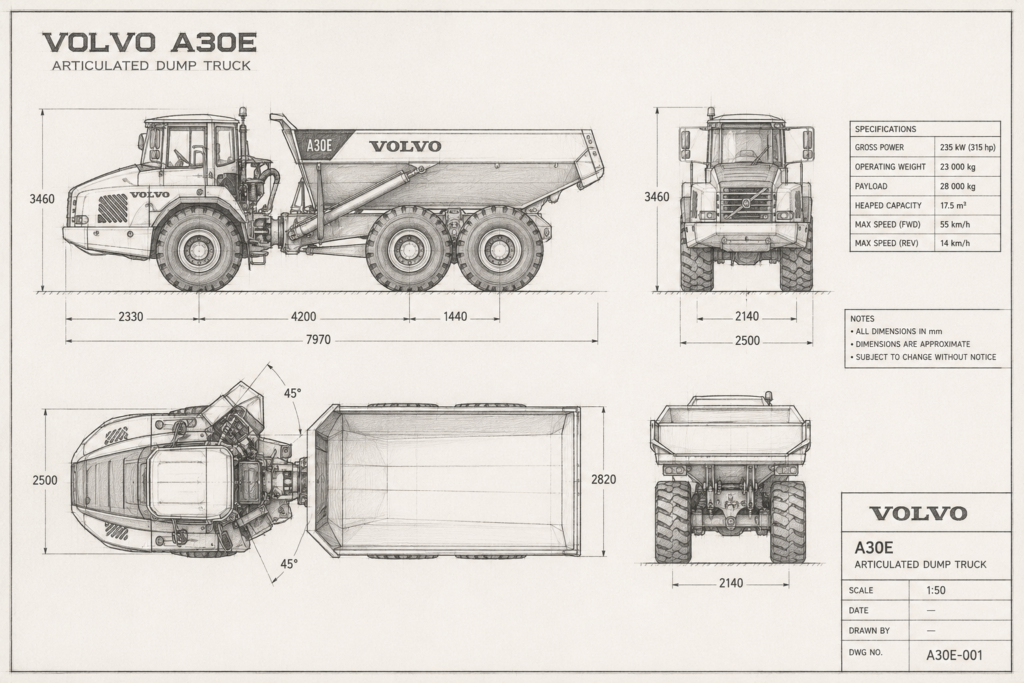
The truck typically operates with a payload capacity around 28 tonnes depending on market specification and body configuration. While that may appear modest compared with modern A35 or A40 machines, the A30E’s true strength lies in its balance between payload, mobility, reliability, versatility, and total operational cost.
Unlike rigid quarry trucks which rely heavily on well-maintained haul roads and relatively smooth operating environments, the A30E was designed specifically for poor terrain, rough haul roads, muddy conditions, steep gradients, soft ground, and constantly changing site conditions.
This is where articulated haulers dominate.
And Volvo historically dominated articulated hauling itself.
The articulation system allows the A30E to maintain traction and maneuverability where rigid trucks often struggle badly. The 6×6 driveline configuration, high ground clearance, oscillating rear bogie setup, differential lock systems, and articulated steering geometry all combine to give the machine exceptional off-road mobility.
Operators working in severe conditions often describe articulated dump trucks as machines that simply keep moving when other equipment gets stuck.
The A30E reinforced that reputation strongly.
At the heart of the machine sits Volvo’s proven diesel powerplant technology. The truck was engineered around delivering strong low-end torque, dependable pulling power, and long-term durability under continuous hauling conditions. Volvo’s focus was not merely peak horsepower figures, but rather sustained usable power delivery across difficult terrain under heavy payload conditions.
That distinction matters in real articulated hauling environments.
Unlike highway trucking, off-road haulage constantly stresses driveline systems, suspension systems, cooling systems, articulation joints, and axle systems simultaneously while the truck operates over uneven terrain carrying massive loads.
The A30E’s driveline system became known for strong durability and dependable traction management. Volvo refined the transmission systems significantly compared with earlier generations, improving gear selection smoothness, operator control, traction delivery, and fuel efficiency.
This was one of the major changes separating the E-series from earlier D-series trucks.
The older D-series trucks gained legendary reputations for toughness partly because they remained relatively mechanical and straightforward. Many operators still love the A30D specifically because of its simplicity and reduced electronic complexity.
The A30E began introducing more advanced control systems and driveline refinements while still remaining relatively serviceable and understandable compared with later-generation articulated trucks.
That is one reason many operators consider the E-series a particularly attractive compromise.
You gained improvements in comfort, control, fuel efficiency, transmission response, diagnostics, and operational refinement without yet entering the much heavier electronic dependency seen on later machines.
The cab environment improved substantially on the E-series trucks.
Volvo focused heavily on operator comfort because articulated haulers often spend entire shifts hauling continuously across rough terrain. Operator fatigue directly affects productivity, cycle times, machine abuse, and site safety.
The A30E therefore introduced improved ergonomics, better seating, lower vibration levels, improved visibility, refined controls, better climate management, and quieter operation compared with many older articulated dump trucks.
This may sound secondary to payload figures and engine power, but in real-world operations comfortable operators usually perform better over long shifts.
Volvo understood that very well.
The suspension and ride characteristics of the A30E also became a major selling point. Volvo had already established itself as one of the leaders in articulated hauling ride quality, and the A30E continued developing that reputation further.
The truck maintains impressive stability over rough terrain while preserving good traction and control. This becomes especially important on longer haul roads where rough surfaces can severely impact both productivity and operator fatigue.
Fuel efficiency also became increasingly important during the E-series era.
Rising fuel costs forced operators to evaluate total operating cost much more aggressively. Volvo responded by improving driveline efficiency, transmission logic, hydraulic performance, and engine management systems throughout the E-series range.
The A30E therefore generally offered noticeably improved fuel economy compared with earlier trucks while still maintaining strong hauling performance.
This balance remains one of the truck’s biggest strengths even today.
The A30E also benefited from Volvo’s growing expertise in serviceability and uptime management. Heavy equipment downtime represents one of the biggest hidden costs within construction, quarrying, and earthmoving industries.
A stopped articulated dump truck affects production immediately.
The A30E therefore incorporated improved service access, grouped maintenance points, easier filter access, improved diagnostics capability, better cooling system layouts, and more service-friendly component positioning.
Compared with later-generation machines, the A30E still remains relatively straightforward to diagnose and repair.
Many fleet operators appreciate this enormously.
Modern articulated trucks can become extremely complex electronically, often requiring advanced dealer diagnostic systems and specialised software access for many repairs. The A30E still sits within a period where experienced heavy equipment engineers could often diagnose and repair many problems conventionally.
This is particularly valuable for independent operators and mixed fleets.
The truck also remains highly popular within secondary markets globally because of its durability and lifecycle value. Many A30E trucks continue operating productively at extremely high service hours provided maintenance schedules have been respected properly.
This long-term durability significantly affects resale values.
Volvo articulated dump trucks traditionally maintain strong resale performance because operators trust the platform. That trust has been earned over decades.
The A30E also benefits heavily from parts support availability. Because Volvo sold large numbers of articulated dump trucks globally, major support networks continue supplying OEM, OEM-equivalent, rebuilt, and aftermarket parts extensively.
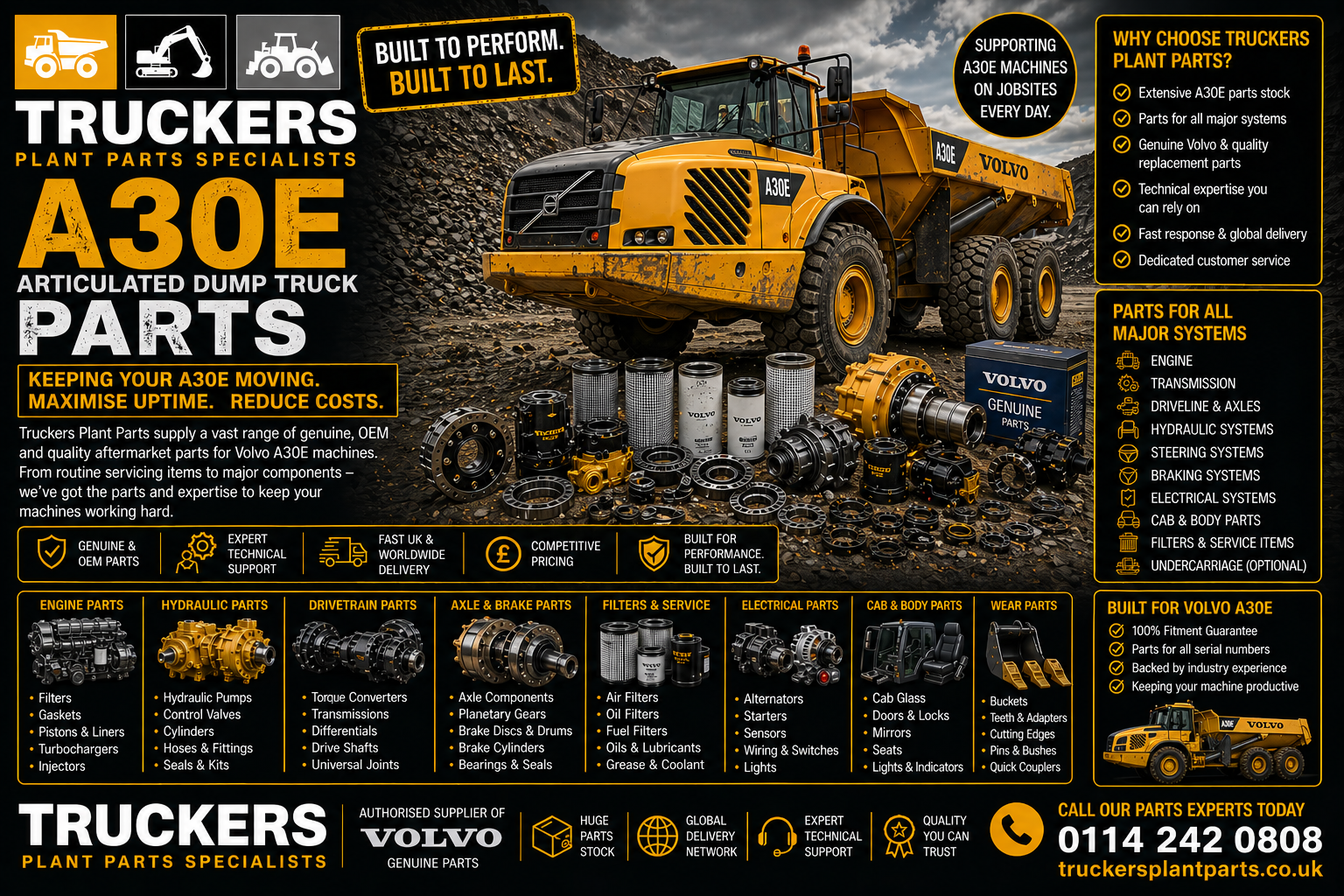
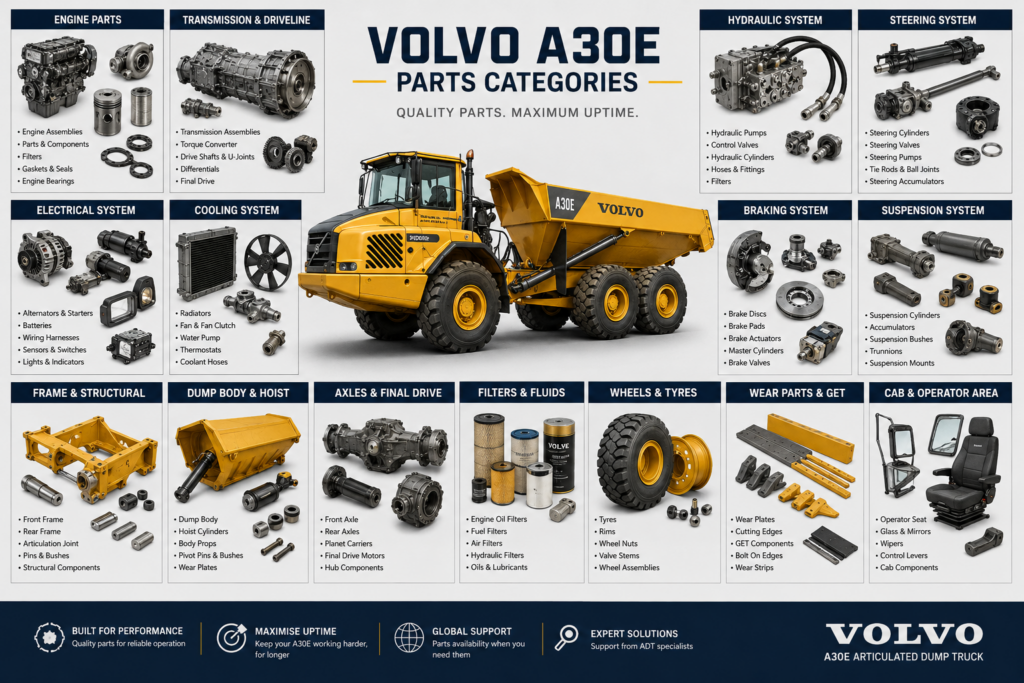
Truckers Plant Parts support the Volvo A30E across all major systems including engines, transmissions, torque converters, differentials, axle systems, suspension systems, articulation joints, steering systems, cooling systems, hydraulics, electrical systems, braking systems, cab systems, body systems, driveline components, filtration systems, service kits, wear components, and emergency VOR breakdown support.
This level of ongoing support matters enormously for older articulated dump truck ownership.
Machines only remain commercially valuable while parts remain obtainable.
The A30E continues benefiting from excellent aftermarket support because of its widespread global usage and respected reputation.
Comparing the A30E against later F-series and G-series trucks becomes extremely interesting because it highlights how articulated hauling evolved.
Later machines introduced major improvements in fuel efficiency, electronics integration, predictive traction systems, onboard telematics, advanced driveline management, and operator assistance technologies.
However many operators believe those improvements also increased electronic complexity and repair costs substantially.
The A30E therefore occupies a particularly respected middle ground.
Modern enough to feel refined.
Old-school enough to remain rugged and manageable.
That combination is surprisingly difficult to achieve successfully.
Compared with the earlier A30D, the A30E generally offered improved operator comfort, smoother driveline operation, improved serviceability, better transmission behaviour, lower noise levels, improved diagnostics capability, and stronger operational refinement overall.
Compared with later A30F, A30G, and A30H machines, the A30E may sacrifice some fuel efficiency, automation capability, payload optimisation, and integrated technology, but many operators still argue it wins strongly on simplicity, maintainability, lower ownership complexity, and reduced dependency on dealer-level electronic diagnostics.
This is precisely why the A30E still commands strong respect throughout the heavy equipment industry.
It represents a point in Volvo articulated dump truck history where modernisation improved the machine without yet fully removing the rugged mechanical character operators loved in the older trucks.
And in severe off-road hauling environments, that balance still matters enormously.
FAQ: Volvo A30E Articulated Dump Truck
1. What is the Volvo A30E?
The Volvo A30E is a heavy-duty articulated dump truck designed for off-road hauling applications.
2. What type of machine is the A30E?
It is a 6×6 articulated hauler used in quarrying, construction, mining support, and earthmoving industries.
3. What payload class does the A30E sit within?
The truck sits within the important 30-ton articulated hauler category.
4. Why is the 30-ton category important?
It offers an excellent balance between payload, maneuverability, operating cost, and productivity.
5. What industries use the A30E?
Quarries, aggregates, mining support, infrastructure, earthmoving, forestry, landfill, and recycling industries use the truck.
6. Why is the A30E still popular today?
The truck combines durability, simplicity, productivity, and strong long-term reliability.
7. What makes articulated dump trucks different from rigid trucks?
Articulated trucks perform far better in rough terrain and soft ground conditions.
8. Why are articulated trucks valuable off-road?
They maintain traction and maneuverability where rigid trucks struggle.
9. What does 6×6 mean?
It means all six wheels can receive drive power.
10. Why is 6×6 important?
It improves traction in mud, steep terrain, and difficult ground conditions.
11. What engine does the Volvo A30E use?
The truck uses a Volvo heavy-duty diesel engine platform.
12. Why are Volvo engines respected?
They are known for durability, torque delivery, and fuel efficiency.
13. Why is low-end torque important?
Low-end torque improves pulling power under heavy load conditions.
14. What transmission improvements did the E-series introduce?
The E-series improved driveline smoothness and transmission refinement.
15. How did the A30E improve over the A30D?
It improved comfort, driveline refinement, serviceability, and operational smoothness.
16. Why do some operators still prefer the A30D?
The older D-series trucks were simpler mechanically.
17. What makes the A30E a compromise between old and new?
It combines ruggedness with improved modern refinement.
18. Why is the A30E considered reliable?
The truck was engineered heavily around durability and long lifecycle operation.
19. What terrain can the A30E handle?
Mud, quarry haul roads, steep grades, soft ground, and rough terrain.
20. Why is articulation important?
Articulation improves steering and terrain adaptability.
21. What suspension system does the A30E use?
The truck uses heavy-duty articulated suspension systems designed for rough terrain.
22. Why is ride quality important?
Operators spend entire shifts hauling continuously.
23. Why does operator comfort matter?
Reduced fatigue improves productivity and safety.
24. What cab improvements did the A30E introduce?
Better ergonomics, improved seating, quieter operation, and improved visibility.
25. Why is visibility important in articulated dump trucks?
Large haul trucks operate in busy and hazardous environments.
26. Why are articulated haulers expensive machines?
They combine massive driveline, suspension, hydraulic, and structural systems.
27. What axle systems does the A30E use?
Heavy-duty axle systems designed for severe off-road hauling.
28. Why are axle systems heavily stressed?
Massive payloads create enormous torque and loading forces.
29. What driveline systems commonly wear?
Differentials, prop shafts, axle systems, and transmissions commonly wear.
30. What are articulation joints?
They connect the front and rear chassis sections together.
31. Why are articulation joints important?
They allow the truck to steer and flex over terrain.
32. What articulation components commonly wear?
Pins, bushes, bearings, and seals commonly wear.
33. Why are cooling systems critical?
Heavy hauling generates enormous heat continuously.
34. What cooling components commonly require replacement?
Radiators, hoses, coolers, and fan systems commonly require support.
35. Why is overheating dangerous?
Overheating can damage engines, hydraulics, and transmissions.
36. What hydraulic systems are fitted to the A30E?
Steering, tipping, braking, and suspension hydraulics are integrated throughout the truck.
37. Why are hydraulic systems important?
Hydraulics power major operational systems across the machine.
38. What hydraulic components commonly fail?
Pumps, hoses, cylinders, valves, and accumulators commonly fail.
39. What are tipping cylinders?
Hydraulic cylinders used to raise the dump body.
40. Why are dump bodies heavily stressed?
Large payloads create enormous loading pressure during hauling and tipping.
41. What body components commonly wear?
Body liners, hinges, pivot points, and structural wear areas commonly wear.
42. Why are articulated trucks popular in quarries?
They perform well in poor haul-road conditions.
43. Why are articulated trucks useful in forestry?
They maintain traction in soft and uneven terrain.
44. Why are articulated trucks effective in earthmoving?
They handle changing site conditions extremely well.
45. What fuel efficiency improvements did the E-series introduce?
Improved driveline management and transmission refinement improved fuel economy.
46. Why does fuel efficiency matter?
Fuel represents one of the biggest operational costs in haulage.
47. Why is uptime important?
Stopped trucks immediately reduce production.
48. Why is serviceability important?
Easy maintenance reduces downtime and repair costs.
49. How did the A30E improve serviceability?
The truck introduced improved access and diagnostics capability.
50. Why do operators still buy older Volvo articulated trucks?
They remain productive and dependable long after initial ownership.
51. Why are Volvo articulated trucks respected globally?
Volvo pioneered articulated hauling technology.
52. Why do Volvo trucks maintain strong resale values?
Operators trust their durability and long lifecycle performance.
53. What braking systems are used on the A30E?
Heavy-duty hydraulic braking systems are fitted throughout the truck.
54. Why are braking systems heavily stressed?
Large payloads create huge stopping forces continuously.
55. What braking components commonly wear?
Brake discs, cooling systems, hydraulic components, and seals commonly wear.
56. Why are tyres important on articulated haulers?
Tyres affect traction, stability, flotation, and operating cost.
57. Why are articulated dump truck tyres expensive?
Large off-road tyres operate under severe conditions continuously.
58. What electrical systems are fitted to the A30E?
The truck includes diagnostics systems, sensors, lighting, and electronic controls.
59. Why is the A30E less electronically complex than later models?
It was built before advanced telematics and automation became dominant.
60. Why do some operators prefer reduced electronics?
Simpler machines can be easier and cheaper to repair.
61. What later models replaced the A30E?
The A30F and later G and H-series machines followed.
62. How did the A30F improve over the A30E?
The F-series introduced more advanced fuel efficiency and electronics integration.
63. What did the A30E retain from older Volvo trucks?
Mechanical ruggedness and relatively straightforward serviceability.
64. Why is the A30E considered a sweet spot?
It balances simplicity and refinement extremely well.
65. What maintenance items commonly require replacement?
Filters, oils, hoses, seals, bearings, and wear parts commonly require replacement.
66. What are VOR situations?
Vehicle Off Road situations occur when machinery stops unexpectedly.
67. Why are VOR situations expensive?
Production delays rapidly increase operational costs.
68. Does Truckers support the Volvo A30E?
Yes. Truckers support the A30E extensively.
69. What parts does Truckers support for the A30E?
Engines, transmissions, hydraulics, axles, brakes, cooling systems, articulation systems, and electrical components are all supported.
70. Does Truckers supply OEM parts?
Yes. Genuine OEM components are supported.
71. Does Truckers also supply aftermarket parts?
Yes. OEM-equivalent and quality aftermarket options are available.
72. Why are aftermarket options popular?
They can reduce operating costs while maintaining reliability.
73. Can Truckers source obsolete A30E parts?
Yes. Rare and obsolete parts can often be sourced internationally.
74. Why are older articulated truck parts difficult to locate?
Production ended years ago and some stock became limited.
75. Does Truckers support emergency breakdowns?
Yes. Rapid-response VOR support is available.
76. Does Truckers offer next-day delivery?
Yes. Fast UK delivery is available for many components.
77. Does Truckers offer same-day collection?
Yes. Many stocked items are available immediately.
78. Can dedicated transport be arranged?
Yes. Urgent delivery solutions are available.
79. Why does real heavy equipment knowledge matter?
Correct diagnostics reduce downtime and repair costs.
80. Why are experienced parts suppliers valuable?
They understand real-world machine failures and operational demands.
81. Why do articulated dump trucks last so long?
They are engineered for severe-duty industrial operation.
82. What are common high-hour A30E wear areas?
Articulation joints, suspension systems, driveline systems, and hydraulics commonly wear.
83. Why are suspension systems important?
Suspension improves ride quality, stability, and traction.
84. What steering systems are used on the A30E?
Hydraulic articulated steering systems are fitted.
85. Why is articulated steering valuable?
It improves maneuverability in confined environments.
86. Why are quarry environments difficult on machinery?
Dust, impact, abrasive material, and continuous loading accelerate wear heavily.
87. Why do operators continue rebuilding older Volvo trucks?
Rebuild costs are often lower than replacement costs.
88. Why are Volvo articulated trucks considered durable?
Volvo engineered them heavily around structural longevity and driveline strength.
89. What are common service intervals on articulated trucks?
Engine oils, filters, hydraulics, driveline oils, and cooling systems require scheduled servicing.
90. Why is preventative maintenance important?
Preventative maintenance reduces catastrophic failures.
91. Why do articulated trucks require heavy cooling systems?
Continuous hauling generates huge thermal loads.
92. Why are transmissions heavily stressed?
Off-road hauling constantly loads driveline systems under heavy torque.
93. What transmission components commonly fail?
Clutches, seals, valve bodies, torque converters, and bearings commonly wear.
94. What are torque converters?
Torque converters transfer engine power through hydraulic driveline systems.
95. Why are differential systems important?
Differentials distribute power between wheels under varying traction conditions.
96. Why are articulated haulers popular worldwide?
They handle difficult terrain better than most haulage equipment.
97. Why is the A30E still commercially valuable?
Strong durability and global parts support maintain lifecycle value.
98. Why do operators still actively search for A30E trucks?
The model remains respected for reliability and operational balance.
99. What best describes the Volvo A30E overall?
The A30E represents one of Volvo’s best-balanced articulated dump trucks, combining old-school ruggedness with improved modern refinement.
100. Why does the Volvo A30E still matter today?
Because it remains one of the clearest examples of a heavy articulated hauler that successfully balanced durability, simplicity, operator comfort, fuel efficiency, off-road capability, serviceability, and long-term reliability without becoming overly dependent on complex electronics.
A20, A25, A25B, A25C, A25D, A25E, A25F, A25G, A30, A30C, A30D, A30E, A30F, A30G, A35, A35C, A35D, A35E, A35F, A35G, A40, A40C, A40D, A40E, A40F, A40G, A45G, A60H, A25, A30, A35, A40, A45, A50, A60H, A30