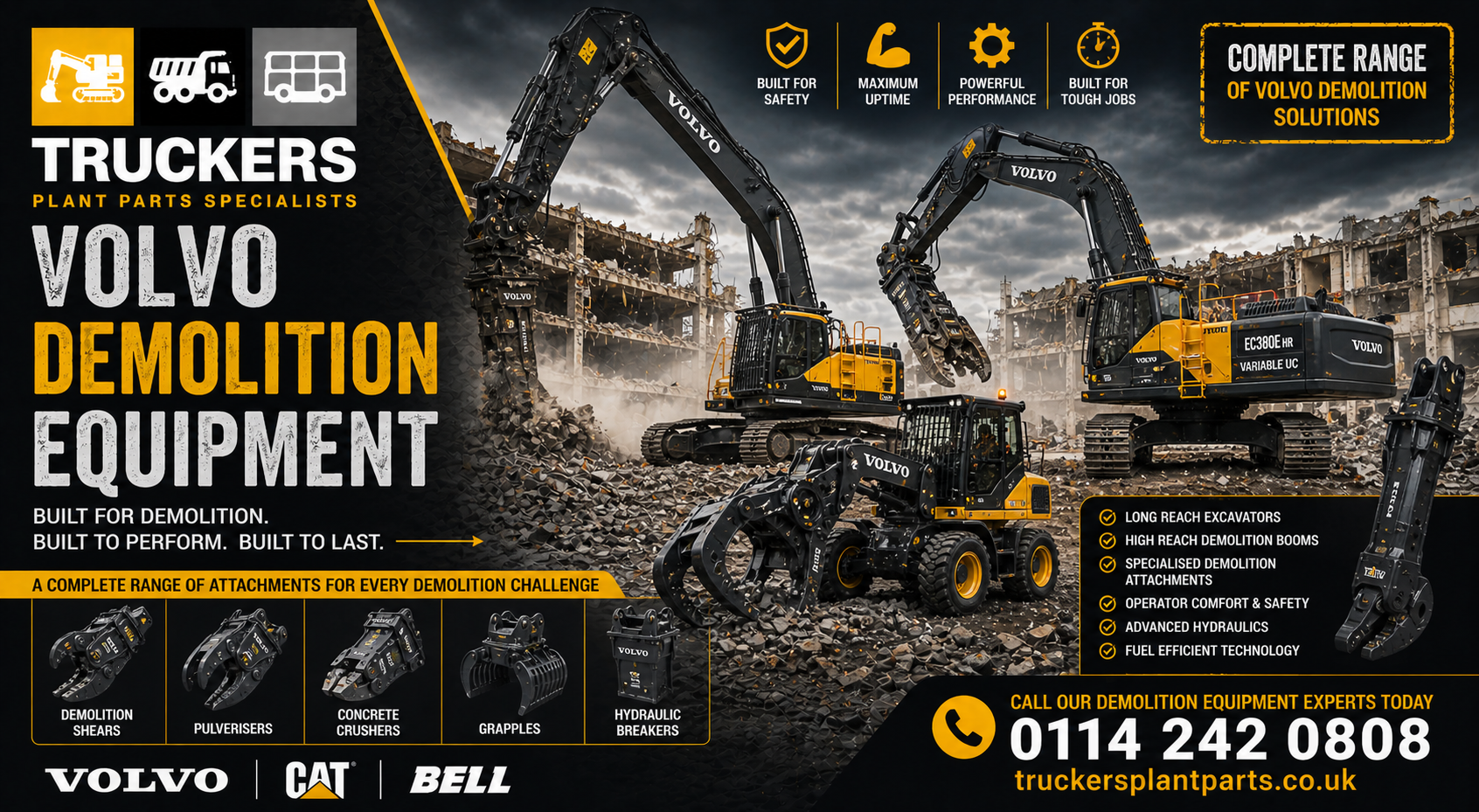
Demolition Equipment Spare Parts & Emergency Support For Volvo, Caterpillar, Komatsu, Liebherr, FUCHS & More – Keeping Your Demolition Fleet Operating When Failure Strikes
Demolition is one of the harshest environments any heavy machinery will ever operate in. Unlike standard earthmoving or quarry applications where loading cycles and operational stresses remain relatively predictable, demolition equipment operates continuously under violent impact loads, extreme hydraulic pressure, twisting forces, airborne contamination, structural shock loading, abrasive debris, unpredictable material resistance, and highly aggressive operating conditions that place enormous stress on both machines and attachments every single hour.
In demolition, there is very little margin for weakness.
Volvo Demolition Excavator Comparison
| Model | Operating Weight | Engine Power | Maximum Reach* | Typical Attachment Weight | Best For | Demolition Class |
|---|---|---|---|---|---|---|
| EC140E | 14 t | 121 hp | 8.5–9.0 m | 0.8–1.5 t | Light demolition, interior strip-out | Light Demolition |
| EC160E | 16–20 t | 148 hp | 9.5–10.0 m | 1.0–2.0 t | Commercial demolition | Light / Medium Demolition |
| EC200E | 20–25 t | 154 hp | 10–11 m | 1.5–2.5 t | Structural demolition | Medium Demolition |
| EC210 | 21–24 t | 154 hp | 10–11 m | 1.5–2.5 t | General demolition | Medium Demolition |
| EC220E | 20–26 t | 173 hp | 10.5–11.5 m | 2.0–3.0 t | Concrete processing | Medium Demolition |
| EC230 | 21–26 t | 173 hp | 11–12 m | 2.0–3.5 t | Heavy structural demolition | Medium Demolition |
| EC250E | 25–28 t | 218 hp | 11.5–12.5 m | 2.5–4.0 t | High production demolition | Large Demolition |
| EC260 | 28–34 t | 225 hp | 12–13 m | 3.0–4.5 t | Commercial demolition | Large Demolition |
| EC300 | 30–37 t | 253 hp | 13–14 m | 3.5–5.0 t | Large concrete structures | Large Demolition |
| EC350E | 36–42 t | 303 hp | 14–15 m | 4.5–6.5 t | High-rise demolition support | Heavy Demolition |
| EC370 | 38–40 t | 344 hp | 15–16 m | 5.0–7.0 t | Large reinforced concrete demolition | Heavy Demolition |
| EC380E | 38–43 t | 306 hp | 15–16 m | 5.5–7.5 t | Industrial demolition | Heavy Demolition |
| EC400 | 39–42 t | 339 hp | 15–17 m | 6.0–8.0 t | Heavy demolition | Heavy Demolition |
| EC480E | 45–53 t | 424 hp | 16–18 m | 7.0–9.5 t | High production demolition | Heavy Demolition |
| EC500 | 48–53 t | 424 hp | 17–18 m | 8.0–10.0 t | Large industrial demolition | Heavy Demolition |
| EC530E | 53–54 t | 456 hp | 18–19 m | 9.0–11.0 t | Major demolition projects | Super Heavy Demolition |
| EC550E | 55–58 t | 456 hp | 18–20 m | 10.0–12.0 t | Steelworks & industrial demolition | Super Heavy Demolition |
| EC750E HR | 75–85 t | 469 hp | Up to 36 m | High Reach Equipment | High-rise demolition | High Reach Demolition |
| EC950 | 90–95 t | 603 hp | 20–22 m | 12–15+ t | Heavy industrial demolition & mining | Ultra Heavy Demolition |
*Reach shown is for standard boom configurations unless noted. High Reach (HR) demolition variants can achieve substantially greater working heights.
Volvo Demolition Excavator Categories
| Category | Models | Ideal Applications |
|---|---|---|
| Light Demolition | EC140E, EC160E | Interior strip-out, residential demolition, garages, schools, offices |
| Medium Demolition | EC200E, EC210, EC220E, EC230 | Commercial buildings, reinforced concrete, warehouses |
| Large Demolition | EC250E, EC260, EC300 | Shopping centres, factories, bridges, multi-storey buildings |
| Heavy Demolition | EC350E, EC370, EC380E, EC400, EC480E, EC500 | Large industrial sites, concrete plants, infrastructure demolition |
| Super Heavy Demolition | EC530E, EC550E | Steelworks, power stations, refineries, docks |
| High Reach Demolition | EC750E HR | Tall buildings, tower blocks, city-centre demolition |
| Ultra Heavy Demolition | EC950 | Mining infrastructure, massive industrial structures, shipbreaking, mega demolition projects |
Excavators supporting high-reach demolition projects, concrete processing operations, steel dismantling, industrial deconstruction, bridge removal, waste transfer, scrap handling, and structural reduction work must perform reliably under some of the toughest conditions found anywhere within heavy industry.
Attachments such as hydraulic shears, demolition grapples, concrete crushers, rotating pulverisers, static pulverisers, breakers, selector grabs, magnets, compaction wheels, quick couplers, tiltrotators, and heavy demolition buckets absorb incredible punishment continuously. The excavators and carriers operating these attachments also endure sustained hydraulic stress, undercarriage loading, elevated temperatures, severe vibration, and structural fatigue throughout their operational life.
This is exactly why demolition equipment maintenance, repairs, and spare parts support become so critically important.
Because when demolition machinery fails unexpectedly, operations can stop instantly.
And in demolition environments, downtime becomes especially dangerous and expensive very quickly.
A failed hydraulic shear during structural dismantling operations can halt steel processing completely. A seized pulveriser rotation motor can immobilise a concrete processing excavator. A failed hydraulic breaker can stop reinforced structure reduction work immediately. A damaged quick coupler can shut down attachment changeovers entirely. A failed slew ring or hydraulic pump on a high-reach excavator may stop critical demolition operations at the worst possible moment.
In demolition, the machinery itself often becomes the entire production system.
If the machine stops, the operation stops.
That is why Truckers Plant Parts works so heavily within demolition machinery support, helping operators source OEM, OEM-equivalent, and quality aftermarket components for demolition excavators, demolition attachments, hydraulic systems, structural wear systems, attachment rebuilds, emergency breakdown repairs, and difficult-to-source demolition components across Volvo, Caterpillar, Komatsu, Liebherr, FUCHS, Hitachi, Hyundai, Doosan, Develon, CASE, JCB, and many other heavy equipment manufacturers.
Because when demolition machinery fails, you need support immediately before everything quite literally comes falling down.
Modern demolition fleets rely heavily on specialised excavators and high-performance attachments working together under severe-duty conditions.
Volvo excavators such as the EC220, EC230, EC250, EC300, EC350, EC380, EC480, EC750, and EC950 are widely used throughout demolition industries because of their hydraulic stability, structural durability, smooth controllability, and ability to operate demanding demolition attachments effectively.
Caterpillar demolition excavators, Komatsu high-reach machines, Liebherr demolition platforms, and specialist demolition carriers from multiple manufacturers are also heavily relied upon across structural dismantling and industrial demolition projects worldwide.
These machines routinely operate with specialised attachments including steel shears capable of cutting structural steel and reinforced beams, rotating grapples handling scrap and demolition debris, pulverisers crushing reinforced concrete structures, hydraulic breakers delivering massive impact energy into structures, and selector grabs sorting demolition material continuously.
Every one of these systems depends heavily on hydraulic performance.
Hydraulic pressure and oil flow form the backbone of modern demolition machinery. Massive hydraulic pumps, valve blocks, accumulators, hoses, swivel joints, cylinders, rotation motors, and auxiliary circuits operate continuously under extremely high pressure while exposed to contamination, impact vibration, dust, debris, and heat.
Demolition hydraulics work incredibly hard.
This means wear becomes inevitable over time.
Hydraulic hoses eventually fatigue.
Seal kits wear.
Rotation motors develop internal leakage.
Shear cylinders weaken.
Pulveriser pivots wear.
Breaker pistons fatigue.
Nitrogen systems lose efficiency.
Accumulator systems degrade.
Valve blocks become contaminated.
Quick couplers wear.
Pins and bushes absorb severe side loading.
Attachment structures fatigue.
Machine undercarriages wear under constant heavy attachment weight.
Slew systems endure enormous rotational loads.
Cooling systems struggle with contamination and sustained hydraulic heat generation.
Even the strongest demolition machinery eventually requires servicing, rebuilding, repairs, and component replacement.
That is where Truckers Plant Parts becomes critically valuable.
Truckers supports demolition contractors with parts supply solutions covering both the machines themselves and the specialised demolition attachments they operate.
Hydraulic systems form one of the largest support categories because demolition attachments depend entirely on reliable hydraulic performance. Hydraulic pumps, auxiliary hydraulic systems, spool valves, control valves, hose assemblies, swivel joints, cylinders, rotation motors, pipework, seal kits, accumulators, filters, hydraulic coolers, and hydraulic rebuild components are all heavily supported.
Demolition shears represent one of the most heavily stressed attachment categories in the industry. Steel-cutting shears operate under enormous hydraulic force while repeatedly cutting structural steel, beams, rebar, industrial framework, and heavy metallic structures. Wear blades, cutting knives, jaw pivots, cylinders, rotation motors, guide systems, bearings, pins, bushes, and hydraulic components all experience severe operational stress continuously.
Truckers supports demolition shear systems with wear blades, knives, jaw rebuild components, seal kits, rotation systems, cylinders, pivots, hydraulic rebuild parts, and structural repair support across multiple attachment manufacturers.
Concrete crushers and pulverisers also require intensive maintenance support because crushing reinforced concrete generates constant impact loading, vibration, abrasive contamination, and structural fatigue. Pulveriser jaws, crushing teeth, rotation bearings, cylinders, hydraulic motors, linkage systems, bushings, and structural weld areas all require ongoing inspection and maintenance.
Hydraulic breakers remain another major support category.
Breakers operate through violent repeated impact energy, placing enormous stress on internal pistons, tool retainers, bushes, diaphragms, nitrogen systems, tool steels, seal systems, and hydraulic flow systems. Breakers operating within demolition environments frequently require rebuild support, seal kits, replacement chisels, pistons, retainer systems, lower bushes, through bolts, diaphragms, recharge systems, and complete rebuild components.
Truckers supports demolition breakers across multiple manufacturers with both OEM and quality aftermarket rebuild solutions designed to withstand severe-duty demolition environments.
Demolition grapples and selector grabs also operate under constant abuse. Sorting scrap, handling demolition waste, moving structural debris, loading crushers, processing timber, and handling mixed waste materials all create ongoing wear within grapple rotators, hydraulic cylinders, jaw systems, pivots, pins, bushes, and structural components.
Quick couplers and attachment interfaces form another critical support area.
Modern demolition fleets often switch between multiple attachments throughout the day depending on operational requirements. Quick coupler reliability therefore becomes absolutely critical for productivity and site safety. Worn coupler systems can create dangerous operating conditions, attachment instability, hydraulic leakage, and severe downtime risks.
Truckers supports coupler systems, locking mechanisms, hydraulic interfaces, wear pads, coupler cylinders, safety systems, sensors, hoses, and structural wear components across numerous attachment platforms.
Undercarriage systems on demolition excavators also experience accelerated wear because demolition attachments significantly increase machine operating weight and side loading forces. Track chains, rollers, sprockets, idlers, recoil systems, and slew bearings therefore require particularly close inspection within demolition environments.
Cooling systems become another major focus area because demolition equipment generates huge amounts of hydraulic heat while simultaneously operating within highly contaminated airborne conditions. Dust, concrete particles, metal debris, insulation fibres, and airborne waste materials constantly challenge cooling systems during demolition operations.
Radiators, hydraulic coolers, intercoolers, fan systems, and filtration systems therefore require aggressive maintenance and rapid replacement support when failures occur.
Electrical systems on modern demolition machinery have also become increasingly important.
Today’s excavators and demolition attachments rely heavily on electronically controlled hydraulic systems, joysticks, auxiliary control systems, attachment management systems, machine monitoring systems, cameras, safety systems, and telematics integration. Electrical faults that once represented relatively minor inconveniences can now immobilise entire demolition systems immediately.
Truckers therefore supports ECUs, wiring harnesses, joysticks, displays, sensors, cameras, attachment control systems, safety switches, electrical diagnostics, and electronically controlled hydraulic systems extensively.
One of the biggest challenges within demolition industries is urgency.
Demolition schedules are often tightly controlled with strict deadlines, environmental requirements, waste processing targets, transport coordination, structural sequencing plans, and contractual obligations all operating simultaneously. Delays can create enormous operational disruption very quickly.
This is why Truckers focuses heavily on rapid response parts supply for demolition industries.
Massive stockholding capability allows many demolition components to be supplied immediately for same-day collection or next-day delivery. Emergency same-day transport options are available when downtime becomes critical. Non-stock or obsolete demolition components can often be sourced internationally through specialist supply networks built over decades within heavy equipment industries.
Truckers also understands that demolition machinery failures are not always straightforward.
A damaged shear may require complete rebuild planning.
A failed pulveriser rotation system may involve hydraulic contamination analysis.
A structural crack on a demolition boom may require specialist welding assessment.
A high-reach excavator failure may involve extremely specialised repair requirements.
This is where real heavy equipment experience matters enormously.
Truckers Plant Parts has built a strong reputation for helping demolition operators solve difficult machinery problems, source rare components, identify practical repair solutions, and minimise downtime in some of the harshest machinery environments anywhere within heavy industry.
Because demolition is not a gentle industry.
It is brutal on machines.
It is brutal on hydraulics.
It is brutal on attachments.
It is brutal on wear systems.
And when failures happen unexpectedly, operators need suppliers capable of responding quickly with the right parts, the right technical understanding, and the right urgency.
Ultimately, demolition machinery exists to bring structures down safely, efficiently, and productively.
But when your equipment goes down unexpectedly, Truckers Plant Parts is here to make sure your operation does not come falling down with it.
FAQ: Volvo, Caterpillar, Komatsu, Liebherr, FUCHS, Breakers, Shears, Pulverisers & Heavy Demolition Machinery Support
1. Why is demolition equipment maintenance so important?
Demolition machinery operates under some of the harshest conditions found anywhere in heavy industry.
2. Why do demolition machines wear so aggressively?
Extreme hydraulic pressure, vibration, impact loading, contamination, twisting forces, and structural shock create severe wear continuously.
3. What industries rely heavily on demolition machinery?
Demolition, scrap processing, recycling, industrial dismantling, waste handling, bridge removal, infrastructure removal, and structural deconstruction industries rely heavily on demolition equipment.
4. Why is downtime especially serious in demolition?
Demolition schedules are often tightly controlled and production stoppages can become extremely expensive very quickly.
5. What happens when demolition equipment fails unexpectedly?
Structural dismantling stops, processing operations halt, transport schedules are disrupted, and project deadlines may be threatened.
6. Why are demolition excavators heavily stressed?
They carry large attachments operating under extremely high hydraulic and structural loads.
7. What excavator manufacturers are commonly used in demolition?
Volvo, Caterpillar, Komatsu, Liebherr, Hitachi, Hyundai, Develon, Doosan, CASE, and JCB are commonly used.
8. What Volvo excavators are popular in demolition?
EC220, EC230, EC250, EC300, EC350, EC380, EC480, EC750, and EC950 excavators are widely used.
9. Why are Volvo excavators respected in demolition?
Operators value hydraulic stability, smooth controls, structural strength, and reliability.
10. What are demolition attachments?
Demolition attachments are specialised hydraulic tools mounted to excavators for cutting, crushing, breaking, sorting, and processing materials.
11. What demolition attachments are commonly used?
Hydraulic shears, pulverisers, concrete crushers, breakers, grapples, selector grabs, magnets, buckets, and quick couplers are commonly used.
12. What are hydraulic shears used for?
Hydraulic shears cut structural steel, rebar, beams, pipelines, and heavy metallic structures.
13. Why are demolition shears heavily stressed?
They repeatedly cut extremely strong materials under enormous hydraulic pressure.
14. What shear components commonly wear?
Blades, knives, pivots, cylinders, bearings, pins, bushes, and rotation systems commonly wear.
15. Why do shear blades require replacement?
Steel cutting gradually wears cutting edges and reduces performance.
16. What are pulverisers used for?
Pulverisers crush reinforced concrete structures and separate rebar from concrete.
17. What are concrete crushers used for?
Concrete crushers break down large concrete structures into manageable material.
18. Why are pulverisers heavily stressed?
Concrete crushing creates constant vibration, impact loading, and structural fatigue.
19. What pulveriser components commonly wear?
Crushing teeth, pivots, cylinders, bearings, jaws, and rotation systems commonly wear.
20. What are hydraulic breakers used for?
Breakers deliver high-impact energy into concrete, rock, foundations, and reinforced structures.
21. Why are hydraulic breakers so demanding on machinery?
Breakers create extreme vibration and repeated impact forces continuously.
22. What breaker components commonly wear?
Pistons, bushes, diaphragms, retainers, chisels, seal kits, and nitrogen systems commonly wear.
23. Why are breaker seal kits important?
Seal failures reduce breaker efficiency and hydraulic performance.
24. What are demolition grapples used for?
Grapples sort, handle, load, and move demolition debris and scrap material.
25. What are selector grabs used for?
Selector grabs allow operators to sort and separate demolition materials precisely.
26. Why do grapple systems wear heavily?
Constant opening, closing, twisting, and debris handling create severe wear.
27. What grapple components commonly fail?
Rotators, cylinders, pins, bushes, bearings, hoses, and jaw systems commonly wear.
28. What are quick couplers?
Quick couplers allow operators to rapidly change attachments on excavators.
29. Why are quick couplers important in demolition?
Demolition projects often require multiple attachment changes throughout the day.
30. What coupler components commonly wear?
Wear pads, locking systems, cylinders, pins, hydraulic systems, and safety mechanisms commonly wear.
31. Why are coupler failures dangerous?
Attachment instability creates serious safety risks on demolition sites.
32. What are rotating demolition attachments?
Attachments with hydraulic rotation systems allowing improved positioning and control.
33. Why are rotation systems heavily stressed?
Demolition attachments absorb twisting loads continuously.
34. What rotation components commonly fail?
Bearings, motors, seals, gear systems, and hydraulic rotators commonly wear.
35. Why are hydraulic systems critical in demolition equipment?
Hydraulics power nearly every demolition attachment and machine function.
36. What hydraulic components commonly fail?
Pumps, hoses, cylinders, valves, motors, swivel joints, and seal systems commonly fail.
37. Why are hydraulic hoses vulnerable in demolition?
Debris, abrasion, heat, pressure, and vibration create extreme stress on hoses.
38. What happens if hydraulic hoses burst?
Hydraulic systems can lose pressure instantly and contamination may spread through the system.
39. Why is hydraulic contamination dangerous?
Contamination can destroy pumps, valves, motors, and cylinders quickly.
40. Why are demolition environments so contaminated?
Dust, concrete particles, scrap, debris, and abrasive airborne material constantly surround machinery.
41. Why are filtration systems important in demolition?
Filters protect engines, hydraulics, and fuel systems from contamination damage.
42. What filters are important on demolition machinery?
Hydraulic filters, fuel filters, air filters, breather filters, and engine oil filters are critical.
43. Why are cooling systems heavily stressed on demolition machinery?
Hydraulic systems generate enormous heat while operating in contaminated environments.
44. What cooling components commonly fail?
Radiators, coolers, fan systems, hoses, thermostats, and intercoolers commonly fail.
45. Why is overheating dangerous in demolition equipment?
Overheating damages hydraulics, engines, seals, and electronic systems.
46. Why are undercarriages heavily stressed in demolition?
Heavy attachments place increased weight and side loading onto crawler systems.
47. What undercarriage components commonly wear?
Track chains, rollers, sprockets, idlers, recoil systems, and slew bearings commonly wear.
48. Why are slew systems important?
Slew systems control excavator upper structure rotation.
49. Why do slew systems wear heavily in demolition?
Continuous rotation under heavy attachment loads creates extreme stress.
50. What slew components commonly fail?
Slew rings, bearings, slew motors, pinions, and gear systems commonly wear.
51. Why are demolition excavators structurally stressed?
Attachments generate heavy side loading, twisting forces, and vibration.
52. What structural areas commonly require inspection?
Booms, dipper arms, stick ends, attachment brackets, chassis sections, and weld areas commonly require inspection.
53. Why are cracks dangerous on demolition equipment?
Structural cracking can eventually lead to catastrophic failure.
54. Why are electrical systems increasingly important in demolition?
Modern excavators rely heavily on electronically controlled hydraulic systems.
55. What electrical systems are commonly used?
ECUs, joysticks, displays, sensors, attachment management systems, cameras, and machine monitoring systems are common.
56. Can electrical faults immobilise demolition machinery?
Yes. Electronic failures can stop entire machines immediately.
57. Why are telematics useful in demolition fleets?
Telematics help monitor machine condition, service intervals, fuel usage, and fault codes.
58. Does Truckers support demolition machinery parts?
Yes. Truckers heavily support demolition excavators and attachments.
59. Does Truckers support Volvo demolition machinery?
Yes. Volvo demolition excavators and attachment systems are heavily supported.
60. Does Truckers support Caterpillar demolition equipment?
Yes. Caterpillar demolition excavators and attachments are supported.
61. Does Truckers support Komatsu demolition machinery?
Yes. Komatsu demolition excavators and systems are supported.
62. Does Truckers support Liebherr demolition equipment?
Yes. Liebherr demolition and material handling machinery are supported.
63. Does Truckers support FUCHS material handlers?
Yes. FUCHS scrap and recycling handlers are heavily supported.
64. What demolition parts does Truckers supply?
Hydraulic systems, wear parts, cylinders, pumps, hoses, seals, pivots, blades, bearings, couplers, filters, and structural parts are supplied.
65. Does Truckers supply demolition shear parts?
Yes. Blades, knives, cylinders, pivots, bearings, and hydraulic systems are supported.
66. Does Truckers support pulveriser rebuilds?
Yes. Pulveriser wear systems and rebuild components are supported.
67. Does Truckers support breaker rebuild parts?
Yes. Pistons, seal kits, chisels, bushes, retainers, and nitrogen systems are supported.
68. Does Truckers support grapple systems?
Yes. Rotators, cylinders, jaws, pivots, bearings, and hydraulic systems are supported.
69. Does Truckers support coupler systems?
Yes. Couplers, wear pads, locking systems, cylinders, and safety systems are supported.
70. Why are wear parts critical in demolition?
Wear parts absorb abuse and protect expensive structural components.
71. What wear parts are commonly replaced?
Teeth, blades, cutting edges, bushes, pins, liners, and wear plates are commonly replaced.
72. Why do demolition attachments require frequent maintenance?
Demolition creates some of the most aggressive operating conditions in heavy industry.
73. Can preventative maintenance reduce attachment failures?
Yes. Regular inspection helps identify wear before catastrophic damage occurs.
74. Why are attachment pins and bushes important?
Pins and bushes absorb major structural loads continuously.
75. What happens if pin wear is ignored?
Excessive wear can damage attachment structures and machine arms.
76. Why are hydraulic cylinders critical?
Cylinders generate the force required for attachment operation.
77. What cylinder failures commonly occur?
Seal failures, rod damage, scoring, leakage, and internal wear commonly occur.
78. Why are demolition schedules highly time-sensitive?
Projects often involve strict deadlines and coordinated operational sequencing.
79. What happens if demolition equipment stops unexpectedly?
Entire structural dismantling operations may halt immediately.
80. Why is downtime especially expensive in demolition?
Idle labour, delayed processing, transport disruption, and project delays escalate costs rapidly.
81. Does Truckers offer rapid parts supply?
Yes. Same-day collection and next-day delivery are available for many components.
82. Can Truckers arrange emergency transport?
Yes. Dedicated emergency delivery options are available when downtime is critical.
83. Does Truckers source obsolete demolition parts?
Yes. Rare and obsolete demolition machinery parts can often be sourced internationally.
84. Why are obsolete demolition parts difficult to locate?
Older attachment systems and machines may no longer have dealer support.
85. Why does industry knowledge matter in demolition repairs?
Demolition equipment often requires specialised technical understanding.
86. Why are demolition attachments expensive?
They operate under extreme stress and contain complex hydraulic systems.
87. Why do demolition contractors need reliable suppliers?
Reliable suppliers reduce downtime risk and improve operational continuity.
88. Can poor-quality parts fail quickly in demolition environments?
Yes. Low-quality components often fail rapidly under demolition conditions.
89. Why does Truckers focus on quality parts?
Reliable parts reduce repeat failures and improve machine uptime.
90. Does Truckers supply OEM and aftermarket options?
Yes. OEM, OEM-equivalent, and quality aftermarket solutions are available.
91. Why are demolition excavators larger than standard excavators?
Large demolition attachments require greater hydraulic power and structural strength.
92. What excavator sizes are commonly used in demolition?
Machines from 20 tonnes to over 100 tonnes are commonly used depending on application.
93. Why are high-reach excavators specialised?
High-reach machines are engineered specifically for tall structural demolition.
94. What systems are especially important on high-reach excavators?
Hydraulics, structural integrity, slew systems, cooling systems, and attachment interfaces are critical.
95. Can demolition equipment failures become dangerous?
Yes. Equipment failures can create major operational and safety risks.
96. Why are emergency repair solutions important in demolition?
Rapid repairs minimise downtime and maintain project schedules.
97. Why do demolition machines require aggressive servicing?
Severe-duty conditions accelerate wear dramatically compared with standard earthmoving.
98. Why do operators trust Truckers with demolition support?
Because of technical understanding, rapid supply capability, and demolition industry experience.
99. What makes demolition machinery support different from normal equipment support?
Demolition environments create far more extreme wear, stress, urgency, and operational pressure.
100. What best describes Truckers demolition equipment support overall?
Truckers provide specialist demolition machinery and attachment parts support for Volvo, Caterpillar, Komatsu, Liebherr, FUCHS, and many other manufacturers, supplying OEM and quality aftermarket solutions for shears, pulverisers, breakers, grapples, crushers, excavators, hydraulic systems, wear components, emergency repairs, and difficult-to-source demolition equipment parts designed to keep critical demolition operations running safely and efficiently.