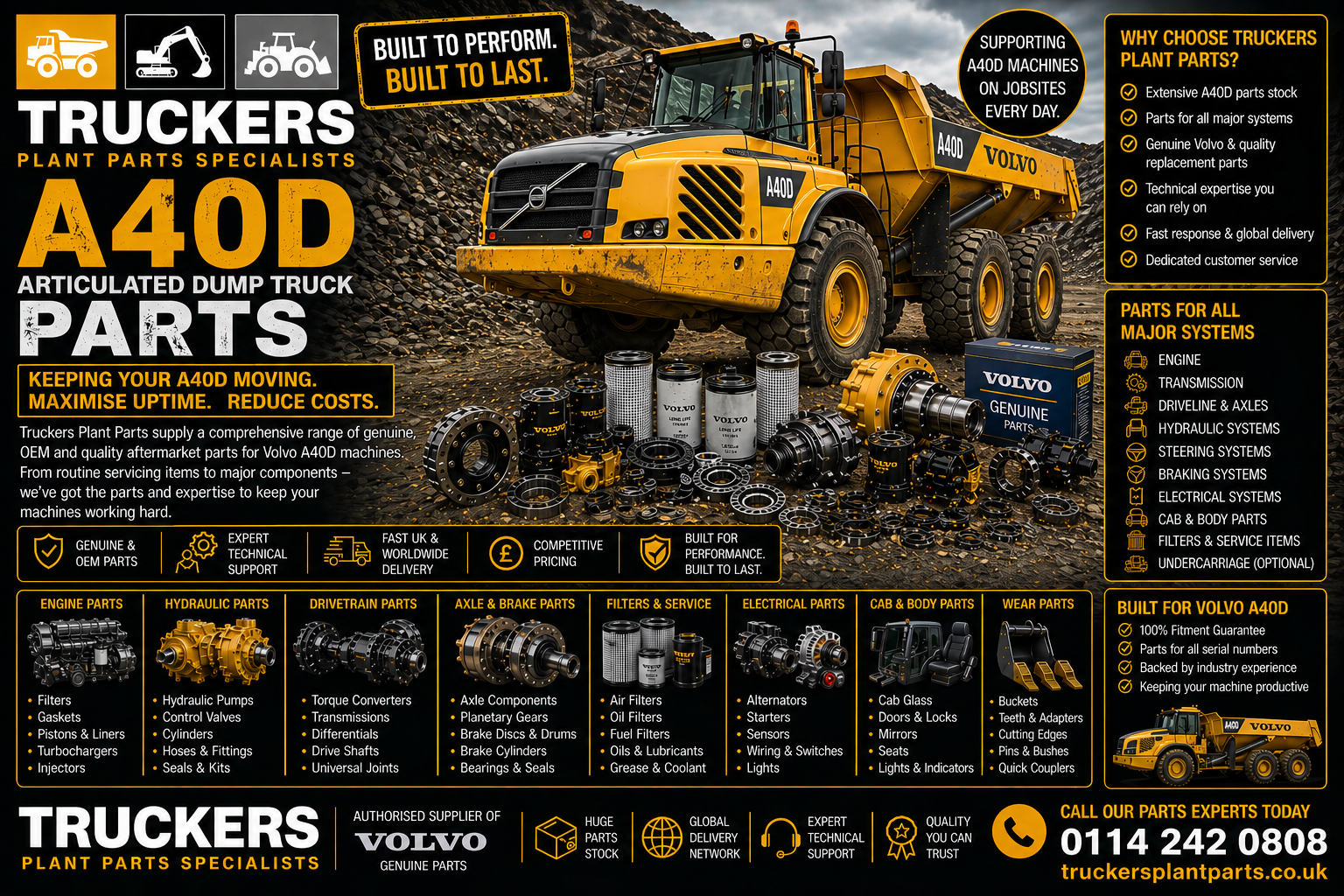
Volvo A40D Articulated Dump Truck – The Big D-Series Production Hauler Built For Serious Tonnage
The Volvo A40D articulated dump truck is one of the most important heavy production machines in Volvo’s D-Series hauler history. It sits above the A25D, A30D, and A35D as a larger, higher-output articulated dump truck designed for serious quarrying, bulk earthmoving, mining support, muck shifting, landfill, overburden removal, heavy civil engineering, infrastructure work, and demanding off-road material movement.
Where the A30D is often viewed as the practical all-rounder and the A35D as the step into heavier production, the A40D moves further into true high-volume hauling. It was built for operators who need more tonnes moved per cycle, more site output, and stronger production capability while still wanting the off-road traction, flexibility, and terrain confidence of a Volvo articulated hauler.
The A40D belongs to the respected Volvo D-Series generation, which many operators still associate with mechanical strength, practical servicing, proven durability, and reduced electronic complexity compared with later Volvo E, F, G, and H-Series machines. This matters because a truck of this size works hard. It is not a light-duty support machine. It is a front-line production asset, and when it stops, the cost of downtime can become significant very quickly.
The A40D is designed for applications where smaller ADTs may need too many cycles to keep up with production demands. In a busy quarry, a large muck shift, or a mining support operation, payload matters. Fewer cycles can mean lower operator hours, reduced traffic on haul roads, better excavator matching, and more efficient movement of material. The A40D gives operators that extra carrying capacity while still retaining articulated truck advantages over rough ground.
That said, the A40D is not always automatically the best answer simply because it is bigger.
This is the important trade-off.
The A40D can move more material per load than an A30D or A35D, but it also brings higher fuel use, larger tyre costs, greater driveline loading, more expensive components, more site space requirements, and greater demands on loading equipment. To get the best value from an A40D, the site must justify it. The haul roads, loading tools, material volume, ground conditions, and production targets all need to suit the truck.
When they do, the A40D can be excellent.
When they do not, a smaller A30D or A35D may actually produce better real-world value.
This is why the A40D is best understood as a production truck rather than a universal truck. It is a machine for serious material movement where the operator has enough work, enough space, and enough loading capacity to make use of its size.
Like all Volvo articulated haulers, the A40D’s core strength is its ability to work where rigid trucks struggle. Its articulated chassis, 6×6 driveline, off-road suspension design, strong traction systems, heavy-duty axles, and Volvo steering geometry allow it to continue hauling across terrain that would stop many conventional haulage machines.
This is where Volvo’s articulated hauler heritage matters.
Volvo has long been considered one of the benchmark manufacturers in articulated dump truck design. The company’s experience shows clearly in the A40D. The machine is large, but it is not crude. It is designed around traction, balance, stability, driveline protection, and real off-road control.
The A40D works across mud, loose aggregate, rough quarry haul roads, gradients, rutted ground, soft material, heavy overburden, wet clay, landfill conditions, and poor access routes. It gives operators the ability to move high volumes of material without requiring the same level of haul-road preparation demanded by rigid dump trucks.
That is one of the biggest reasons articulated haulers remain so valuable.
A rigid truck may be efficient on a well-maintained haul road, but it loses much of its advantage when ground conditions become difficult. The A40D gives a high-payload alternative that can still operate in changing site conditions.
The D-Series generation adds another layer of appeal.
Compared with later E, F, G, and H-Series machines, the A40D is generally less electronically complex. It still has electronic systems and machine controls, but it belongs to a generation where mechanical durability and practical repairability remained central. For many operators, this is a major advantage.
A newer A40G or A45G may offer better fuel efficiency, more refined transmission control, advanced telematics, improved operator interfaces, smarter traction systems, and stronger emissions compliance. Those advantages are real. But newer machines also cost more to buy, can be more complex to diagnose, and may require more specialist electronic support.
The A40D therefore remains attractive to operators who want serious payload capacity without fully stepping into the ownership profile of modern electronically intensive trucks.
The engine and driveline of the A40D were designed to deliver strong low-speed pulling power under load. In articulated hauling, torque and traction matter more than headline speed. The machine must pull heavy payloads away from loading areas, climb gradients, maintain traction through poor ground, and travel safely across rough terrain while loaded.
The transmission, axles, differentials, planetary hub systems, torque converter, prop shafts, and suspension components all work under heavy stress. Maintenance quality is therefore essential. An A40D can be highly reliable when properly maintained, but neglected examples can become expensive quickly because components in this size class are substantial.
Common A40D maintenance focus areas include engine servicing, transmission oil condition, axle oil condition, brake system health, hydraulic hoses, steering cylinders, articulation joint wear, cooling system cleanliness, suspension components, driveline seals, body pivots, dump cylinders, electrical connections, and tyre condition.
Tyres deserve special attention on the A40D because they represent a major ownership cost. Larger ADT tyres are expensive, and poor haul-road conditions, sharp rock, wheelspin, underinflation, overloads, and harsh operation can destroy tyre life quickly. A well-managed A40D fleet depends heavily on haul-road discipline and tyre management.
Fuel consumption is another major part of the ownership calculation.
The A40D will generally use more fuel than smaller A30D and A35D trucks, but that does not automatically make it less efficient. The real question is cost per tonne. If the A40D moves significantly more material per cycle and reduces the total number of cycles required, it may be more efficient overall on suitable jobs. If it is underloaded, poorly matched, or used on restricted sites, the extra fuel burn may not be justified.
This is why the A40D suits high-volume work.
It needs to be fed properly.
A large excavator or production wheel loader should be matched correctly so the truck is filled efficiently without excessive waiting time. If the loading machine is too small, the A40D may spend too long being loaded. If haul routes are too tight or soft for its weight, productivity suffers. If material volumes are inconsistent, the smaller A35D may be more flexible.
But on the right site, the A40D becomes a very serious production asset.
Compared with the A35D, the A40D offers higher payload and better output potential. It is better suited to bigger quarries, larger muck shifts, mining support work, and high-volume earthmoving. The A35D may be more versatile and cheaper to run, but the A40D can deliver stronger tonnage movement when conditions suit it.
Compared with the A30D, the A40D is a different class of machine. The A30D is usually the more flexible all-rounder with lower running costs and easier deployment across mixed jobs. The A40D is for operators who know they need heavier production and have the site setup to support it.
Compared with later A40E, A40F, and A40G models, the A40D is less refined and less fuel optimised, but it may be simpler, cheaper to buy, easier for some workshops to maintain, and more attractive to operators who value mechanical confidence over technology.
This is where the used-machine value equation becomes interesting.
A well-maintained A40D can be an excellent buy because it offers large payload capacity at a significantly lower capital cost than newer trucks. For operators with strong maintenance capability and reliable parts support, it can deliver serious earning power. However, condition is everything. A neglected A40D can quickly become expensive due to the scale of its components.
Buying an A40D should involve careful inspection of articulation play, driveline noise, transmission shifting, brake performance, tyre condition, hydraulic leaks, cooling system health, body wear, service history, axle condition, suspension wear, steering performance, and signs of frame stress.
Truckers Plant Parts support Volvo A40D articulated dump trucks with OEM, OEM-equivalent, rebuilt, and quality aftermarket parts covering engine systems, transmissions, axles, differentials, final drives, prop shafts, torque converters, hydraulic pumps, steering cylinders, dump cylinders, cooling systems, wet brake systems, articulation joints, suspension parts, cab components, electrical systems, filters, oils, service kits, body wear parts, pins, bushes, seals, hoses, and emergency VOR support.
That support is vital because many A40D trucks remain in productive use across the world. Operators continue running them because they are strong, proven, capable, and still commercially viable when maintained correctly.
The A40D is not just an old truck.
It is a serious production hauler from a generation of Volvo machines that many operators still trust deeply.
Its strength is the combination of large payload, D-Series durability, Volvo off-road traction, practical maintainability, and strong used-market value. Its weakness is that it needs the right job to justify its size. It is not as cheap to run as an A30D, not as versatile as an A35D, and not as technologically refined as a later G-Series truck. But when the site demands serious tonnes moved through difficult ground, the A40D remains a formidable machine.
For operators who understand the balance between payload, cost, condition, maintenance, and site suitability, the Volvo A40D can still make excellent commercial sense.
It is a big, capable, hard-working articulated hauler built for operators who need production without losing the rugged, practical Volvo D-Series character that made these machines so respected in the first place.
Volvo A40D Articulated Dump Truck FAQ
1. What is the Volvo A40D?
The Volvo A40D is a large articulated dump truck designed for quarrying, earthmoving, mining support, landfill, infrastructure, aggregates, and severe off-road hauling.
2. What type of machine is the A40D?
It is a 6×6 articulated dump truck, also known as an articulated hauler or ADT.
3. Where does the A40D sit in Volvo’s ADT range?
It sits above the A30D and A35D as a larger production hauler.
4. Why is the A40D important?
It gives operators higher payload capacity while retaining articulated off-road mobility.
5. What makes the A40D different from the A35D?
The A40D is larger, carries more material, and suits higher-production jobs, but usually costs more to run.
6. What makes the A40D different from the A30D?
The A30D is more flexible and cheaper to operate, while the A40D is built for heavier production.
7. Is the A40D a good quarry truck?
Yes. The A40D is well suited to quarry haulage where heavy payload and off-road traction are both required.
8. Is the A40D good for earthmoving?
Yes. It is very capable in bulk earthmoving and large muck shifting contracts.
9. Is the A40D suitable for landfill work?
Yes. Its articulated chassis and 6×6 drive make it useful in soft and unstable conditions.
10. What industries commonly use the A40D?
Quarrying, aggregates, construction, earthmoving, landfill, mining support, forestry, demolition, and civil engineering.
11. Why do operators choose the A40D?
They choose it for payload, Volvo reliability, off-road traction, and D-Series maintainability.
12. Is the A40D still used today?
Yes. Many A40D machines remain in active service worldwide.
13. Why are D-Series Volvo haulers respected?
They are known for durability, practical servicing, strong driveline systems, and reduced electronic complexity.
14. Does the A40D have 6×6 drive?
Yes. The A40D uses a 6×6 driveline for severe off-road traction.
15. Why is 6×6 drive important?
It helps maintain traction in mud, gradients, loose material, and poor haul-road conditions.
16. What does articulated mean?
The truck has a pivoting joint between the front and rear sections, allowing it to steer and flex across uneven terrain.
17. Why is articulation important?
It improves manoeuvrability, traction, and stability on rough ground.
18. Is the A40D better than a rigid truck?
It can be better on rough, soft, muddy, steep, or poorly prepared haul roads.
19. When is a rigid truck better?
A rigid truck may be better on smooth, well-maintained haul roads where maximum speed and payload efficiency matter.
20. What is the A40D’s biggest advantage?
Its ability to move heavy payloads across difficult terrain.
21. What is the A40D’s biggest trade-off?
Higher fuel, tyre, component, and maintenance costs compared with smaller ADTs.
22. Is bigger always better with ADTs?
No. The best truck depends on workload, haul distance, site conditions, loading equipment, and cost per tonne.
23. What does cost per tonne mean?
It means the total cost of moving each tonne of material.
24. Why is cost per tonne important?
A bigger truck only makes sense if it reduces the total cost of material movement.
25. Can the A40D be more efficient than smaller trucks?
Yes, if the site has enough volume and proper loading equipment.
26. Can the A35D be better value than the A40D?
Yes, if the A40D’s larger payload is not fully used.
27. Can the A30D be better value than the A40D?
Yes, on mixed, smaller, tighter, or lower-volume jobs.
28. What loading equipment suits the A40D?
Large excavators and production wheel loaders capable of filling it efficiently.
29. Why does loading match matter?
Poor loading match increases cycle time and reduces productivity.
30. Is the A40D suitable for tight sites?
It can work on many sites, but smaller ADTs are usually better in restricted areas.
31. Is the A40D suitable for long haul routes?
Yes, especially where higher payload reduces total cycle numbers.
32. Is the A40D good in mud?
Yes. Volvo articulated haulers are designed for difficult ground conditions.
33. Why are Volvo ADTs good off-road?
They combine articulation, 6×6 drive, strong traction systems, and balanced chassis design.
34. What are common A40D wear areas?
Tyres, brakes, articulation joints, hydraulic hoses, driveline components, suspension parts, and cooling systems.
35. Why are tyres a major cost on the A40D?
Large ADT tyres are expensive and exposed to severe terrain.
36. How can tyre life be improved?
Good haul roads, correct pressures, reduced wheelspin, smooth operation, and proper loading help protect tyres.
37. Does the A40D use more fuel than the A35D?
Generally yes, because it is larger and heavier.
38. Can the extra fuel be justified?
Yes, if the larger payload improves cost per tonne.
39. Why is fuel consumption important?
Fuel is one of the largest operating costs for articulated haulers.
40. What engine systems require maintenance?
Filters, oils, injectors, turbo systems, cooling systems, sensors, belts, and gaskets require attention.
41. What driveline parts commonly require support?
Transmissions, differentials, axles, prop shafts, torque converters, planetary hubs, bearings, and seals.
42. Why are driveline components heavily stressed?
They transfer power under heavy load across rough terrain.
43. What hydraulic parts commonly wear?
Hoses, cylinders, pumps, seals, valves, accumulators, and filters commonly wear.
44. What hydraulic systems are used on the A40D?
Steering, tipping, braking support, suspension-related functions, and machine systems use hydraulics.
45. Why are dump cylinders important?
They lift the loaded body during tipping.
46. What body parts wear on the A40D?
Body liners, pivots, hinges, tailgate parts, wear plates, and structural sections.
47. Why does the dump body wear?
Abrasive material, impact loading, and repeated tipping cycles wear the body.
48. Why are articulation joints important?
They control steering and chassis flexibility.
49. What articulation parts commonly wear?
Pins, bushes, bearings, seals, steering cylinders, and joint components.
50. What happens if articulation wear is ignored?
It can cause instability, steering problems, tyre wear, frame stress, and expensive repairs.
51. What brake parts may need support?
Wet brake components, valves, accumulators, lines, seals, discs, and cooling systems.
52. Why are brakes heavily stressed?
The truck carries heavy loads and often works on gradients.
53. What cooling parts are important?
Radiators, hydraulic coolers, oil coolers, hoses, thermostats, fan assemblies, and coolant systems.
54. Why are cooling systems critical?
Heavy hauling creates major heat loads across engine, transmission, brake, and hydraulic systems.
55. What happens if the A40D overheats?
Overheating can damage engines, transmissions, hydraulics, seals, and electrical systems.
56. What filters are used on the A40D?
Engine oil filters, fuel filters, air filters, hydraulic filters, transmission filters, and breathers.
57. Why are filters important?
Filters protect expensive systems from contamination.
58. What fluids are important?
Engine oil, hydraulic oil, transmission oil, axle oil, brake cooling oil, coolant, and grease.
59. Can poor oil maintenance damage the truck?
Yes. Poor lubrication can destroy major components.
60. What electrical parts may be required?
Sensors, switches, wiring, relays, lights, alternators, starters, gauges, and control components.
61. Is the A40D electronically complex?
It has electronics, but it is generally less electronically complex than later models.
62. Why do some operators prefer the A40D over newer trucks?
They value its simplicity, durability, and lower purchase cost.
63. How does the A40D compare with the A40E?
The A40E is more refined and more modern, while the A40D is simpler and often cheaper to own.
64. How does the A40D compare with the A40F?
The A40F offers better technology and efficiency, while the A40D may be more mechanically straightforward.
65. How does the A40D compare with the A40G?
The A40G is more advanced electronically and more fuel optimised, while the A40D remains valued for D-Series toughness.
66. Is the A40D a good used buy?
Yes, if it is well maintained and correctly priced.
67. What should buyers check on a used A40D?
Articulation play, tyres, brakes, driveline noise, transmission shifting, hydraulics, cooling system, body wear, and service history.
68. Why is service history important?
It helps prove whether the truck has been maintained properly.
69. What are signs of poor maintenance?
Leaks, overheating, poor shifting, worn tyres, excessive play, weak brakes, smoke, and unusual driveline noise.
70. Does the A40D have strong resale value?
Well-maintained examples can hold strong value due to demand for Volvo D-Series ADTs.
71. Why are Volvo D-Series trucks popular in export markets?
They are strong, practical, and widely understood by engineers.
72. Does Truckers Plant Parts support the A40D?
Yes. Truckers Plant Parts support Volvo A40D trucks extensively.
73. What A40D parts can Truckers supply?
Engines, transmissions, axles, hydraulics, brakes, cooling systems, articulation components, cab parts, electrical systems, filters, and service kits.
74. Can Truckers supply OEM A40D parts?
Yes. OEM parts may be supplied depending on availability.
75. Can Truckers supply aftermarket A40D parts?
Yes. OEM-equivalent and quality aftermarket options are available.
76. Can Truckers help with obsolete A40D parts?
Yes. Rare and difficult-to-source parts can often be located.
77. Does Truckers offer emergency VOR support?
Yes. Truckers can help source parts quickly when a machine is down.
78. What does VOR mean?
VOR means Vehicle Off Road, where a machine is out of operation and needs urgent repair.
79. Why is VOR expensive on an A40D?
A stopped A40D can reduce site production immediately.
80. Can Truckers offer same-day collection?
Yes. Stocked parts may be available for same-day collection.
81. Can Truckers offer next-day delivery?
Yes. Many parts can be supplied quickly depending on stock.
82. Can dedicated transport be arranged?
Yes. Urgent delivery can be arranged when downtime is critical.
83. Why is parts availability important?
The A40D only remains profitable if it can be repaired quickly when components fail.
84. Why is preventative maintenance important?
It reduces catastrophic failures and protects uptime.
85. What maintenance should be prioritised?
Fluids, filters, tyres, brakes, cooling systems, driveline components, articulation systems, and hydraulics.
86. Is the A40D suitable for high-hour work?
Yes, if maintained properly.
87. What is the main risk with high-hour A40D trucks?
Major driveline, brake, hydraulic, tyre, and articulation repair costs.
88. Why is condition more important than age?
A well-maintained older truck can outperform a neglected newer one.
89. What makes the A40D commercially attractive?
Large payload, lower purchase cost than newer trucks, strong Volvo reputation, and parts support.
90. What makes the A40D less suitable for some operators?
Its size, fuel use, tyre costs, and maintenance demands may be excessive for smaller jobs.
91. Is the A40D better than the A35D?
Only where the site needs and can use the extra payload.
92. Is the A35D more versatile?
Often yes. The A35D can be easier to deploy across varied sites.
93. Is the A30D more economical?
Generally yes, but it carries less payload.
94. Where does the A40D fit best?
Large quarries, heavy muck shifts, mining support, landfill, and high-volume earthmoving.
95. Why is fleet matching important?
The loading machine, haul road, truck size, and production target must work together.
96. What happens if an A40D is underused?
Its higher running costs may not be justified.
97. What makes the A40D a serious production truck?
Its payload, traction, driveline strength, and Volvo D-Series durability.
98. Why does the A40D still matter today?
It remains a capable high-output ADT with strong used-market appeal.
99. Why should operators use Truckers for A40D parts?
Truckers offer practical knowledge, OEM and aftermarket options, urgent sourcing, and support for older Volvo ADTs.
100. What best describes the Volvo A40D overall?
The Volvo A40D is a large, respected D-Series articulated dump truck built for serious production hauling, combining high payload capacity, strong off-road performance, practical maintainability, proven Volvo durability, and long-term commercial value when used on the right site.
A20, A25, A25B, A25C, A25D, A25E, A25F, A25G, A30, A30C, A30D, A30E, A30F, A30G, A35, A35C, A35D, A35E, A35F, A35G, A40, A40C, A40D, A40E, A40F, A40G, A45G, A60H, A25, A30, A35, A40, A45, A50, A60H, A30