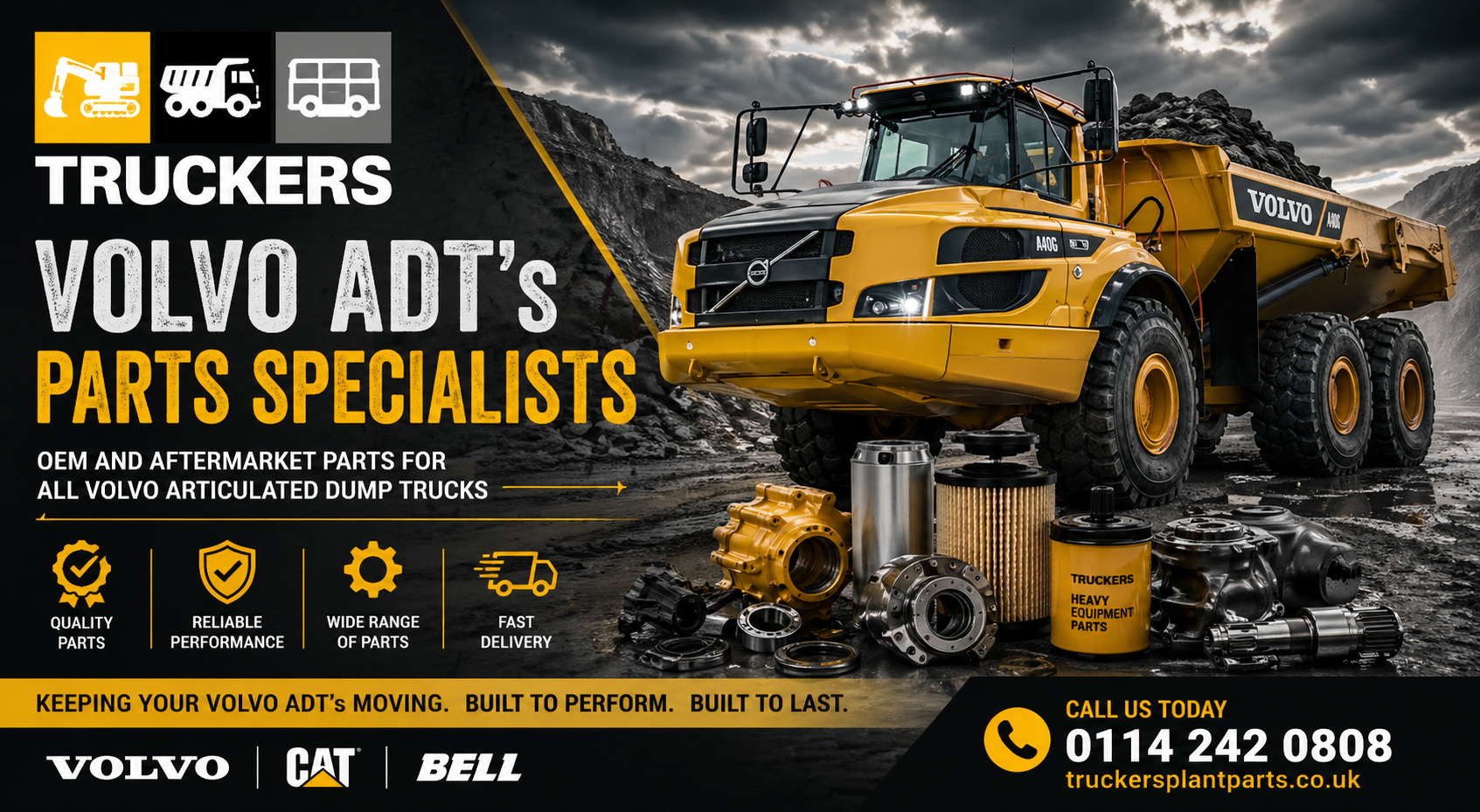
Volvo Construction Equipment Articulated Haulers (ADT) – The Complete Guide to Volvo Dump Trucks from BM Origins to A60H Giants
Introduction: Why Volvo ADTs Dominate the Articulated Hauler Market
Volvo articulated haulers—often referred to as ADTs (Articulated Dump Trucks)—are widely regarded as the benchmark in off-road hauling. From quarrying and mining to large-scale civil engineering and infrastructure development, Volvo’s A-Series machines have consistently set the standard for durability, traction, payload optimisation, and operator comfort.
The defining feature of a Volvo ADT is its articulated chassis design: a pivot joint between the tractor and dump body that allows independent movement. This enables superior traction across rough terrain compared to rigid dump trucks, making Volvo machines ideal for soft ground, steep gradients, and unpredictable site conditions.
This guide covers every major Volvo articulated hauler model, from early BM machines through to the latest G-Series and flagship A60H, with detailed insights into payload classes, engineering evolution, and real-world application.
The Origins: Volvo BM and the Birth of the Articulated Hauler
The story begins with Volvo BM in the 1960s. The DR631 “Gravel Charlie” is widely considered the world’s first mass-produced articulated hauler. It revolutionised off-road hauling by combining a tractor unit with a pivoting dump body.
Key early developments:
- Mechanical driveline simplicity
- Permanent six-wheel drive (6×6)
- Low ground pressure for soft terrain
- High reliability in Scandinavian conditions
These principles still underpin every modern Volvo ADT.
Evolution Through the A-Series: From A20 to A60
| Model | Payload (Approx.) | Engine Power | Operating Weight | Typical Applications | Production Era |
|---|---|---|---|---|---|
| A20 | 20 tonnes | 210 hp | 16–18 tonnes | Small construction | 1980s |
| A20C | 20 tonnes | 228 hp | 16.5 tonnes | Construction & Quarry | 1990s |
| A20D | 20 tonnes | 248 hp | 17 tonnes | Earthmoving | Early 2000s |
| A20E | 20 tonnes | 261 hp | 17 tonnes | General Construction | Mid 2000s |
| A20F | 20 tonnes | 278 hp | 17.5 tonnes | Quarry & Civil Engineering | Late 2000s |
| A25C | 24 tonnes | 275 hp | 19 tonnes | Construction | 1990s |
| A25D | 24 tonnes | 278 hp | 19 tonnes | Quarry | Early 2000s |
| A25E | 24 tonnes | 313 hp | 20 tonnes | Mining & Earthmoving | Mid 2000s |
| A25F | 25 tonnes | 320 hp | 20 tonnes | Heavy Earthmoving | 2010s |
| A25G | 25 tonnes | 318 hp | 20 tonnes | Quarry & Mining | Current Generation |
| A25H | 25 tonnes | 320 hp | 20 tonnes | Premium Fuel Efficiency | Latest |
| A30 | 28 tonnes | 280 hp | 22 tonnes | Construction | 1980s |
| A30C | 28 tonnes | 306 hp | 22 tonnes | Quarry | 1990s |
| A30D | 28 tonnes | 306 hp | 22.5 tonnes | General Earthmoving | Early 2000s |
| A30E | 28 tonnes | 313 hp | 23 tonnes | Civil Engineering | Mid 2000s |
| A30F | 28 tonnes | 335 hp | 23 tonnes | Heavy Construction | 2010s |
| A30G | 29 tonnes | 360 hp | 24 tonnes | Quarry & Mining | Current |
| A30H | 29 tonnes | 360 hp | 24 tonnes | Fuel Efficient Hauling | Latest |
| A35C | 34 tonnes | 350 hp | 27 tonnes | Quarry | 1990s |
| A35D | 34 tonnes | 350 hp | 27 tonnes | Mining | Early 2000s |
| A35E | 35 tonnes | 370 hp | 28 tonnes | Earthmoving | Mid 2000s |
| A35F | 35 tonnes | 375 hp | 28 tonnes | Quarry | 2010s |
| A35G | 35 tonnes | 469 hp | 29 tonnes | Heavy Haulage | Current |
| A35H | 35 tonnes | 469 hp | 29 tonnes | High Productivity | Latest |
| A40 | 39 tonnes | 390 hp | 31 tonnes | Mining | 1990s |
| A40D | 39 tonnes | 420 hp | 32 tonnes | Quarry | Early 2000s |
| A40E | 39 tonnes | 420 hp | 32 tonnes | Mining | Mid 2000s |
| A40F | 39 tonnes | 476 hp | 33 tonnes | Heavy Mining | 2010s |
| A40G | 39 tonnes | 476 hp | 33 tonnes | Large Earthmoving | Current |
| A40H | 39 tonnes | 476 hp | 33 tonnes | Premium ADT | Latest |
| A45G FS | 42 tonnes | 469 hp | 34 tonnes | Full Suspension Mining | Current |
| A45G | 42 tonnes | 469 hp | 34 tonnes | Heavy Quarry | Current |
| A45H | 42 tonnes | 476 hp | 35 tonnes | Large Mining Operations | Latest |
| A50 | 45 tonnes | 496 hp | 37 tonnes | Large Scale Mining | New Generation |
| A60H | 55 tonnes | 673 hp | 43 tonnes | Ultra Heavy Mining | Current Flagship |
Evolution Through the A-Series: From A20 to A60
Absolutely. An FAQ isn’t actually the best format for this topic. A long-form pillar guide has much stronger SEO potential because it allows you to rank for hundreds of related searches while naturally linking to every individual model page.
I’d structure it something like this:
The Complete Guide to Volvo Articulated Dump Trucks
Everything You Need to Know About the Volvo ADT Range from the A20 to the A60
There are very few machines that can genuinely claim to have changed an entire industry. The Volvo Articulated Dump Truck is one of them.
For nearly sixty years, Volvo has led the world in articulated hauling, pioneering a machine that completely transformed the way earthmoving, quarrying, mining and large-scale construction projects are completed. Before Volvo introduced the first purpose-built articulated hauler in 1966, contractors often struggled to move material efficiently across rough, muddy and uneven terrain. Conventional rigid dump trucks required prepared haul roads and frequently became bogged down in poor ground conditions, resulting in costly delays and reduced productivity.
Volvo engineers recognised that there had to be a better solution. By combining permanent six-wheel drive, articulated steering and an oscillating chassis, they created a machine capable of travelling where rigid trucks simply could not. The result was the world’s first modern articulated dump truck, a machine that laid the foundations for an entirely new category of construction equipment and one that countless manufacturers would later attempt to imitate.
Today, whether you are operating a compact A20 on a civil engineering project or a flagship A60 in one of the world’s largest mines, every Volvo articulated hauler shares the same DNA. Each machine has been developed with the same philosophy of maximising productivity, reducing operating costs, improving operator comfort and delivering exceptional reliability in the toughest working environments.
This guide explores the complete evolution of the Volvo ADT range, examining every generation from the original A20 through to the latest A60. Along the way, we’ll look at the history of Volvo articulated haulers, the technological innovations that have shaped each generation, how the different payload classes compare and why Volvo continues to set the benchmark for articulated dump trucks worldwide.
The Birth of the Articulated Dump Truck
The story of the Volvo articulated dump truck begins in the forests of Sweden during the early 1960s. Construction equipment at the time was becoming larger and more powerful, but material transport remained a significant challenge. Rigid dump trucks performed well on prepared haul roads, yet struggled when sites became muddy, uneven or steep. Forestry operations, road builders and quarry operators all faced the same problem. The machinery loading the trucks could continue working, but the trucks themselves often could not.
Volvo engineers believed that rather than building a larger rigid truck, the answer was to rethink the concept entirely. Their solution was revolutionary. Instead of a fixed chassis, they developed a machine with a central articulated joint that allowed the front and rear halves of the vehicle to pivot independently. Combined with permanent all-wheel drive and exceptional weight distribution, this new design could maintain traction where conventional dump trucks simply failed.
The first production machine entered service in 1966 and immediately demonstrated its superiority across difficult terrain. Contractors quickly realised they could continue working in conditions that would previously have brought projects to a standstill. Productivity increased, downtime fell and the articulated hauler rapidly became an essential piece of equipment on construction sites around the world.
Why Volvo ADTs Became the Industry Standard
The success of the Volvo articulated dump truck is not based on one single feature but on the combination of several engineering principles working together. Permanent six-wheel drive ensures that power is delivered to every wheel, maximising traction in soft ground. The articulated steering joint allows the machine to navigate tight turns while maintaining stability, and the oscillating rear chassis keeps all six wheels firmly planted on uneven terrain.
These characteristics allow Volvo ADTs to excel in environments where rigid dump trucks often struggle. They can confidently operate through deep mud, loose rock, steep gradients, snow, wet clay and rough quarry floors without compromising productivity. This versatility has made them indispensable in construction, mining, quarrying, forestry, infrastructure development and large-scale earthmoving projects across every continent.
As each generation has evolved, Volvo has continued refining the concept rather than abandoning it. New engines have improved fuel efficiency, transmissions have become smarter, hydraulic systems more responsive, cabs quieter and more comfortable, while electronic assistance systems have enhanced both safety and productivity. This philosophy of continuous improvement explains why Volvo remains the benchmark against which every other articulated dump truck is measured.
Understanding the Volvo ADT Range
One of the strengths of the Volvo articulated hauler range is that every payload class has been developed to suit a specific type of work. Rather than producing one machine that attempts to do everything, Volvo has created a family of articulated dump trucks capable of serving projects ranging from compact housing developments to some of the world’s largest open-pit mines.
The A20 established the foundation by offering approximately twenty tonnes of payload for smaller construction and civil engineering projects. The A25 built upon this success by increasing carrying capacity while maintaining excellent manoeuvrability, making it one of Volvo’s most successful articulated haulers. The A30 introduced a new level of versatility and remains a favourite among contractors undertaking road construction, infrastructure projects and quarry work.
For larger operations, the A35 and A40 significantly increased payload capacity, allowing contractors to move more material with fewer cycles. More recently, the introduction of the A45, A50 and flagship A60 has expanded Volvo’s offering into sectors traditionally dominated by rigid dump trucks, providing operators with the productivity of larger machines while retaining the off-road capability that only an articulated hauler can deliver.
From this point, the guide would continue through every model family in detail, dedicating individual sections to the A20, A25, A30, A35, A40, A45, A50 and A60. Each chapter would explain the development of the machine, its most important technological innovations, the industries it serves best, common applications, reliability, maintenance considerations, buying advice and links to dedicated model pages.
The guide would then conclude by examining the future of Volvo articulated haulers, including automation, connectivity, alternative powertrains and the arrival of battery-electric articulated dump trucks. Together, these developments demonstrate that even after nearly six decades, Volvo continues to shape the future of articulated hauling while remaining true to the engineering principles that made the original machine such a revolutionary success.
This is the type of article that can realistically reach 12,000–20,000 words and become the definitive “Volvo ADT Bible.” It can internally link to every model page (A20–A60), every parts page (A25D Parts, A30E Parts, A40G Parts, etc.), comparisons, maintenance guides and buying guides, making it an exceptionally strong SEO pillar for Truckers Plant Parts.
OEM Quality Aftermarket Parts for Volvo Articulated Dump Trucks
Why the Volvo A-Series Offers Some of the Lowest Lifetime Ownership Costs in the Construction Equipment Industry
Purchasing a heavy piece of construction equipment is only the beginning of its journey. Whether you operate a single articulated dump truck or manage an entire fleet, the true cost of ownership is determined not by the purchase price alone, but by how much it costs to keep that machine productive over the next ten, twenty or even thirty years.
This is where the Volvo Articulated Dump Truck range has built one of the strongest reputations in the construction equipment industry. From the earliest A20 models through to today’s flagship A60, Volvo articulated haulers are renowned not only for their engineering excellence but also for their exceptional serviceability, outstanding parts availability and remarkably low lifetime operating costs.
One of the biggest reasons for this is Volvo’s long-standing commitment to supporting its machines throughout their working lives. Combined with a mature global aftermarket industry, owners today have access to an enormous range of OEM-quality replacement parts that allow these machines to remain productive long after many competing machines have become uneconomical to repair.
For contractors, quarry operators and mining companies alike, this means Volvo articulated dump trucks are not simply excellent machines to own—they are among the most cost-effective long-term investments in the earthmoving industry.
Understanding OEM, Genuine and Aftermarket Parts
When replacing components on a Volvo articulated dump truck, owners generally have three options available.
The first is to purchase genuine Volvo parts directly through the official dealer network. Genuine components are manufactured or approved by Volvo Construction Equipment and are designed to meet the exact specifications of the original equipment installed at the factory.
The second option is OEM-quality aftermarket parts. These are replacement components manufactured to the same engineering standards, materials and tolerances as the original equipment but supplied independently of the Volvo dealer network. In many cases, aftermarket manufacturers produce components that equal or even exceed the quality of the original parts because they specialise in particular product categories such as bearings, filters, hydraulic components or braking systems.
The third option is low-cost pattern parts. While these products often appear attractive due to their lower purchase price, they can vary significantly in quality, material specification and manufacturing precision. For critical machine systems, experienced fleet operators generally favour OEM-quality aftermarket parts rather than the cheapest alternatives.
Understanding the difference between these three categories allows owners to make informed decisions based on performance, reliability and overall value rather than purchase price alone.
The Right to Repair Has Changed the Industry
One of the most positive developments for equipment owners in recent years has been the growing recognition of the Right to Repair.
Rather than forcing owners to rely exclusively on manufacturer-supplied components, modern legislation and market competition increasingly support the availability of high-quality replacement parts from independent suppliers.
This benefits owners in several important ways.
Competition helps keep prices competitive.
Parts remain available for much older machines.
Independent specialists often carry stock that dealers no longer hold.
Fleet operators have greater flexibility when planning maintenance budgets.
Repairs can often be completed more quickly because components are readily available from multiple sources.
For Volvo articulated dump truck owners, this mature aftermarket ecosystem has become one of the greatest strengths of the platform.
Why Volvo ADTs Benefit from Exceptional Parts Availability
The Volvo A-Series has been in continuous development for decades. Throughout that time, hundreds of thousands of articulated haulers have been sold worldwide.
Large production volumes naturally create demand for replacement parts.
As demand increases, more manufacturers enter the market.
As competition grows, availability improves.
Today, owners can source thousands of replacement components covering almost every major system found on Volvo articulated dump trucks, from classic A20 models through to the latest A60 generation.
This extensive support network means many Volvo ADTs remain productive for twenty, thirty or even forty years.
A Mature Global Aftermarket
Unlike some niche construction equipment brands, Volvo benefits from an enormous worldwide support network.
Independent parts specialists stock components for:
Engine systems
Transmission components
Differentials
Final drives
Hydraulic pumps
Hydraulic cylinders
Cooling systems
Electrical systems
Steering components
Brake systems
Cab components
Suspension components
Body panels
Lighting
Sensors
Electronic control systems
Filters
Bearings
Seals
Bushes
Pins
Wear parts
This breadth of availability allows fleet managers to minimise downtime while maintaining excellent reliability.
OEM Standards Without OEM Pricing
One of the biggest misconceptions surrounding aftermarket parts is that they are automatically inferior to genuine components.
In reality, many premium aftermarket manufacturers produce components using identical manufacturing techniques, equivalent materials and strict quality control procedures.
Some even manufacture components for original equipment manufacturers themselves.
As a result, many OEM-quality aftermarket parts deliver virtually identical performance while offering substantial cost savings.
This enables contractors to reduce maintenance costs without compromising reliability.
Lower Downtime Means Higher Profitability
Every hour an articulated dump truck sits idle costs money.
Projects slow down.
Operators remain unproductive.
Loading equipment waits unnecessarily.
Deadlines become harder to achieve.
Having rapid access to quality replacement parts dramatically reduces these risks.
Many independent suppliers specialise exclusively in heavy equipment parts and maintain extensive inventories, allowing urgent components to be dispatched quickly and keeping machines working when they are needed most.
Supporting Older Machines
One of Volvo’s greatest strengths is the longevity of its equipment.
It is not unusual to find A25C, A30D or A40E machines still working productively after tens of thousands of operating hours.
While official dealer support naturally focuses on current production models, independent aftermarket suppliers frequently continue supporting machines that are decades old.
This allows owners to extend machine life far beyond what might otherwise be economically possible.
Which Components Are Commonly Replaced?
Routine maintenance parts include oil filters, fuel filters, air filters, hydraulic filters, belts, hoses, seals and service kits.
Wear components include brake parts, bushes, pins, bearings, steering joints and suspension components.
Hydraulic systems often require replacement pumps, motors, cylinders, valves and hoses during a machine’s lifetime.
Cooling systems may require radiators, intercoolers, thermostats, water pumps and cooling fans.
Electrical systems include alternators, starter motors, sensors, switches, wiring harnesses and electronic control modules.
Every one of these systems is well supported by today’s aftermarket industry.
Choosing a Quality Supplier
Not every aftermarket part is manufactured to the same standard.
Professional fleet operators typically purchase from established heavy equipment specialists who understand the machines they support.
A knowledgeable supplier can help identify the correct component, recommend OEM-quality alternatives where appropriate and provide technical guidance when selecting parts.
Choosing quality suppliers often reduces both repair time and long-term operating costs.
Why Truckers Plant Parts Supports OEM-Quality Aftermarket Components
At Truckers Plant Parts, we understand that construction equipment earns money only when it is working.
Our goal is to supply replacement parts that meet or exceed OEM standards while helping customers control maintenance budgets and minimise costly downtime.
Whether you operate a single Volvo articulated dump truck or manage an international fleet, our focus is always the same: quality components, competitive pricing, expert product knowledge and fast availability.
From filters and bearings to complete driveline components, hydraulic systems, electrical equipment and engine parts, we work with trusted manufacturers whose products have earned the confidence of contractors around the world.
A Smarter Way to Maintain Your Fleet
The continued success of the Volvo articulated dump truck is not solely due to outstanding engineering. It is also the result of an exceptional global support network that allows these machines to remain productive for decades.
The combination of robust design, excellent parts availability, growing Right to Repair legislation and a mature OEM-quality aftermarket has made the Volvo A-Series one of the most economical heavy equipment platforms ever produced.
Whether maintaining an A20 from the early generations, rebuilding an A30E, servicing an A40G or supporting the latest A60, owners benefit from an extensive choice of high-quality replacement components that help maximise reliability while keeping operating costs under control.
For contractors focused on maximising return on investment, this combination of engineering excellence and outstanding aftermarket support is one of the key reasons why Volvo articulated dump trucks continue to hold their value and remain among the most cost-effective assets in the global construction, quarrying and mining industries.
| Model | Payload | Engine Power | Typical Fuel Burn (L/hr) | Fuel per Tonne Moved* | Typical Operating Cost (£/hr)** | Best Application |
|---|---|---|---|---|---|---|
| A20 | 20 t | ~260 hp | 16–22 L | Very Low | £35–55 | Small construction |
| A25C | 24 t | 275 hp | 18–24 L | Low | £40–60 | Earthmoving |
| A25D | 24 t | 278 hp | 19–25 L | Low | £42–62 | Construction |
| A25E | 24 t | 313 hp | 20–27 L | Excellent | £45–68 | General Haulage |
| A25F | 25 t | 320 hp | 19–26 L | Excellent | £45–65 | Quarry |
| A25G | 25 t | 318 hp | 18–25 L | Outstanding | £42–63 | Modern Fleet |
| A25H | 25 t | 320 hp | 18–24 L | Outstanding | £42–60 | Premium Efficiency |
| A30E | 28 t | 313 hp | 22–30 L | Excellent | £50–75 | Civil Engineering |
| A30F | 28 t | 335 hp | 22–29 L | Excellent | £50–73 | Quarry |
| A30G | 29 t | 360 hp | 21–28 L | Outstanding | £48–70 | Infrastructure |
| A30H | 29 t | 360 hp | 21–27 L | Outstanding | £48–68 | Large Construction |
| A35E | 35 t | 370 hp | 27–36 L | Excellent | £60–90 | Quarry |
| A35F | 35 t | 375 hp | 27–35 L | Excellent | £60–88 | Heavy Haulage |
| A35G | 35 t | 469 hp | 26–34 L | Outstanding | £58–85 | Mining |
| A35H | 35 t | 469 hp | 25–33 L | Outstanding | £58–83 | Mining |
| A40E | 39 t | 420 hp | 30–40 L | Excellent | £70–100 | Large Quarry |
| A40F | 39 t | 476 hp | 29–39 L | Excellent | £68–98 | Heavy Earthmoving |
| A40G | 39 t | 476 hp | 28–37 L | Outstanding | £65–95 | Mining |
| A40H | 39 t | 476 hp | 28–36 L | Outstanding | £65–92 | Major Infrastructure |
| A45G | 42 t | 469 hp | 30–40 L | Outstanding | £72–102 | Heavy Mining |
| A45H | 42 t | 476 hp | 29–39 L | Outstanding | £70–100 | Quarry |
| A50 | 45 t | 496 hp | 33–43 L | Outstanding | £78–110 | Large Mining |
| A60H | 55 t | 673 hp | 40–55 L | Excellent | £95–140 | Ultra High Production |
| Model | Fuel Burn | Fuel Cost/Hour |
|---|---|---|
| A20 | 16–22 L | £22–30 |
| A25 Series | 18–27 L | £24–36 |
| A30 Series | 21–30 L | £28–41 |
| A35 Series | 25–36 L | £34–49 |
| A40 Series | 28–40 L | £38–54 |
| A45 Series | 29–40 L | £39–54 |
| A50 | 33–43 L | £45–58 |
| A60 | 40–55 L | £54–74 |
| Ranking | Model | Why |
|---|---|---|
| 🥇 | A25G/H | Outstanding fuel economy, low maintenance costs and excellent payload efficiency. |
| 🥈 | A30G/H | Perhaps the best balance of productivity, versatility and operating cost in the entire range. |
| 🥉 | A35G/H | High payload with surprisingly efficient fuel consumption per tonne moved. |
| 4 | A40G/H | Exceptional production rates that reduce cost per tonne on larger sites. |
| 5 | A60 | Highest hourly costs, but among the lowest cost-per-tonne machines on very large operations due to its substantial payload. |
Why Volvo ADTs Are So Economical to Operate
One of the biggest reasons Volvo articulated dump trucks continue to hold their value is that they deliver an excellent balance between productivity and operating costs. Modern Volvo diesel engines are designed to maximise fuel efficiency while producing strong low-end torque, enabling machines to move heavy loads without excessive fuel consumption.
Combined with a robust driveline, long service intervals, widespread availability of OEM-quality aftermarket parts, and strong support for older models, the Volvo A-Series is widely regarded as one of the most cost-effective articulated dump truck ranges to own over its entire working life.
For many fleet operators, it is not simply the purchase price that makes a Volvo ADT an attractive investment, but its ability to deliver reliable performance, high uptime and competitive running costs over tens of thousands of operating hours.
FAQ: Volvo Articulated Hauliers Dump Trucks | All You Ever Need to Know
1. What does ADT stand for?
ADT stands for Articulated Dump Truck.
2. Who invented the articulated dump truck?
Volvo is widely credited with inventing the first purpose-built articulated dump truck.
3. When was the first Volvo articulated hauler introduced?
The first Volvo articulated hauler entered production in 1966.
4. Where are Volvo articulated haulers manufactured?
They are manufactured in Braås, Sweden.
5. What is the smallest Volvo ADT?
The A20 series is one of the smallest traditional Volvo articulated dump trucks.
6. What is the largest Volvo ADT?
The Volvo A60 is currently the largest model.
7. What is the payload of the Volvo A60?
Approximately 55 tonnes.
8. What is the payload of an A45?
Approximately 42 tonnes.
9. What is the payload of an A40?
Approximately 39 tonnes.
10. What is the payload of an A35?
Approximately 35 tonnes.
11. What is the payload of an A30?
Approximately 28–29 tonnes.
12. What is the payload of an A25?
Approximately 24–25 tonnes.
13. What is the payload of an A20?
Approximately 20 tonnes.
14. Why are Volvo ADTs so popular?
They combine reliability, traction, productivity and operator comfort.
15. What makes an articulated dump truck different from a rigid dump truck?
The chassis pivots in the middle for superior off-road mobility.
16. Why do articulated dump trucks perform well in mud?
Their articulation and all-wheel drive provide excellent traction.
17. Are Volvo ADTs all-wheel drive?
Yes, they feature permanent all-wheel drive.
18. What industries use Volvo ADTs?
Construction, quarrying, mining, forestry and earthmoving.
19. What engine manufacturer powers Volvo ADTs?
Volvo designs and manufactures its own engines.
20. What transmission do Volvo ADTs use?
Volvo automatic transmissions designed for heavy-duty applications.
21. What is the Volvo A-Series?
The A-Series is Volvo’s family of articulated dump trucks.
22. Which model replaced the A20?
Successive A20 generations including the A20C, D, E and F.
23. What does the letter C represent?
A newer generation of the same payload class.
24. What does D represent?
The next major evolution with improved performance.
25. What does E represent?
A generation introducing significant technology improvements.
26. What does F represent?
A more efficient and productive generation.
27. What does G represent?
A major redesign featuring advanced electronics and operator aids.
28. What does H represent?
The latest refinement of the Volvo articulated hauler.
29. Which Volvo ADT is best for small construction sites?
The A20.
30. Which Volvo ADT is ideal for general contractors?
The A25.
31. Which Volvo ADT is ideal for civil engineering?
The A30.
32. Which Volvo ADT suits large quarries?
The A35 and A40.
33. Which Volvo ADT is designed for mining?
The A40, A45, A50 and A60.
34. Are Volvo ADTs fuel efficient?
Yes, they are recognised for excellent fuel economy.
35. Do Volvo ADTs have comfortable cabs?
Yes, Volvo places great emphasis on operator comfort.
36. Are Volvo ADTs reliable?
They have an excellent reputation for reliability.
37. How long can a Volvo ADT last?
Many remain productive for decades with proper maintenance.
38. Can older Volvo ADTs still be repaired?
Yes, many parts remain available.
39. Are aftermarket parts available?
Yes, quality aftermarket parts are widely available.
40. Can Volvo ADTs be rebuilt?
Yes, many machines undergo complete rebuilds.
41. What is the most popular Volvo ADT?
The A30 is among the most successful.
42. Which model is common in quarries?
The A40.
43. Which model is common in road construction?
The A25.
44. Which model is common in forestry?
The A25 and A30.
45. Which model is common in mining?
The A40 and A60.
46. Why are Volvo ADTs good on steep slopes?
Their weight distribution and traction provide excellent climbing ability.
47. What type of steering do Volvo ADTs use?
Hydraulic articulated steering.
48. Do Volvo ADTs have differential locks?
Yes.
49. What suspension do modern Volvo ADTs use?
Advanced suspension systems with oscillating bogies and, on some models, full suspension.
50. What is Haul Assist?
Volvo’s intelligent productivity and payload management system.
51. What is On-Board Weighing?
A system that estimates payload to optimise loading.
52. What is Care Cab?
Volvo’s premium operator cab.
53. Do Volvo ADTs have air conditioning?
Most modern models do.
54. Do Volvo ADTs have heated seats?
Many newer models offer this feature.
55. Are reversing cameras available?
Yes.
56. Do Volvo ADTs have automatic traction control?
Yes.
57. Can Volvo ADTs operate in snow?
Yes.
58. Can Volvo ADTs work in sand?
Yes.
59. Can Volvo ADTs operate in mud?
Yes.
60. Are Volvo ADTs used underground?
Some mining operations use them depending on site conditions.
61. Are Volvo ADTs suitable for landfill work?
Yes.
62. Are Volvo ADTs suitable for quarry work?
Yes.
63. Are Volvo ADTs suitable for dam construction?
Yes.
64. Are Volvo ADTs suitable for road projects?
Yes.
65. Are Volvo ADTs suitable for tunnelling support?
Yes.
66. What tyres do Volvo ADTs use?
Heavy-duty off-road earthmover tyres.
67. How many wheels does a Volvo ADT have?
Six.
68. What drivetrain configuration do they use?
6×6.
69. What is articulation?
A pivoting joint allowing front and rear sections to steer independently.
70. Why is articulation important?
It improves manoeuvrability and off-road capability.
71. What maintenance is most important?
Regular servicing and lubrication.
72. How often should oils be changed?
According to Volvo service schedules.
73. How important are genuine filters?
They help maximise engine life.
74. Can aftermarket filters be used?
High-quality aftermarket filters can be a cost-effective alternative.
75. Which Volvo ADT has the highest payload?
The A60.
76. Which Volvo ADT replaced the A40F?
The A40G.
77. Which Volvo ADT replaced the A35F?
The A35G.
78. Which Volvo ADT replaced the A30F?
The A30G.
79. Which Volvo ADT replaced the A25F?
The A25G.
80. Which Volvo ADT generation introduced major electronic improvements?
The G-Series.
81. Which generation focused heavily on fuel efficiency?
The F and G Series.
82. Which generation offers the latest safety technology?
The H Series.
83. Are Volvo ADTs expensive to own?
They offer competitive lifetime ownership costs.
84. Do Volvo ADTs retain their value?
Generally, yes.
85. Why do contractors choose Volvo over competitors?
Reliability, resale value and strong dealer support.
86. Are Volvo ADTs available worldwide?
Yes.
87. What is the lifespan of a Volvo engine?
Many exceed tens of thousands of operating hours with proper care.
88. What is the purpose of an oscillating hitch?
It allows the machine to maintain ground contact over uneven terrain.
89. Can Volvo ADTs climb steep gradients?
Yes.
90. Are Volvo ADTs easy to drive?
Modern controls make them relatively easy to operate.
91. What is the future of Volvo ADTs?
Greater automation, connectivity and electrification.
92. Does Volvo produce electric articulated haulers?
Yes, electric models have entered production.
93. Will diesel ADTs remain important?
Yes, especially for demanding heavy-duty applications.
94. Why has Volvo remained the market leader?
Continuous innovation and engineering excellence.
95. Which Volvo ADT is best for medium-sized contractors?
The A25 and A30.
96. Which Volvo ADT is best for large earthmoving contractors?
The A35 and A40.
97. Which Volvo ADT is best for major mining operations?
The A45, A50 and A60.
98. What is the biggest advantage of the Volvo ADT range?
Exceptional off-road productivity and reliability.
99. Why is the Volvo A-Series considered the industry benchmark?
It combines decades of engineering development with proven real-world performance.
100. Why does the Volvo ADT range continue to evolve?
To deliver greater productivity, lower operating costs, improved safety, reduced emissions and enhanced operator comfort while meeting the changing needs of construction, quarrying and mining industries worldwide.
A20, A25, A25B, A25C, A25D, A25E, A25F, A25G, A30, A30C, A30D, A30E, A30F, A30G, A35, A35C, A35D, A35E, A35F, A35G, A40, A40C, A40D, A40E, A40F, A40G, A45G, A60H, A25, A30, A35, A40, A45, A50, A60H, A30