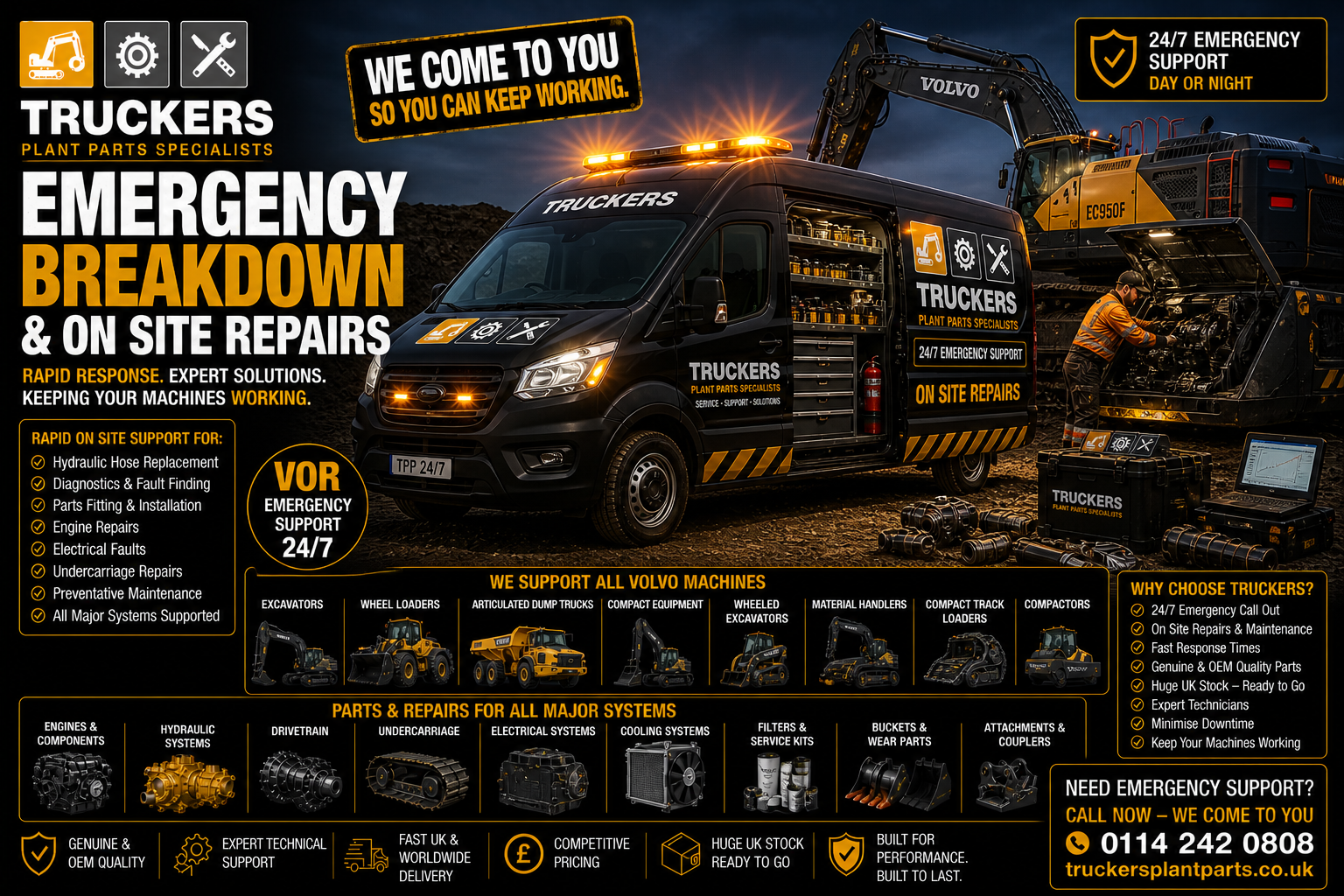
Heavy Machinery Repairs When Critical Equipment Fails: Emergency Breakdown Support When Production Cannot Stop
In heavy industry, there is a major difference between planned maintenance and real-world emergency breakdown situations. Preventative servicing, scheduled inspections, fluid analysis, filter replacement, wear monitoring, and proactive maintenance programs dramatically reduce the risk of catastrophic machinery failure, but no machine is completely immune from unexpected breakdowns forever.
Every component inside heavy machinery has a lifecycle.
No matter how well a Volvo articulated dump truck is maintained, bearings eventually wear. Hydraulic pumps eventually fatigue. Cooling systems eventually deteriorate. Final drives eventually reach operational limits. Electronic systems eventually fail. Hoses age. Wiring degrades. Seals harden. Gearboxes absorb years of torque stress. Pins and bushes wear under constant load. Engines accumulate thousands upon thousands of operating hours under severe-duty conditions.
Even the strongest Caterpillar wheel loader, Komatsu excavator, Bell articulated hauler, Liebherr material handler, Terex crusher support machine, or FUCHS scrap handler can eventually experience sudden failure without warning.
And when those failures happen on critical front-line machinery, everything changes instantly.
Production stops.
Haul cycles collapse.
Loading operations freeze.
Crushers stop feeding.
Contracts become threatened.
Operators stand idle.
Transport schedules become disrupted.
Deadlines move closer.
Penalty clauses begin looming.
Entire operational chains can suddenly grind to a halt because one critical machine is no longer moving.
This is where emergency heavy machinery repair support becomes absolutely essential.
When critical infrastructure stops unexpectedly, time is literally money.
The financial consequences of major heavy equipment downtime escalate incredibly fast within quarrying, earthmoving, demolition, mining support, recycling, construction, ports, and industrial handling sectors. Many modern operations depend entirely on continuous machine movement to maintain production output. One failed excavator may immobilise multiple articulated dump trucks. One failed wheel loader can stop an entire crushing operation. One broken material handler can halt scrap processing throughput. One transmission failure on a production-critical articulated dump truck can immediately affect entire haulage schedules.
In these situations, operators do not need generic answers.
They need rapid action.
They need technical understanding.
They need accurate diagnostics.
They need access to experienced engineers.
They need reliable parts sourcing.
They need immediate planning.
Most importantly, they need machinery returned to work as quickly and safely as possible.
This is exactly where Truckers Plant Parts operates most effectively.
While preventative maintenance remains critically important, Truckers fully understands the reality of heavy industry: eventually, machines break.
And when they do, response speed becomes everything.
The difference between a well-managed emergency repair and a poorly managed breakdown situation can easily mean the difference between minor operational disruption and devastating financial loss.
That is why Truckers approaches emergency heavy machinery breakdown support with urgency from the very first phone call.
The moment critical equipment fails, the focus immediately shifts toward rapid inspection, fault identification, repair planning, parts availability, labour coordination, transport logistics, and minimising operational downtime as aggressively as possible.
Sometimes the failure is relatively straightforward.
A hydraulic hose failure on a Volvo EC220 excavator.
A starter motor failure on a Caterpillar wheel loader.
A cooling system leak on a Bell articulated dump truck.
A damaged slew motor on a Komatsu excavator.
An electrical fault immobilising a Liebherr material handler.
A failed steering cylinder on a Volvo articulated hauler.
These failures still require urgent response because downtime costs money every minute, but they are generally manageable with rapid diagnosis and correct parts availability.
Other failures become significantly more serious.
Transmission failures.
Final drive collapses.
Hydraulic pump destruction.
Engine seizure.
Differential failures.
Articulation damage.
Turbocharger failures.
Major cooling system catastrophes.
Undercarriage collapses.
ECU failures.
Brake system failures.
Axle damage.
Structural cracking.
These situations demand a far more technical and coordinated repair approach.
This is where decades of real-world heavy machinery industry experience become critically valuable.
Truckers Plant Parts understands that emergency repairs are rarely just about supplying a part number.
They are about understanding the machine, understanding the operating environment, understanding the urgency, understanding likely secondary damage risks, understanding labour requirements, understanding repair sequencing, and understanding how to return production-critical equipment back into operation as quickly as realistically possible.
That often means acting immediately.
Inspection and fault diagnosis become the first priority.
Rapid assessment allows operators to understand the scale of failure properly rather than wasting valuable time guessing at potential causes. In many situations, early diagnosis also prevents further damage from occurring through continued operation or incorrect repair attempts.
Once the fault is understood properly, the next step becomes building a clear repair strategy.
This may involve immediate parts sourcing from existing stock, dedicated transport arrangements, workshop coordination, field-service support, specialist engineering support, recovery planning, machining services, hydraulic rebuilding, driveline rebuilds, or complete component replacement depending on the severity of the breakdown.
Truckers can either attend directly or recommend experienced specialist engineers and field-service professionals capable of handling even the most technically demanding site emergencies.
This matters enormously because modern heavy machinery has become increasingly specialised.
Repairing a Volvo A60H articulated hauler driveline issue requires a very different skillset compared with diagnosing advanced electro-hydraulic faults on a modern Liebherr material handler or rebuilding final drives on a Caterpillar wheel loader operating within quarry conditions.
Different failures require different expertise.
Truckers understands this and works closely with trusted specialists capable of supporting severe-duty heavy equipment across multiple manufacturers and machinery categories.
One of the biggest advantages Truckers brings to emergency breakdown situations is parts sourcing capability.
In many emergency repair situations, the greatest delay is not labour.
It is parts availability.
A machine may be repairable quickly, but if critical components are unavailable for several days or weeks, downtime costs escalate dramatically.
This is where Truckers’ stockholding capability and sourcing network become extremely valuable.
Massive stock availability across Volvo, Caterpillar, Komatsu, Bell, Liebherr, Terex, FUCHS, and many other manufacturers allows many emergency repairs to begin immediately without waiting for slow supply chains. Same-day collection, next-day delivery, dedicated transport, and urgent emergency dispatch options allow critical components to reach site quickly when every hour matters.
For obsolete, specialist, or difficult-to-source components, Truckers leverages extensive international sourcing networks developed through decades within the heavy equipment industry.
This becomes particularly important for older machinery where traditional dealer support may no longer exist properly.
Many fleets still operate older but highly productive machines because they remain economically viable and operationally effective. However, when older equipment fails unexpectedly, locating rare or obsolete parts can become extremely difficult without specialist sourcing experience.
Truckers actively encourages operators to challenge the team with difficult breakdown situations.
Rare transmission components.
Obsolete electronic systems.
Hard-to-find driveline assemblies.
Discontinued hydraulic systems.
Legacy axle components.
Specialist material handler systems.
Unusual quarry machinery components.
Complex cooling assemblies.
Older generation ECU systems.
These situations require far more than generic catalogue supply.
They require heavy equipment knowledge.
One of the most important aspects of emergency machinery repair is understanding the true cost of downtime.
Many operators initially focus only on repair invoices themselves.
In reality, secondary operational losses are often far larger.
Idle labour.
Stopped production.
Missed contracts.
Delayed transport.
Crusher downtime.
Haulage interruption.
Penalty clauses.
Lost processing time.
Equipment rental requirements.
Emergency subcontracting.
Fuel inefficiencies.
Recovery costs.
Project delays.
Customer dissatisfaction.
The total financial impact of critical machinery failure can escalate into enormous sums very quickly.
This is exactly why rapid response matters so much.
Truckers therefore focuses heavily on urgency, communication, realistic planning, and practical solutions designed around restoring operational continuity as fast as possible.
Competitive hourly rates remain important too.
Heavy machinery repairs can become extremely expensive, especially during severe breakdown situations involving major driveline rebuilds, engine failures, hydraulic contamination, or structural repairs. Truckers therefore works hard to ensure customers receive access to skilled repair capability at competitive rates while still maintaining high-quality workmanship and dependable parts support.
Because ultimately, emergency breakdown situations are already stressful enough without operators worrying about unreliable support or poor-quality components creating further problems later.
Quality matters enormously during emergency repairs.
A failed aftermarket hydraulic hose contaminating an entire system.
A low-quality bearing destroying a rebuilt final drive.
Inferior seals causing repeated leaks.
Poor-quality electrical components causing recurring faults.
Incorrect cooling parts creating overheating problems.
These shortcuts often create much larger problems later.
Truckers therefore focuses heavily on supplying dependable OEM, OEM-equivalent, and proven aftermarket solutions capable of surviving real-world heavy-duty operation properly.
When critical machinery fails, operators need confidence that repairs will last.
The reality of heavy industry is simple.
Machines fail.
Unexpected breakdowns happen.
Even the best preventative maintenance program cannot eliminate every possible failure forever.
But what truly matters is how quickly, intelligently, and effectively those failures are managed once they happen.
That is where experience matters.
That is where industry knowledge matters.
That is where rapid parts sourcing matters.
That is where trusted engineering support matters.
And that is exactly where Truckers Plant Parts continues building its reputation every day.
Because when production-critical machinery stops unexpectedly, the clock starts immediately.
And in heavy industry, every minute counts.
FAQ: Critical Equipment Breakdowns, Emergency Site Support & Keeping Production Moving
1. Why are emergency heavy machinery repairs so important?
Because when critical machinery stops unexpectedly, production, transport, loading operations, and site productivity can stop immediately.
2. Can even well-maintained machinery still fail unexpectedly?
Yes. Every component has a lifecycle and unexpected failures can still occur despite excellent maintenance.
3. Why do machine components eventually fail?
Continuous stress, vibration, heat, contamination, fatigue, wear, pressure, and operating hours eventually affect all components.
4. What industries are most affected by machinery downtime?
Quarrying, mining, earthmoving, demolition, recycling, ports, construction, waste handling, forestry, and infrastructure industries are heavily affected.
5. Why does downtime cost so much money?
Downtime affects production output, labour efficiency, project deadlines, transport schedules, and operational profitability.
6. What happens when a front-line machine fails?
Haul cycles stop, excavators stop digging, crushers stop feeding, operators stand idle, and production can slow or stop entirely.
7. Why is response speed critical during breakdowns?
Every hour of downtime can increase financial losses significantly.
8. What should operators do immediately after a critical machine failure?
Contact experienced heavy machinery repair specialists immediately for inspection and planning.
9. Why is rapid inspection important?
Rapid inspection identifies the fault quickly and prevents wasted time or incorrect repairs.
10. Why are accurate diagnostics important?
Correct diagnosis prevents unnecessary parts replacement and secondary damage.
11. Can continuing to operate damaged machinery make failures worse?
Yes. Continued operation can turn minor issues into catastrophic failures.
12. What is considered a catastrophic machine failure?
Major failures involving engines, transmissions, hydraulics, final drives, brakes, or structural systems are considered catastrophic.
13. What are common emergency heavy equipment failures?
Hydraulic failures, transmission failures, engine problems, electrical faults, cooling system failures, final drive failures, and articulation damage are common.
14. What hydraulic failures commonly occur?
Burst hoses, failed pumps, leaking cylinders, damaged valves, and hydraulic contamination are common.
15. Why are hydraulic failures dangerous?
Hydraulic failures can immobilise machines and contaminate entire systems.
16. What transmission failures commonly occur?
Gear failures, torque converter damage, clutch failures, overheating, and driveline damage commonly occur.
17. Why are transmission failures serious?
Heavy equipment transmissions operate under enormous stress continuously.
18. What final drive failures commonly occur?
Bearing collapse, planetary gear damage, seal failures, contamination, and overheating are common.
19. Why are final drives critical?
Final drives transfer massive torque loads to wheels or tracks.
20. What engine failures commonly occur?
Injector failures, turbocharger damage, overheating, bearing wear, coolant contamination, and complete engine seizure can occur.
21. What electrical faults commonly immobilise machinery?
ECU failures, wiring faults, sensor failures, battery problems, alternator failures, and communication faults commonly stop machines.
22. Why are electrical systems increasingly important?
Modern heavy machinery relies heavily on electronically controlled systems.
23. What cooling system failures commonly occur?
Radiator leaks, blocked cooling cores, fan failures, coolant loss, hose bursts, and overheating issues are common.
24. Why is overheating dangerous?
Overheating can rapidly destroy engines, hydraulics, seals, and electronic systems.
25. What articulation failures can occur on articulated dump trucks?
Pins, bushes, steering cylinders, bearings, and chassis pivot systems can wear or fail.
26. Why are articulation systems so important?
Articulation controls steering and chassis flexibility on articulated machinery.
27. What undercarriage failures commonly occur?
Track damage, roller failures, sprocket wear, recoil failures, and chain problems commonly occur.
28. Why do emergency repairs require specialist knowledge?
Different machinery systems and manufacturers require specific technical expertise.
29. Can Truckers attend emergency breakdowns directly?
Yes. Truckers can attend directly or recommend experienced specialist repair engineers.
30. Does Truckers support 24/7 emergency situations?
Yes. Emergency breakdown situations can be supported around the clock depending on requirements.
31. Why is heavy equipment experience important during emergencies?
Correct diagnosis and repair planning reduce downtime and secondary damage.
32. Does Truckers support Volvo machinery repairs?
Yes. Volvo articulated haulers, excavators, wheel loaders, and heavy equipment are heavily supported.
33. Does Truckers support Caterpillar machinery repairs?
Yes. Caterpillar excavators, loaders, articulated trucks, and heavy machinery are supported.
34. Does Truckers support Komatsu machinery repairs?
Yes. Komatsu excavators, dozers, loaders, and articulated machinery are supported.
35. Does Truckers support Bell Equipment repairs?
Yes. Bell articulated dump trucks and support machinery are supported.
36. Does Truckers support Liebherr machinery repairs?
Yes. Liebherr material handlers, excavators, and industrial machinery are supported.
37. Does Truckers support Terex machinery repairs?
Yes. Terex articulated haulers and heavy equipment are supported.
38. Does Truckers support FUCHS machinery repairs?
Yes. FUCHS material handlers and scrap handling equipment are supported.
39. Why are quarry breakdowns especially serious?
Quarry production relies heavily on continuous material movement.
40. What happens if a wheel loader fails at a crusher?
Crusher feed operations may stop completely.
41. What happens if an articulated dump truck fails?
Haulage productivity and transport cycles are disrupted immediately.
42. What happens if an excavator fails?
Digging, loading, trenching, and production operations may stop.
43. Why are material handlers critical in recycling operations?
Material handlers control continuous scrap and waste processing flow.
44. Why are emergency repair plans important?
Clear planning reduces confusion and speeds up recovery operations.
45. What does a repair plan usually include?
Inspection, diagnosis, parts sourcing, labour coordination, transport logistics, and repair scheduling.
46. Why are parts availability critical during emergencies?
Repair speed often depends entirely on how quickly parts can be obtained.
47. Does Truckers hold large parts stock?
Yes. Large stockholding capability allows many emergency repairs to begin immediately.
48. Can parts be collected same day?
Yes. Many stocked components are available immediately.
49. Does Truckers offer next-day delivery?
Yes. Rapid next-day delivery is available for many components.
50. Can Truckers arrange dedicated emergency transport?
Yes. Dedicated same-day transport can be arranged for urgent VOR situations.
51. What does VOR mean?
Vehicle Off Road or machine downtime requiring urgent attention.
52. Why is VOR response important?
Downtime costs can escalate extremely quickly during production stoppages.
53. Does Truckers source obsolete parts during emergencies?
Yes. Obsolete and hard-to-find parts sourcing is a major speciality.
54. Why are obsolete parts difficult to locate?
Older machines may no longer have official dealer support or active stock availability.
55. Can Truckers source parts internationally?
Yes. International sourcing networks are used extensively for difficult parts.
56. Why are older machines still widely used?
Many older machines remain productive, durable, and economically viable.
57. Why do operators keep older heavy machinery?
Older machinery can still offer excellent value and productivity.
58. Can Truckers locate rare components others cannot?
Yes. Difficult sourcing situations are one of Truckers’ strongest areas.
59. What types of difficult parts can be sourced?
Rare transmissions, obsolete electronics, driveline systems, hydraulic components, cooling systems, and structural parts can often be sourced.
60. Why does industry knowledge matter in parts sourcing?
Understanding machine generations and compatibility improves sourcing success dramatically.
61. Why is repair quality important during emergencies?
Poor-quality repairs often create further breakdowns later.
62. Does Truckers focus on quality parts?
Yes. OEM, OEM-equivalent, and proven quality aftermarket components are prioritised.
63. Why can poor-quality parts create bigger problems?
Inferior parts may fail quickly and damage other machine systems.
64. Can contaminated hydraulic systems become catastrophic?
Yes. Hydraulic contamination can destroy entire systems very quickly.
65. Why are emergency hydraulic repairs time-critical?
Hydraulic failures can immobilise machines completely.
66. Can Truckers support major driveline rebuilds?
Yes. Driveline systems and major transmission-related repairs are supported.
67. Why are driveline repairs complex?
Heavy machinery driveline systems absorb enormous torque loads continuously.
68. What repairs commonly require specialist engineers?
Transmission rebuilds, engine rebuilds, final drive repairs, hydraulic contamination repairs, and structural repairs often require specialists.
69. Why is correct sequencing important during repairs?
Incorrect repair order can waste time and create additional failures.
70. Why is downtime planning important?
Structured planning helps minimise operational disruption.
71. Can downtime create contract penalties?
Yes. Delays can trigger financial penalties and project overruns.
72. Why is time literally money in heavy industry?
Production delays directly affect revenue and operating costs.
73. What hidden costs occur during downtime?
Idle labour, delayed transport, lost production, emergency freight, and project delays all increase costs.
74. Why are idle operators expensive?
Labour costs continue even when machinery stops operating.
75. Why do production interruptions affect entire operations?
Many heavy industries rely on interconnected machine workflows.
76. Can one machine failure affect multiple machines?
Yes. A failed excavator or loader can disrupt entire haulage systems.
77. Why is communication important during emergencies?
Operators need accurate information and realistic timelines quickly.
78. Does Truckers help coordinate repairs?
Yes. Repair coordination and planning form a major part of emergency support.
79. Can Truckers recommend specialist engineers?
Yes. Trusted repair specialists can be recommended for difficult breakdowns.
80. Why are experienced heavy equipment engineers important?
Complex machinery requires real-world technical understanding.
81. Why are emergency repair costs sometimes high?
Large machinery failures often involve expensive labour and major components.
82. Does Truckers aim to keep rates competitive?
Yes. Competitive repair support remains important for customers.
83. Why are preventative maintenance programs still important?
Preventative maintenance greatly reduces breakdown risk even though it cannot eliminate every failure.
84. Can wear monitoring reduce emergency failures?
Yes. Monitoring wear trends helps identify components nearing end-of-life.
85. Why do bearings eventually fail?
Continuous stress, contamination, heat, and lubrication breakdown gradually create wear.
86. Why do hydraulic hoses fail?
Pressure cycling, age, abrasion, contamination, and environmental exposure eventually weaken hoses.
87. Why do electrical systems fail over time?
Heat, vibration, moisture, corrosion, and age gradually damage wiring and electronics.
88. Why do cooling systems deteriorate?
Dust contamination, corrosion, vibration, and thermal stress gradually damage cooling systems.
89. Why is emergency support valuable for operators?
Rapid support minimises downtime and financial losses.
90. Why do customers trust Truckers during emergencies?
Because of technical understanding, rapid response, and sourcing capability.
91. Why is real heavy equipment experience valuable?
Experience helps identify failures quickly and avoid unnecessary delays.
92. Does Truckers support field-service repairs?
Yes. Site-based repair support can often be arranged.
93. Why are field repairs important?
Some machines cannot easily be transported to workshops.
94. Can severe site conditions complicate repairs?
Yes. Quarry, demolition, landfill, and mining environments often create difficult repair conditions.
95. Why are rapid quotations important during emergencies?
Operators need immediate clarity on repair costs and recovery options.
96. Can emergency breakdowns happen despite excellent maintenance?
Yes. No machinery is completely immune from failure forever.
97. Why should operators act immediately after breakdowns?
Fast response reduces secondary damage and production loss.
98. What is the biggest mistake during machine breakdowns?
Delaying diagnosis or continuing operation after major warning signs appear.
99. Why does Truckers encourage customers to challenge them with difficult breakdowns?
Because solving complex machinery emergencies is one of Truckers’ strongest capabilities.
100. What best describes Truckers emergency heavy machinery support overall?
Truckers provide rapid-response heavy machinery breakdown support, technical expertise, urgent parts sourcing, emergency repair coordination, and specialist recovery solutions designed to minimise downtime, restore production quickly, and keep critical heavy equipment operating when unexpected failures threaten business operations.