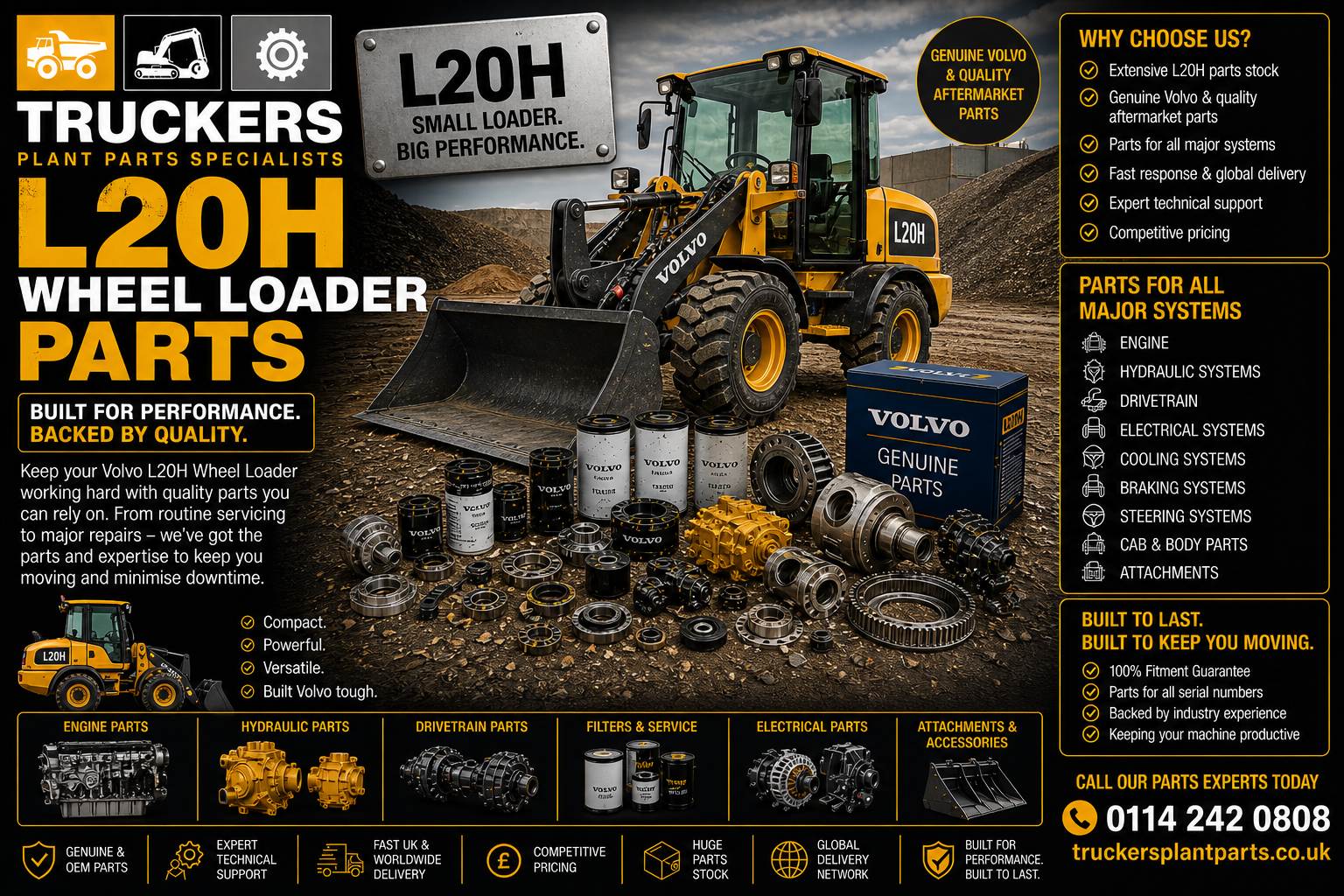
Volvo L20H Compact Wheel Loader Parts Supply, Specifications, Reliability, Attachments & Complete Machine Guide
The Volvo L20H compact wheel loader represents one of the most refined, versatile, and commercially practical compact loaders available in the modern construction equipment industry. Built by Volvo Construction Equipment as part of the advanced H-Series compact wheel loader range, the L20H combines compact dimensions with impressive lifting performance, excellent visibility, strong hydraulic capability, low operating costs, premium operator comfort, and the durability expected from the Volvo name.
While larger wheel loaders are designed primarily for bulk production and high-volume material movement, the Volvo L20H was engineered around versatility, manoeuvrability, and all-day usability across a huge variety of industries and applications. The machine is equally at home on construction sites, landscaping projects, municipal contracts, agriculture, equestrian facilities, property maintenance, waste handling, recycling centres, industrial yards, snow clearance operations, groundwork projects, utility installations, plant hire fleets, ports, timber yards, and infrastructure maintenance environments.
The L20H occupies a particularly important part of the market because many operators now need compact machinery capable of doing far more than traditional compact loaders from previous generations. Modern operators expect compact wheel loaders to perform attachment work, loading duties, pallet handling, site support tasks, snow operations, landscaping, bulk handling, and transport work while remaining fuel efficient, easy to operate, reliable, and economical to maintain.
Volvo designed the L20H specifically around those requirements.
The machine may be compact in physical size, but it delivers a level of refinement, control, visibility, hydraulic performance, and operator comfort that closely reflects Volvo’s larger wheel loader philosophy. This is one of the reasons compact Volvo loaders have gained such a strong reputation globally.
The Volvo L20H uses an articulated chassis design combined with hydrostatic drive technology, allowing the machine to remain extremely manoeuvrable while maintaining smooth traction and excellent operator control. Compact wheel loaders often operate in environments where space is limited, visibility is critical, and precision matters. The L20H was therefore engineered to provide strong bucket control, tight turning capability, responsive steering, and excellent balance without feeling unstable or overcomplicated.
This becomes particularly important in urban construction, landscaping, utility work, and agricultural environments where operators frequently work around buildings, pedestrians, fencing, vehicles, livestock, storage areas, and confined work zones. A machine that feels too large or awkward becomes inefficient quickly. Volvo focused heavily on keeping the L20H compact without compromising usability.
One of the strongest aspects of the Volvo L20H is its visibility.
Compact wheel loaders spend much of their time around people, structures, vehicles, and obstacles. Operators need clear sightlines around the bucket, articulation joint, tyres, rear counterweight, and attachment area. Volvo designed the L20H cab and chassis layout to maximise visibility in all directions, helping improve both productivity and safety.
The operator position is elevated and well-balanced, allowing excellent visibility to the work tool while still maintaining awareness around the entire machine. For applications such as pallet handling, loading trucks, moving aggregates, feeding mixers, handling feed, or operating around landscaping crews, this visibility becomes a major productivity advantage.
The L20H also demonstrates Volvo’s long-standing focus on operator comfort.
Compact machines are often underestimated when discussing operator fatigue, but operators may spend entire days repeatedly loading, reversing, steering, lifting, and travelling across rough surfaces. Poor seating, awkward controls, high vibration, and poor visibility can quickly reduce productivity and increase fatigue.
Volvo therefore designed the L20H with a modern ergonomic operator environment featuring intuitive controls, low-effort steering, comfortable seating, reduced vibration, excellent cab access, strong climate control options, low interior noise levels, and logically positioned controls.
Unlike many lower-cost compact loaders, the Volvo L20H feels more like a scaled-down premium production loader than a basic utility machine. This refined operating experience is one of the key reasons many operators prefer Volvo compact wheel loaders.
Hydraulic performance is another major strength.
The Volvo L20H uses advanced hydraulic systems designed to provide smooth, controllable attachment operation while maintaining fuel efficiency. Compact loaders increasingly rely on hydraulic versatility because many customers use attachments extensively. A modern compact wheel loader is rarely just a bucket machine.
The L20H may operate buckets, forks, sweepers, snow blades, snow blowers, grapples, grabs, augers, planers, hydraulic breakers, compactors, mixers, brush cutters, bale handlers, pallet forks, material handling attachments, and many other work tools depending on the industry.
This means attachment response and hydraulic precision matter enormously.
Operators need smooth hydraulic response when lifting pallets, handling fragile materials, loading vehicles, clearing snow, feeding sites, or operating around tight spaces. Jerky or inconsistent hydraulics reduce productivity and increase the risk of damage. Volvo’s hydraulic refinement helps the L20H maintain excellent attachment control even during repetitive work cycles.
The articulation system is another critical design feature.
Articulated steering allows the L20H to remain highly manoeuvrable while maintaining excellent traction and machine balance. Unlike skid steer loaders which often damage surfaces during turning, articulated compact loaders are far gentler on finished ground, paving, landscaping, and delicate surfaces. This makes the L20H especially attractive for landscaping contractors, municipal operations, property maintenance companies, golf courses, equestrian sites, and agricultural users.
Ground protection is an important commercial advantage.
Many contractors increasingly work on finished surfaces where tyre damage and surface scuffing are unacceptable. The L20H’s steering geometry helps minimise these issues while still delivering excellent turning performance.
The compact dimensions of the L20H also make transportation easier compared with larger wheel loaders. Smaller transport requirements improve flexibility for plant hire fleets, groundwork contractors, landscaping businesses, utility operators, and municipal authorities who frequently move machines between sites.
Plant hire companies in particular value the Volvo L20H because it appeals to a broad customer base. Compact wheel loaders have become increasingly popular rental machines due to their versatility, ease of operation, and lower training requirements compared with some other machine types.
A single L20H may be hired for landscaping one week, agricultural work the next, then move into utility support, construction loading, or municipal maintenance. This broad commercial flexibility helps improve utilisation rates for hire fleets.
The Volvo L20H is also widely respected for reliability and serviceability.
Compact loaders often work in harsh environments despite their smaller size. Dust, mud, manure, silage, salt, debris, construction contamination, demolition waste, and abrasive materials all place stress on machine components. Regular servicing therefore becomes essential.
Truckers Plant Parts support the Volvo L20H with OEM, OEM-equivalent, rebuilt, and quality aftermarket parts covering engines, hydraulic pumps, hydraulic hoses, steering systems, articulation joints, hydrostatic drive systems, cooling systems, electrical systems, cab components, loader arms, quick couplers, buckets, filters, service kits, pins, bushes, cylinders, tyres, lighting systems, radiators, sensors, joysticks, fuel systems, starters, alternators, hydraulic valves, auxiliary hydraulic systems, and attachment-related components.
Compact wheel loaders frequently require support around wear areas such as pins and bushes, articulation joints, bucket edges, hydraulic hoses, tyres, steering cylinders, and hydraulic couplers. Machines operating in agricultural or waste handling environments may also experience accelerated corrosion, contamination, and cooling system stress.
Hydraulic hoses are particularly important because compact wheel loaders constantly articulate and cycle attachments under pressure. A failed hose can quickly stop the machine and contaminate the work area. Fast hose replacement and hydraulic support therefore become important for reducing downtime.
Cooling systems are also critical.
Compact loaders often work at low travel speeds while maintaining constant hydraulic demand, especially during loading, sweeping, or attachment operation. Dusty or contaminated coolers can quickly create overheating problems. Proper maintenance of cooling packs, fans, radiators, and hydraulic coolers is therefore essential.
Electrical systems on modern compact loaders are increasingly advanced as well. The L20H integrates electronic monitoring, safety systems, lighting controls, hydraulic management, and operator display functions. Sensors, switches, control modules, joysticks, and electrical harnesses therefore form an important part of machine reliability.
One reason Volvo compact loaders retain strong resale value is because the machines are widely regarded as premium products built for long-term ownership. Buyers often recognise the difference in visibility, comfort, control quality, hydraulic refinement, and build quality compared with lower-cost alternatives.
The Volvo L20H is not simply a basic utility loader.
It is a premium compact machine designed around productivity, operator experience, and long-term reliability.
Compared with skid steers, the L20H offers lower ground disturbance, improved visibility, easier access, smoother operation, and often greater comfort. Compared with larger wheel loaders, it retains compactness, lower transport costs, easier access to confined spaces, and improved suitability for urban or sensitive environments.
This balance is exactly why the compact articulated wheel loader market continues to grow globally.
Operators increasingly want versatile machines capable of doing many different jobs efficiently without requiring oversized equipment. The L20H fits that role extremely well.
Whether loading aggregates, clearing snow, handling pallets, moving feed, operating attachments, supporting landscaping projects, feeding recycling operations, working on utility contracts, assisting demolition teams, maintaining municipal infrastructure, or supporting plant hire operations, the Volvo L20H delivers a highly refined and commercially effective compact loader solution.
Combined with strong parts support from Truckers Plant Parts, fast servicing access, OEM and aftermarket options, and emergency breakdown support, the Volvo L20H remains one of the most capable and respected compact wheel loaders in its class.
Volvo L20H Compact Wheel Loader FAQ
1. What is the Volvo L20H?
The Volvo L20H is a compact articulated wheel loader designed for versatile loading and material handling applications.
2. What type of machine is the L20H?
It is a compact wheel loader.
3. What industries use the Volvo L20H?
Construction, landscaping, agriculture, municipal work, recycling, waste handling, utility work, snow clearance, property maintenance, and plant hire.
4. Why is the Volvo L20H popular?
It combines compact dimensions with premium comfort, visibility, and versatility.
5. Is the L20H a compact loader?
Yes. It belongs to Volvo’s compact wheel loader range.
6. What makes compact wheel loaders useful?
They are versatile, manoeuvrable, and suitable for many different tasks.
7. Does the L20H use articulated steering?
Yes. The machine uses an articulated chassis design.
8. Why is articulated steering important?
It improves manoeuvrability and reduces ground damage during turning.
9. Why is reduced ground damage useful?
It protects paving, landscaping, finished surfaces, and delicate ground conditions.
10. Is the L20H suitable for landscaping work?
Yes. It is widely used in landscaping and grounds maintenance.
11. Is the L20H suitable for agriculture?
Yes. Many agricultural businesses use compact wheel loaders daily.
12. Is the L20H suitable for snow clearance?
Yes. It can operate snow blades, sweepers, and snow equipment.
13. Is the L20H suitable for utility work?
Yes. It works well in confined utility and groundwork environments.
14. Is the L20H suitable for plant hire?
Yes. Compact loaders are very popular rental machines.
15. Why do plant hire fleets like the L20H?
It appeals to a wide range of customers and industries.
16. Does the L20H offer good visibility?
Yes. Volvo designed the machine for excellent all-round visibility.
17. Why is visibility important on compact loaders?
Compact loaders often operate around people, vehicles, and buildings.
18. Is operator comfort important on compact loaders?
Yes. Operators may spend full shifts inside the machine.
19. What comfort features does the L20H offer?
Comfortable seating, ergonomic controls, low noise, smooth hydraulics, and excellent visibility.
20. Does the L20H have smooth hydraulics?
Yes. Volvo loaders are known for hydraulic refinement.
21. Why are smooth hydraulics important?
They improve attachment control and reduce operator fatigue.
22. Can the L20H use attachments?
Yes. It supports a wide range of hydraulic and mechanical attachments.
23. What attachments can the L20H use?
Buckets, forks, sweepers, snow equipment, grapples, augers, breakers, and pallet forks.
24. Why is attachment versatility important?
One machine can perform many different tasks.
25. Does the L20H use hydrostatic drive?
Yes. Hydrostatic drive improves smoothness and control.
26. Why is hydrostatic drive useful?
It provides precise movement and responsive control.
27. Is the L20H easy to transport?
Yes. Compact dimensions make transport easier.
28. Why are compact dimensions important?
The machine can access tighter spaces and smaller sites.
29. Can the L20H work in urban environments?
Yes. It is well suited to confined urban projects.
30. Is the L20H suitable for municipal operations?
Yes. Many councils and municipalities use compact loaders.
31. Why are compact wheel loaders replacing skid steers in some jobs?
They often provide better visibility, comfort, and lower ground damage.
32. Does the L20H have low ground impact?
Yes. Articulated steering helps protect surfaces.
33. Why is surface protection important?
Many modern projects involve finished landscaping or paved areas.
34. Does the L20H have strong lifting capability?
Yes. It offers impressive lifting performance for its size.
35. What materials can the L20H handle?
Soil, aggregates, pallets, feed, waste, snow, timber, and construction materials.
36. Is the L20H suitable for pallet handling?
Yes. Fork attachments make it highly effective for pallet work.
37. Why do agricultural operators use compact loaders?
They are manoeuvrable and versatile around farms and livestock areas.
38. Why do landscaping contractors use compact loaders?
Compact loaders work efficiently in restricted spaces without excessive ground damage.
39. Does the L20H have modern controls?
Yes. Volvo designed the controls for intuitive operation.
40. Is the L20H fuel efficient?
Yes. Volvo focused heavily on operational efficiency.
41. Does Volvo prioritise operator comfort?
Yes. Operator experience is a major Volvo design priority.
42. Why do operators prefer Volvo compact loaders?
They often feel more refined and easier to use.
43. Is the L20H suitable for recycling operations?
Yes. It works well in smaller recycling and waste facilities.
44. Can the L20H support demolition projects?
Yes. It can assist with material movement and site support tasks.
45. What hydraulic parts commonly wear?
Hoses, pumps, cylinders, valves, and couplers.
46. Why do hydraulic hoses fail?
Constant articulation and pressure cycles create wear.
47. Does Truckers Plant Parts support the Volvo L20H?
Yes. Extensive parts support is available.
48. What parts can Truckers supply for the L20H?
Hydraulics, engines, steering parts, filters, tyres, cab parts, electrical components, and service items.
49. Can Truckers supply OEM Volvo L20H parts?
Yes. Genuine Volvo parts may be available depending on stock.
50. Can Truckers supply aftermarket L20H parts?
Yes. Quality aftermarket and OEM-equivalent options are available.
51. Can Truckers support emergency L20H breakdowns?
Yes. Urgent VOR support is available.
52. What does VOR mean?
Vehicle Off Road or machine down due to failure.
53. Why is downtime serious for compact loaders?
Compact loaders are often central to daily site operations.
54. What service items are commonly required?
Filters, oils, grease, hoses, belts, coolant, and hydraulic fluids.
55. Why are filters important?
Filters protect hydraulic and engine systems from contamination.
56. What oils are important?
Engine oil, hydraulic oil, axle oil, and transmission fluids.
57. Why is hydraulic oil cleanliness important?
Contaminated oil damages pumps and valves.
58. What articulation parts wear on compact loaders?
Pins, bushes, steering joints, and pivot bearings.
59. Why is articulation wear important?
Worn articulation affects steering precision and machine stability.
60. What bucket wear parts may need replacement?
Cutting edges, teeth, side cutters, pins, and bushes.
61. Why are cooling systems important?
Compact loaders often operate continuously at low travel speeds with high hydraulic demand.
62. What cooling components may fail?
Radiators, hydraulic coolers, fans, hoses, and thermostats.
63. Why do compact loaders overheat?
Dust, blocked coolers, or cooling system failures reduce heat management.
64. What electrical parts may require support?
Switches, joysticks, sensors, lights, wiring, starters, and alternators.
65. Why are electrical systems increasingly important?
Modern compact loaders use advanced monitoring and control systems.
66. What tyres are used on the L20H?
Heavy-duty compact loader tyres designed for traction and stability.
67. Why are tyres important?
Tyres affect traction, ride quality, stability, and operating costs.
68. Can compact loader tyres wear quickly?
Yes. Harsh surfaces and aggressive turning increase tyre wear.
69. Is preventative maintenance important?
Yes. Proper servicing reduces downtime and expensive repairs.
70. Why inspect hydraulic hoses regularly?
Early hose damage can lead to sudden hydraulic failure.
71. Why inspect articulation joints regularly?
Wear can increase rapidly if ignored.
72. Can the L20H work in muddy conditions?
Yes. Compact wheel loaders are widely used in difficult site environments.
73. Can the L20H operate on paved surfaces?
Yes. Articulated loaders are well suited to paved environments.
74. Is the L20H easy to operate?
Yes. Volvo designed it for intuitive operation.
75. Why is easy operation important?
Reduced training time improves productivity and safety.
76. Can inexperienced operators use the L20H effectively?
Yes. The machine is user friendly and predictable.
77. Does the L20H retain strong resale value?
Yes. Volvo compact loaders are highly regarded in used markets.
78. Why do Volvo compact loaders retain value?
Build quality, comfort, reliability, and versatility support demand.
79. Does the L20H suit mixed-contract work?
Yes. It adapts very well across industries.
80. Why are compact wheel loaders becoming more popular?
Businesses increasingly want versatile, efficient multi-role machines.
81. Is the L20H suitable for equestrian facilities?
Yes. Compact dimensions and low ground impact make it ideal.
82. Can the L20H work inside buildings?
Yes. Compact size allows indoor and restricted access operation.
83. Why is manoeuvrability important?
Tight turning improves productivity on confined sites.
84. Can the L20H operate sweepers?
Yes. Sweeper attachments are commonly used.
85. Can the L20H operate snow blades?
Yes. Snow equipment is widely used on compact loaders.
86. Why do municipalities use compact loaders?
They support maintenance, snow removal, loading, and material handling tasks.
87. Why do property maintenance companies use compact loaders?
One machine can perform many maintenance functions.
88. Can the L20H support utility contractors?
Yes. It is effective for trench support and site logistics.
89. Why is machine balance important?
Balance improves lifting stability and operator confidence.
90. Does the L20H provide smooth travel?
Yes. Hydrostatic drive and articulation improve machine smoothness.
91. Why are compact loaders commercially attractive?
They offer broad versatility with relatively low operating costs.
92. Can the L20H replace multiple smaller machines?
In some operations, yes.
93. Why is compact machine efficiency important?
Many businesses need high productivity from limited space and budget.
94. Does Truckers offer same-day collection?
Yes. Many stocked parts can be collected quickly.
95. Does Truckers offer next-day delivery?
Yes. Rapid delivery is available nationwide.
96. Can Truckers source older Volvo compact loader parts?
Yes. Older and difficult-to-find parts may be sourced.
97. Can Truckers source newer Volvo compact loader parts?
Yes. Current model support is available.
98. Why contact Truckers for Volvo L20H parts?
Truckers provide fast supply, OEM options, technical support, and emergency assistance.
99. What makes the Volvo L20H stand out?
Its combination of compact size, premium comfort, hydraulic refinement, and versatility.
100. What best describes the Volvo L20H overall?
The Volvo L20H is a highly refined compact articulated wheel loader built for operators who need versatile loading performance, excellent manoeuvrability, smooth hydraulic operation, premium operator comfort, strong attachment capability, efficient operation, and reliable long-term productivity across construction, landscaping, agriculture, municipal work, recycling, property maintenance, and mixed-industry applications.
L20, L20B, L20F, L20H, L20 Electric, L25, L25B, L25H, L25 Electric, L30, L30B, L30G, L30H, L32, L32B, L35, L35B, L35G, L35H, L40, L40B, L45, L45B, L45F, L45G, L45H, L50, L50B, L50C, L50D, L50E, L50F, L50G, L50H, L60, L60E, L60F, L60G, L60H, L70, L70B, L70C, L70D, L70E, L70F, L70G, L70H, L90, L90B, L90C, L90D, L90E, L90F, L90G, L90H, L110, L110E, L110F, L110G, L110H, L120, L120B, L120C, L120D, L120E, L120F, L120G, L120H, L120 Electric, L150, L150C, L150D, L150E, L150F, L150G, L150H, L180, L180C, L180D, L180E, L180F, L180G, L180H, L190H, L200 High Lift, L220, L220D, L220E, L220F, L220G, L220H, L250G, L250H, L260, L260H, L330C, L330D, L330E, L350F, L350H