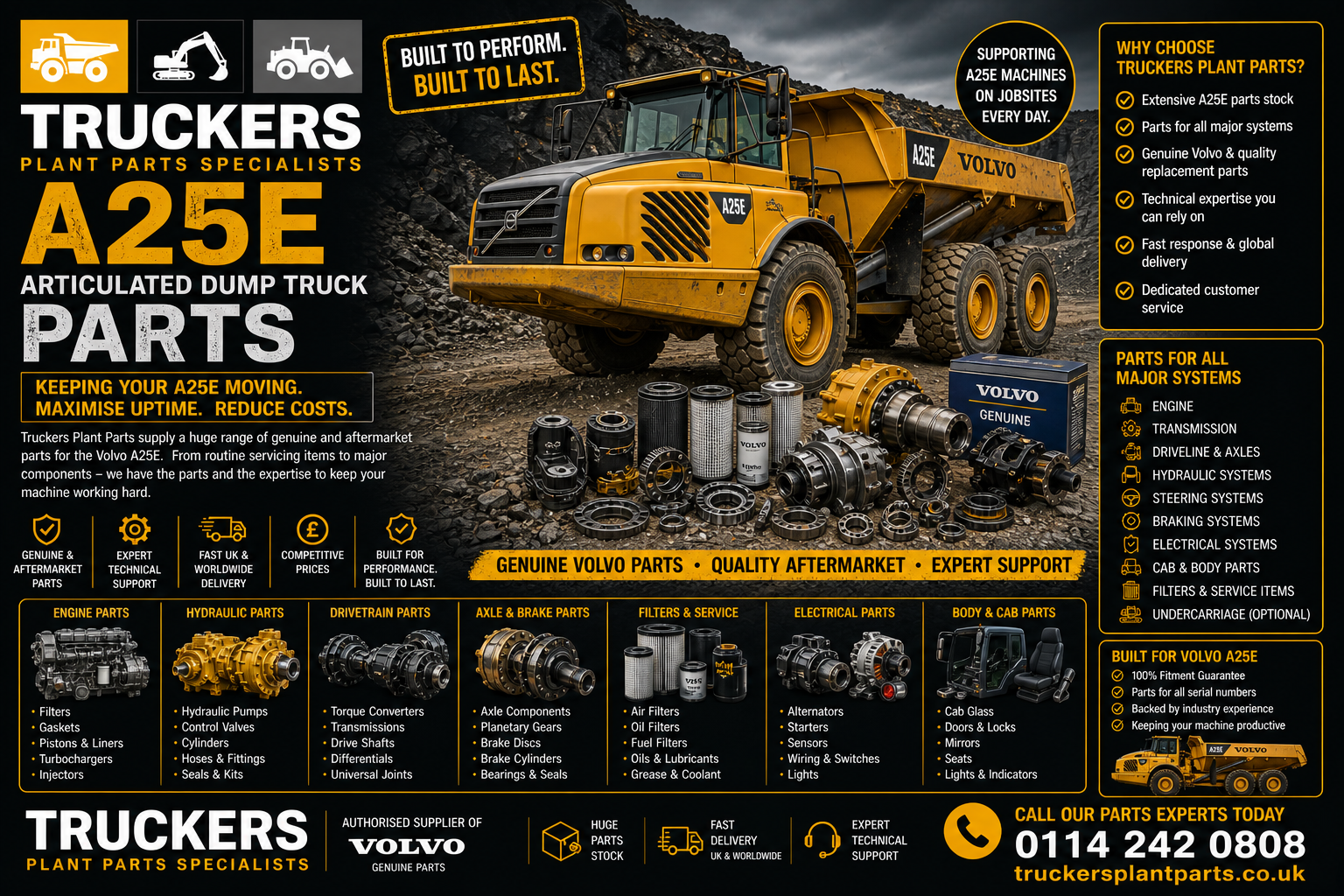
Volvo A25E Articulated Dump Truck: The Evolution Between Old-School Volvo Strength And Modern Intelligent Hauling
The Volvo A25E articulated dump truck occupies an extremely important position within the history of Volvo articulated hauler development because it represents a transitional generation between the rugged, mechanically focused older Volvo articulated dump trucks and the far more electronically integrated, fuel-optimised, intelligent hauling systems that would arrive later with the F-Series and G-Series machines.
For many operators and fleet owners, the A25E sits directly in the middle of two very different eras of articulated dump truck engineering. It retains much of the proven durability, driveline simplicity, structural toughness, and mechanical reliability that made earlier Volvo articulated haulers such as the A25C and A25D so respected worldwide, while also introducing more modern engine technology, improved fuel efficiency, enhanced hydraulics, updated operator environments, electronic integration, and more advanced machine management systems.
This balance is exactly why the A25E continues to maintain a strong reputation across quarrying, aggregates, construction, landfill, mining support, earthmoving, forestry, and civil engineering industries even today.
The A25E was designed during a period where the heavy equipment industry was beginning to transition more aggressively toward emissions compliance, fuel efficiency improvements, operator productivity systems, and electronically managed machine performance. Volvo understood that operators still demanded the severe-duty durability and off-road capability that had built the brand’s reputation, but customers were increasingly expecting lower operating costs, smoother operation, improved comfort, and better long-term efficiency as fuel prices and production pressures increased globally.
The result was the Volvo A25E.
At first glance, the A25E still looks unmistakably like a traditional Volvo articulated hauler. The machine maintains the familiar Volvo articulated chassis design, six-wheel-drive layout, heavy-duty dump body, aggressive off-road stance, and balanced hauling geometry that defined earlier generations. However, underneath the surface, Volvo introduced multiple refinements designed to improve overall machine performance and ownership efficiency compared with the older A25D platform.
One of the biggest changes involved engine technology.
| Specification | Volvo A25E |
|---|---|
| Manufacturer | Volvo Construction Equipment |
| Machine Type | Articulated Dump Truck (ADT) |
| Model | A25E |
| Production Period | Mid-2000s |
| Payload Capacity | 24 tonnes (Approx.) |
| Heaped Body Capacity | Approx. 15.3 m³ |
| Struck Body Capacity | Approx. 11.8 m³ |
| Gross Vehicle Weight | Approx. 45,000 kg |
| Empty Operating Weight | Approx. 20,500–21,000 kg |
| Engine | Volvo D9B |
| Engine Type | 6-Cylinder Turbocharged Diesel |
| Engine Displacement | 9.4 Litres |
| Engine Power | 313 hp (233 kW) |
| Maximum Torque | Approx. 1,600 Nm |
| Transmission | Volvo Fully Automatic Powershift |
| Drive Configuration | Permanent 6×6 All-Wheel Drive |
| Steering | Hydraulic Articulated Steering |
| Maximum Speed | Approx. 53 km/h (33 mph) |
| Fuel Tank Capacity | Approx. 360 Litres |
| Hydraulic System | Load Sensing Hydraulic System |
| Tyre Size | 23.5R25 (Typical) |
| Front Suspension | Independent Front Suspension |
| Rear Suspension | Oscillating Tandem Bogie |
| Braking System | Oil-Cooled Wet Disc Brakes |
| Retarder | Hydraulic Retarder |
| Cab Certification | ROPS/FOPS Approved |
| Air Conditioning | Optional / Model Dependent |
| Differential Locks | Automatic |
| Turning Radius | Approx. 8.5 m |
| Typical Applications | Quarrying, Earthmoving, Construction, Mining, Forestry, Civil Engineering |
| Successor Model | Volvo A25F |
The Volvo A25D primarily relied on the respected D10 engine platform which had built a strong reputation for durability and low-end torque delivery. The A25E moved toward newer engine systems designed to improve fuel economy, emissions compliance, throttle response, and overall operational efficiency while maintaining the pulling power and driveline strength operators expected from a Volvo articulated hauler.
Volvo engineers focused heavily on improving usable torque delivery throughout the hauling cycle rather than simply increasing horsepower figures. In real quarry and earthmoving environments, articulated dump trucks spend much of their working life accelerating under heavy load, climbing grades, travelling through soft ground, and operating under varying traction conditions. Smooth torque delivery and driveline efficiency matter far more in these environments than outright speed.
The A25E therefore delivered improved hauling refinement compared with the A25D while maintaining the strong low-speed pulling characteristics Volvo articulated haulers were already famous for.
Fuel efficiency also improved noticeably over the older D-Series machines. The heavy equipment industry was beginning to focus more aggressively on operational cost reduction during the A25E era, and fuel consumption represented one of the largest ownership expenses for quarrying and earthmoving fleets. Volvo responded by refining engine management systems, driveline performance, hydraulic efficiency, and transmission operation to reduce unnecessary fuel burn while maintaining productivity.
Compared with the older A25D, the A25E generally feels more refined, smoother under load, quieter in operation, and slightly more efficient throughout the haul cycle. Operators often describe the A25D as raw, rugged, and mechanically tough, whereas the A25E introduced a more polished operational character without completely sacrificing the older machine’s heavy-duty feel.
This refinement extended into the transmission and driveline systems.
Volvo improved transmission intelligence and power delivery characteristics to help optimise traction and reduce driveline shock loading during difficult hauling conditions. Smooth shifting and more intelligent torque management improved operator comfort while also helping reduce stress on driveline components over time.
Traction systems remained one of Volvo’s defining strengths throughout the E-Series generation. Volvo had already established itself as arguably the benchmark manufacturer for articulated dump truck traction performance by this stage. The A25E continued this reputation with advanced all-wheel-drive capability, differential management systems, balanced chassis geometry, and highly effective articulation performance across difficult terrain.
In quarry environments, haul roads constantly evolve due to weather, production movement, water, loose rock, mud, and heavy traffic. Maintaining traction consistently becomes critical for productivity and fuel efficiency. The A25E remained extremely capable in these severe off-road conditions and continued Volvo’s reputation for confident off-road hauling where rigid trucks and less refined articulated haulers often struggled.
| Dimension | Measurement |
|---|---|
| Overall Length | Approx. 10.1 m |
| Overall Width | Approx. 2.9 m |
| Overall Height | Approx. 3.5 m |
| Wheelbase | Approx. 4.6 m |
| Ground Clearance | Approx. 500 mm |
Operator comfort improved significantly on the A25E compared with older Volvo articulated dump trucks.
The A25D already represented a major improvement over much older ADTs, but the A25E pushed further toward modern operator-focused machine design. Volvo refined cab ergonomics, seating comfort, noise reduction, vibration isolation, visibility, climate systems, and machine controls to create a more productive and less fatiguing operator environment.
This matters enormously in articulated hauling operations because operators often spend entire shifts repeating the same loading, hauling, and dumping cycles continuously. Reduced vibration, smoother transmission behaviour, lower noise levels, improved seating, and more intuitive controls all contribute directly to productivity and reduced operator fatigue.
Visibility improvements also became increasingly important.
Large articulated dump trucks regularly operate around excavators, wheel loaders, stockpiles, crushers, haul roads, service vehicles, and site personnel. Volvo improved cab visibility and operator awareness on the E-Series to help improve safety and machine control confidence during busy site operation.
The hydraulic systems on the A25E also became more refined compared with earlier machines. Tipping performance, steering response, suspension integration, and hydraulic efficiency all improved incrementally over the A25D platform. While these improvements may not seem dramatic individually, together they created a machine that generally felt smoother, more responsive, and more efficient overall.
The A25E also introduced greater electronic integration compared with older Volvo articulated hauliers.
This represented both an upgrade and, for some operators, a compromise.
| Performance Specification | Value |
|---|---|
| Payload | 24 tonnes |
| Engine Power | 313 hp |
| Drive | Permanent 6×6 |
| Top Speed | 53 km/h |
| Body Capacity (Heaped) | 15.3 m³ |
| Fuel Tank | 360 L |
On one hand, increased electronics allowed Volvo to improve engine management, diagnostics, transmission behaviour, machine monitoring, and operational efficiency. Fault monitoring became more sophisticated, machine systems became more intelligent, and operators benefited from better machine feedback and system optimisation.
On the other hand, some operators and plant engineers still preferred the relative simplicity of older D-Series machines.
The A25D sits within a generation many mechanics describe as easier to diagnose mechanically because electronic integration remained more limited. The A25E moved further toward electronically managed systems, introducing additional sensors, machine monitoring systems, and control integration which improved overall machine performance but also increased diagnostic complexity compared with older machines.
This transitional character is one reason the A25E remains such an interesting machine historically.
It still retains much of the older Volvo mechanical toughness while beginning to move toward the electronically optimised hauling systems that would fully mature later with the A25F and especially the A25G generations.
Compared with the newer A25F, the A25E begins to show some limitations in overall machine intelligence, fuel optimisation, operator assistance technology, and emissions performance.
The A25F introduced more advanced electronic integration, improved machine diagnostics, more refined transmission control systems, improved fuel efficiency strategies, and greater overall system integration. Volvo increasingly focused on intelligent hauling optimisation during the F-Series era, allowing machines to better manage power delivery, traction control, hydraulic demand, and fuel usage dynamically depending on operating conditions.
The A25F also improved operator environment quality further with better display systems, more modern controls, improved ergonomics, and more advanced machine monitoring features.
The A25G pushed this evolution even further.
Compared with the A25G, the A25E feels noticeably older in terms of technology integration, fuel efficiency management, operator assistance systems, telematics capability, emissions systems, and overall machine intelligence. The G-Series represented a major leap toward modern smart-haulage philosophy where machines increasingly optimise themselves dynamically to improve fuel efficiency, reduce driveline stress, minimise tyre wear, and maximise productivity.
The A25G introduced significantly more advanced telematics integration, fuel-saving driveline optimisation, electronically controlled suspension refinement, advanced machine diagnostics, and more sophisticated traction management systems. Operator environments also became substantially more modern, quieter, more digital, and more ergonomically refined.
However, despite these technological advances, many operators still continue to respect the A25E because it avoids some of the complexity escalation that came later.
This is one of the key reasons the A25E remains attractive within many fleets even today.
For some operators, especially within quarrying, earthmoving, forestry, and harsh off-road environments, there remains strong value in machines that strike a balance between modern performance and manageable mechanical complexity. The A25E sits directly within this balance point.
It is modern enough to deliver improved comfort, fuel efficiency, hauling refinement, and machine performance compared with older D-Series machines, while still remaining less electronically intensive than later F-Series and G-Series articulated haulers.
This balance often translates into practical long-term ownership advantages.
Plant engineers familiar with older Volvo systems often find the A25E more approachable from a servicing and repair perspective compared with newer fully integrated machines. Independent operators also frequently appreciate the machine’s combination of durability and manageable complexity.
The A25E therefore developed a strong reputation as a dependable production hauler capable of surviving severe-duty environments while delivering improved refinement and efficiency compared with earlier generations.
Truckers Plant Parts continue supporting Volvo A25E articulated dump trucks with OEM and quality aftermarket components covering engines, transmissions, driveline systems, final drives, axles, articulation systems, steering systems, brake systems, cooling packages, hydraulic systems, suspension components, electrical systems, sensors, cab systems, body wear components, filters, service kits, and machine diagnostics-related parts.
Many A25E machines remain operational globally because the platform itself was fundamentally engineered around long-term durability and severe-duty performance. When properly maintained, these machines continue hauling material daily across quarries, earthmoving projects, construction sites, landfill operations, forestry environments, and mining support applications worldwide.
The Volvo A25E ultimately represents a fascinating and highly important stage within articulated dump truck evolution.
It bridges the gap between the rugged mechanical simplicity of older Volvo articulated haulers and the highly intelligent electronically optimised machines that followed later.
It introduced greater refinement, improved efficiency, smoother operation, and more modern machine management systems without fully abandoning the heavy-duty toughness and practical reliability that made Volvo articulated haulers legendary in the first place.
For many operators, that balance remains exactly what makes the Volvo A25E such a respected and highly regarded articulated dump truck even today.
FAQ – Everything You Need To Know About The Volvo A25E ADT
1. What is the Volvo A25E?
The Volvo A25E is a heavy-duty articulated dump truck designed for quarrying, earthmoving, construction, aggregates, landfill, forestry, mining support, demolition, and severe off-road hauling applications.
2. What type of machine is the A25E?
The A25E is an articulated dump truck, commonly referred to as an ADT or articulated hauler.
3. What does articulated mean?
Articulated means the machine has a pivoting joint between the front tractor unit and rear dump body section, allowing the chassis to flex independently over rough terrain.
4. Why are articulated dump trucks important?
They allow heavy materials to be moved efficiently across difficult terrain where rigid trucks struggle with traction and stability.
5. What industries use the Volvo A25E?
The machine is widely used in quarrying, mining support, landfill operations, earthmoving, civil engineering, aggregates, demolition, construction, forestry, and recycling.
6. What is the payload capacity of the A25E?
The Volvo A25E typically carries payloads around 24–25 tonnes depending on specification and operating conditions.
7. Why is the A25E considered important in Volvo history?
The A25E sits between the older mechanically focused D-Series machines and the more electronically advanced F-Series and G-Series articulated haulers.
8. What makes the A25E different from the older A25D?
The A25E introduced improved fuel efficiency, refined driveline systems, better operator comfort, updated hydraulics, improved machine management systems, and more electronic integration.
9. Did the A25E replace the A25D?
Yes. The A25E followed the A25D generation.
10. Was the A25E more modern than the A25D?
Yes. The A25E introduced more advanced systems while retaining much of Volvo’s traditional durability and driveline strength.
11. What engine does the Volvo A25E use?
The A25E uses a Volvo diesel engine designed for strong torque delivery, fuel efficiency, and heavy hauling performance.
12. Why is low-end torque important in articulated dump trucks?
Heavy off-road hauling requires strong pulling power at low engine speeds under load.
13. Did fuel efficiency improve on the A25E?
Yes. Volvo focused heavily on improving operational efficiency compared with older D-Series machines.
14. Why is fuel efficiency important in quarrying?
Fuel is one of the largest operating costs for heavy haulage fleets.
15. Was the A25E smoother than the A25D?
Yes. Operators often describe the A25E as more refined and smoother under load.
16. What areas improved operational refinement?
Transmission behaviour, hydraulic response, cab comfort, noise reduction, and driveline management all improved.
17. Did the A25E still keep Volvo’s rugged durability?
Yes. The machine retained much of the severe-duty toughness that made older Volvo articulated haulers famous.
18. Is the A25E considered reliable?
Yes. The A25E developed a strong reputation for dependable long-term performance.
19. Why do operators still use A25E trucks today?
Many remain productive, durable, and economically viable within modern fleets.
20. What terrain can the A25E operate in?
The machine handles mud, rough haul roads, steep gradients, soft ground, quarry environments, rocky terrain, landfill conditions, and forestry tracks.
21. Does the A25E use all-wheel drive?
Yes. Volvo articulated haulers use all-wheel-drive systems for maximum traction.
22. Why is traction so important on ADTs?
Poor traction reduces productivity, increases tyre wear, wastes fuel, and limits site access.
23. What made Volvo traction systems respected?
Volvo engineered highly effective driveline systems, articulation geometry, suspension balance, and differential management.
24. Did the A25E improve traction systems?
The machine refined driveline and traction management systems compared with older models.
25. Why is articulation important?
Articulation allows the machine to flex and steer independently across uneven ground.
26. Does articulation improve stability?
Yes. It helps maintain wheel contact and load balance across rough terrain.
27. Is the A25E good in quarries?
Yes. Quarry hauling is one of the machine’s most common applications.
28. What materials does the A25E haul?
Rock, aggregate, clay, soil, overburden, demolition debris, timber products, recycled material, and bulk earthmoving materials.
29. What makes articulated haulers ideal for earthmoving?
They combine high payloads with excellent off-road mobility.
30. Does the A25E work well in wet conditions?
Yes. The machine is designed for difficult off-road environments including mud and soft terrain.
31. Was the cab upgraded compared with the A25D?
Yes. Volvo improved comfort, visibility, ergonomics, and vibration reduction.
32. Why is operator comfort important?
Operators often spend long shifts continuously hauling material.
33. Did Volvo focus heavily on operator comfort?
Yes. Volvo has long prioritised operator environment quality.
34. What comfort features improved on the A25E?
Noise levels, seating, visibility, suspension behaviour, and control layouts all improved.
35. Did vibration levels improve?
Yes. Volvo refined machine balance and cab isolation systems.
36. Why does vibration reduction matter?
Reduced vibration lowers operator fatigue and improves comfort during long shifts.
37. Was visibility improved on the A25E?
Yes. Cab visibility improved compared with older generations.
38. Why is visibility important on articulated haulers?
Operators constantly manoeuvre around excavators, stockpiles, haul roads, and site traffic.
39. Did the A25E introduce more electronics?
Yes. The machine moved further toward electronically managed systems.
40. Was this an advantage?
In many ways yes, because it improved efficiency, diagnostics, and operational refinement.
41. Did some operators prefer the older A25D systems?
Yes. Some operators preferred the simpler mechanical nature of older machines.
42. Why do some operators prefer less electronics?
Simpler systems can sometimes be easier to diagnose and maintain.
43. Did the A25E become more fuel efficient because of electronics?
Partly yes. Electronic engine and driveline management helped improve efficiency.
44. What machine systems became more electronically controlled?
Engine management, transmission behaviour, diagnostics, and machine monitoring systems improved significantly.
45. Did the A25E have better diagnostics than older models?
Yes. Machine monitoring systems became more advanced.
46. Was the transmission upgraded compared with the A25D?
Yes. Transmission refinement and driveline smoothness improved noticeably.
47. Why is smooth transmission behaviour important?
Smooth shifting reduces driveline stress, improves comfort, and increases efficiency.
48. What hydraulic systems does the A25E use?
Hydraulic systems control steering, tipping, suspension-related systems, and machine functions.
49. Did hydraulic refinement improve?
Yes. Steering response and hydraulic operation became smoother and more controlled.
50. Why are hydraulics important on articulated dump trucks?
Hydraulics control body tipping and critical machine systems under load.
51. Did the A25E remain mechanically tough?
Yes. The machine retained heavy-duty structural durability.
52. Why are articulated dump trucks subjected to heavy stress?
They haul large payloads continuously over difficult terrain.
53. What are common A25E applications?
Quarry hauling, aggregate transport, bulk earthmoving, forestry support, landfill operations, demolition waste hauling, and mining support work.
54. Is the A25E suitable for landfill operations?
Yes. Its traction and stability make it highly capable in landfill conditions.
55. Does the A25E perform well on rough haul roads?
Yes. Rough terrain capability is one of its strongest characteristics.
56. What makes Volvo articulated haulers stable?
Balanced chassis design, suspension systems, articulation geometry, and driveline engineering.
57. Did the A25E improve operator ergonomics?
Yes. Control layouts and seating positions improved significantly.
58. Did noise levels improve compared with older models?
Yes. Cab refinement became noticeably better.
59. Was the A25E more refined overall?
Yes. Most operators consider it more polished and smoother than the A25D.
60. Did the A25E still feel like a traditional Volvo hauler?
Absolutely. It retained the rugged Volvo hauling character.
61. What are the biggest strengths of the A25E?
Durability, traction, reliability, balance, hauling capability, and a good balance between old and modern systems.
62. How does the A25E compare with the newer A25F?
The A25F introduced more advanced electronics, improved fuel optimisation, and greater machine intelligence.
63. Did the A25F improve machine diagnostics?
Yes. Diagnostic and electronic integration improved significantly.
64. Was the A25F more electronically advanced?
Yes. The F-Series moved further toward intelligent machine management.
65. Did the A25F improve operator systems?
Yes. Cab displays, controls, and monitoring systems became more advanced.
66. How does the A25E compare with the A25G?
The A25G introduced much more advanced telematics, fuel optimisation, traction management, and smart hauling technologies.
67. Is the A25G more fuel efficient?
Generally yes, due to advanced driveline and electronic optimisation systems.
68. Did telematics improve on the A25G?
Yes. Machine monitoring and fleet management systems became much more sophisticated.
69. Why do some operators still prefer the A25E over newer trucks?
Many appreciate the balance between modern performance and manageable complexity.
70. Is the A25E easier to maintain than newer models?
In some cases yes, because later generations became more electronically intensive.
71. Why does lower complexity matter for some fleets?
It can simplify diagnostics and reduce repair difficulty in certain environments.
72. Did the A25E bridge two different machine eras?
Yes. It sits directly between old-school mechanical Volvo haulers and newer intelligent haulage systems.
73. What suspension systems does the A25E use?
Heavy-duty suspension systems designed for rough terrain stability and comfort.
74. Why is suspension important on ADTs?
Suspension affects ride comfort, stability, traction, and machine durability.
75. Did Volvo improve ride quality on the E-Series?
Yes. Ride refinement improved noticeably.
76. What tyres are used on the A25E?
Heavy-duty off-road earthmover tyres depending on application and terrain.
77. Why are tyres critical on articulated dump trucks?
Tyres affect traction, stability, load carrying capability, and fuel efficiency.
78. What causes tyre wear on articulated haulers?
Rough haul roads, sharp rock, excessive speed, overloads, and poor maintenance.
79. Does the A25E require regular maintenance?
Yes. Proper servicing is essential for reliability and long machine life.
80. What maintenance areas are most important?
Filters, fluids, cooling systems, driveline inspections, articulation systems, brakes, and hydraulics are critical.
81. Why are cooling systems important?
Heavy hauling generates large amounts of heat continuously.
82. What cooling parts are commonly serviced?
Radiators, hydraulic coolers, hoses, fans, thermostats, and coolant systems.
83. Are transmissions heavily stressed on articulated haulers?
Yes. Heavy loads and rough terrain create enormous driveline stress.
84. What driveline components commonly wear?
Differentials, hub reductions, shafts, bearings, universal joints, and axle systems.
85. What articulation components commonly wear?
Pins, bushes, bearings, seals, and steering cylinders.
86. Are brake systems heavily loaded on ADTs?
Yes. Heavy payloads and steep haul roads place huge demands on braking systems.
87. Does Truckers Plant Parts support the A25E?
Yes. Truckers Plant Parts support OEM and aftermarket parts for Volvo A25E articulated haulers.
88. What systems are supported?
Engine systems, hydraulics, driveline components, axles, transmissions, brakes, electrical systems, cooling systems, articulation components, and service kits are supported.
89. Are final drives supported?
Yes. Final drives and driveline systems are supported.
90. Are cab parts available?
Yes. Cab glass, controls, seats, switches, displays, and operator environment parts are supported.
91. Are hydraulic components available?
Yes. Pumps, cylinders, valves, hoses, and hydraulic systems are supported.
92. Are electrical systems supported?
Yes. Wiring, sensors, ECUs, switches, and machine monitoring systems are supported.
93. Why is uptime important for articulated haulers?
Downtime affects production, transport cycles, labour efficiency, and site profitability.
94. Why do quarry fleets still value the A25E?
Because it remains durable, dependable, and highly capable off-road.
95. Is the A25E considered a transitional machine?
Yes. It bridges traditional Volvo mechanical toughness and modern intelligent haulage systems.
96. What makes the A25E historically important?
It represents Volvo’s movement toward more refined and electronically optimised articulated hauling.
97. Did Volvo maintain severe-duty capability on the A25E?
Absolutely. Severe-duty durability remained central to the machine’s design.
98. Why do operators respect the A25E?
Because it combines strength, refinement, traction, reliability, and manageable complexity.
99. Is the Volvo A25E still productive today?
Yes. Many machines continue working globally in demanding heavy-duty environments.
100. What best describes the Volvo A25E overall?
The Volvo A25E is a highly respected articulated dump truck that successfully combines old-school Volvo durability and traction performance with improved refinement, fuel efficiency, operator comfort, and modern machine technology.
A20, A25, A25B, A25C, A25D, A25E, A25F, A25G, A30, A30C, A30D, A30E, A30F, A30G, A35, A35C, A35D, A35E, A35F, A35G, A40, A40C, A40D, A40E, A40F, A40G, A45G, A60H, A25, A30, A35, A40, A45, A50, A60H, A30