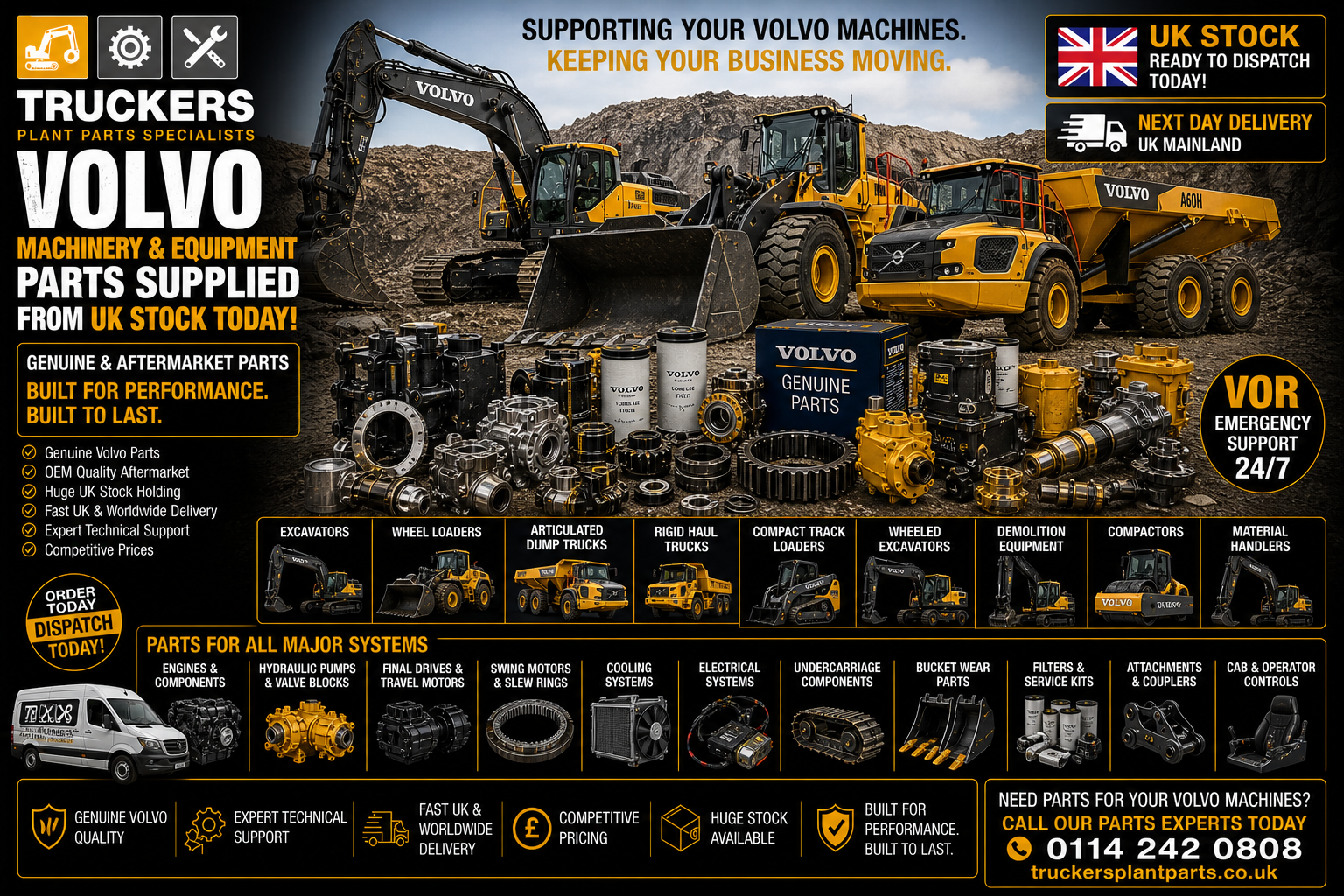
Truckers Plant Parts: The Heavy Equipment Parts Specialists Trusted To Deliver When Others Cannot
In the heavy equipment industry, machinery downtime is never just an inconvenience. Every immobilised excavator, failed articulated dump truck, disabled wheel loader, broken material handler, grounded dozer, or inoperative quarry machine immediately affects production, transport schedules, labour efficiency, fuel consumption, site operations, customer commitments, and profitability. When critical machinery stops, operators do not simply need parts. They need solutions, speed, technical knowledge, industry experience, and suppliers capable of delivering under pressure when production is on the line.
This is exactly where Truckers Plant Parts has built its reputation.
Truckers Plant Parts operates within one of the most demanding sectors in the industrial world, supplying OEM, OEM-equivalent, and quality aftermarket components for heavy machinery across Volvo Construction Equipment, Caterpillar, Komatsu, Bell Equipment, Liebherr, Terex, FUCHS, and many other leading manufacturers operating globally across quarrying, mining, demolition, earthmoving, aggregates, recycling, ports, waste handling, forestry, construction, and infrastructure industries.
But supplying heavy equipment parts is only part of the story.
What truly separates Truckers Plant Parts from many competitors is the ability to solve problems others cannot solve.
Within heavy machinery industries, there are suppliers who sell parts.
Then there are specialists who understand machinery.
Truckers belongs firmly within the second category.
Decades of real-world industry experience across articulated dump trucks, crawler excavators, wheeled excavators, wheel loaders, material handlers, dozers, tracked loading equipment, quarry machinery, demolition equipment, mining support machines, and waste handling equipment have created a level of technical understanding that extends far beyond simply identifying part numbers from a catalogue.
Because heavy equipment operators rarely call when everything is running perfectly.
Most urgent enquiries happen during breakdown situations where production is already under threat.
A Volvo A30D loses hydraulic drive pressure during a quarry shift. A Caterpillar wheel loader develops transmission issues during crusher loading operations. A Komatsu excavator suffers final drive failure in the middle of an earthmoving contract. A Bell articulated dump truck requires emergency brake components before the next production shift begins. A Liebherr material handler develops cooling system problems inside a recycling facility. A Terex machine requires obsolete driveline components no longer available through traditional channels. A FUCHS material handler operator desperately needs hydraulic parts for a machine supporting continuous scrap processing operations.
These are the situations where experience matters.
Truckers Plant Parts has built a strong reputation throughout the heavy equipment sector for succeeding where others fail because the business understands both the machinery itself and the operational pressure customers are facing when critical components fail.
Truckers keeps you moving is not simply a slogan.
It reflects the entire operating philosophy behind the business.
Heavy machinery industries operate continuously under pressure. Production targets do not stop. Quarry schedules continue. Earthmoving contracts continue. Demolition timelines continue. Recycling facilities continue processing waste. Ports continue loading materials. Infrastructure projects continue operating. Downtime becomes financially damaging extremely quickly.
This is why Truckers Plant Parts focuses so heavily on availability, sourcing capability, rapid dispatch, technical understanding, and flexible supply solutions designed around real-world operational urgency.
The business supports a massive range of equipment categories across multiple manufacturers.
Volvo Construction Equipment remains one of the strongest supported sectors, including articulated dump trucks such as the A25D, A25E, A25F, A25G, A30D, A30E, A30F, A30G, A35D, A35E, A35F, A35G, A40D, A40E, A40F, A40G, and A60H. Support extends across wheel loaders including L20H, L30, L45, L60, L70, L90, L110, L120, L150, L180, L220, and larger production loaders operating within aggregates and quarry industries.
Crawler excavators including EC140, EC160, EC210, EC220, EC230, EC240, EC250, EC300, EC350, EC380, EC480, EC750, and EC950 are extensively supported alongside wheeled excavators such as EW160, EW180, EW200, EW220, EW240, and material handling variants operating within waste, scrap, and recycling industries.
Compact excavators, compact track loaders, skid steers, pavers, rollers, and attachment systems are also supported extensively.
Caterpillar support extends across articulated dump trucks, wheel loaders, crawler excavators, mining equipment, dozers, material handlers, compact machinery, and quarry loading equipment. Komatsu support includes articulated haulers, crawler excavators, dozers, mining machinery, wheel loaders, rigid dump trucks, and specialist earthmoving equipment. Bell Equipment articulated dump trucks and support machinery form another major supported category, especially within quarrying and earthmoving fleets.
Liebherr support covers crawler excavators, mining machines, material handlers, quarry loading equipment, cranes, and specialist industrial handling machinery. Terex machinery including articulated haulers, crushers, material handling systems, and quarry support equipment are supported alongside FUCHS material handlers heavily used within scrap and recycling industries.
Truckers Plant Parts supports virtually every major system found across heavy machinery platforms.
Engine systems form one of the largest categories supported, including complete engines, short blocks, cylinder heads, injectors, turbochargers, intercoolers, pistons, liners, crankshafts, bearings, water pumps, oil pumps, fuel systems, fuel rails, injection pumps, gasket kits, seal kits, valve train components, emission system components, exhaust systems, cooling assemblies, thermostats, alternators, starter motors, sensors, ECUs, wiring harnesses, and engine management systems.
Hydraulic systems represent another enormous category because modern heavy machinery depends heavily on hydraulic performance. Truckers supports hydraulic pumps, piston pumps, vane pumps, gear pumps, slew motors, travel motors, hydraulic cylinders, seal kits, hoses, valve blocks, spool valves, control valves, servo systems, hydraulic tanks, coolers, filters, pipework, fittings, accumulators, fan drive systems, hydraulic couplings, swivel joints, and complete hydraulic rebuild components.
Driveline systems remain critically important within articulated dump trucks, wheel loaders, and severe-duty off-road machinery. Truckers supplies transmissions, torque converters, differentials, axles, half shafts, propshafts, universal joints, planetary systems, final drives, hub reductions, bearings, seals, crown wheel and pinion assemblies, clutch systems, gearbox components, transmission control systems, and driveline rebuild parts.
Undercarriage systems form another huge support category covering track chains, rollers, sprockets, idlers, recoil systems, carrier rollers, track pads, undercarriage bolts, tensioning systems, and crawler wear components for excavators and tracked machinery operating under severe abrasive conditions.
Steering systems and articulation systems are especially important on articulated dump trucks and wheel loaders. Truckers supports articulation joints, steering cylinders, articulation bearings, bushes, pins, steering pumps, steering valves, steering sensors, hydraulic steering systems, and chassis pivot components.
Brake systems include wet brake systems, dry brake systems, retarder components, calipers, brake discs, brake pads, brake valves, hydraulic braking systems, accumulators, parking brake systems, and complete braking rebuild solutions.
Cooling systems are heavily supported because overheating remains one of the most common causes of catastrophic machinery failure. Radiators, intercoolers, hydraulic coolers, fan systems, coolant pumps, thermostats, expansion tanks, cooling pipework, cooling cores, and associated cooling assemblies are all supplied across multiple machine platforms.
Electrical systems have become increasingly important as modern machinery relies heavily on electronically controlled systems. Truckers supports ECUs, machine controllers, joysticks, wiring harnesses, sensors, displays, monitoring systems, cameras, safety systems, lighting systems, relays, switches, telematics hardware, batteries, alternators, starter systems, and advanced electronic machine management components.
Cab components and operator environment systems are also heavily supported because machine comfort directly affects productivity. Truckers supplies seating systems, cab glass, mirrors, controls, HVAC systems, wiper systems, lighting, displays, control panels, switchgear, operator seats, joystick systems, safety components, and interior trim systems.
Wear parts form another major category. Bucket teeth, cutting edges, side cutters, wear plates, blade edges, ripper teeth, bucket pins, bushes, quick coupler systems, attachment interfaces, grab systems, demolition wear components, material handling wear systems, and quarry wear packages are all supported extensively.
Filtration and servicing components remain one of the largest day-to-day supply areas. Engine oil filters, hydraulic filters, transmission filters, air filters, fuel filters, breather filters, fuel water separators, service kits, lubrication systems, coolants, engine oils, hydraulic oils, transmission oils, axle oils, greases, DEF fluids, and maintenance consumables are supplied continuously across all supported machine sectors.
One of the strongest advantages Truckers offers is flexibility in supply options.
Not every customer requires the same solution.
Some operators demand genuine OEM components for warranty-sensitive or mission-critical applications. Others prefer OEM-equivalent solutions offering excellent performance while controlling operational costs. Some fleets require quality aftermarket options to maintain older machines economically without compromising reliability.
Truckers supports all these requirements.
Massive stockholding capability allows many components to be supplied immediately for same-day collection or next-day delivery. Dedicated transport options are available for VOR-critical breakdown situations where every hour of downtime matters. Emergency same-day delivery services can be arranged when production-critical machinery must return to work urgently.
For non-stock or obsolete items, Truckers leverages extensive international sourcing networks developed through decades within the heavy equipment industry.
This becomes especially valuable for rare, discontinued, hard-to-source, or obsolete machinery components where traditional dealer channels may no longer support older equipment properly.
This is another area where Truckers has built its reputation strongly.
The business actively encourages operators to challenge the team with difficult sourcing requirements.
Obsolete Volvo driveline components.
Rare Caterpillar transmission parts.
Discontinued Komatsu hydraulic systems.
Hard-to-find Bell Equipment articulation components.
Liebherr cooling assemblies.
Terex driveline systems.
FUCHS material handler hydraulic components.
Legacy quarry equipment systems.
Specialist demolition machine parts.
Older generation machine electronics.
Many of these enquiries require genuine heavy equipment experience to solve successfully.
Understanding machine evolution, component compatibility, supersession changes, OEM sourcing routes, international inventory channels, and cross-platform component relationships becomes critical when dealing with older or difficult machinery.
This level of understanding is not always possessed by general parts suppliers.
Truckers Plant Parts therefore operates not simply as a parts business but as a heavy equipment support partner capable of assisting operators with technical understanding, sourcing expertise, practical industry knowledge, and rapid supply solutions designed around real-world operational pressure.
Because ultimately, the heavy equipment industry is not built around machinery standing still.
It is built around movement.
Movement of material.
Movement of production.
Movement of projects.
Movement of profitability.
And when machinery stops unexpectedly, operators need suppliers capable of helping restore that movement quickly, reliably, and professionally.
That is why Truckers keeps you moving is far more than just a slogan.
For many operators across quarrying, earthmoving, demolition, recycling, mining support, and heavy industry, it reflects exactly what Truckers Plant Parts delivers every single day.
FAQ – Heavy Equipment Parts Supply, OEM Components, Rare Parts Sourcing & Emergency Machine Support
1. Who are Truckers Plant Parts?
Truckers Plant Parts are heavy equipment parts specialists supplying OEM, OEM-equivalent, and quality aftermarket parts for construction, quarrying, mining, demolition, recycling, forestry, and earthmoving machinery.
2. What industries does Truckers support?
Truckers support quarrying, aggregates, mining support, demolition, construction, recycling, waste handling, ports, earthmoving, civil engineering, forestry, scrap handling, and infrastructure industries.
3. What manufacturers does Truckers support?
Truckers support Volvo, Caterpillar, Komatsu, Bell Equipment, Liebherr, Terex, FUCHS, Hitachi, Hyundai, CASE, Doosan, Develon, JCB, and many other manufacturers.
4. Why do customers choose Truckers Plant Parts?
Customers choose Truckers because of industry knowledge, fast supply capability, technical understanding, massive stockholding, and the ability to source difficult or obsolete parts.
5. What makes Truckers different from many competitors?
Truckers focus heavily on solving difficult machinery problems and sourcing parts others cannot locate.
6. What does “Truckers Keeps You Moving” mean?
It reflects Truckers’ commitment to minimising downtime and keeping customer machinery operational.
7. Why is downtime so expensive in heavy industry?
Downtime affects production, labour efficiency, transport schedules, fuel usage, deadlines, and profitability immediately.
8. Does Truckers supply OEM parts?
Yes. Genuine OEM parts are available for many manufacturers and machine categories.
9. What are OEM parts?
OEM stands for Original Equipment Manufacturer parts produced to original factory specifications.
10. Does Truckers also supply aftermarket parts?
Yes. Truckers supply quality aftermarket and OEM-equivalent options to suit different budgets and operational needs.
11. What are OEM-equivalent parts?
OEM-equivalent parts are components manufactured to meet or closely match original factory specifications.
12. Why do some operators choose aftermarket parts?
Aftermarket parts can provide strong value while reducing operational costs on older or high-hour machinery.
13. Are aftermarket parts lower quality?
Not necessarily. Quality aftermarket parts can offer excellent durability and performance when sourced correctly.
14. Can customers choose between OEM and aftermarket options?
Yes. Truckers offer multiple supply solutions depending on customer requirements and budgets.
15. Does Truckers carry large stock levels?
Yes. Massive stockholding capability is one of Truckers’ major strengths.
16. Are parts available for same-day collection?
Yes. Many stocked items are available immediately for collection.
17. Does Truckers offer next-day delivery?
Yes. Next-day delivery services are available across many stocked parts.
18. Can Truckers arrange emergency delivery?
Yes. Same-day dedicated transport solutions are available when downtime is critical.
19. What is VOR?
VOR means Vehicle Off Road or machine downtime where urgent repair is required.
20. Why is VOR support important?
Every hour of downtime can cost operators significant money and lost production.
21. Does Truckers support obsolete machinery?
Yes. Truckers specialise in sourcing obsolete, discontinued, rare, and hard-to-find parts.
22. Why are obsolete parts difficult to source?
Older machines often lose official dealer support over time.
23. Can Truckers source internationally?
Yes. International sourcing networks allow Truckers to locate difficult parts globally.
24. Why is industry experience important in parts sourcing?
Understanding machine generations, supersessions, and compatibility often helps locate parts others cannot find.
25. What machine categories does Truckers support?
Articulated dump trucks, excavators, wheel loaders, dozers, material handlers, compact equipment, quarry machinery, and mining support equipment are all supported.
26. Does Truckers support articulated dump trucks?
Yes. Volvo, Bell, Caterpillar, Komatsu, and Terex articulated haulers are heavily supported.
27. What Volvo articulated dump trucks are supported?
Models including A25D, A25E, A25F, A25G, A30D, A30E, A30F, A30G, A35D, A35E, A35F, A35G, A40D, A40E, A40F, A40G, and A60H are supported.
28. Does Truckers support wheel loaders?
Yes. Wheel loaders across Volvo, Caterpillar, Komatsu, Liebherr, and other manufacturers are supported.
29. What Volvo wheel loaders are commonly supported?
L20H, L30, L45, L60, L70, L90, L110, L120, L150, L180, L190, and L220 loaders are heavily supported.
30. Does Truckers support crawler excavators?
Yes. Crawler excavators from multiple manufacturers are supported extensively.
31. What Volvo crawler excavators are supported?
EC140, EC160, EC210, EC220, EC230, EC240, EC250, EC300, EC350, EC380, EC480, EC750, and EC950 models are commonly supported.
32. Does Truckers support wheeled excavators?
Yes. Wheeled excavators and material handlers are heavily supported.
33. What Volvo wheeled excavators are supported?
EW160, EW180, EW200, EW220, EW240, EWR150, and EWR170 models are commonly supported.
34. Does Truckers support FUCHS material handlers?
Yes. FUCHS material handling machinery is supported for scrap and recycling industries.
35. Does Truckers support Liebherr machinery?
Yes. Liebherr excavators, material handlers, loading equipment, and specialist machinery are supported.
36. Does Truckers support Caterpillar equipment?
Yes. Caterpillar excavators, wheel loaders, articulated haulers, and mining equipment are heavily supported.
37. Does Truckers support Komatsu machinery?
Yes. Komatsu excavators, dozers, loaders, articulated haulers, and mining support equipment are supported.
38. Does Truckers support Bell Equipment?
Yes. Bell articulated dump trucks and heavy machinery are extensively supported.
39. Does Truckers support Terex machinery?
Yes. Terex articulated haulers, crushers, and support machinery are supported.
40. What engine parts does Truckers supply?
Engines, injectors, pistons, liners, bearings, turbochargers, water pumps, fuel systems, gaskets, seals, and cooling components are supplied.
41. Does Truckers supply hydraulic parts?
Yes. Hydraulic pumps, cylinders, valves, hoses, motors, seals, and hydraulic rebuild components are supported.
42. Why are hydraulic systems so important?
Hydraulics power most machine functions including digging, lifting, steering, articulation, and attachments.
43. Does Truckers supply driveline parts?
Yes. Transmissions, final drives, differentials, axles, shafts, torque converters, and planetary systems are supported.
44. Why are final drives important?
Final drives transfer massive torque loads to wheels or tracks.
45. Does Truckers support undercarriage systems?
Yes. Tracks, rollers, sprockets, idlers, recoil systems, and crawler wear components are supplied.
46. Does Truckers supply cooling systems?
Yes. Radiators, intercoolers, oil coolers, fan systems, thermostats, and cooling assemblies are supported.
47. Why are cooling systems critical?
Overheating can destroy engines, hydraulics, and transmissions very quickly.
48. Does Truckers supply brake systems?
Yes. Brake discs, calipers, hydraulic brake systems, wet brake components, and retarder systems are supported.
49. Does Truckers support articulation systems?
Yes. Pins, bushes, bearings, steering cylinders, and articulation joints are supported.
50. Why are articulation systems important?
They control steering and chassis movement on articulated machinery.
51. Does Truckers support electrical systems?
Yes. ECUs, sensors, wiring harnesses, displays, switches, alternators, and machine control systems are supplied.
52. Why are electrical systems increasingly important?
Modern machinery relies heavily on electronic machine management systems.
53. Does Truckers supply cab components?
Yes. Glass, seats, mirrors, lighting, HVAC systems, controls, and operator environment parts are supported.
54. Does Truckers supply wear parts?
Yes. Bucket teeth, cutting edges, side cutters, wear plates, pins, bushes, and attachment wear systems are supported.
55. Why are wear parts important?
Wear parts protect major structural components and maintain machine efficiency.
56. Does Truckers supply filters?
Yes. Oil filters, hydraulic filters, fuel filters, air filters, and breather filters are stocked extensively.
57. Does Truckers supply oils and fluids?
Yes. Engine oils, hydraulic oils, transmission oils, axle oils, coolants, greases, and maintenance fluids are available.
58. Why are filters and fluids critical?
Clean lubrication and filtration protect expensive machine systems from wear and contamination.
59. Does Truckers support servicing requirements?
Yes. Service kits and preventative maintenance components are heavily supported.
60. Why is preventative maintenance important?
Preventative maintenance reduces unexpected downtime and extends machine life.
61. Does Truckers support older machines?
Yes. Older and legacy machinery remain a major support category.
62. Why are older machines still popular?
Many older machines remain reliable, durable, and economically viable.
63. Does Truckers help identify difficult parts?
Yes. Technical experience helps identify unusual or difficult-to-find components.
64. Why is technical knowledge important in heavy equipment parts supply?
Correct identification prevents costly downtime and compatibility problems.
65. Can incorrect parts damage machinery?
Yes. Incorrect components can cause severe machine damage and operational failures.
66. Does Truckers understand machine supersessions?
Yes. Knowledge of superseded part numbers and compatibility changes is a major strength.
67. What are superseded parts?
Superseded parts are updated or replacement versions of older original components.
68. Why are supersessions important?
Incorrect supersession identification can lead to compatibility and installation problems.
69. Does Truckers support quarrying operations?
Yes. Quarry machinery support is a major part of the business.
70. Does Truckers support demolition industries?
Yes. Demolition equipment and attachment systems are heavily supported.
71. Does Truckers support recycling operations?
Yes. Material handlers and waste handling machinery are extensively supported.
72. Does Truckers support mining support equipment?
Yes. Mining support and severe-duty earthmoving machinery are supported.
73. Why is uptime critical in quarrying?
Production targets depend on continuous material movement.
74. Why do operators need fast parts supply?
Delays can stop production and create major financial losses.
75. Does Truckers understand emergency breakdown situations?
Yes. Emergency machine support is one of Truckers’ strongest areas.
76. Can Truckers help with difficult sourcing projects?
Yes. Rare and hard-to-find parts sourcing is a core speciality.
77. Why do some customers switch from competitors to Truckers?
Because Truckers often succeeds where other suppliers cannot.
78. Does Truckers help with discontinued parts?
Yes. Obsolete and discontinued components are frequently sourced successfully.
79. Can Truckers support mixed-brand fleets?
Yes. Multi-brand fleet support is extremely common.
80. Why do operators value one supplier covering multiple brands?
It simplifies maintenance logistics and parts sourcing.
81. Does Truckers support heavy equipment workshops?
Yes. Independent workshops and fleet maintenance teams are heavily supported.
82. Does Truckers support owner-operators?
Yes. Independent contractors and owner-operators are supported extensively.
83. Why does same-day delivery matter?
Critical machines often need immediate repair to resume production.
84. Why is dedicated transport valuable?
Dedicated transport minimises downtime during emergency repairs.
85. Does Truckers supply international customers?
Yes. International sourcing and supply support are available.
86. Can Truckers locate rare imported machinery parts?
Yes. International sourcing networks help locate unusual equipment components.
87. Why is heavy equipment experience important?
Real-world industry understanding improves problem-solving and technical support.
88. Does Truckers understand quarry machinery specifically?
Yes. Quarry production machinery is heavily supported.
89. Does Truckers support mining support fleets?
Yes. Mining support equipment forms a major supported sector.
90. Does Truckers support waste handling machinery?
Yes. Waste and recycling machinery are extensively supported.
91. Why do customers trust Truckers?
Because of reliability, technical understanding, sourcing capability, and long-term industry reputation.
92. Can Truckers support high-hour machines?
Yes. Older and high-hour machinery support is one of Truckers’ strengths.
93. Why are aftermarket options important for older machines?
Aftermarket solutions can maintain productivity economically.
94. Does Truckers understand VOR pressure?
Yes. The business operates heavily around urgent machine recovery situations.
95. What does “keeping customers moving” really mean?
It means reducing downtime and restoring operational productivity quickly.
96. Why does heavy equipment downtime affect entire operations?
Because many production systems depend on continuous machine operation.
97. Why are reliable suppliers important in heavy industry?
Reliable suppliers reduce downtime risk and operational disruption.
98. Does Truckers only supply parts?
No. Truckers also provide technical understanding and sourcing expertise.
99. Why do customers challenge Truckers with difficult parts enquiries?
Because Truckers has built a reputation for solving sourcing problems others cannot solve.
100. What best describes Truckers Plant Parts overall?
Truckers Plant Parts are experienced heavy equipment parts specialists supplying OEM, OEM-equivalent, and quality aftermarket components for Volvo, Caterpillar, Komatsu, Bell, Liebherr, Terex, FUCHS, and many other manufacturers while providing rapid delivery, rare parts sourcing, technical expertise, and real-world machinery support designed to keep critical heavy equipment operating efficiently.