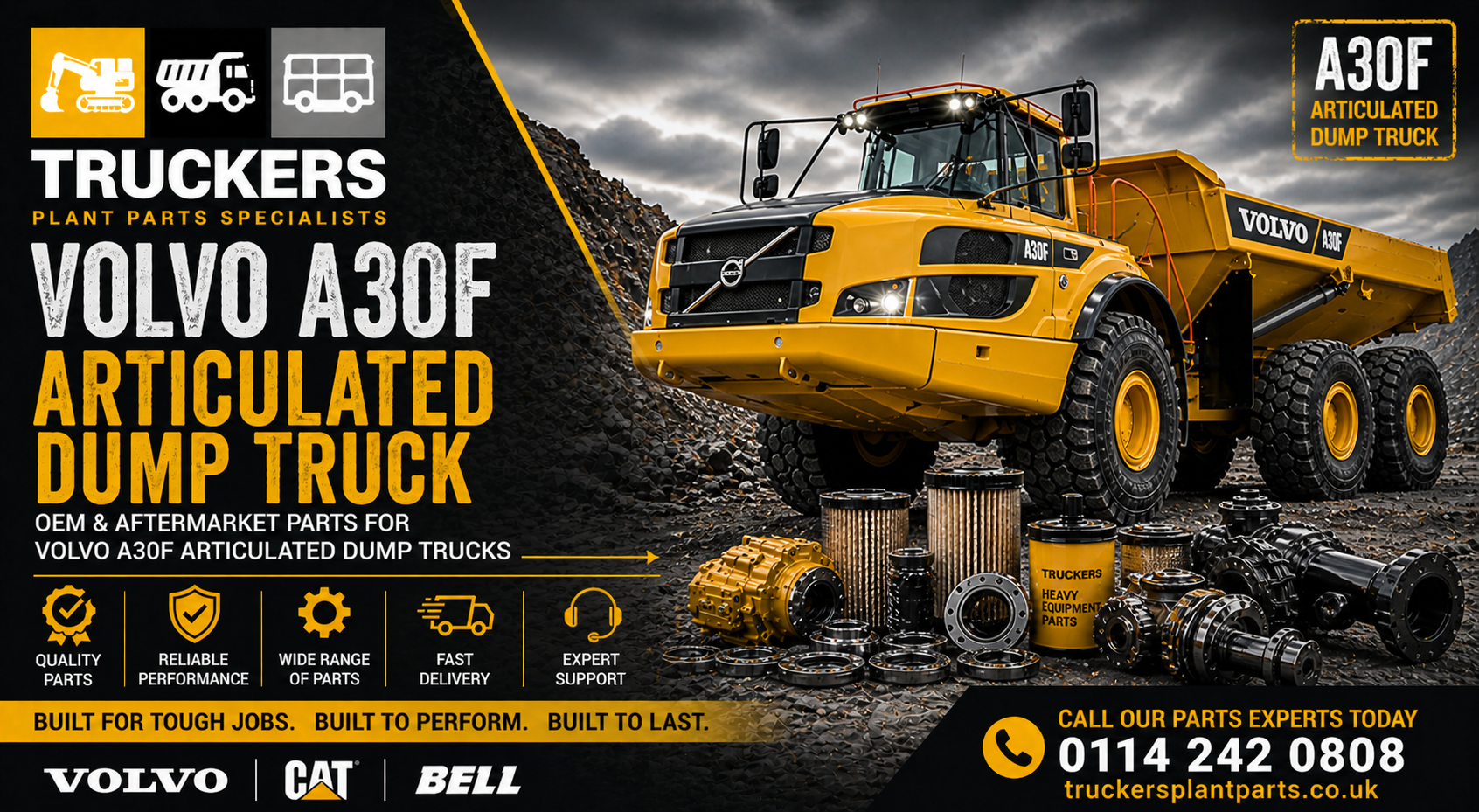
Volvo A30F Articulated Dump Truck – The Refined Evolution Of Volvo’s Legendary 30-Ton Hauler Platform
The Volvo A30F represents one of the most important evolutionary steps in the history of articulated dump trucks because it sits directly at the point where Volvo transitioned from traditional mechanically rugged articulated haulers into fully modern intelligent production machines designed around fuel efficiency, electronic driveline optimisation, advanced operator systems, lower total operating costs, and significantly improved production performance.
Where the older Volvo A30D became famous for its brutal simplicity and near-indestructible reputation, and the A30E introduced the first major steps toward refinement and modernisation, the Volvo A30F fully embraced the modern articulated hauling philosophy without abandoning the core characteristics that made Volvo articulated trucks globally respected in the first place.
That balance is critical to understanding why the A30F remains such an important machine.
Because the A30F was not merely designed to carry material.
It was designed to maximise total operational efficiency across every aspect of heavy off-road hauling.
This included payload management, traction optimisation, fuel economy, transmission intelligence, operator comfort, site productivity, driveline protection, serviceability, uptime, electronic diagnostics, and long-term lifecycle cost reduction.
In many ways, the A30F became the blueprint for the modern articulated dump truck.
The truck sits within Volvo’s highly successful 30-ton articulated hauler category, a payload class many operators still consider the sweet spot within the entire articulated hauling sector. Trucks in this category provide substantial hauling capability while maintaining lower operating costs, greater maneuverability, lower tyre expenses, reduced fuel burn, easier transportation logistics, and greater site flexibility than larger articulated trucks such as A40 and A60 models.
This is particularly important in real-world operations.
Because while larger trucks may deliver higher payloads, they also require larger haul roads, stronger site preparation, greater fuel budgets, larger transport arrangements, and significantly higher component costs.
The A30F instead delivers an exceptionally balanced operating package.
It is large enough to handle serious quarrying, earthmoving, aggregates, mining support, infrastructure, and bulk haulage work while still remaining highly versatile and manageable across a huge variety of job sites.
That versatility is one of the main reasons the A30F became so widely adopted globally.
The machine typically operates with payload capacities around 28 tonnes depending on specification and market configuration. While later Volvo articulated trucks continued pushing payloads higher, the A30F remained highly attractive because it delivered strong production capability without entering the significantly higher ownership costs associated with larger articulated dump truck classes.
Volvo engineered the A30F specifically for severe off-road environments where traction, stability, maneuverability, and ride quality become just as important as payload itself.
This is where articulated haulers continue to dominate over rigid-frame trucks.
Rigid trucks perform exceptionally well on maintained haul roads and smooth quarry operations, but once terrain becomes soft, steep, muddy, heavily rutted, uneven, or unstable, articulated trucks rapidly regain major advantages.
The Volvo A30F thrives in exactly those environments.
The articulated chassis design allows the truck to maintain excellent traction and maneuverability over severe terrain where rigid trucks can become unstable or immobilised. The oscillating rear bogie, articulated steering system, high ground clearance, advanced suspension geometry, and fully integrated 6×6 driveline all combine to give the A30F exceptional off-road mobility.
This is one of the defining strengths of the Volvo articulated hauling platform overall.
And by the time the F-series arrived, Volvo had refined that platform significantly.
The A30F introduced major advancements in transmission technology and driveline intelligence compared with earlier generations. Volvo focused heavily on improving fuel efficiency, traction control, shift quality, torque management, and overall production optimisation.
This became one of the major distinctions separating the A30F from both the A30D and A30E.
Older articulated dump trucks often relied heavily on mechanical durability and operator skill. The A30F instead introduced much more active machine intelligence into the driveline itself.
The transmission system was designed to work more dynamically with engine performance, terrain conditions, traction demands, and hauling cycles.
The result was noticeably smoother operation, improved fuel economy, reduced driveline shock loading, and more consistent productivity across varying site conditions.
Operators immediately noticed the difference.
The truck felt more refined, smoother under load, and more efficient during hauling cycles compared with older models.
Fuel economy improvements became especially important during the A30F era because operational costs across quarrying and earthmoving industries were rising aggressively. Fleet operators increasingly focused on total cost per tonne rather than simply payload figures alone.
Volvo responded directly to those market pressures.
The A30F therefore became heavily optimised around reducing unnecessary fuel consumption while still maintaining strong hauling performance.
This was achieved through improved engine management systems, more intelligent transmission logic, refined hydraulic systems, improved driveline efficiency, and better integration between engine output and transmission behaviour.
Compared with older D-series trucks, the A30F generally offered substantially improved fuel efficiency.
This mattered enormously over thousands of annual operating hours.
Fuel remains one of the single biggest operational costs within articulated hauling fleets.
Even modest efficiency improvements dramatically affect profitability over machine lifecycles.
The engine itself reflected Volvo’s growing emphasis on cleaner, more efficient power delivery. The A30F used advanced diesel engine technology designed to provide strong low-end torque while improving emissions performance and fuel economy simultaneously.
Volvo’s engines have long maintained strong reputations for reliability, torque characteristics, and smooth pulling power under heavy load conditions. The A30F continued building on that reputation while integrating more advanced electronic management systems than earlier generations.
This is where the truck began moving more noticeably toward modern electronically managed heavy equipment.
However, importantly, the A30F still retained a relatively practical balance between electronics integration and serviceability compared with much newer G and H-series trucks.
Many operators consider this extremely important.
Later articulated dump trucks introduced huge advances in automation, telematics, onboard diagnostics, traction prediction systems, dynamic driveline optimisation, and operator assistance technologies. But those improvements also increased machine complexity significantly.
The A30F still sits within a generation many independent operators and heavy equipment engineers consider relatively manageable.
It introduced meaningful technological improvements without yet becoming overwhelmingly software dependent.
That is one reason many operators continue actively searching for A30F machines specifically.
The truck occupies a particularly attractive middle ground.
More refined and fuel efficient than older trucks.
Simpler and less electronically intrusive than many newer machines.
That combination continues to hold enormous value within heavy equipment ownership.
Operator comfort improved substantially on the A30F platform.
Volvo had already established itself as one of the strongest manufacturers in articulated hauling operator environments, but the F-series pushed this even further.
The cab became quieter, more ergonomic, better insulated, and more operator-focused overall. Improved seating systems, refined control layouts, reduced vibration levels, better visibility, improved climate systems, and enhanced operational ergonomics all contributed toward reducing operator fatigue during long shifts.
This matters more than many people initially realise.
Articulated dump trucks often operate continuously for extremely long periods across rough haul roads under severe conditions. Fatigue directly affects operator performance, productivity, fuel efficiency, machine abuse, and site safety.
Comfort therefore becomes a production feature.
Not merely a luxury.
The A30F also improved ride quality significantly through suspension and chassis refinement. Volvo continued developing its reputation for producing articulated trucks with excellent stability and predictable off-road handling characteristics.
The truck remains highly stable over rough terrain while maintaining strong traction and controllability.
This contributes heavily toward operator confidence and cycle efficiency.
Serviceability also improved noticeably on the A30F compared with earlier trucks.
Volvo increasingly focused on reducing downtime through improved maintenance access, grouped service points, improved diagnostics capability, easier filter access, simplified servicing procedures, and more efficient component layouts.
Because downtime remains one of the most expensive aspects of heavy machinery ownership.
An articulated dump truck sitting idle affects production immediately.
The A30F therefore became designed not only around production output, but also around maintaining uptime efficiently throughout long operational lifecycles.
Compared with later machines, the A30F still remains relatively approachable mechanically and electronically for experienced heavy equipment engineers.
That is another reason the truck continues holding strong secondary-market value.
Many fleet owners appreciate machines they can still diagnose, maintain, and repair without becoming completely dependent on dealer-level proprietary systems.
The A30F therefore occupies a particularly respected position within Volvo articulated hauling history.
It represents the point where Volvo successfully modernised the articulated dump truck platform while still preserving much of the ruggedness, practicality, durability, and serviceability operators valued in the older trucks.
Compared with the A30E, the A30F generally improved fuel efficiency, driveline intelligence, transmission refinement, operator comfort, diagnostics capability, and total operational optimisation.
Compared with later G and H-series trucks, the A30F may sacrifice some advanced automation and integrated telematics capability, but many operators still argue it remains easier to own, easier to maintain, and less electronically burdensome overall.
That balance remains one of the truck’s greatest strengths.
Truckers Plant Parts support the Volvo A30F extensively with OEM, OEM-equivalent, rebuilt, and quality aftermarket parts covering engines, transmissions, torque converters, axle systems, suspension systems, articulation joints, steering systems, hydraulics, braking systems, cooling systems, electrical systems, body systems, driveline components, cab systems, filtration systems, wear components, service kits, and emergency VOR support.
Because machines like the A30F continue operating productively throughout the world every single day.
And keeping them moving remains absolutely critical to the industries that depend on them.
FAQ: Volvo A30F Articulated Dump Truck
1. What is the Volvo A30F?
The Volvo A30F is a heavy-duty articulated dump truck designed for severe off-road hauling applications.
2. What type of machine is the A30F?
It is a 6×6 articulated hauler used in quarrying, construction, mining support, and earthmoving operations.
3. What payload category does the A30F sit within?
The machine sits within the important 30-ton articulated hauling category.
4. Why is the 30-ton category popular?
It balances productivity, operating cost, maneuverability, and site flexibility extremely well.
5. What industries commonly use the A30F?
Quarrying, aggregates, mining support, landfill, earthmoving, infrastructure, forestry, and recycling industries commonly use the truck.
6. Why is the A30F considered important within Volvo history?
It represents Volvo’s transition into modern electronically optimised articulated hauling.
7. How did the A30F improve over the A30E?
It introduced greater driveline intelligence, fuel efficiency, refinement, and operator optimisation.
8. What made the A30D different from the A30F?
The older A30D was mechanically simpler and less electronically advanced.
9. Why do some operators still prefer older articulated trucks?
Simpler trucks can sometimes be easier and cheaper to maintain.
10. What makes the A30F attractive today?
It balances modern refinement with relatively manageable complexity.
11. What terrain can the A30F operate in?
Mud, quarry haul roads, steep grades, rough terrain, soft ground, and severe off-road environments.
12. Why are articulated trucks effective off-road?
Articulation improves traction and terrain adaptability.
13. What does 6×6 mean?
All six wheels can receive drive power.
14. Why is 6×6 important?
It improves traction and mobility under poor ground conditions.
15. Why are articulated dump trucks different from rigid trucks?
They perform far better in difficult off-road terrain.
16. Why are articulated trucks popular in quarries?
They remain productive even on poor haul roads.
17. Why are articulated trucks useful in earthmoving?
They adapt well to constantly changing site conditions.
18. What engine technology does the A30F use?
Advanced Volvo diesel engine systems designed for torque and fuel efficiency.
19. Why is low-end torque important?
Low-end torque improves pulling power under load.
20. Why did Volvo focus heavily on fuel efficiency?
Fuel became one of the largest operational costs in hauling fleets.
21. How did the A30F improve fuel economy?
Improved driveline management and transmission optimisation reduced fuel consumption.
22. Why is fuel economy important in articulated haulage?
Small efficiency gains create major long-term savings.
23. What transmission improvements did the A30F introduce?
Smoother shifts, improved torque management, and better driveline integration.
24. Why is transmission refinement important?
Smooth driveline operation reduces wear and improves productivity.
25. What driveline systems are fitted to the A30F?
Transmission, differentials, axle systems, prop shafts, and torque management systems are integrated throughout the truck.
26. Why are driveline systems heavily stressed?
Large payloads and rough terrain create enormous mechanical forces.
27. What axle systems does the A30F use?
Heavy-duty off-road axle systems designed for severe hauling conditions.
28. Why are axle systems important?
They transfer torque while supporting massive payloads.
29. What suspension systems are fitted?
Heavy-duty articulated suspension systems improve stability and ride quality.
30. Why is ride quality important?
Operators spend long shifts hauling continuously across rough terrain.
31. Why does operator comfort affect productivity?
Fatigue reduces operator performance and site efficiency.
32. How did the A30F improve cab comfort?
Improved seating, visibility, insulation, ergonomics, and vibration control improved comfort.
33. Why is visibility important on articulated haulers?
Large haul trucks operate within busy and potentially hazardous environments.
34. What steering system does the A30F use?
Hydraulic articulated steering systems are fitted.
35. Why is articulated steering useful?
It improves maneuverability on confined or uneven sites.
36. What braking systems are fitted to the A30F?
Heavy-duty hydraulic braking systems are integrated throughout the machine.
37. Why are braking systems heavily stressed?
Large payloads create massive stopping forces continuously.
38. What braking components commonly wear?
Brake discs, cooling systems, hydraulic seals, and brake components commonly wear.
39. Why are cooling systems important?
Continuous hauling generates major heat loads.
40. What cooling components commonly fail?
Radiators, hydraulic coolers, hoses, and fan systems commonly require replacement.
41. Why is overheating dangerous?
Overheating damages engines, transmissions, hydraulics, and seals.
42. What hydraulic systems are fitted to the A30F?
Hydraulics power steering, tipping, braking, and machine control systems.
43. Why are hydraulic systems critical?
Hydraulics control major operational systems throughout the truck.
44. What hydraulic components commonly require support?
Pumps, cylinders, hoses, valves, and accumulators commonly require servicing.
45. What are articulation joints?
They connect the front and rear chassis sections.
46. Why are articulation joints important?
They allow steering and chassis movement over rough terrain.
47. What articulation components commonly wear?
Pins, bushes, bearings, and seals commonly wear.
48. What body systems are fitted to the A30F?
Heavy-duty dump body systems designed for bulk material hauling.
49. Why are dump bodies heavily stressed?
Payload impacts and abrasive material create continuous wear.
50. What body components commonly wear?
Hinges, wear plates, liners, and structural body sections commonly wear.
51. What electrical systems are used on the A30F?
Sensors, diagnostics systems, electronic controls, and monitoring systems are integrated throughout the machine.
52. Why did the A30F introduce more electronics?
Volvo aimed to improve efficiency and operational control.
53. Why do some operators prefer the A30F over newer trucks?
It offers a balance between technology and maintainability.
54. Why are later trucks more electronically complex?
Modern machines integrate advanced telematics and automation systems.
55. Why can electronic complexity increase ownership costs?
Advanced systems often require specialised diagnostics and dealer-level support.
56. Why does the A30F remain commercially valuable?
The machine still offers excellent productivity and reliability.
57. Why do operators still actively buy A30F trucks?
They remain dependable and versatile production machines.
58. What are common high-hour wear areas?
Driveline systems, articulation joints, hydraulics, and suspension systems commonly wear.
59. Why are tyres important on articulated dump trucks?
Tyres affect traction, flotation, stability, and operating costs.
60. Why are articulated dump truck tyres expensive?
Large off-road tyres operate under severe continuous loading.
61. What maintenance items commonly require replacement?
Filters, oils, hoses, seals, bearings, and wear components commonly require replacement.
62. Why is preventative maintenance important?
Preventative maintenance reduces catastrophic failures.
63. Why is uptime important?
Stopped trucks immediately reduce site productivity.
64. Why did Volvo improve serviceability on the A30F?
Simplified maintenance reduces downtime and ownership costs.
65. What serviceability improvements did the A30F introduce?
Better component access, grouped service points, and improved diagnostics access improved servicing.
66. Why are diagnostics systems important?
Diagnostics improve troubleshooting and repair efficiency.
67. What are VOR situations?
Vehicle Off Road situations occur when machinery fails unexpectedly.
68. Why are VOR situations expensive?
Idle machinery rapidly increases operational losses.
69. Does Truckers support the Volvo A30F?
Yes. Truckers support the A30F extensively.
70. What A30F systems are commonly supported?
Engines, transmissions, hydraulics, axles, brakes, cooling systems, articulation systems, and electrical systems are all supported.
71. Does Truckers supply OEM parts?
Yes. Genuine OEM parts are available.
72. Does Truckers supply aftermarket options?
Yes. OEM-equivalent and quality aftermarket parts are also available.
73. Why are aftermarket options useful?
They provide cost-effective repair alternatives.
74. Can Truckers source obsolete A30F parts?
Yes. Difficult-to-source components can often be sourced globally.
75. Why are older articulated truck parts sometimes difficult to find?
Production may have ended years earlier.
76. Does Truckers offer emergency breakdown support?
Yes. Rapid-response VOR assistance is available.
77. Does Truckers offer next-day delivery?
Yes. Fast UK delivery is available for many components.
78. Does Truckers offer same-day collection?
Yes. Many stocked items are available immediately.
79. Can dedicated transport be arranged?
Yes. Urgent delivery solutions can be arranged.
80. Why does heavy equipment expertise matter?
Correct diagnosis reduces downtime and unnecessary repair costs.
81. Why are experienced parts suppliers valuable?
They understand machine systems and common failure patterns.
82. Why are quarry environments difficult on articulated trucks?
Dust, impact loading, and abrasive materials accelerate wear heavily.
83. Why are articulated trucks effective in mining support?
They maintain traction and productivity under severe conditions.
84. Why are articulated dump trucks used in landfill operations?
They perform well on unstable and soft ground.
85. What later models replaced the A30F?
The A30G and later H-series trucks followed.
86. How did later G-series trucks improve further?
They introduced more advanced telematics and intelligent driveline systems.
87. Why do some operators still prefer the A30F over newer trucks?
It remains less electronically intrusive overall.
88. Why are Volvo articulated trucks respected worldwide?
Volvo pioneered articulated hauling technology globally.
89. Why do Volvo trucks maintain strong resale value?
Operators trust their durability and lifecycle performance.
90. Why are articulated dump trucks expensive to rebuild?
Large driveline and hydraulic systems create major repair costs.
91. What transmission components commonly wear?
Clutches, seals, valve bodies, and torque converters commonly wear.
92. What are torque converters?
Hydraulic systems transferring engine power through the driveline.
93. Why are differential systems important?
Differentials distribute power across the axles effectively.
94. Why are suspension systems heavily stressed?
Continuous off-road hauling creates constant impact loading.
95. What suspension components commonly wear?
Bushes, cylinders, pivot systems, and mounting components commonly wear.
96. Why are articulated trucks popular globally?
They outperform many alternatives in severe terrain conditions.
97. Why is the A30F considered well balanced?
It combines productivity, comfort, efficiency, and reliability successfully.
98. What best separates the A30F from older trucks?
Its improved driveline intelligence and fuel optimisation systems.
99. What best separates the A30F from newer trucks?
It remains more manageable mechanically and electronically.
100. What best describes the Volvo A30F overall?
The Volvo A30F represents one of the most balanced and respected articulated dump trucks ever produced, successfully combining modern fuel efficiency, driveline refinement, operator comfort, off-road capability, productivity, durability, and manageable ownership complexity into a highly effective heavy hauling platform still trusted throughout the world today.
A20, A25, A25B, A25C, A25D, A25E, A25F, A25G, A30, A30C, A30D, A30E, A30F, A30G, A35, A35C, A35D, A35E, A35F, A35G, A40, A40C, A40D, A40E, A40F, A40G, A45G, A60H, A25, A30, A35, A40, A45, A50, A60H, A30