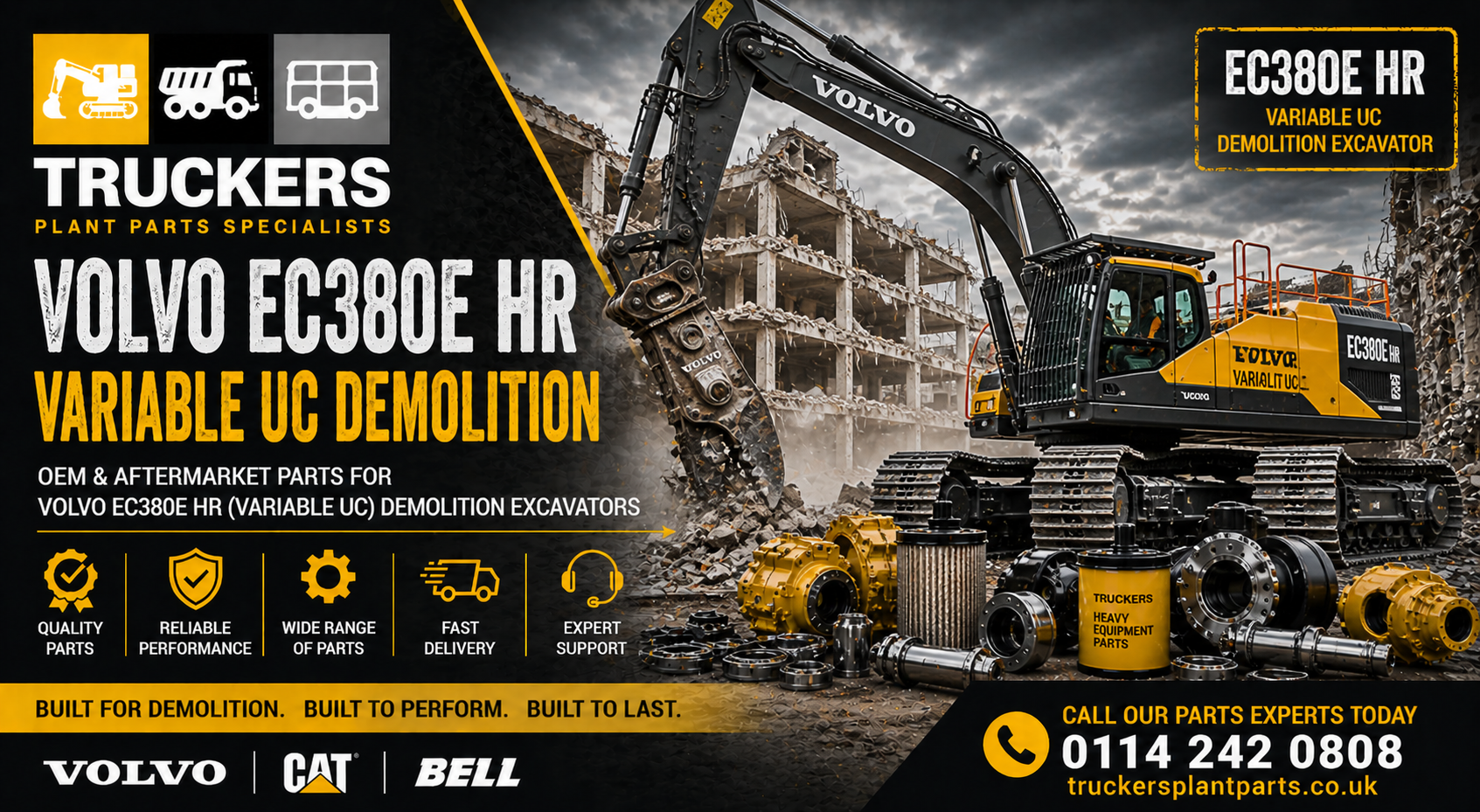
Volvo EC380E HR High Reach Demolition Excavator Parts, Repairs & Support – Truckers Plant Parts
The Volvo EC380E HR represents one of the most specialised and purpose-built demolition excavators within the heavy equipment industry. Designed specifically for demanding structural dismantling, industrial demolition, high-reach concrete processing, steel reduction, infrastructure removal, bridge demolition, and severe-duty deconstruction projects, the EC380E HR combines enormous hydraulic capability, advanced stability systems, specialised demolition engineering, and exceptional structural durability into a machine purpose-built for one of the harshest environments any excavator will ever face.
Unlike conventional crawler excavators adapted for occasional demolition work, the Volvo EC380E HR was engineered from the ground up as a dedicated demolition platform capable of supporting high-reach attachments safely and efficiently under extreme operational conditions. Everything about the machine reflects this purpose. The reinforced structure, advanced hydraulic systems, tilting demolition cab, modular boom system, variable undercarriage design, counterweight balancing, and specialised demolition safety features all work together to create a machine capable of performing safely and productively during highly demanding demolition projects.
In demolition environments, machines operate under a completely different category of stress compared with normal excavation or earthmoving work.
Hydraulic systems operate continuously at high pressure while powering heavy demolition attachments. Structural components absorb constant shock loading and vibration. Undercarriages carry heavy high-reach equipment while maintaining machine stability. Cooling systems operate under enormous thermal load while exposed to heavy contamination from concrete dust, metal debris, insulation fibres, and airborne demolition material. Attachments generate violent twisting forces and impact loads continuously. The machine itself often works close to structural collapse zones while maintaining precise hydraulic control and maximum operator visibility.
This is why high-reach demolition excavators such as the Volvo EC380E HR require specialist parts support, rapid repairs capability, preventative maintenance, and technical understanding far beyond standard construction equipment.
Truckers Plant Parts supports the Volvo EC380E HR and the wider Volvo demolition excavator range with OEM, OEM-equivalent, and quality aftermarket parts covering engines, hydraulics, demolition attachments, structural systems, undercarriage systems, cooling packages, electrical systems, demolition booms, wear systems, cylinders, slew systems, cab systems, and critical demolition support components designed specifically for severe-duty demolition environments.
The EC380E HR sits within Volvo’s specialist demolition range alongside machines such as the EC300E HR, EC480E HR, and EC750E HR. These machines are specifically engineered for high-reach and heavy-duty demolition operations where conventional excavators simply cannot operate safely or efficiently.
At the heart of the EC380E HR is Volvo’s D13J engine platform producing approximately 307 horsepower. The 12.8-litre engine provides the hydraulic power and low-end torque required for sustained demolition attachment operation under continuous heavy load. Demolition excavators place enormous demand on hydraulic systems because attachments such as pulverisers, shears, crushers, and breakers require constant oil flow and sustained pressure to operate effectively.
The EC380E HR hydraulic system is therefore one of the most important and heavily stressed areas of the machine.
The excavator utilises variable axial piston hydraulic pumps capable of delivering approximately 79 gallons per minute per pump while operating at pressures exceeding 4,690 PSI with boost pressures reaching over 5,120 PSI. These are extremely high hydraulic loads sustained continuously throughout demolition operations.
This level of hydraulic demand means every component within the hydraulic system becomes critically important.
Hydraulic pumps, main control valves, auxiliary spool systems, demolition attachment circuits, swivel joints, hose assemblies, hydraulic cylinders, hydraulic tanks, pipework, accumulators, hydraulic filters, cooling systems, fan drives, and hydraulic motors all require ongoing inspection, servicing, and replacement support throughout the machine lifecycle.
Truckers Plant Parts supports all major hydraulic systems across the Volvo demolition range including complete hydraulic pumps, seal kits, control valves, auxiliary hydraulic systems, pressure sensors, pipework assemblies, hose kits, hydraulic coolers, filtration systems, accumulators, and demolition attachment hydraulic interfaces.
One of the defining features of the EC380E HR is Volvo’s patented modular boom system.
This highly specialised demolition boom configuration allows the machine to operate across multiple demolition applications while maintaining structural strength and safe operating geometry. The machine can utilise straight boom configurations, demolition boom systems, triple articulated boom arrangements, and banana boom setups depending on project requirements.
These boom systems are highly engineered structural assemblies operating under severe stress continuously.
Boom pivots, boom cylinders, demolition dipper arms, articulation points, pins, bushes, structural welds, lifting systems, attachment brackets, quick couplers, hydraulic routing systems, and structural reinforcement zones all require specialist maintenance and parts support to maintain safe operating performance.
Truckers supports demolition boom systems across the Volvo HR range including pins, bushes, cylinder systems, seal kits, wear plates, boom pipework, structural repair components, attachment brackets, coupler systems, and heavy-duty wear items designed specifically for demolition applications.
The EC380E HR variable undercarriage system represents another highly specialised engineering feature designed specifically for demolition stability.
Demolition excavators require maximum stability when operating at height with heavy attachments because structural loads and machine balance become critically important for operator safety and operational control. The variable undercarriage allows the machine to widen for operational stability and retract for transport requirements.
This system places huge stress on undercarriage structures, track systems, slew rings, rollers, idlers, recoil systems, and undercarriage hydraulic systems.
Demolition environments are exceptionally aggressive on undercarriage systems because machines often operate over broken concrete, sharp debris, steel fragments, unstable ground conditions, and abrasive demolition waste continuously.
Truckers supports the EC380E HR undercarriage systems with rollers, sprockets, idlers, track chains, track pads, recoil systems, slew rings, slew bearings, slew motors, undercarriage hydraulics, final drives, planetary systems, and structural undercarriage components designed for severe-duty demolition environments.
The EC380E HR is also designed around specialised demolition attachments capable of processing reinforced structures efficiently.
Hydraulic shears, pulverisers, concrete crushers, breakers, selector grabs, grapples, magnets, and sorting attachments all place huge demands on the excavator platform itself. These attachments often weigh up to 6,614 lbs while operating at substantial height and reach distances.
The machine therefore depends heavily on hydraulic stability, structural integrity, and attachment management systems operating correctly at all times.
Truckers Plant Parts supports both the machine itself and the attachments operating on it.
Demolition shears require support for wear blades, jaw pivots, hydraulic cylinders, rotation motors, bearings, seal kits, and cutting systems. Pulverisers require crushing teeth, rotation systems, cylinder rebuild kits, jaw pivots, structural wear systems, and hydraulic support components. Breakers require pistons, bushes, diaphragms, retainer systems, tool steels, seal kits, nitrogen systems, and rebuild components.
Because demolition attachments operate under constant violent stress, failures become inevitable over time.
A failed rotation motor on a pulveriser can stop concrete processing immediately. A damaged shear blade can halt steel cutting operations. A burst hose on a demolition boom may immobilise the entire machine. A failed breaker piston may stop bridge removal work instantly.
When these failures occur on front-line demolition machinery, downtime becomes extremely expensive very quickly.
Demolition projects are often tightly scheduled with strict operational deadlines, environmental requirements, waste removal coordination, transport schedules, and structural sequencing plans all interconnected. Delays can create major financial consequences rapidly.
This is why Truckers focuses heavily on rapid-response demolition parts supply.
Massive stockholding capability allows many demolition wear parts, hydraulic systems, filters, cylinders, seals, pumps, attachment systems, and structural components to be supplied immediately for same-day collection or next-day delivery. Dedicated same-day transport can be arranged when critical demolition equipment becomes VOR and immediate response is essential.
For obsolete or specialist demolition systems, Truckers leverages extensive international sourcing networks built through decades within the heavy equipment sector.
This becomes particularly important for older demolition equipment, discontinued attachment systems, obsolete hydraulic controls, legacy boom systems, and specialist structural components no longer easily available through traditional dealer networks.
Operator safety is another area where the EC380E HR demonstrates Volvo’s specialist demolition engineering approach.
The machine incorporates a Falling Object Guard system, reinforced demolition cab protection, a 30-degree tilting high-visibility cab, advanced monitoring systems, and structural protection features designed specifically for demolition risk environments.
Visibility becomes critically important during demolition work because operators often work around unstable structures, falling debris zones, steel collapse risks, and restricted urban environments where precise machine positioning matters enormously.
Truckers supports demolition cab systems including glass, guards, lighting systems, camera systems, operator controls, joysticks, displays, HVAC systems, electrical systems, seating systems, and electronic monitoring systems across the Volvo demolition range.
Modern EC380E HR machines also integrate Volvo CareTrack telematics systems allowing operators and fleet managers to monitor machine performance, operating hours, fault codes, fuel usage, service intervals, hydraulic performance, and operational efficiency remotely.
These systems become increasingly important within demolition fleets where proactive maintenance and rapid diagnostics can significantly reduce downtime risk.
Truckers supports electrical systems, telematics hardware, ECUs, displays, sensors, cameras, machine control systems, and electronic diagnostics systems throughout the Volvo demolition equipment range.
Ultimately, the Volvo EC380E HR represents far more than simply a large excavator.
It is a highly specialised demolition platform engineered specifically for severe-duty structural dismantling operations where strength, stability, hydraulic performance, safety, and reliability become absolutely critical.
Machines of this type do not operate in easy environments.
They operate in collapsing structures.
They operate in abrasive contamination.
They operate under constant impact loading.
They operate under extreme hydraulic stress.
They operate against aggressive production schedules where downtime becomes incredibly expensive.
That is exactly why specialist support matters so much.
Truckers Plant Parts therefore supports the Volvo EC380E HR and the complete Volvo demolition range with rapid parts supply, demolition attachment support, emergency repair assistance, hydraulic systems, structural components, undercarriage systems, wear parts, OEM and aftermarket solutions, and difficult-to-source demolition equipment components designed to keep critical demolition machinery operating safely, efficiently, and productively even under the harshest demolition conditions imaginable.
FAQ: Parts, Hydraulics, Demolition Attachments, Repairs & Severe-Duty Demolition Support
1. What is the Volvo EC380E HR?
The Volvo EC380E HR is a purpose-built high reach demolition excavator designed for structural demolition, industrial dismantling, concrete processing, and severe-duty demolition operations.
2. What does HR stand for?
HR stands for High Reach.
3. Why is the EC380E HR different from a normal excavator?
The machine was engineered specifically for demolition rather than standard excavation work.
4. What industries use the EC380E HR?
Demolition, industrial dismantling, bridge removal, infrastructure demolition, recycling, scrap processing, and structural deconstruction industries use the machine.
5. Why are demolition excavators heavily specialised?
Demolition creates extreme structural stress, hydraulic demand, vibration, and safety requirements far beyond standard construction work.
6. What operating weight does the EC380E HR have?
The machine operates at approximately 118,520 lbs depending on configuration.
7. What engine powers the EC380E HR?
The machine uses a Volvo D13J engine.
8. How much power does the EC380E HR produce?
The excavator produces approximately 307 horsepower.
9. Why is engine torque important on demolition excavators?
Demolition attachments require sustained hydraulic power under heavy continuous load.
10. What hydraulic pump system does the EC380E HR use?
The machine uses variable axial piston hydraulic pumps.
11. How much hydraulic flow does the machine produce?
The EC380E HR delivers approximately 79 gallons per minute per pump.
12. Why is hydraulic performance so important in demolition?
Attachments such as shears, pulverisers, and breakers depend entirely on hydraulic power.
13. What hydraulic pressure does the EC380E HR operate at?
Boom pressure reaches approximately 4,690 PSI with boost pressure exceeding 5,120 PSI.
14. Why are demolition hydraulics heavily stressed?
Attachments operate continuously under high pressure while absorbing impact and vibration.
15. What demolition attachments can the EC380E HR operate?
Shears, pulverisers, crushers, breakers, grapples, selector grabs, magnets, and demolition buckets are commonly used.
16. What are hydraulic shears used for?
Hydraulic shears cut steel beams, rebar, structural steel, and heavy metallic structures.
17. What are pulverisers used for?
Pulverisers crush reinforced concrete and separate rebar from concrete structures.
18. What are concrete crushers used for?
Concrete crushers reduce large reinforced concrete structures into manageable material.
19. What are demolition breakers used for?
Breakers deliver high-impact energy into concrete, foundations, rock, and structures.
20. What are demolition grapples used for?
Grapples handle demolition waste, scrap material, steel, timber, and structural debris.
21. Why do demolition attachments wear heavily?
Extreme hydraulic force, impact loading, vibration, and abrasive debris create severe wear.
22. What attachment parts commonly wear?
Blades, teeth, pivots, cylinders, bearings, hoses, rotators, pins, bushes, and seals commonly wear.
23. What is the maximum demolition tool weight for the EC380E HR?
The machine supports demolition tools weighing approximately 6,614 lbs.
24. Why is machine balance important on high-reach demolition excavators?
Heavy attachments operating at height create major stability challenges.
25. What is the Volvo modular boom system?
Volvo’s modular boom system allows the machine to operate across multiple demolition configurations.
26. Why is a modular boom system valuable?
It improves versatility and allows adaptation to different demolition applications.
27. What boom configurations can the machine use?
Straight boom, demolition boom, banana boom, and triple articulated boom configurations are available.
28. Why are demolition booms heavily stressed?
They absorb constant vibration, structural loading, and attachment forces.
29. What boom components commonly wear?
Pins, bushes, cylinders, wear plates, structural welds, and hydraulic pipework commonly wear.
30. Why are boom inspections important?
Structural cracking and fatigue can become dangerous if ignored.
31. What is the maximum demolition boom height?
The machine reaches approximately 75 ft 8 in at the attachment pivot.
32. Why is high reach capability important?
It allows safe dismantling of tall structures from controlled positions.
33. What is the EC380E HR variable undercarriage?
A hydraulically adjustable undercarriage designed for improved demolition stability.
34. Why is a variable undercarriage important?
It increases stability during demolition work while improving transport flexibility.
35. Why are demolition undercarriages heavily stressed?
Machines operate over broken concrete, steel debris, and unstable surfaces continuously.
36. What undercarriage parts commonly wear?
Track chains, rollers, idlers, sprockets, recoil systems, and slew systems commonly wear.
37. Why are slew systems important?
Slew systems control upper structure rotation during demolition operations.
38. Why are slew systems heavily stressed?
Heavy attachments and continuous rotational loading create enormous stress.
39. What slew components commonly fail?
Slew rings, slew motors, bearings, pinions, and gear systems commonly wear.
40. What final drive systems does the EC380E HR use?
Planetary reduction final drive systems designed for severe-duty operation.
41. Why are final drives important?
Final drives transfer enormous torque loads to the tracks.
42. What final drive failures commonly occur?
Bearing failures, contamination, seal failures, overheating, and planetary damage commonly occur.
43. Why are demolition cooling systems heavily stressed?
Hydraulic systems generate huge heat while operating in contaminated environments.
44. What cooling components commonly fail?
Radiators, hydraulic coolers, hoses, fan systems, and intercoolers commonly fail.
45. Why is overheating dangerous in demolition equipment?
Overheating damages hydraulics, seals, engines, electronics, and driveline systems.
46. What safety systems does the EC380E HR include?
Falling Object Guards, reinforced structures, monitoring systems, and demolition-specific safety features are included.
47. What is a Falling Object Guard?
A protective system designed to shield operators from falling debris.
48. Why is operator visibility important in demolition?
Operators often work around unstable structures and dangerous debris zones.
49. What is the EC380E HR tilting cab system?
A demolition cab capable of tilting approximately 30 degrees for improved upward visibility.
50. Why is a tilting cab important?
It improves operator visibility during high-reach demolition work.
51. Why are demolition cabs reinforced?
Operators require protection from debris, falling material, and structural hazards.
52. What cab systems commonly require maintenance?
Glass, lighting, HVAC systems, joysticks, displays, controls, cameras, and wiring systems commonly require support.
53. What telematics system does the EC380E HR use?
Volvo CareTrack telematics systems are integrated into the machine.
54. Why are telematics valuable?
They help monitor machine performance, fault codes, service intervals, and operating efficiency.
55. What electrical systems are used on the EC380E HR?
ECUs, sensors, displays, cameras, joysticks, electronic hydraulic controls, and machine management systems are used.
56. Why are electrical systems important in demolition machinery?
Modern demolition excavators rely heavily on electronic machine control systems.
57. Can electrical faults immobilise demolition excavators?
Yes. Electronic failures can stop machine operation immediately.
58. What electrical components commonly fail?
Sensors, harnesses, joysticks, ECUs, connectors, switches, and displays commonly fail.
59. Why are demolition environments difficult on electronics?
Dust, vibration, moisture, impact, and contamination create harsh operating conditions.
60. Does Truckers support Volvo demolition excavator parts?
Yes. Truckers support the EC380E HR and wider Volvo demolition range extensively.
61. What Volvo demolition machines are supported?
EC300E HR, EC380E HR, EC480E HR, EC750E HR, and associated demolition platforms are supported.
62. Does Truckers support demolition attachment parts?
Yes. Shears, pulverisers, crushers, breakers, grapples, and coupler systems are supported.
63. Does Truckers supply hydraulic pumps?
Yes. Hydraulic pumps and complete hydraulic support systems are supplied.
64. Does Truckers supply demolition boom parts?
Yes. Boom cylinders, pivots, pipework, pins, bushes, and structural components are supported.
65. Does Truckers support undercarriage systems?
Yes. Tracks, rollers, sprockets, idlers, slew systems, and final drives are supported.
66. Does Truckers support cooling systems?
Yes. Radiators, coolers, fan systems, hoses, and cooling assemblies are supported.
67. Does Truckers support demolition breaker rebuilds?
Yes. Pistons, seal kits, bushes, diaphragms, and breaker wear systems are supported.
68. Does Truckers support demolition shear rebuilds?
Yes. Blades, pivots, cylinders, bearings, and rotation systems are supported.
69. Does Truckers support pulveriser rebuilds?
Yes. Crushing teeth, jaw systems, bearings, pivots, and hydraulic systems are supported.
70. Does Truckers support grapple systems?
Yes. Rotators, cylinders, jaws, pivots, and wear systems are supported.
71. Does Truckers support coupler systems?
Yes. Quick couplers, locking systems, hydraulic interfaces, and wear pads are supported.
72. Does Truckers supply OEM parts?
Yes. Genuine OEM demolition machine and attachment parts are available.
73. Does Truckers also supply aftermarket options?
Yes. OEM-equivalent and quality aftermarket solutions are available.
74. Why are quality parts especially important in demolition?
Demolition environments destroy weak components very quickly.
75. What happens if low-quality parts fail?
Failures can create major downtime, safety risks, and secondary machine damage.
76. Why are demolition projects highly time-sensitive?
Project schedules, waste processing, and structural sequencing often depend on continuous machine operation.
77. Why is downtime expensive in demolition?
Idle labour, delayed transport, structural delays, and contract penalties can escalate quickly.
78. Does Truckers offer rapid parts delivery?
Yes. Same-day collection and next-day delivery are available for many components.
79. Can Truckers arrange emergency transport?
Yes. Dedicated same-day transport options are available for urgent breakdown situations.
80. Does Truckers source obsolete demolition parts?
Yes. Rare and obsolete demolition systems can often be sourced internationally.
81. Why are obsolete demolition parts difficult to locate?
Older demolition systems may no longer receive official dealer support.
82. Why is demolition machinery more specialised than standard excavators?
High-reach demolition creates extreme structural and hydraulic demands.
83. Why are demolition excavators structurally reinforced?
Attachments create heavy vibration and side loading continuously.
84. What structural areas commonly require repair?
Booms, dipper arms, attachment brackets, slew structures, and undercarriage sections commonly require repair.
85. Why are attachment interfaces important?
Incorrect attachment alignment creates dangerous operating conditions.
86. Why do demolition attachments require aggressive maintenance?
Constant vibration and impact loading accelerate wear rapidly.
87. What hydraulic components commonly fail on demolition attachments?
Cylinders, hoses, rotators, valves, and motors commonly fail.
88. Why are demolition hydraulics difficult to maintain?
High pressure and contamination create extremely demanding operating conditions.
89. Why are demolition excavators expensive machines?
They combine specialised hydraulics, reinforced structures, advanced safety systems, and high-reach engineering.
90. Why is preventative maintenance important on demolition equipment?
Preventative maintenance reduces catastrophic failures and costly downtime.
91. Can severe demolition conditions accelerate wear dramatically?
Yes. Demolition environments are among the harshest conditions in heavy industry.
92. Why do demolition contractors need specialist suppliers?
Demolition equipment requires technical understanding and rapid support capability.
93. Why does real demolition industry experience matter?
Understanding demolition machinery improves diagnostics, sourcing, and repair planning.
94. Can attachment failures stop entire projects?
Yes. Attachment failure can halt structural processing operations immediately.
95. Why are hydraulic leaks dangerous on demolition sites?
Leaks reduce machine performance and may create contamination or safety hazards.
96. What maintenance areas are most critical on the EC380E HR?
Hydraulics, structures, undercarriage systems, slew systems, cooling systems, and attachments are critical.
97. Why are demolition excavators considered severe-duty machines?
They operate continuously under high pressure, vibration, contamination, and structural load.
98. Why do operators trust Volvo demolition excavators?
Operators value stability, hydraulic performance, structural durability, and operator safety.
99. Why do demolition fleets trust Truckers Plant Parts?
Because of technical understanding, rapid parts support, and demolition industry experience.
100. What best describes Truckers support for the Volvo EC380E HR overall?
Truckers Plant Parts provide specialist OEM, OEM-equivalent, and quality aftermarket support for the Volvo EC380E HR and wider Volvo demolition range, supplying hydraulics, undercarriage systems, slew systems, demolition booms, structural components, attachment rebuild parts, cooling systems, electrical systems, emergency breakdown support, and difficult-to-source demolition equipment components designed to keep critical demolition machinery operating safely and efficiently in the harshest demolition environments imaginable.
You have not enough Humanizer words left. Upgrade your Surfer plan.