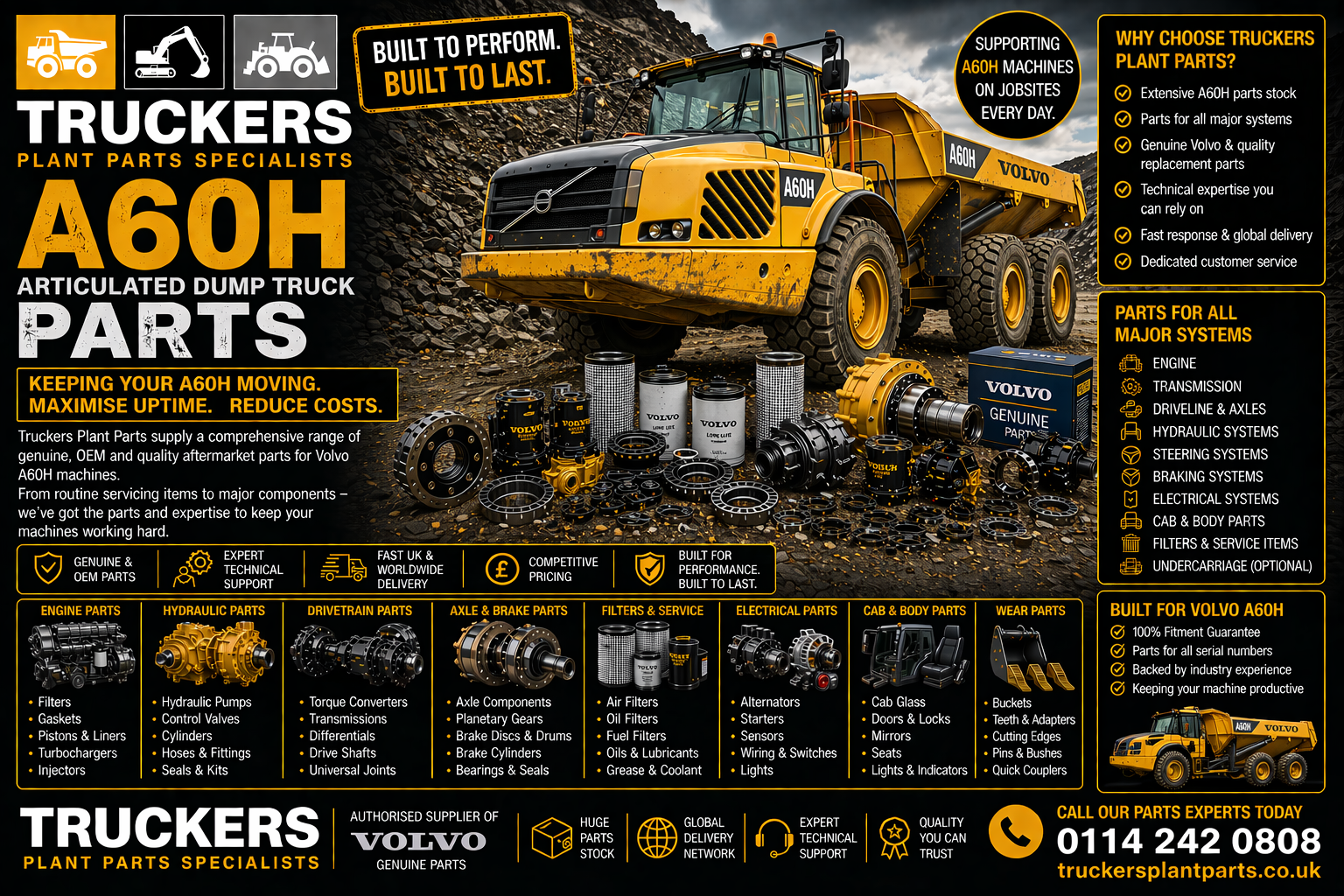
Volvo A60H Articulated Dump Truck – The Giant Volvo Hauler That Changed The 6×6 ADT Market
The Volvo A60H is one of the most important articulated dump trucks ever produced because it took the traditional off-road hauler concept and pushed it into a payload class that had previously been dominated by rigid mining and quarry trucks. Volvo did not simply build a bigger articulated truck with the A60H. It created a new kind of production machine for operators who needed extreme payload capacity, serious off-road traction, high site output, and lower cost per tonne in conditions where rigid trucks could not always operate efficiently.
The A60H sits at the very top of Volvo’s articulated hauler range. It was introduced as the world’s largest full-suspension 6×6 articulated hauler, carrying approximately 55 tonnes, or around 60 short tons, depending on market specification. That makes it a machine built for the largest earthmoving, quarrying, mining support, infrastructure, overburden removal, muck shifting, landfill, and bulk material movement applications.
Where machines like the A25, A30, A35, and A40 are often chosen for flexibility and general off-road hauling, the A60H is chosen for production. It is not a small support truck. It is a frontline tonnage machine. It exists to move serious material, all day, in difficult ground conditions, while keeping the articulated hauler advantages that Volvo has refined for decades.
The biggest strength of the A60H is that it gives operators very large payload capacity without forcing them entirely into rigid truck territory. Rigid dump trucks can be extremely efficient on prepared haul roads, but they need stable, well-maintained routes and wider operating areas. The A60H gives far more terrain flexibility. Its articulated chassis, 6×6 drive, powerful Volvo driveline, hydro-mechanical steering, all-terrain bogie system, differential locks, and high ground clearance allow it to keep working in conditions that may reduce rigid truck productivity.
That is the key point.
The A60H is not just about carrying more. It is about carrying more where other machines may struggle.
It is especially useful on large sites where ground conditions change frequently. In earthmoving and mining support work, haul roads may be temporary, soft, wet, uneven, steep, or under constant development. In major infrastructure and overburden applications, operators may not have the luxury of permanent haul roads. In these situations, the A60H gives operators massive payload with off-road confidence.
The A60H is powered by Volvo’s large D16 engine platform, producing around 630 horsepower. This is not simply a high-horsepower engine for specification sheets. It is designed around torque, pulling power, low-speed strength, and sustained heavy hauling. Articulated dump trucks spend much of their working lives accelerating under load, climbing gradients, pulling through soft conditions, and maintaining traction across variable terrain. That means low-end torque and driveline efficiency matter more than outright top speed.
Volvo engineered the A60H with a heavy-duty automatic transmission, strong axles, planetary hub reductions, torque converter systems, and intelligent traction management. The drivetrain is built to deal with enormous payload forces while protecting the machine from excessive wheelspin and driveline shock.
This matters enormously because a truck of this size can become very expensive to repair if abused or poorly maintained. Tyres, axles, differentials, transmissions, brake systems, cooling systems, hydraulics, and suspension components all operate under huge stress. The A60H is designed for that environment, but it still needs correct operation, scheduled maintenance, and high-quality parts support to deliver its full commercial value.
Compared with older Volvo ADTs like the A40D, the A60H is in a completely different production class. It carries far more material, uses more advanced technology, has stronger driveline management, delivers better payload monitoring, and offers a far more modern operator environment. It is also far more expensive to buy, run, maintain, and repair. This is why the A60H only makes sense where the work justifies the truck.
Compared with an A30D or A35D, the A60H is not a general all-rounder. The smaller trucks are easier to move between sites, cheaper to operate, more flexible in tighter spaces, and often better for mixed-contract use. The A60H is for high-volume work where loading tools, haul roads, production targets, and site layout can use its size properly.
Compared with an A40D or A45G, the A60H offers a major payload increase. This can reduce the number of trucks required on certain jobs and improve cost per tonne if loading and haul cycles are properly matched. However, if the excavator or wheel loader cannot fill it efficiently, or if haul roads are too restricted, the advantage can disappear quickly.
The A60H therefore depends heavily on fleet matching.
It should be paired with large production excavators, large wheel loaders, or mining support loading equipment capable of filling the body efficiently. If a loading machine takes too many passes, the truck spends too long waiting, and cycle efficiency suffers. When paired correctly, the A60H can dramatically increase site output.
Fuel consumption is one of the biggest considerations with any A60H. A truck this large will naturally burn more fuel than smaller ADTs, but the real measure is not litres per hour alone. The real measure is cost per tonne moved. If the A60H moves significantly more material per cycle and reduces total machine movements, it can deliver excellent efficiency on the right site.
Volvo designed the A60H around this exact principle. The machine is built for maximum productivity at the lowest possible cost per tonne within its size class. Features such as intelligent driveline control, automatic traction systems, Volvo Dynamic Drive, payload monitoring, engine braking, downhill speed control, and efficient powertrain management all contribute to lower total operating cost when the truck is used correctly.
Operator comfort is another major strength of the A60H. Volvo has always placed strong emphasis on the operator environment, and this matters even more in a machine this large. Operators may spend entire shifts hauling material over rough roads, gradients, and changing ground conditions. Fatigue can quickly affect safety, productivity, fuel use, and machine wear.
The A60H cab is designed to provide excellent visibility, intuitive controls, modern display systems, climate control, low noise levels, comfortable seating, strong ergonomics, and clear machine feedback. Modern Volvo haulers also include advanced operator assistance systems and machine monitoring tools that help improve productivity and reduce errors.
Braking and retarding systems are critical on a truck of this size. The A60H uses heavy-duty braking systems designed to control enormous loaded weight on gradients and rough terrain. Downhill speed control, engine braking, retarder functions, wet disc brakes, and load-related machine control systems all help the operator manage the machine safely and consistently.
This is especially important in quarrying and mining support environments where loaded descents can be one of the most demanding parts of the haul cycle.
The A60H also benefits from Volvo’s focus on serviceability. Large trucks need maintenance access to be practical. Ground-level service points, grouped filters, strong diagnostic systems, remote monitoring, long service intervals, and intelligent maintenance planning all help reduce downtime. On a machine this size, uptime is everything. One stopped A60H can remove a huge amount of hauling capacity from the site instantly.
Truckers Plant Parts support the Volvo A60H with OEM, OEM-equivalent, rebuilt, and quality aftermarket parts covering engine systems, D16 components, turbochargers, injectors, cooling systems, hydraulic systems, transmission components, torque converters, axle systems, differentials, planetary hubs, brake systems, suspension components, articulation joints, steering systems, electrical systems, sensors, ECUs, cab parts, filters, service kits, body components, dump cylinders, hoses, seals, oils, greases, and emergency VOR support.
That parts support is vital because the A60H is not a machine where downtime can be treated casually. If an A60H fails during production, the effect can be immediate and expensive. Haul cycles slow. Excavators wait. Loading tools lose efficiency. Production targets come under pressure. On major infrastructure and quarrying operations, that lost time can translate directly into financial loss.
The A60H’s closest rivals include large articulated haulers from Bell, Caterpillar, Komatsu, and John Deere, as well as smaller rigid trucks in certain applications. Bell’s large ADTs are serious competitors, particularly where operators value robust hauling and simple ownership. Caterpillar brings huge dealer support and strong resale confidence. Komatsu offers proven heavy-duty engineering, especially in mining-related environments. Rigid trucks can outperform articulated haulers on prepared roads with long, stable haul routes.
However, the A60H’s key advantage is its blend of payload, traction, Volvo driveline intelligence, operator comfort, off-road capability, and true articulated mobility.
It is not always the cheapest truck to own. It is not always the most flexible truck. It is not always the right truck for smaller sites. But where conditions suit it, the A60H is one of the most productive articulated haulers ever built.
The best way to understand the A60H is not as a bigger A40. It is a specialist high-production hauler designed to reduce cost per tonne in severe conditions where operators need both payload and terrain capability. Used correctly, maintained properly, and supported with reliable parts availability, it can be one of the most powerful earning assets in a heavy equipment fleet.
Volvo A60H Articulated Dump Truck FAQ
1. What is the Volvo A60H?
The Volvo A60H is a large 6×6 articulated dump truck designed for high-production off-road hauling.
2. What type of machine is the A60H?
It is an articulated hauler, also called an ADT or articulated dump truck.
3. What makes the A60H special?
It is one of the largest 6×6 articulated haulers ever produced and is built for serious tonnage movement.
4. What payload does the Volvo A60H carry?
The A60H carries approximately 55 tonnes, or around 60 short tons, depending on specification.
5. What engine does the A60H use?
The A60H uses Volvo’s D16 engine platform.
6. How much power does the A60H produce?
It produces around 630 horsepower.
7. What type of work is the A60H built for?
It is built for quarrying, mining support, infrastructure, bulk earthmoving, overburden removal, and major muck shifting.
8. Is the A60H suitable for small sites?
Usually no. It is best suited to large sites with enough space, material volume, and loading equipment.
9. Is the A60H better than an A40D?
It is much larger and more productive, but also more expensive to operate and maintain.
10. Is the A60H better than an A30D?
Only on high-volume sites. The A30D is more flexible and cheaper to run.
11. Why would an operator choose an A60H?
To move more material per cycle and reduce cost per tonne on suitable high-production jobs.
12. What is cost per tonne?
Cost per tonne is the total cost of moving each tonne of material.
13. Why is cost per tonne important?
It shows whether a larger truck is actually more efficient overall.
14. Does the A60H use more fuel than smaller ADTs?
Yes, but it also moves far more material per load.
15. Can the A60H be fuel efficient?
Yes, when used on the right site and matched correctly to loading equipment.
16. What is the biggest ownership risk with the A60H?
Using it on sites where its size and payload cannot be fully utilised.
17. What loading equipment suits the A60H?
Large production excavators and wheel loaders capable of filling it efficiently.
18. Why does fleet matching matter?
Poor matching increases waiting time and reduces productivity.
19. Does the A60H have 6×6 drive?
Yes. It uses a full 6×6 articulated driveline.
20. Why is 6×6 drive important?
It provides traction in mud, gradients, loose material, and poor ground conditions.
21. What does articulated mean?
The truck has a pivoting joint between the front and rear chassis sections.
22. Why is articulation useful?
It improves manoeuvrability, traction, and off-road stability.
23. Can the A60H replace rigid trucks?
In some applications yes, especially where terrain is too poor for rigid trucks.
24. When are rigid trucks better?
Rigid trucks can be better on smooth, permanent, well-maintained haul roads.
25. What are the closest rivals to the A60H?
Bell large ADTs, Caterpillar large ADTs, Komatsu articulated haulers, John Deere ADTs, and small rigid trucks.
26. What gives the Volvo A60H an advantage?
Payload, off-road traction, Volvo driveline technology, operator comfort, and articulated mobility.
27. Does the A60H have advanced traction systems?
Yes. It uses intelligent traction and driveline systems.
28. What is Volvo Dynamic Drive?
A system that helps optimise gear selection and driveline performance.
29. Why is traction control important?
It reduces wheelspin, protects tyres, improves fuel use, and maintains productivity.
30. Does the A60H have strong brakes?
Yes. It uses heavy-duty braking and retarding systems for loaded hauling.
31. Why are brakes critical on the A60H?
The machine carries enormous weight and often works on gradients.
32. What brake parts may need support?
Wet brake components, accumulators, valves, discs, seals, cooling systems, and hydraulic lines.
33. Why are retarder systems important?
They help control speed downhill and reduce brake wear.
34. What are common A60H wear areas?
Tyres, brakes, axles, differentials, hydraulics, suspension parts, articulation joints, and cooling systems.
35. Why are A60H tyres expensive?
They are very large off-road tyres operating under extreme loads.
36. How can tyre life be improved?
Good haul roads, correct inflation, smooth operation, reduced wheelspin, and proper loading.
37. What hydraulic systems are used on the A60H?
Hydraulics support steering, tipping, braking, suspension-related systems, and machine functions.
38. What hydraulic parts may fail?
Pumps, hoses, cylinders, seals, valves, accumulators, and filters.
39. What cooling parts are important?
Radiators, oil coolers, hydraulic coolers, brake cooling systems, hoses, fans, and coolant components.
40. Why is cooling important?
Large haulers generate extreme heat during heavy production work.
41. What driveline parts commonly need support?
Transmissions, torque converters, axles, differentials, planetary hubs, prop shafts, bearings, and seals.
42. Why is the driveline heavily stressed?
It transfers huge torque while carrying very high payloads over rough ground.
43. What engine parts may be required?
Injectors, turbochargers, filters, belts, sensors, cooling components, gaskets, starters, alternators, and service parts.
44. Is the A60H electronically advanced?
Yes. It uses modern electronic control, diagnostics, monitoring, and driveline management systems.
45. Does this make it more complex than older D-Series trucks?
Yes. It is more advanced and more complex than A30D, A35D, and A40D models.
46. Why do operators still choose the A60H?
Because its productivity can justify the complexity on large sites.
47. Does the A60H have good operator comfort?
Yes. Volvo designed it with a modern, comfortable, high-visibility cab.
48. Why does operator comfort matter?
Comfort reduces fatigue and helps maintain productivity during long shifts.
49. Does the A60H use telematics?
Yes. Volvo haulers can use remote monitoring and machine management systems.
50. Why are telematics useful?
They help monitor utilisation, service intervals, fault codes, fuel use, and machine health.
51. What is payload monitoring?
A system that helps operators monitor and manage truck loading.
52. Why is payload monitoring important?
Overloading causes wear, fuel waste, safety risk, and tyre damage.
53. Is the A60H suitable for quarrying?
Yes. It is highly suitable for large quarry operations.
54. Is it suitable for mining support?
Yes. It is useful where terrain requires articulated mobility.
55. Is it suitable for road construction?
Yes, but mainly on very large infrastructure and earthmoving projects.
56. Is it suitable for landfill?
It can be, but site conditions and payload requirements must justify its size.
57. Why is site suitability important?
The A60H needs enough room, volume, and loading capacity to be profitable.
58. What happens if an A60H is underused?
Its high running costs may not be justified.
59. Can one A60H replace smaller trucks?
Potentially yes, depending on haul route, loading equipment, and cycle times.
60. Can fewer larger trucks reduce traffic?
Yes, larger payloads can reduce total truck movements on suitable sites.
61. What is the A60H’s main strength?
Massive payload with true articulated off-road capability.
62. What is its main weakness?
High operating cost if used on unsuitable sites.
63. Is the A60H good value?
Yes, when used in high-production work where its size is fully used.
64. Is the A60H expensive to repair?
Major repairs can be expensive because components are large and complex.
65. Why is preventative maintenance important?
It reduces the risk of major failures and downtime.
66. What maintenance should be prioritised?
Fluids, filters, brakes, tyres, cooling systems, hydraulics, driveline systems, and articulation components.
67. What fluids are important?
Engine oil, hydraulic oil, transmission oil, axle oil, coolant, brake cooling oil, DEF, and grease.
68. What filters are important?
Engine oil filters, fuel filters, air filters, hydraulic filters, transmission filters, and breather filters.
69. Can poor filtration damage the A60H?
Yes. Contamination can destroy expensive systems.
70. What electrical parts may need support?
Sensors, ECUs, wiring harnesses, displays, switches, cameras, alternators, and starters.
71. Does Truckers Plant Parts support the A60H?
Yes. Truckers support the Volvo A60H extensively.
72. What A60H parts can Truckers supply?
Engines, transmissions, axles, hydraulics, brakes, cooling systems, suspension parts, articulation parts, electrical systems, cab parts, filters, oils, and service kits.
73. Can Truckers supply OEM A60H parts?
Yes. OEM parts may be supplied depending on availability.
74. Can Truckers supply aftermarket A60H parts?
Yes. OEM-equivalent and quality aftermarket options are available.
75. Can Truckers help with urgent A60H breakdowns?
Yes. Emergency VOR parts support can be provided.
76. What does VOR mean?
Vehicle Off Road, meaning the machine is down and needs urgent repair.
77. Why is A60H downtime expensive?
A stopped A60H removes a huge amount of hauling capacity from the site.
78. Can Truckers offer same-day collection?
Yes, if required parts are in stock.
79. Can Truckers offer next-day delivery?
Yes, many parts can be delivered quickly.
80. Can dedicated transport be arranged?
Yes, urgent dedicated delivery can be arranged when downtime is critical.
81. What should buyers inspect on a used A60H?
Service history, tyres, driveline, brakes, hydraulics, cooling systems, articulation play, suspension condition, body wear, and fault codes.
82. Why is service history important?
It shows whether the truck has been maintained correctly.
83. What are warning signs on a used A60H?
Overheating, leaks, poor shifting, driveline noise, brake issues, excessive articulation play, worn tyres, and electrical faults.
84. Is the A60H better than an A45G?
It carries more payload, but the A45G may be more flexible and cheaper to operate.
85. Is the A60H better than an A40D?
It is more productive, but much larger, more advanced, and more expensive to own.
86. Is the A60H better than an A30D?
Only for very high-volume work. The A30D is a better general-purpose truck.
87. What is the best Volvo ADT size overall?
It depends on site needs. A30 and A35 sizes are often the most flexible, while A60 is best for maximum production.
88. Where does the A60H make most sense?
Large quarries, mining support, major infrastructure, overburden removal, and long-term bulk earthmoving.
89. Why do operators trust Volvo ADTs?
Volvo has decades of articulated hauler experience and a strong reliability reputation.
90. What makes the A60H different from smaller Volvo ADTs?
Its payload, engine power, driveline strength, tyre size, operating weight, and production role.
91. Does the A60H have strong resale value?
Well-maintained examples can be desirable because few machines offer this payload with articulated mobility.
92. Why is condition so important?
Major component repairs on large ADTs can be expensive.
93. Can the A60H reduce fleet size?
Potentially, because each truck carries more material.
94. Can the A60H increase site productivity?
Yes, when properly matched to the site and loading equipment.
95. Can the A60H lower total operating cost?
Yes, if it reduces cost per tonne on suitable work.
96. Why is the A60H not suitable for every operator?
Its size, cost, complexity, and site requirements are too much for some operations.
97. What makes the A60H a specialist machine?
Its extreme payload and production focus make it best suited to large-scale work.
98. Why is parts support critical?
Downtime on a machine this size can be extremely costly.
99. Why should operators contact Truckers for A60H parts?
Truckers can support OEM, aftermarket, urgent, and difficult-to-source parts for Volvo haulers.
100. What best describes the Volvo A60H overall?
The Volvo A60H is a massive high-production articulated hauler built for operators who need maximum payload, serious off-road capability, Volvo driveline strength, advanced technology, and strong cost-per-tonne performance on large-scale heavy hauling sites.