Truckers Plant Parts | UK's Heavy Equipment Parts Specialists
For Scrap Collections Call 07395 611 153 Only or Email [email protected] Not Truckers
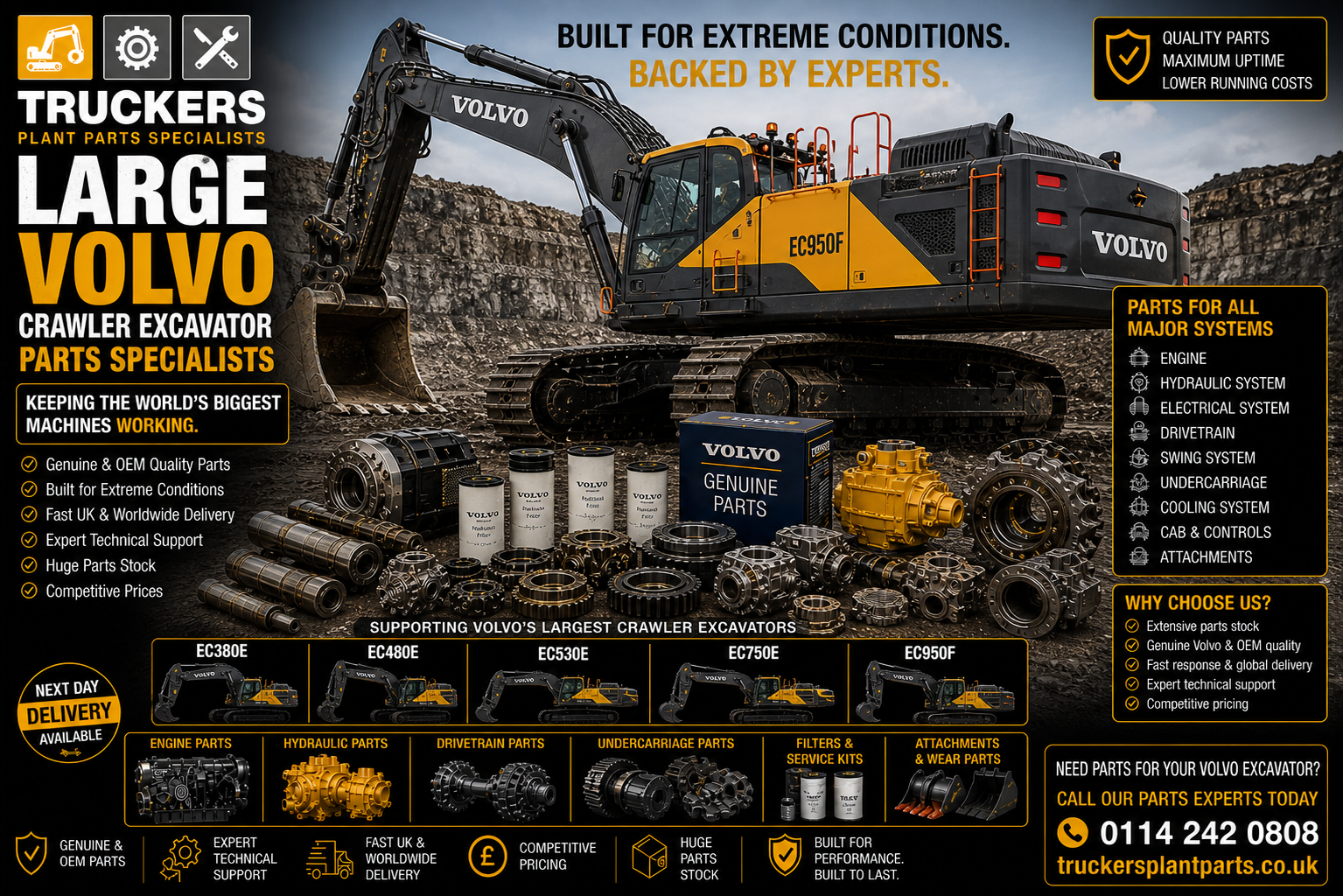
Volvo’s largest crawler excavators sit at the top end of the company’s earthmoving, quarrying, mining support, demolition, bulk excavation, infrastructure, and heavy production machinery range. These are not ordinary digging machines. They are front-line production assets built for operators who need serious digging force, high hydraulic output, large bucket capacity, powerful engines, exceptional stability, and long-term durability in some of the most demanding working environments in heavy industry.
Machines such as the Volvo EC750, EC750E, EC950, EC950E and EC950F represent the upper end of Volvo’s crawler excavator engineering. These machines are built for high-volume excavation, quarry face loading, overburden removal, mass earthmoving, heavy civil engineering, mining support, deep excavation, large demolition support, rock handling, muck shifting, bulk loading, infrastructure construction, and severe-duty material movement.
When operators move into this size category, every decision becomes more serious. The machines are larger, heavier, more powerful, more expensive to run, and more production-critical than smaller excavators. But when correctly matched to the right site, the largest Volvo crawler excavators can deliver outstanding productivity, high tonnes moved per hour, reduced cycle numbers, strong loading efficiency, and excellent cost-per-tonne performance.
The largest Volvo crawler excavators are designed for work where smaller machines cannot keep pace. A mid-size excavator may be ideal for general construction, utilities, roadworks, drainage, and standard earthmoving, but in quarrying, mining support, heavy infrastructure, and bulk excavation, the operator often needs a machine capable of moving huge volumes of material quickly and consistently. This is where Volvo’s largest tracked excavators prove their value.
A Volvo EC750 or EC950 working correctly can load articulated dump trucks, rigid haulers, crushers, hoppers, or stockpile areas with serious efficiency. The large bucket capacity, powerful hydraulic system, strong digging force, and stable undercarriage allow the machine to work continuously under heavy load. This makes it especially valuable in operations where loading output controls the entire site’s productivity.
In many quarry and earthmoving operations, the excavator is the pace-setter. If the excavator is slow, trucks wait. If trucks wait, production drops. If production drops, costs rise. A large Volvo crawler excavator is therefore not just a machine; it is often the heartbeat of the site.
Volvo’s biggest crawler excavators are engineered around high hydraulic performance. Hydraulic pumps, main control valves, boom cylinders, arm cylinders, bucket cylinders, slew motors, travel motors, pipework, hoses, cooling systems, and filters all work under serious pressure. On machines of this size, hydraulic efficiency is critical because every movement consumes energy and affects cycle time.
A large excavator with smooth, powerful hydraulics can dig, lift, swing, load, and return efficiently. A machine with weak hydraulics becomes slow, thirsty, and expensive. This is why hydraulic system condition is one of the most important maintenance priorities on Volvo’s largest crawler excavators.
Truckers Plant Parts support Volvo large crawler excavators with OEM, OEM-equivalent, rebuilt, and quality aftermarket hydraulic parts including hydraulic pumps, pump assemblies, valves, hoses, cylinders, seal kits, hydraulic coolers, filters, pressure sensors, auxiliary circuits, pipework, fittings, hydraulic motors, travel motors, slew motors, and related system components.
The engine systems on large Volvo excavators are equally important. Machines such as the EC750 and EC950 rely on powerful Volvo diesel engines designed to deliver sustained output under heavy load. These engines must provide strong torque, fuel efficiency, cooling stability, emissions compliance, and reliability across long working shifts.
Engine parts support includes injectors, turbochargers, fuel pumps, filters, belts, sensors, starters, alternators, cooling components, EGR systems, exhaust aftertreatment components, gaskets, seals, oil pumps, water pumps, radiators, intercoolers, ECUs, wiring, and complete service components.
Cooling systems are especially critical on large excavators because these machines often work in dusty, hot, severe-duty environments. Quarry dust, demolition debris, mining contamination, and continuous hydraulic load can all push cooling systems hard. Radiators, hydraulic coolers, oil coolers, intercoolers, fan systems, thermostats, hoses, coolant, and cooling packs must be maintained properly to prevent overheating.
An overheating large crawler excavator can quickly become a major production problem. Heat damages hydraulic oil, seals, sensors, engines, pumps, and electronic systems. Preventing cooling failure is far cheaper than dealing with a major breakdown.
Undercarriage systems are another major cost area on the largest Volvo excavators. Track chains, rollers, idlers, sprockets, recoil systems, track pads, final drives, travel motors, slew rings, slew bearings, and lower frame components all operate under enormous stress. Large excavators may work on rock, clay, mud, demolition rubble, quarry floors, haul roads, and uneven ground. Every movement wears the undercarriage.
Correct track tension, regular cleaning, proper operation, and timely parts replacement can dramatically improve undercarriage life. Neglecting undercarriage wear can lead to track failures, roller damage, drive system stress, poor tracking, instability, and expensive downtime.
Truckers support undercarriage parts for Volvo large crawler excavators including chains, rollers, sprockets, idlers, recoil parts, track pads, bolts, final drives, travel motors, bearings, seals, and related crawler components.
The slew system is also critical. Large crawler excavators constantly swing heavy loads between the dig face and dump point. The slew ring, slew bearing, slew motor, gearbox, pinion, grease system, bolts, and upper frame structure all experience significant loading. Any play, noise, vibration, or unusual movement in the slew system should be investigated quickly.
A failed slew system on a large excavator can stop production instantly.
Booms, arms, buckets, pins, bushes, and linkage systems are another major support category. Large Volvo excavators work under huge digging and breakout forces. The front-end equipment carries extreme loading through every cycle. Bucket pins, arm bushes, boom foot pins, H-links, dog bones, bucket links, cylinder eyes, and attachment brackets must be inspected regularly.
Wear in these areas reduces digging accuracy, increases shock loading, damages surrounding structures, and can eventually create expensive line-boring or structural repair requirements. Truckers support pins, bushes, seals, bucket links, linkage components, bucket teeth, adapters, cutting edges, side cutters, wear plates, rock buckets, heavy-duty buckets, and attachment components for Volvo’s largest excavators.
Large crawler excavators are often used with specialist attachments. Hydraulic breakers, rippers, rock buckets, heavy-duty buckets, grabs, shears, pulverisers, crushers, quick couplers, and demolition tools all place additional stress on the machine. Correct hydraulic setup, attachment matching, cooling performance, and structural inspection are essential.
A large excavator operating an attachment that is too heavy or poorly matched can suffer premature wear, hydraulic overheating, boom stress, and undercarriage strain. This is why correct parts, correct setup, and proper maintenance matter so much.
Electrical and electronic systems are increasingly important on modern Volvo crawler excavators. Sensors, ECUs, displays, joysticks, wiring harnesses, cameras, telematics, emissions systems, pressure transducers, safety systems, and diagnostic controls all contribute to modern excavator performance. Electrical faults can reduce power, limit hydraulic performance, trigger warning codes, or stop machine functions.
Truckers support electrical parts including sensors, switches, displays, joysticks, ECUs, harnesses, relays, lighting, cameras, alternators, starter motors, and diagnostic-related components where available.
The largest Volvo crawler excavators are expensive machines, but they are also capable of generating serious revenue when kept working. This makes parts supply and emergency support extremely important. If a Volvo EC950 stops during quarry production, the impact can be immediate. Dump trucks wait. Crushers may slow. Operators stand idle. Production targets come under pressure.
Truckers Plant Parts support urgent VOR requirements for large Volvo crawler excavators with same-day collection, next-day delivery, dedicated transport where required, OEM options, quality aftermarket alternatives, rebuilt solutions, and difficult-to-source component support.
The largest Volvo crawler excavators are built to work hard, but no machine is immune from wear. Hydraulic pumps fatigue. Cylinders leak. Final drives wear. Track components stretch. Pins and bushes develop play. Cooling systems block. Electrical sensors fail. Buckets wear. Engines need servicing. Filters clog. Hoses burst. Pumps lose efficiency. These are normal lifecycle realities in heavy equipment.
The difference between profitable ownership and expensive downtime often comes down to how quickly parts are identified, sourced, supplied, and fitted.
That is where Truckers Plant Parts provide real value.
For operators running Volvo EC750, EC950 and other large crawler excavators, parts support is not optional. It is part of keeping production alive.
The largest Volvo crawler excavators include heavy production models such as the EC750, EC750E, EC950, EC950E, and EC950F.
They are large tracked crawler excavators built for heavy-duty digging, loading, quarrying, mining support, and bulk excavation.
Quarrying, mining support, earthmoving, demolition, infrastructure, civil engineering, aggregates, muck shifting, and heavy construction.
They move huge volumes of material and often control the productivity of an entire site.
The EC950 is one of Volvo’s largest crawler excavators, built for severe-duty production work.
The EC750 is a large Volvo crawler excavator designed for quarrying, mining support, and heavy excavation.
Yes. They are widely used in quarry face loading, rock handling, and aggregate production.
Yes. They are used for overburden removal, loading, and heavy material movement.
Yes. Large Volvo crawlers can support heavy demolition, breaking, crushing, and material processing.
They have more weight, more hydraulic power, larger buckets, stronger digging force, and greater production capacity.
Larger excavators can move more material per cycle when properly matched to the job.
No. The machine must match the site, material, loading target, access, and fleet.
Fuel use, transport cost, ground pressure, and operating costs may outweigh the productivity benefit.
It may take too many cycles and slow down site production.
The excavator must match the trucks, haul distance, material type, and production target.
Yes. They are commonly used to load Volvo A30, A35, A40, A45, and A60 articulated haulers.
Yes. They can load rigid haulers where site conditions suit them.
Yes. Large crawler excavators may feed crushers and processing plants.
Hydraulics power digging, lifting, slewing, travelling, bucket control, and attachments.
Hydraulic pumps, hoses, cylinders, valves, motors, filters, coolers, sensors, and seal kits.
Yes. Truckers can support hydraulic pump supply for Volvo crawler excavators.
They generate the oil flow and pressure needed for machine movement.
Slow operation, weak digging, overheating, pump noise, jerky controls, and pressure loss.
Yes. Hydraulic failure can stop digging, lifting, travel, slew, or attachment operation.
Contamination can damage pumps, valves, cylinders, motors, and the full hydraulic system.
Boom cylinders, arm cylinders, bucket cylinders, and sometimes auxiliary cylinders.
Seal leaks, rod damage, internal bypassing, scoring, and worn bushes.
Travel motors drive the tracks and move the excavator.
Final drives transfer power from the travel motor to the tracks through reduction gearing.
They contain heavy-duty planetary gears, bearings, seals, and precision components.
Oil leaks, metal contamination, noise, overheating, slow travel, and loss of drive.
Track chains, rollers, idlers, sprockets, recoil systems, track pads, and bolts.
Undercarriage repairs can be one of the largest costs on crawler excavators.
Abrasive ground, poor track tension, excessive travel, side loading, mud, rock, and poor maintenance.
Yes. Track chains, rollers, idlers, sprockets, pads, and related parts can be supported.
The slew system allows the upper structure of the excavator to rotate.
Slew rings, slew bearings, slew motors, gearboxes, pinions, seals, and bolts.
Large excavators constantly swing heavy loads between dig and dump points.
Play, noise, vibration, grinding, oil leaks, slow swing, or uneven rotation.
Yes. A failed slew system can immobilise the machine.
Filters, injectors, turbochargers, belts, sensors, starters, alternators, gaskets, pumps, and cooling parts.
Large excavators operate under sustained load for long shifts.
Engines and hydraulics generate major heat during production work.
Radiators, hydraulic coolers, oil coolers, fan systems, hoses, thermostats, and coolant components.
Blocked coolers, heavy dust, poor coolant, fan failure, hydraulic inefficiency, or engine issues can cause overheating.
It can damage engines, hydraulics, seals, pumps, and electronics.
Engine oil filters, fuel filters, air filters, hydraulic filters, pilot filters, and breathers.
They protect expensive systems from contamination.
Engine oil, hydraulic oil, coolant, final drive oil, swing gearbox oil, grease, and fuel system fluids.
Yes. Poor maintenance can cause major hydraulic, engine, driveline, and undercarriage failures.
Boom pins, arm pins, bucket pins, bushes, links, H-links, dog bones, and cylinder eyes.
They absorb load and allow controlled movement at pivot points.
It can damage booms, arms, buckets, links, and cylinder mounts.
Yes. Pins, bushes, seals, and linkage components can be supplied.
Teeth, adapters, cutting edges, side cutters, wear plates, heel blocks, and bucket pins.
They protect the bucket and maintain digging efficiency.
Yes. Worn buckets dig slower and increase fuel use.
Yes. With correct hydraulic setup, they can operate hydraulic breakers.
Yes. Large crawler excavators can operate heavy demolition attachments when correctly configured.
Incorrect attachments can overload hydraulics, boom structures, and cooling systems.
Sensors, ECUs, wiring, displays, joysticks, cameras, alternators, starters, and switches.
Modern excavators rely on electronic controls, diagnostics, emissions systems, and monitoring.
Yes. Some faults can limit or stop machine functions.
Yes. Electrical and control components can be supported where available.
Glass, mirrors, seats, controls, joysticks, displays, heaters, cameras, lights, and wiper systems.
Operator comfort and visibility affect safety and productivity.
Yes. Truckers can support Volvo EC750 parts across major systems.
Yes. Truckers can support Volvo EC950 parts across major systems.
Yes. Older and discontinued Volvo crawler excavator parts may often be sourced.
Yes. Current and modern Volvo crawler excavator parts can be supported.
Yes. OEM Volvo parts may be supplied depending on stock and availability.
Yes. OEM-equivalent and quality aftermarket options are available.
OEM is often best for critical systems, high-value machines, and production-critical repairs.
Aftermarket can reduce repair costs while maintaining productivity when quality is suitable.
Yes. Model, serial number, photos, part numbers, and component tags help identification.
Specifications vary by machine generation, market, build, and hydraulic setup.
VOR means Vehicle Off Road, where a machine is down and needs urgent support.
A stopped large excavator can stop site production immediately.
Yes. Urgent parts sourcing and supply can be supported.
Yes. Stocked parts may be available for same-day collection.
Yes. Fast delivery is available on many parts.
Yes. Urgent dedicated transport can be arranged for critical downtime.
Large crawler excavator downtime can be extremely expensive.
Service history, hydraulics, undercarriage, slew system, engine, cooling, pins, bushes, bucket wear, electronics, and final drives.
It shows whether the machine has been maintained properly.
Leaks, overheating, slow hydraulics, excessive slew play, worn tracks, noisy final drives, smoke, and electrical faults.
Yes, when condition, maintenance history, and parts support are strong.
Major components are large, heavy, and highly specialised.
It reduces catastrophic failures and protects uptime.
Hydraulics, undercarriage, final drives, slew system, cooling systems, filters, fluids, pins, bushes, and attachments.
Yes. Oil analysis can identify wear and contamination before failure.
Dirty oil can destroy pumps, valves, motors, and cylinders.
Greasing protects pins, bushes, slew bearings, and working joints.
Pins, bushes, bearings, and structural points wear rapidly.
They offer strong hydraulics, robust structures, operator comfort, and reliable production capability.
They deliver high output and strong cost-per-tonne performance on the right site.
Truckers offer fast supply, OEM and aftermarket options, technical support, and urgent delivery.
Experience, stock access, rapid sourcing, and support across critical systems.
Their ability to move large volumes of material efficiently in demanding production environments.
Volvo’s largest crawler excavators are heavy-duty production machines built for quarrying, mining support, demolition, infrastructure, and bulk earthmoving, combining powerful hydraulics, strong engines, robust undercarriages, high digging force, large bucket capability, operator comfort, and critical parts support from Truckers Plant Parts to keep major operations moving.