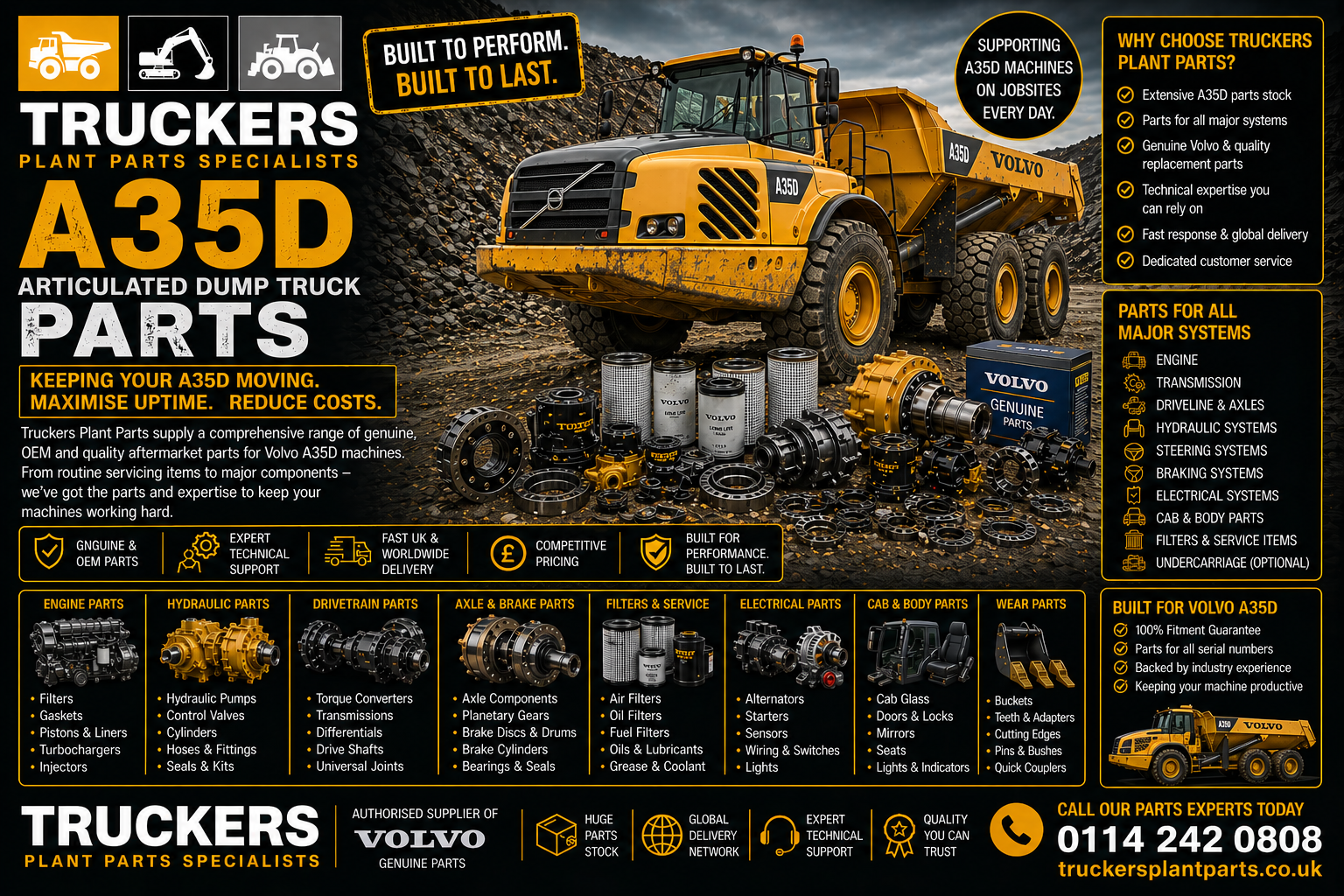
Volvo A35D Articulated Dump Truck – The Heavy-Duty D-Series Hauler That Took Volvo Into Serious Production Territory
The Volvo A35D articulated dump truck sits in one of the most important payload classes in Volvo’s articulated hauler history. It is larger and more productive than the A25 and A30 machines, but still more manageable, practical, and widely usable than the biggest A40, A45, and A60 haulers. For many quarry operators, earthmoving contractors, mining support fleets, landfill operators, and civil engineering companies, the A35D became a serious production truck without moving into the highest operating cost bracket.
That is what makes the A35D such an interesting machine.
It belongs to the respected Volvo D-Series generation, a generation many operators still associate with strength, durability, straightforward servicing, excellent off-road capability, and long working life. The A35D offers more payload and production capacity than the A30D, while retaining much of the mechanical character and practical reliability that made older Volvo articulated haulers so popular across the world.
The A35D was designed for demanding off-road haulage where site conditions are too difficult for rigid trucks, but where smaller ADTs may not move enough material per cycle. It is a machine built for quarry haul roads, bulk earthmoving, overburden removal, muck shifting, aggregates, forestry haulage, landfill work, civil engineering, mining support, and heavy infrastructure projects where traction, stability, and uptime matter every day.
The move from an A30D to an A35D is not simply about buying a bigger truck. It changes the economics of the job. The A35D carries more material per load, which can reduce the number of cycles required to shift the same tonnage. On longer haul routes or higher-volume sites, that additional payload can make a major difference to output. However, the larger machine also brings higher fuel use, larger tyres, increased component loading, and potentially greater servicing costs compared with the smaller A30D.
That is the trade-off operators must understand.
The A30D is often seen as the all-rounder. The A35D moves further toward production hauling. It gives more capacity and stronger output, but it needs the work to justify it. On a busy quarry, large earthmoving project, or high-volume muck shift, the A35D can be a very smart choice. On smaller or tighter sites, the A30D may still offer better overall value because of its lower running costs and easier manoeuvrability.
The A35D sits in the middle ground between manageable ownership and serious payload performance.
Like other Volvo articulated haulers, the A35D uses an articulated chassis layout that allows the front tractor unit and rear body section to move independently. This gives the truck excellent off-road ability over uneven terrain, soft ground, gradients, rutted haul roads, and slippery surfaces. The 6×6 driveline, differential systems, heavy-duty axles, suspension design, and Volvo articulation geometry all work together to keep the machine moving where conventional haulage equipment may struggle.
This is one of Volvo’s great strengths.
Volvo did not simply build articulated dump trucks. Volvo effectively defined the category. The company’s long history in articulated hauler development shows clearly in machines like the A35D. The truck is not just powerful; it is balanced. It is designed to keep traction, protect the driveline, carry heavy loads safely, and give operators confidence in poor ground conditions.
The D-Series machines are especially respected because they deliver this performance without the electronic complexity of later generations. Compared with newer E, F, G, and H-Series Volvo trucks, the A35D feels more mechanical, more direct, and easier for many experienced engineers to diagnose and repair. That simplicity is one reason older D-Series Volvo ADTs remain desirable on the used market.
For operators who value uptime, repairability, and long-term practicality, that matters.
Newer Volvo articulated haulers offer better fuel economy, improved operator interfaces, advanced diagnostics, telematics, intelligent traction systems, improved transmissions, and more sophisticated driveline management. Those improvements are real and valuable. But newer machines can also bring higher purchase prices, more electronic dependency, more specialist diagnostic requirements, and potentially higher repair costs when complex systems fail.
The A35D therefore appeals to operators who want a larger production Volvo hauler without stepping too far into modern machine complexity.
The truck’s engine and driveline are built around heavy pulling power rather than speed alone. In articulated haulage, torque delivery is far more important than headline horsepower. These trucks spend their working lives climbing haul roads, pulling heavy payloads through soft ground, travelling over rough terrain, and maintaining productivity in poor conditions. The A35D’s powertrain is designed to deliver usable force where it matters.
The transmission, axles, differentials, final drives, and driveline components all operate under serious stress in this size class. That is why maintenance quality is so important. Oils, filters, seals, bearings, cooling systems, brake systems, and articulation components must be inspected and serviced properly if the machine is expected to deliver reliable long-term performance.
The A35D is strong, but no articulated truck is immune to wear.
High-hour A35D machines commonly require attention around articulation joints, steering cylinders, hydraulic hoses, brake systems, driveline seals, axle components, suspension bushes, cooling systems, body pivots, and electrical systems. These are not weaknesses unique to the A35D; they are simply the natural wear areas of a heavy articulated hauler working under load for thousands of hours.
The important thing is parts support.
Truckers Plant Parts support Volvo A35D articulated haulers with OEM, OEM-equivalent, rebuilt, and quality aftermarket parts covering engines, transmissions, axles, differentials, final drives, hydraulic systems, cooling systems, braking systems, articulation joints, suspension systems, cab components, electrical systems, filters, service kits, body components, wear parts, and emergency VOR support.
That support matters because many A35D machines are still working hard today.
The A35D is often used in environments where downtime is expensive. In a quarry, one stopped hauler can reduce total material movement immediately. On an earthmoving project, a failed truck can disrupt excavator loading cycles. In landfill or mining support work, a broken ADT can delay operations that depend on continuous movement. Keeping parts available and repairs moving quickly is critical.
Compared with the A30D, the A35D’s biggest advantage is output. It gives operators more payload per cycle, making it better suited to higher-production sites. If the loading equipment is large enough, the haul route is suitable, and the site needs consistent tonnage movement, the A35D can outperform smaller trucks in cost-per-tonne terms.
But the A30D may still win on flexibility.
The A30D is easier to place on mixed worksites, tighter areas, softer sites, and smaller contracts where the extra payload of the A35D is not always fully used. If an A35D is regularly underloaded, poorly matched to the excavator, or working on routes too tight for efficient hauling, its advantage disappears quickly.
Compared with the A40D, the A35D can sometimes be the more sensible choice for operators who want strong production but do not want the larger truck’s higher operating costs. The A40D delivers more payload and can be excellent in the right application, but it needs enough material, haul road capacity, loading equipment, and fleet balance to justify its size. The A35D can be easier to integrate into more varied operations while still offering serious hauling power.
That is why the A35D often becomes the practical middle choice.
It is bigger than the universal A30D, but not as demanding as the A40D. It gives a strong production increase without forcing the operator fully into the economics of the largest D-Series trucks.
Compared with newer A35E, A35F, and A35G machines, the A35D gives up some refinement and technology. Later trucks improved fuel efficiency, driveline control, operator comfort, diagnostics, service planning, emissions performance, and traction management. The newer models are smoother, smarter, and often more efficient when operated correctly.
However, the A35D remains attractive because of purchase value, simpler repairability, strong resale demand, and mechanical confidence among operators who know the D-Series platform well.
The best value does not always come from the newest machine.
A well-maintained A35D bought at the right price can be a very profitable truck. It may use more fuel than a later model, but if purchase cost is substantially lower, parts support is strong, and maintenance is well managed, the total ownership equation can still make excellent sense.
This is especially true for operators who have workshop capability, experienced engineers, and existing familiarity with Volvo D-Series machines.
The A35D’s cab reflects Volvo’s focus on operator comfort for its era. It may not have the modern digital interfaces of current G and H-Series machines, but it still offers a practical, comfortable, highly usable operating environment for long shifts. Visibility, control layout, seating, and ride quality were all important parts of the D-Series design philosophy.
Operator comfort matters because rough haulage is physically demanding. A tired operator can become less efficient, harsher on the machine, and more vulnerable to mistakes. Volvo understood this early, which is why even older Volvo ADTs often feel more refined than many competitors from the same era.
The A35D also benefits from Volvo’s strong structural engineering. The frame, articulation joint, dump body, axles, and suspension systems were all designed for severe-duty haulage. These machines were built for hard work, and when properly maintained, they can deliver very long service lives.
Ultimately, the Volvo A35D is a machine about balance.
It is not the smallest, cheapest, or simplest Volvo ADT.
It is not the biggest, fastest, or most technologically advanced either.
Its strength lies in being a serious production hauler with D-Series toughness, strong payload, excellent off-road ability, practical maintainability, and proven Volvo reliability.
For the right operation, that combination remains extremely valuable.
The A35D is best suited to operators who need more output than an A30D can comfortably deliver, but who do not necessarily want the higher running costs, size, and site demands of an A40D or larger machine. It is a strong choice for quarries, muck shifting, large earthmoving projects, landfill operations, mining support, and infrastructure work where payload matters, but long-term value matters just as much.
In the bigger picture of Volvo articulated hauler history, the A35D stands as one of the most capable and practical D-Series trucks ever built.
A machine with enough size to make a serious production difference, enough simplicity to remain attractive years later, and enough Volvo DNA to keep earning money long after many competitors have faded from frontline use.
FAQ: Volvo A35D Articulated Dump Truck
1. What is the Volvo A35D?
The Volvo A35D is a heavy-duty articulated dump truck designed for quarrying, earthmoving, mining support, landfill, civil engineering, forestry, aggregates, and severe off-road hauling.
2. What type of machine is the A35D?
It is a 6×6 articulated dump truck, also known as an articulated hauler or ADT.
3. What does articulated mean?
Articulated means the truck has a pivoting joint between the front tractor section and rear dump body section, allowing it to steer and flex over rough terrain.
4. Why is the A35D important in Volvo’s hauler range?
It sits above the A30D and below the larger A40D, giving operators a strong middle-ground production truck.
5. What makes the A35D different from the A30D?
The A35D offers more payload and production capacity than the A30D, but usually has higher running costs.
6. What makes the A35D different from the A40D?
The A35D is smaller and generally easier to manage than the A40D, but it carries less material per cycle.
7. Why do operators choose the A35D?
Operators choose it for its strong payload, Volvo reliability, off-road traction, D-Series simplicity, and production capability.
8. Is the Volvo A35D still popular today?
Yes. Many A35D machines remain in active use because they are durable, productive, and well supported with parts.
9. What industries use the A35D?
Quarrying, aggregates, earthmoving, mining support, landfill, demolition, forestry, and infrastructure projects commonly use the A35D.
10. Is the A35D good for quarry work?
Yes. The A35D is well suited to quarry haulage where rough roads, gradients, and heavy payloads are common.
11. Is the A35D good for earthmoving?
Yes. It is highly capable in bulk earthmoving and muck shifting applications.
12. Is the A35D useful in landfill operations?
Yes. Its traction and articulated chassis make it effective on soft and unstable ground.
13. Why are Volvo articulated haulers respected?
Volvo pioneered the articulated hauler concept and built a strong reputation for traction, durability, and operator comfort.
14. Does the A35D have 6×6 drive?
Yes. The A35D uses a 6×6 driveline for maximum off-road traction.
15. Why is 6×6 drive important?
It helps the truck maintain movement in mud, gradients, soft ground, and poor haul-road conditions.
16. What is the main advantage of the A35D over smaller trucks?
The main advantage is greater payload per cycle.
17. What is the main disadvantage compared with smaller trucks?
The A35D usually consumes more fuel and may have higher tyre and maintenance costs.
18. Is bigger always better with articulated dump trucks?
No. The best truck depends on site size, haul distance, loading equipment, ground conditions, and cost-per-tonne.
19. What is the best use case for the A35D?
The A35D is best where the site has enough material volume to justify more payload than an A30D.
20. Is the A35D easy to maintain?
Compared with newer electronic trucks, the A35D is relatively straightforward for experienced engineers to maintain.
21. Why do operators like D-Series Volvo trucks?
They are known for durability, practical servicing, and reduced electronic complexity.
22. How does the A35D compare with newer A35E or A35F models?
Newer models are generally more refined and fuel efficient, but the A35D is often simpler and cheaper to maintain.
23. How does the A35D compare with the A35G?
The A35G is more advanced electronically, with better efficiency and diagnostics, but the A35D remains valued for simplicity and proven durability.
24. Does the A35D have strong resale value?
Well-maintained A35D trucks can hold strong value because demand remains high for dependable D-Series Volvo haulers.
25. Why does resale value matter?
Strong resale value lowers total ownership cost over the machine’s lifecycle.
26. What are common wear areas on an A35D?
Articulation joints, brakes, tyres, hydraulic hoses, suspension components, driveline seals, axles, and cooling systems commonly wear.
27. Why are articulation joints important?
They allow the truck to steer and flex between the front and rear frames.
28. What happens if articulation wear is ignored?
It can cause instability, steering issues, tyre wear, chassis stress, and expensive repairs.
29. What driveline parts commonly need support?
Transmissions, differentials, prop shafts, axles, planetary hubs, torque converters, and seals commonly require attention.
30. Why are driveline systems heavily stressed?
The truck constantly hauls heavy loads across rough terrain.
31. What hydraulic systems are used on the A35D?
Hydraulics support steering, tipping, braking assistance, suspension functions, and other machine operations.
32. What hydraulic parts may need replacing?
Hydraulic pumps, cylinders, hoses, seals, valves, accumulators, and filters may require replacement.
33. Why are cooling systems important on the A35D?
Heavy haulage generates significant engine, transmission, hydraulic, and brake heat.
34. What cooling parts may need replacing?
Radiators, hydraulic coolers, oil coolers, hoses, thermostats, fan components, and coolant systems may require support.
35. Why are brakes important on articulated haulers?
The machine carries heavy loads and often works on gradients, so braking performance is critical.
36. What brake parts may need support?
Wet brake components, discs, seals, accumulators, brake valves, hydraulic lines, and cooling systems may require servicing.
37. Why are tyres a major cost?
ADT tyres are large, expensive, and exposed to rocks, mud, poor haul roads, and heavy loading.
38. How can tyre life be improved?
Good haul-road maintenance, correct tyre pressures, proper loading, reduced wheelspin, and smooth operation can improve tyre life.
39. Why is fuel consumption important?
Fuel is one of the biggest operating costs for articulated dump trucks.
40. Does the A35D use more fuel than an A30D?
Generally yes, because it is larger and carries more payload.
41. Can the A35D be more cost-effective than an A30D?
Yes, if the extra payload reduces cycle numbers and improves cost per tonne.
42. Can the A30D be better value than the A35D?
Yes, on smaller sites or lower-volume jobs where the A35D’s extra capacity is not fully used.
43. Can the A35D be better value than the A40D?
Yes, if the site does not require or cannot fully justify the larger A40D.
44. What does cost per tonne mean?
Cost per tonne measures how much it costs to move each tonne of material.
45. Why is cost per tonne more important than payload alone?
A bigger truck is only better if it reduces the total cost of moving material.
46. What loading equipment suits the A35D?
Medium-to-large excavators and wheel loaders capable of filling the truck efficiently are best suited.
47. Why does loader matching matter?
Poor matching increases cycle times and reduces productivity.
48. Is the A35D suitable for tight sites?
It can work on many sites, but the smaller A30D may be better in very tight or restricted areas.
49. Is the A35D suitable for long haul routes?
Yes, especially where increased payload helps reduce total cycle numbers.
50. Is the A35D suitable for soft ground?
Yes, its articulated chassis and 6×6 drive help maintain traction.
51. What is the main strength of the A35D?
Its main strength is strong production capability with D-Series Volvo durability.
52. What is the main trade-off of the A35D?
The main trade-off is higher operating cost than smaller trucks.
53. Is the A35D more complex than newer trucks?
No. Newer trucks are generally more electronically complex.
54. Is the A35D less refined than newer trucks?
Yes. Newer E, F, G, and H-Series models generally offer better comfort, diagnostics, and efficiency.
55. Why do some operators still prefer older trucks?
Older trucks can be easier to diagnose and repair.
56. Does the A35D rely heavily on electronics?
It uses electronics, but far less than later generations.
57. Why is lower electronic complexity useful?
It can reduce dependency on specialist diagnostic systems.
58. Does Truckers Plant Parts support the A35D?
Yes. Truckers Plant Parts support Volvo A35D machines extensively.
59. What A35D parts can Truckers supply?
Truckers can support engines, transmissions, axles, hydraulics, brakes, cooling systems, articulation parts, electrical components, filters, and service kits.
60. Can Truckers supply OEM parts for the A35D?
Yes. OEM parts may be supplied depending on availability and requirement.
61. Can Truckers supply aftermarket parts?
Yes. OEM-equivalent and quality aftermarket options are available.
62. Can Truckers help with obsolete A35D parts?
Yes. Rare and difficult-to-source parts can often be sourced through specialist networks.
63. Why is parts support important for older A35D trucks?
Older trucks remain productive only if parts are available quickly and reliably.
64. Does Truckers offer emergency VOR support?
Yes. Truckers can help source parts quickly when a machine is down.
65. What does VOR mean?
VOR means Vehicle Off Road, where a machine is stopped and needs urgent repair.
66. Why is VOR costly?
A stopped ADT can reduce site production immediately.
67. Can Truckers offer next-day delivery?
Yes. Many parts can be delivered quickly depending on stock.
68. Can same-day collection be possible?
Yes. Stocked items may be available for same-day collection.
69. Can dedicated transport be arranged?
Yes. Urgent dedicated transport can be arranged when time is critical.
70. What filters are used on the A35D?
Engine oil filters, fuel filters, hydraulic filters, transmission filters, air filters, and breather filters may be required.
71. Why are filters important?
Filters protect expensive systems from contamination.
72. What fluids are important on the A35D?
Engine oil, hydraulic oil, transmission oil, axle oil, coolant, brake fluids, and grease are critical.
73. Why is oil quality important?
Correct oil protects components under heat, pressure, and load.
74. Can poor oil maintenance damage the A35D?
Yes. Poor lubrication can destroy engines, transmissions, axles, and hydraulics.
75. What cab parts may be required?
Seats, glass, controls, switches, wipers, heaters, mirrors, lights, and interior parts may need replacement.
76. Why is cab condition important?
Operator comfort and visibility affect safety and productivity.
77. What body parts may wear?
Body liners, pivot pins, hinges, tailgate components, and wear plates may wear over time.
78. Why does the dump body wear?
Abrasive materials and impact loading gradually wear the body structure.
79. Is the A35D suitable for high-hour use?
Yes, when maintained properly.
80. What should buyers check on a used A35D?
Articulation wear, driveline condition, brake performance, tyres, hydraulics, cooling system, service history, and body condition should be checked.
81. Why is service history important?
It helps show whether the truck has been maintained correctly.
82. What are signs of poor maintenance?
Leaks, overheating, excessive play, weak brakes, poor shifting, smoke, worn tyres, and noisy driveline components can indicate problems.
83. Is the A35D a good used buy?
It can be, especially if condition, maintenance history, and price are strong.
84. What makes the A35D attractive used?
Payload, simplicity, Volvo reputation, parts support, and resale demand make it attractive.
85. What makes the A35D risky used?
Poor maintenance, high wear, unknown history, and major driveline issues can make it costly.
86. How does the A35D fit into Volvo’s ADT history?
It represents a larger D-Series production hauler with strong mechanical durability.
87. Is the A35D still productive by modern standards?
Yes. Many machines still work productively across global heavy industries.
88. Does the A35D compete with Bell and Caterpillar trucks?
Yes. It competes with similar-size articulated haulers from Bell, Caterpillar, Komatsu, and others.
89. What gives Volvo an advantage?
Volvo’s long history in articulated hauler design gives it strong credibility.
90. Why do operators trust Volvo ADTs?
They are known for traction, stability, durability, and long service life.
91. Is the A35D better than newer trucks?
Not technically, but it may be better value for some operators.
92. Is the A35D better than smaller trucks?
Only where the work justifies the extra payload and cost.
93. Is the A35D better than larger trucks?
It may be more cost-effective where A40 or A60 trucks are too large or expensive.
94. What is the happy medium in Volvo ADTs?
For many operators, the A30D or A35D can be the most practical balance depending on workload.
95. Why might the A35D be the happy medium?
It offers serious payload without the full cost escalation of larger machines.
96. Why might the A30D still be the better medium?
The A30D may offer lower costs and greater flexibility on mixed sites.
97. What makes the A35D a production truck?
Its increased payload, traction, driveline strength, and off-road stability make it suitable for serious production work.
98. What should operators prioritise when running an A35D?
Maintenance, parts availability, tyre management, fuel control, and driveline care should be prioritised.
99. Why is Truckers useful for A35D operators?
Truckers can support older Volvo haulers with quality parts, urgent sourcing, and practical industry knowledge.
100. What best describes the Volvo A35D overall?
The Volvo A35D is a strong, respected D-Series articulated dump truck that offers serious production capacity, excellent off-road ability, proven Volvo durability, practical maintainability, and a valuable middle-ground position between smaller all-round ADTs and larger high-cost production haulers.
A20, A25, A25B, A25C, A25D, A25E, A25F, A25G, A30, A30C, A30D, A30E, A30F, A30G, A35, A35C, A35D, A35E, A35F, A35G, A40, A40C, A40D, A40E, A40F, A40G, A45G, A60H, A25, A30, A35, A40, A45, A50, A60H, A30