Truckers Plant Parts | UK's Heavy Equipment Parts Specialists
For Scrap Collections Call 07395 611 153 Only or Email [email protected] Not Truckers
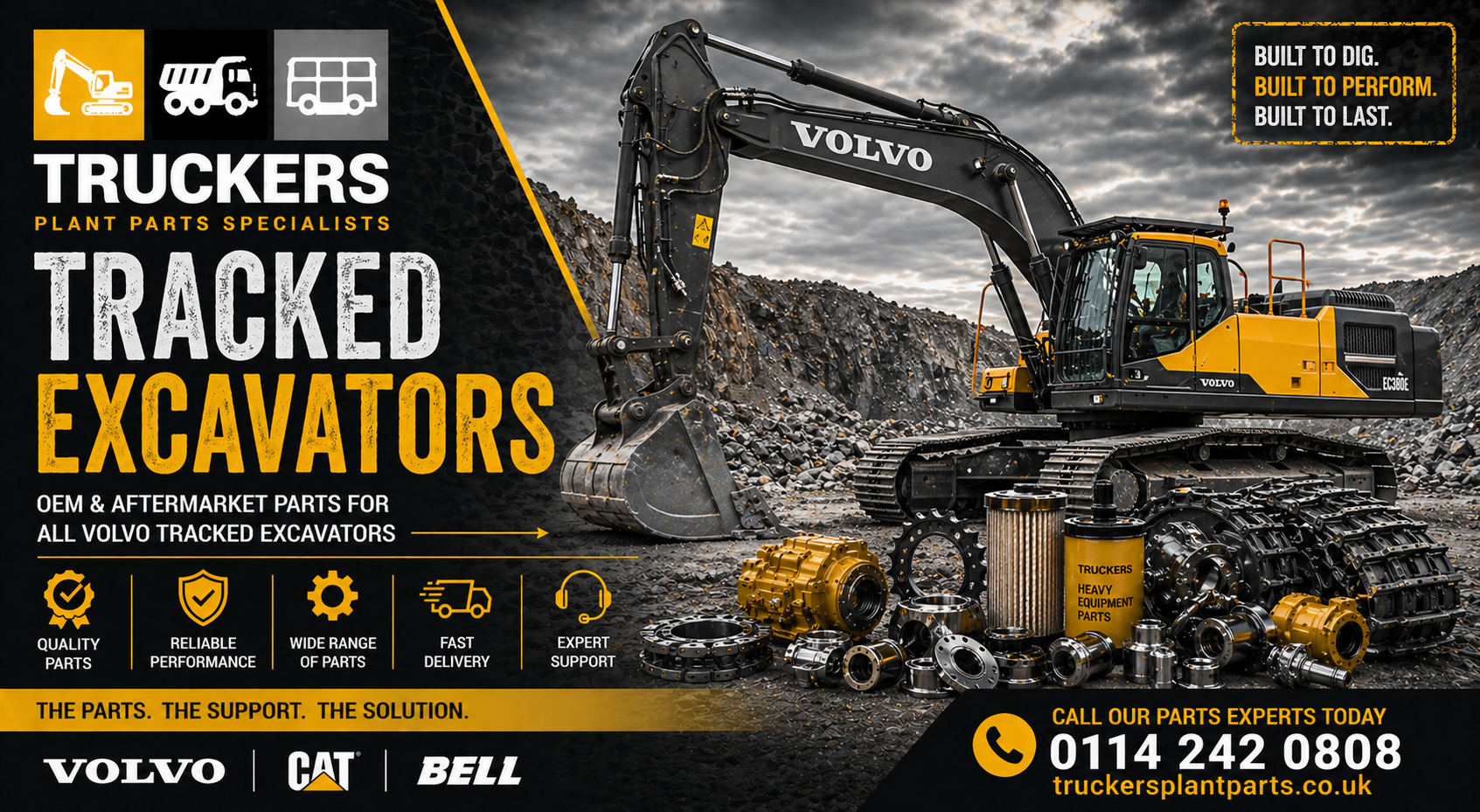
Volvo tracked excavators sit at the centre of modern construction, quarrying, demolition, infrastructure, earthmoving, drainage, recycling, aggregates, forestry, utilities, muck shifting, civil engineering and heavy site preparation. From mid-sized machines such as the Volvo EC140, EC160, EC180, EC210, EC220, EC230 and EC250 through to larger production excavators such as the EC300, EC350, EC380, EC480, EC530, EC750 and EC950, Volvo crawler excavators are built to dig, lift, load, slew, trench, break, grade and move material in demanding environments where uptime matters every day.
For many operators, Volvo tracked excavators offer the ideal balance between hydraulic smoothness, digging force, operator comfort, fuel efficiency, stability, durability and serviceability. A Volvo crawler excavator is not simply a digging machine. It is often the main production asset on site. If the excavator stops, everything behind it can stop as well. Dump trucks wait. Groundworkers stand idle. Crushers slow down. Concrete works are delayed. Drainage lines fall behind. Demolition sequencing is disrupted. Production targets come under pressure.
That is why fast, accurate and dependable parts supply is essential.
Truckers Plant Parts support large and mid-sized Volvo tracked excavators with OEM, OEM-equivalent, rebuilt and quality aftermarket parts across all major machine systems. Whether you operate a general-purpose EC210, a popular EC220, a versatile EC230, a heavy production EC300, a quarry-focused EC380, a demolition-ready EC480, or one of Volvo’s largest crawler excavators such as the EC750 or EC950, Truckers can help keep your machine working.
Volvo mid-sized crawler excavators are some of the most widely used machines in construction and civil engineering. Models such as the EC140, EC160, EC180, EC210, EC220 and EC230 are commonly found on housing developments, road schemes, drainage projects, utilities work, groundworks, landscaping, site clearance, small quarry operations, recycling yards and general contracting sites. They are large enough to deliver serious digging performance but still manageable enough for transport, access and mixed-site use.
These machines often work with buckets, quick couplers, hydraulic breakers, grabs, tilting hitches, rippers, compactors, grading beams, augers and specialist attachments. That makes hydraulic condition especially important. Hydraulic pumps, hoses, cylinders, control valves, auxiliary circuits, filters, coolers and pressure sensors all need to perform correctly if the excavator is to deliver full power and smooth response.
Larger Volvo tracked excavators take that requirement further. Machines such as the EC300, EC350, EC380 and EC480 are frequently used for quarrying, demolition, bulk earthmoving, large muck shifts, infrastructure, deep drainage, heavy loading, rock breaking and production excavation. These machines carry heavier buckets, larger attachments and stronger front-end equipment. They place much greater demand on hydraulic systems, slew systems, undercarriages, final drives, cooling systems and structural components.
At the top end, Volvo EC750 and EC950 machines become site-critical production units. These machines are built for major quarrying, mining support, overburden removal, bulk loading and severe-duty excavation. When a machine of this size goes down, the cost of downtime can escalate very quickly.
Truckers Plant Parts support all key categories for Volvo tracked excavators including hydraulic pumps, hydraulic motors, final drives, travel motors, slew motors, slew rings, main control valves, hydraulic cylinders, seal kits, hose assemblies, pipework, filters, engine parts, turbochargers, injectors, fuel systems, cooling packs, radiators, hydraulic coolers, fan systems, electrical sensors, ECUs, joysticks, displays, undercarriage parts, rollers, idlers, sprockets, track chains, track pads, recoil systems, bucket pins, bushes, links, H-links, dog bones, quick couplers, bucket teeth, cutting edges, side cutters, wear plates, cab glass, lights, mirrors, seats, wipers, service kits, oils, fluids and greases.
Undercarriage parts are one of the most important ownership costs on any tracked excavator. Track chains, rollers, idlers, sprockets, pads and recoil systems all wear gradually through contact with rock, clay, mud, rubble, aggregate and abrasive ground. Poor track tension, excessive tracking, poor site conditions, side loading and lack of cleaning can dramatically shorten undercarriage life. Truckers can support Volvo crawler excavators with the parts needed to keep tracked machines stable, mobile and productive.
Hydraulic systems are just as critical. A weak pump, leaking cylinder, damaged hose, contaminated oil, blocked filter or failing valve can make the excavator slow, weak, hot or unreliable. Early warning signs such as slow boom lift, weak arm-in power, poor bucket curl, slow travel, weak slew, pump noise, oil overheating or erratic controls should be investigated quickly. Hydraulic failure can spread contamination through the entire machine if ignored.
The front-end equipment on Volvo tracked excavators also needs regular attention. Boom pins, arm pins, bucket pins, bushes, links, cylinder eyes, quick coupler parts and bucket wear systems take constant punishment. If pins and bushes are allowed to wear too far, the repair may move beyond simple replacement into line boring, welding or structural repair. Good parts support and preventative maintenance protect both performance and machine value.
Truckers Plant Parts can support operators running Volvo tracked excavators across every working environment, from mid-sized civil engineering machines to large production crawlers. Parts can be supplied for scheduled servicing, preventative maintenance, planned rebuilds, emergency breakdowns and VOR situations where the machine is down and time is critical.
Same-day collection, next-day delivery and urgent dedicated transport may be available depending on stock and requirement. For difficult, rare or older Volvo excavator parts, Truckers can help source components through specialist supply routes.
If your Volvo tracked excavator is working, Truckers helps keep it working. If it has stopped, Truckers helps get it moving again.
Volvo tracked excavators are crawler excavators built for digging, loading, trenching, demolition, quarrying, earthmoving and construction.
Truckers support mid-sized, large and heavy production Volvo crawler excavators.
EC140, EC160, EC180, EC210, EC220, EC230, EC250, EC300, EC350, EC380, EC480, EC530, EC750 and EC950.
Construction, demolition, quarrying, aggregates, recycling, infrastructure, earthmoving, drainage, forestry, utilities and mining support.
They provide digging power, stability and traction for demanding site conditions.
They are known for smooth hydraulics, operator comfort, fuel efficiency, durability and strong productivity.
Hydraulic, engine, undercarriage, final drive, slew, cooling, electrical, cab, wear and service parts.
Yes. OEM Volvo parts may be supplied depending on availability.
Yes. OEM-equivalent and quality aftermarket options are available.
Yes. Urgent VOR support can be provided.
VOR means Vehicle Off Road, where a machine is down and requires urgent support.
A stopped excavator can stop loading, digging, trenching, demolition and site production.
Yes. Stocked parts may be available for same-day collection.
Yes. Fast delivery is available on many parts.
Yes. Dedicated urgent transport can be arranged when downtime is critical.
Hydraulic pumps, hoses, cylinders, valves, filters, motors, coolers, fittings and seal kits.
Hydraulics power boom, arm, bucket, slew, travel and attachment functions.
Slow movement, weak digging, overheating, leaks, pump noise and jerky controls.
Yes. Major hydraulic failure can make the machine unusable.
Yes. Hydraulic pumps for Volvo tracked excavators can be supplied.
Final drives transfer hydraulic motor power into track movement.
Yes. Final drives, travel motors and related components can be supported.
Oil leaks, noise, metal contamination, slow travel and loss of drive.
The undercarriage is the tracked running system beneath the excavator.
Track chains, rollers, idlers, sprockets, pads, bolts and recoil systems.
Undercarriage repairs can be one of the largest crawler excavator costs.
Yes. Volvo crawler undercarriage parts can be supported.
Abrasive ground, poor track tension, excessive travel, mud, rock and poor cleaning.
The slew system allows the upper structure to rotate.
Slew rings, slew motors, bearings, gearboxes, pinions, seals and bolts.
Excavators constantly swing loads between dig and dump positions.
Pins, bushes, cylinders, links, seals, brackets and structural components.
They carry heavy loads during digging and attachment work.
It can damage booms, arms, buckets, links and cylinder mounts.
Yes. Pins, bushes and linkage parts can be supplied.
Teeth, adapters, cutting edges, side cutters, wear plates, pins and bushes.
They protect the bucket and maintain digging efficiency.
Yes. Bucket wear parts and attachment components can be supplied.
Yes. Breakers, grabs, couplers, rippers, compactors, shears and pulverisers may be used.
Incorrect attachments can overload hydraulics and structures.
Filters, injectors, turbochargers, belts, sensors, starters, alternators, gaskets and pumps.
Excavators generate major engine and hydraulic heat.
Radiators, hydraulic coolers, oil coolers, fans, thermostats, hoses and coolant components.
Blocked coolers, fan faults, coolant problems, heavy cycles or hydraulic inefficiency.
Engine oil, fuel, air, hydraulic, pilot, transmission and breather filters depending on model.
Filters protect expensive systems from contamination.
Engine oil, hydraulic oil, coolant, final drive oil, slew gearbox oil and grease.
Yes. Poor servicing can cause major hydraulic, engine and driveline failures.
Sensors, wiring, ECUs, joysticks, displays, lights, cameras, alternators and starters.
Modern excavators rely on electronic controls, diagnostics and monitoring.
Yes. Some electrical faults can limit or stop machine functions.
Glass, mirrors, seats, joysticks, displays, wipers, lights and HVAC parts.
Operator comfort and visibility affect safety and productivity.
Yes. EC210 parts can be supported.
Yes. EC220 parts can be supported.
Yes. EC230 parts can be supported.
Yes. EC300 parts can be supported.
Yes. EC350 parts can be supported.
Yes. EC380 parts can be supported.
Yes. EC480 parts can be supported.
Yes. EC750 parts can be supported.
Yes. EC950 parts can be supported.
Many older and discontinued parts can be sourced depending on availability.
Yes. Current and modern Volvo crawler excavator parts can be supported.
Specifications vary by model year, market, build and hydraulic setup.
Yes. Model, serial number, part number, photos and component tags help identification.
Machine model, serial number, part number if known, photos and urgency level.
Wrong parts delay repairs and extend downtime.
Some rebuilt components may be available depending on model and stock.
They can reduce cost on major components while restoring machine performance.
OEM is best for critical systems and high-value production machines.
Aftermarket can offer strong value when quality and specification are suitable.
They are known for smooth hydraulics, operator comfort, durability and fuel efficiency.
Yes. They suit construction, utilities, drainage, groundworks and general earthmoving.
Yes. They are built for high-volume work.
Tracked excavators offer greater stability and traction on soft or uneven ground.
Tracked machines are slower to move between sites and usually require transport.
It prevents catastrophic failures and protects uptime.
Fluids, leaks, tracks, hoses, pins, bushes, bucket wear, cooling systems and warning lights.
Dirty oil can destroy pumps, valves, motors and cylinders.
Greasing protects pins, bushes, slew systems and working joints.
Pins, bushes and bearings wear rapidly.
Undercarriage wear can become expensive if ignored.
Final drive failure can immobilise the machine.
Blocked cooling packs can cause overheating and major failures.
Worn wear parts reduce digging efficiency and damage buckets.
Burst hoses can stop the machine and contaminate the system.
Wiring faults can trigger warnings or stop machine functions.
Operators often notice changes before major failure occurs.
Yes, when condition, service history and parts support are strong.
Hydraulics, undercarriage, slew, final drives, engine, cooling, pins, bushes, buckets and electronics.
It shows whether the machine has been maintained correctly.
Leaks, smoke, overheating, slow hydraulics, worn tracks, slew play and noisy final drives.
Reliable parts supply keeps older machines commercially viable.
Truckers offer OEM, aftermarket, rebuilt, urgent and difficult-to-source parts support.
Yes. Other makes and models can also be supported.
Fast supply, technical knowledge, broad stock access and emergency support.
Their balance of hydraulic performance, durability, comfort and productivity.
To avoid expensive downtime and protect machine value.
Truckers Plant Parts support large and mid-sized Volvo tracked excavators with fast OEM, OEM-equivalent, rebuilt and quality aftermarket parts covering hydraulics, undercarriage, engines, final drives, slew systems, cooling systems, electrical components, buckets, wear parts, service kits and emergency VOR requirements to keep Volvo crawler excavators working productively.