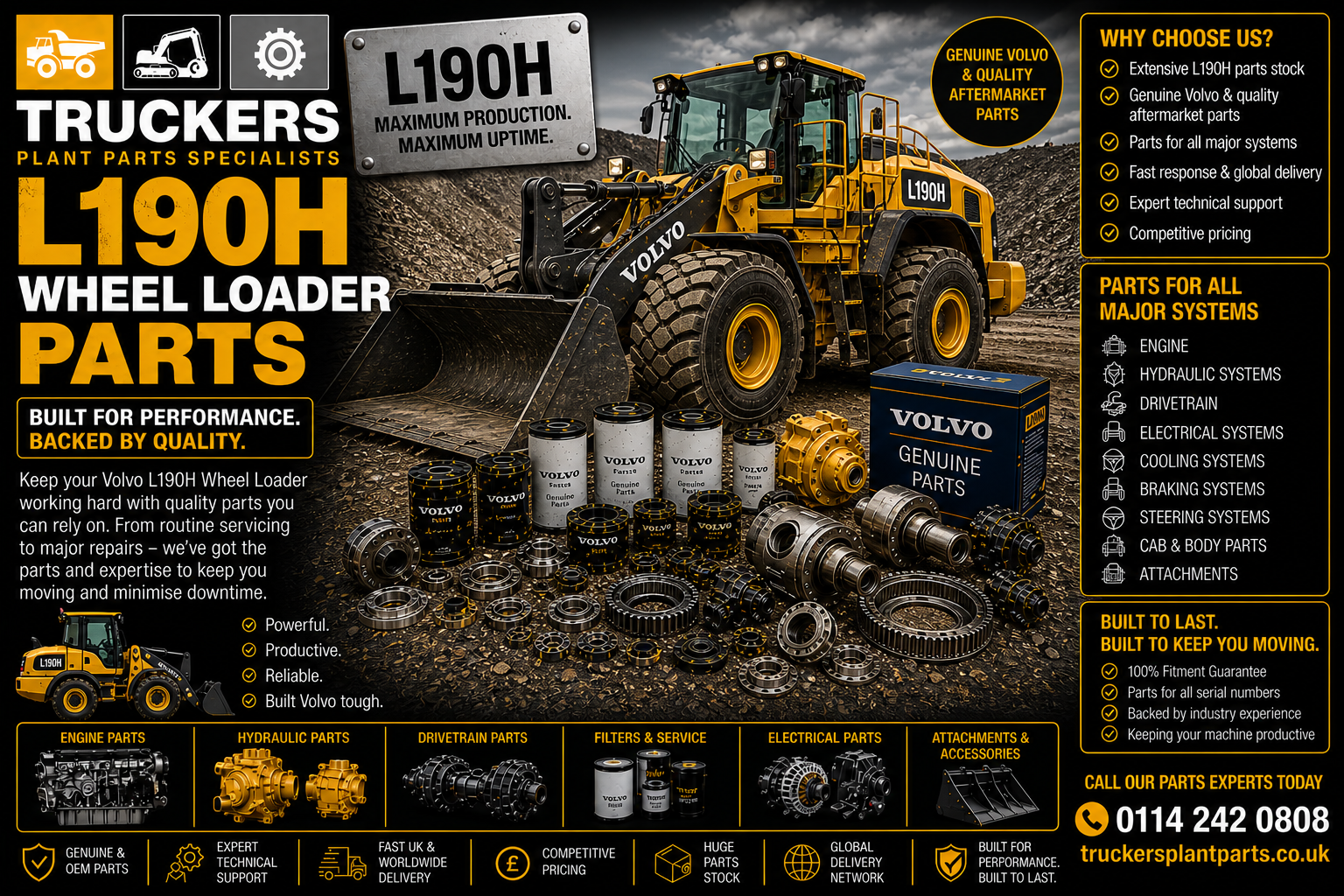
Volvo L190H Wheel Loader Parts Supply, Machine Guide, Reliability, Performance & Complete Support
The Volvo L190H wheel loader is a powerful H-Series production loader built for operators who need heavy loading performance, strong stability, high daily output, smooth hydraulic control, modern driveline efficiency, and dependable long-term durability. Sitting above the L180H and below the larger L220H, the L190H occupies an important position in Volvo’s wheel loader range for quarrying, aggregates, recycling, waste handling, timber, ports, construction, infrastructure, agriculture, demolition support, and heavy industrial material handling.
The L190H is designed for serious work. It is larger and more capable than many mid-size loaders, but still more manageable than the biggest production loaders where fuel use, tyre costs, site space, transport, and ownership costs increase significantly. For many operators, the L190H is a practical high-output machine that offers more muscle than an L180H while avoiding some of the full-scale demands of an L220H.
This balance is exactly why the L190H is valuable.
In quarry and aggregate environments, the L190H can load trucks, feed crushers, rehandle processed materials, maintain stockpiles, clear haul roads, and support screening plants. In recycling and waste handling, it can move green waste, rubble, soil, wood, scrap, mixed waste, RDF material, aggregates, and industrial bulk materials. In ports and timber yards, it can handle bulk products, timber attachments, forks, grabs, and specialist material handling tools. In construction and infrastructure work, it can support muck shifting, wagon loading, stone handling, pipe work, demolition clearance, and general heavy site logistics.
The L190H belongs to Volvo’s H-Series generation, which focused heavily on fuel efficiency, productivity, operator comfort, serviceability, driveline optimisation, and hydraulic refinement. Volvo wheel loaders are widely respected because they are not simply powerful machines; they are smooth, controllable, comfortable, durable, and efficient production tools designed around the full working cycle.
Hydraulic performance is one of the most important strengths of the L190H. The loader depends on hydraulic power for lift, bucket control, steering, attachment operation, quick coupler functions, auxiliary tools, and smooth loading cycles. Volvo’s hydraulic systems are known for refined control, giving operators strong lift performance without making the machine feel harsh or difficult to manage.
This matters in real-world production. A quarry loader may repeat the same loading cycle hundreds of times a day. A recycling loader may constantly push, lift, reverse, sort, and load in contaminated environments. A timber loader may require precise grapple control. A port loader may need smooth handling of bulk material or pallets. In each case, hydraulic smoothness directly affects productivity, safety, fuel use, and operator fatigue.
The L190H is also highly valuable as an attachment platform. Depending on specification, it can work with general purpose buckets, rock buckets, rehandling buckets, high-tip buckets, light material buckets, waste handling buckets, timber grapples, pallet forks, pipe handling attachments, quick couplers, sweepers, snow blades, side-dump buckets, and specialist hydraulic equipment.
That attachment flexibility increases the machine’s commercial value because it allows one loader to earn across different applications. A machine that can work in aggregates, recycling, ports, timber, waste, construction, and industrial handling is easier to keep productive throughout the year.
The driveline is equally important. Wheel loaders constantly change direction, push into material, lift, reverse, brake, travel, and repeat. This places heavy stress on transmissions, torque converters, axles, differentials, wet brakes, tyres, and articulation systems. Volvo’s H-Series driveline design is intended to deliver smooth power transfer, controlled directional changes, strong traction, and efficient operation.
For operators, this means better control, reduced unnecessary wear, improved cycle consistency, and better fuel economy compared with harsh or poorly matched loader systems.
Operator comfort is another major strength of the Volvo L190H. Large production loaders often work long shifts in busy, noisy, dusty, high-traffic environments. The operator needs visibility, comfort, control, and confidence. Volvo cabs are designed around strong sightlines, ergonomic controls, comfortable seating, low vibration, climate control, low noise, modern displays, intuitive joystick operation, and safe access.
A comfortable operator is not just happier. They are usually smoother, safer, more productive, and less likely to abuse the machine. On a loader of this size, poor operation can increase tyre wear, fuel burn, brake wear, bucket damage, hydraulic stress, and driveline shock.
Truckers Plant Parts support Volvo L190H wheel loaders with OEM, OEM-equivalent, rebuilt, and quality aftermarket parts covering engine systems, hydraulic pumps, hydraulic hoses, lift cylinders, bucket cylinders, steering cylinders, transmission components, torque converters, axle systems, differentials, wet brake systems, articulation joints, cooling systems, radiators, hydraulic coolers, oil coolers, fan systems, electrical components, sensors, ECUs, joysticks, cab glass, mirrors, lighting, seats, filters, oils, service kits, pins, bushes, loader arms, quick couplers, buckets, cutting edges, side cutters, wear plates, tyres, seals, bearings, fuel systems, turbochargers, starters, alternators, and emergency VOR support.
Hydraulic pumps and hydraulic components are among the most important L190H parts categories. A weak hydraulic pump, damaged hose, failing valve, worn cylinder seal, blocked hydraulic filter, or contaminated hydraulic system can immediately reduce loader performance. Symptoms such as slow lift, weak bucket response, overheating, pump noise, leaks, jerky operation, poor steering response, or weak attachment function should be investigated quickly before a small issue becomes a major failure.
Driveline parts also need serious attention. The L190H’s transmission, torque converter, axles, differentials, propshafts, hub components, and wet brakes work hard under repetitive production loading. Correct oils, clean filtration, proper servicing, and high-quality replacement parts are essential to protect these expensive systems.
The articulation joint is a critical inspection area. Pins, bushes, bearings, seals, steering cylinders, and centre pivot components carry enormous loading while allowing the machine to steer. Excessive articulation wear can affect steering accuracy, tyre life, stability, operator confidence, and long-term frame health. Truckers can support these components quickly to help keep the loader safe and productive.
Cooling systems are vital because the L190H may operate in dusty quarry environments, contaminated recycling yards, timber sites, waste facilities, and industrial handling areas. Blocked cooling packs, poor coolant condition, worn hoses, faulty thermostats, fan issues, or damaged radiators can quickly lead to overheating. Overheating can damage engines, transmissions, hydraulics, seals, and electronic systems, so cooling maintenance should never be treated as secondary.
Wear parts are constant requirements on a production loader. Bucket teeth, cutting edges, side cutters, wear plates, bucket pins, bushes, quick coupler parts, and attachment wear components protect expensive structures and maintain loading efficiency. Worn edges reduce penetration, slow cycle times, increase fuel burn, and can damage the bucket if ignored too long.
The L190H can be a strong used-machine purchase when maintained correctly. Buyers should inspect service history, hydraulic strength, articulation wear, transmission behaviour, brake performance, axle noise, cooling system condition, tyre wear, bucket condition, electrical faults, cab condition, loader arm condition, and any signs of frame stress.
A well-maintained L190H can remain a highly profitable production loader for many years. A neglected one can become expensive quickly because major components on machines of this size are substantial.
Overall, the Volvo L190H is a strong high-output wheel loader for operators who need more than an L180H but do not necessarily require the full scale of an L220H. With smooth hydraulics, powerful loading performance, operator comfort, attachment versatility, Volvo H-Series efficiency, and dependable parts support from Truckers Plant Parts, the L190H remains a serious machine for serious material handling.
Volvo L190H Wheel Loader FAQ
1. What is the Volvo L190H?
The Volvo L190H is a large H-Series articulated wheel loader designed for high-output loading and material handling.
2. What type of machine is the L190H?
It is an articulated wheel loader.
3. Where does the L190H sit in Volvo’s loader range?
It sits above the L180H and below the larger L220H.
4. Why is the Volvo L190H important?
It offers more production capability than an L180H while remaining more manageable than an L220H.
5. What industries use the L190H?
Quarrying, aggregates, recycling, waste handling, ports, timber, construction, demolition support, agriculture, infrastructure, and industrial handling.
6. Is the L190H a production loader?
Yes. It is built for serious production loading.
7. Is the L190H bigger than the L180H?
Yes. It offers a step up in size and capability.
8. Is the L190H smaller than the L220H?
Yes. It sits below the L220H in Volvo’s wheel loader range.
9. Why choose an L190H instead of an L180H?
Choose the L190H when extra lifting capability, bucket capacity, stability, and output are needed.
10. Why choose an L190H instead of an L220H?
Choose the L190H when strong production is required but the L220H may be too large or costly.
11. What jobs can the L190H perform?
Truck loading, crusher feeding, stockpiling, bulk rehandling, timber handling, waste handling, snow clearance, and industrial loading.
12. Can the L190H feed crushers?
Yes. It can support crusher and screening plant operations.
13. Can the L190H load trucks?
Yes. Truck loading is one of its core roles.
14. Can the L190H work in recycling?
Yes. It is well suited to recycling and waste processing environments.
15. Can the L190H work in timber yards?
Yes. With suitable attachments, it can handle timber and logs.
16. Can the L190H work in ports?
Yes. It can support bulk material handling and industrial logistics.
17. Can the L190H use attachments?
Yes. It can use many wheel loader attachments.
18. What attachments can the L190H use?
Buckets, forks, grapples, grabs, high-tip buckets, snow blades, sweepers, timber tools, quick couplers, waste buckets, and specialist hydraulic tools.
19. Why is attachment versatility important?
It allows one loader to work across multiple sectors and applications.
20. Does the L190H use articulated steering?
Yes. It steers through a centre articulation joint.
21. Why is articulation important?
It improves manoeuvrability, loading efficiency, and site control.
22. What articulation parts commonly wear?
Pins, bushes, bearings, seals, steering cylinders, and centre pivot components.
23. Why should articulation wear be monitored?
Excessive wear affects stability, steering precision, tyre life, and frame condition.
24. Does the L190H have smooth hydraulics?
Yes. Volvo H-Series loaders are known for smooth hydraulic control.
25. Why are hydraulics important on the L190H?
They power lift, bucket, steering, auxiliary, and attachment functions.
26. What hydraulic parts commonly require replacement?
Pumps, hoses, cylinders, seals, valves, couplings, filters, coolers, and auxiliary components.
27. Can hydraulic failure stop an L190H?
Yes. Weak or failed hydraulics can stop production immediately.
28. What are signs of hydraulic problems?
Slow lift, weak bucket response, overheating, leaks, pump noise, jerky controls, and poor attachment response.
29. Does Truckers supply L190H hydraulic pumps?
Yes. Hydraulic pumps and related hydraulic parts can be supplied.
30. Does Truckers supply hydraulic hoses?
Yes. Hydraulic hoses, fittings, and hydraulic components can be supported.
31. What driveline parts does the L190H use?
Transmission, torque converter, axles, differentials, propshafts, bearings, hub systems, and wet brake components.
32. Why are driveline systems important?
They transfer power and handle repeated heavy loading cycles.
33. Why do loader transmissions work hard?
Wheel loaders repeatedly change direction under load.
34. What driveline parts may need support?
Transmission components, torque converters, axle parts, seals, bearings, propshafts, hub parts, and differentials.
35. What brake systems does the L190H use?
Volvo wheel loaders typically use heavy-duty wet brake systems.
36. Why are wet brakes important?
They provide durability and controlled braking in demanding production environments.
37. What brake components may require support?
Brake discs, seals, valves, accumulators, lines, cooling components, and related hardware.
38. Why are cooling systems important?
The L190H generates heat through engine, hydraulic, transmission, and brake systems.
39. What cooling parts are commonly needed?
Radiators, hydraulic coolers, oil coolers, fan systems, thermostats, hoses, coolant components, and cooling packs.
40. Why do loaders overheat?
Blocked cooling packs, coolant problems, fan faults, heavy cycles, or contamination can cause overheating.
41. What engine parts may be required?
Filters, injectors, turbochargers, belts, sensors, starters, alternators, gaskets, pumps, and cooling parts.
42. Why are filters important?
Filters protect engines, hydraulics, transmissions, and fuel systems from contamination.
43. What filters are used on the L190H?
Engine oil filters, fuel filters, air filters, hydraulic filters, transmission filters, and breathers.
44. What fluids are important?
Engine oil, hydraulic oil, transmission oil, axle oil, coolant, brake oil, DEF, and grease.
45. Why is correct oil important?
Correct oil protects components under heat, pressure, and load.
46. Can poor servicing damage the L190H?
Yes. Poor maintenance can cause engine, hydraulic, transmission, axle, and brake failures.
47. What wear parts are commonly needed?
Cutting edges, bucket teeth, side cutters, wear plates, pins, bushes, quick coupler parts, and attachment wear parts.
48. Why are cutting edges important?
They protect the bucket and improve loading efficiency.
49. What happens if bucket wear is ignored?
It reduces productivity and can damage the bucket structure.
50. Does Truckers supply L190H bucket parts?
Yes. Bucket wear parts and attachment components can be supplied.
51. What cab parts may be required?
Glass, mirrors, seats, lights, switches, joysticks, displays, wipers, heaters, cameras, and interior parts.
52. Why is cab condition important?
Operator comfort and visibility affect productivity and safety.
53. What electrical parts may fail?
Sensors, ECUs, switches, wiring, joysticks, displays, alternators, starters, cameras, and lights.
54. Why are electrical systems important?
Modern H-Series loaders rely on electronic controls, diagnostics, and machine monitoring.
55. Does the L190H have good visibility?
Yes. Volvo loaders are designed for strong all-round visibility.
56. Why is visibility important?
Loaders work around trucks, people, crushers, stockpiles, hoppers, conveyors, and yard traffic.
57. Is operator comfort important on the L190H?
Yes. Operators often work long shifts in repetitive loading cycles.
58. How does comfort improve productivity?
Comfort reduces fatigue and helps operators work smoothly and consistently.
59. Is the L190H fuel efficient?
Yes. Volvo H-Series loaders are designed for strong output with efficient fuel use.
60. Why is fuel efficiency important?
Fuel is one of the largest operating costs in loader ownership.
61. Is the L190H cheaper to run than an L220H?
Generally yes, although it carries less material per cycle.
62. Can the L190H be better value than an L220H?
Yes, if the job does not require the larger loader’s full capacity.
63. Can the L220H outperform the L190H?
Yes, on heavier production jobs where larger bucket capacity is fully used.
64. Why choose the correct loader size?
Correct sizing improves fuel use, cycle times, tyre life, cost per tonne, and productivity.
65. Is the L190H suitable for plant hire?
Yes. It can suit heavy-duty hire fleets needing strong production capability.
66. Is the L190H suitable for municipal work?
Yes, especially for heavier waste, snow, loading, and maintenance operations.
67. Is the L190H suitable for timber handling?
Yes, with suitable timber or grapple attachments.
68. What tyres does the L190H use?
Heavy-duty loader tyres selected for application, surface, and load conditions.
69. Why are tyres important?
Tyres affect traction, stability, fuel use, ride quality, and operating costs.
70. What damages loader tyres?
Sharp material, wheelspin, overloads, poor surfaces, incorrect pressure, and poor operating habits.
71. How can tyre life be improved?
Correct pressures, smooth operation, reduced wheelspin, good yard maintenance, and proper loading.
72. Is the L190H durable?
Yes. Volvo H-Series loaders are built for long-term heavy-duty use.
73. Is the L190H good used?
A well-maintained L190H can be a strong used-machine purchase.
74. What should buyers check on a used L190H?
Service history, articulation wear, hydraulics, transmission, brakes, tyres, cooling system, bucket condition, axles, electrical faults, cab condition, and frame condition.
75. Why is service history important?
It shows whether the loader has been maintained correctly.
76. What are warning signs on a used L190H?
Leaks, overheating, poor shifting, weak hydraulics, worn articulation, brake issues, tyre damage, axle noise, and electrical faults.
77. Does the L190H hold resale value?
Yes. Volvo H-Series production loaders often retain strong market demand.
78. Why do Volvo loaders hold value?
They are known for reliability, comfort, efficiency, hydraulic smoothness, and broad application use.
79. Does Truckers support older Volvo L190 machines?
Yes. Older and discontinued Volvo L190 parts may be sourced where available.
80. Does Truckers support L190H parts?
Yes. Truckers support the Volvo L190H extensively.
81. Does Truckers supply OEM parts?
Yes. OEM Volvo parts may be supplied depending on availability.
82. Does Truckers supply aftermarket parts?
Yes. OEM-equivalent and quality aftermarket options are available.
83. Why use aftermarket parts?
They can reduce repair costs while maintaining machine productivity.
84. When is OEM best?
OEM may be best for critical systems, production machines, and high-value repairs.
85. Can Truckers help identify parts?
Yes. Model, serial number, photos, and part references can help correct identification.
86. Why is serial number important?
Specifications vary by generation, market, and build.
87. Does Truckers offer same-day collection?
Yes. Stocked parts may be available for same-day collection.
88. Does Truckers offer next-day delivery?
Yes. Fast delivery is available on many parts.
89. Can dedicated transport be arranged?
Yes. Urgent transport can be arranged for critical downtime.
90. What does VOR mean?
Vehicle Off Road, meaning a machine is down and needs urgent repair.
91. Why is L190H VOR support important?
A stopped L190H can affect site production immediately.
92. Can Truckers support emergency breakdowns?
Yes. Urgent parts sourcing and supply can be supported.
93. Why is preventative maintenance important?
It prevents major failures and protects uptime.
94. What should be inspected regularly?
Hydraulics, articulation, tyres, brakes, cooling systems, filters, fluids, bucket wear parts, and driveline systems.
95. Why is contamination dangerous?
Contamination can destroy hydraulic pumps, valves, engines, fuel systems, and transmissions.
96. Why should operators contact Truckers for L190H parts?
Truckers offer fast supply, OEM and aftermarket options, technical support, and urgent delivery.
97. What makes the L190H a strong fleet machine?
It combines heavy production capability with versatility, efficiency, comfort, and strong parts support.
98. What is the biggest advantage of the Volvo L190H?
Its balance between higher output than an L180H and more manageable ownership than an L220H.
99. What type of operator is the L190H best suited to?
Operators needing a step up from L180H performance without committing fully to the scale and cost of an L220H.
100. What best describes the Volvo L190H overall?
The Volvo L190H is a high-output H-Series production wheel loader built for operators who need strong loading performance, smooth Volvo hydraulics, operator comfort, efficient driveline systems, broad attachment capability, reliable parts support, and long-term productivity across quarrying, recycling, waste handling, timber, ports, construction, infrastructure, and heavy industrial material handling.
L20, L20B, L20F, L20H, L20 Electric, L25, L25B, L25H, L25 Electric, L30, L30B, L30G, L30H, L32, L32B, L35, L35B, L35G, L35H, L40, L40B, L45, L45B, L45F, L45G, L45H, L50, L50B, L50C, L50D, L50E, L50F, L50G, L50H, L60, L60E, L60F, L60G, L60H, L70, L70B, L70C, L70D, L70E, L70F, L70G, L70H, L90, L90B, L90C, L90D, L90E, L90F, L90G, L90H, L110, L110E, L110F, L110G, L110H, L120, L120B, L120C, L120D, L120E, L120F, L120G, L120H, L120 Electric, L150, L150C, L150D, L150E, L150F, L150G, L150H, L180, L180C, L180D, L180E, L180F, L180G, L180H, L190H, L200 High Lift, L220, L220D, L220E, L220F, L220G, L220H, L250G, L250H, L260, L260H, L330C, L330D, L330E, L350F, L350H