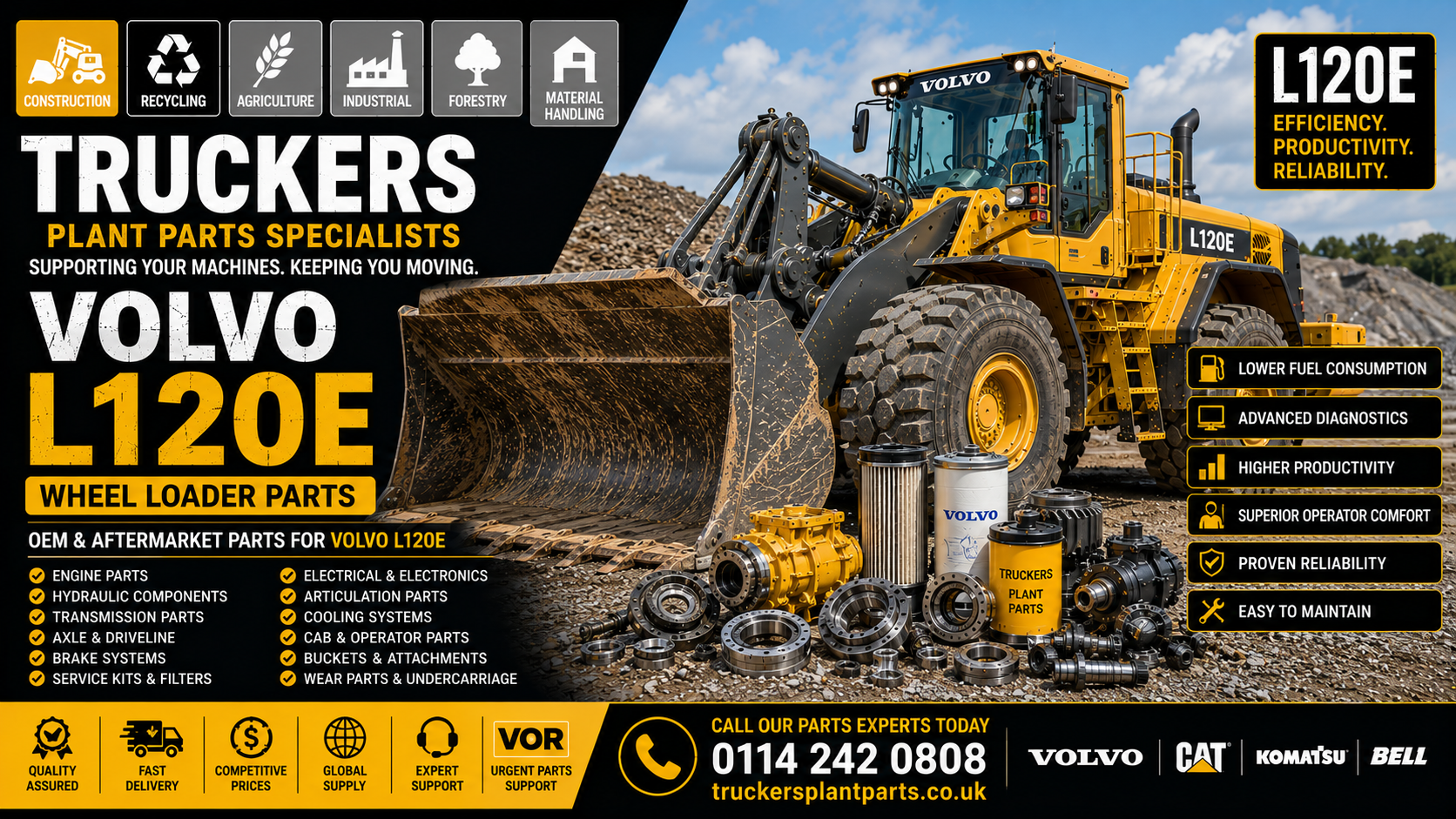
Volvo L120E Wheel Loader Parts Supply, Machine Guide, Reliability, Performance, Model Comparisons & Complete Support
The Volvo L120E wheel loader represents one of the most important developments in Volvo Construction Equipment’s highly successful mid-sized wheel loader range. Building upon the strong reputation established by the earlier L120B, L120C, and L120D models, the L120E introduced significant advancements in fuel efficiency, machine intelligence, hydraulic performance, operator comfort, diagnostics, and overall productivity.
Today, the Volvo L120E remains one of the most popular wheel loaders operating across construction projects, recycling facilities, waste transfer stations, agricultural businesses, timber yards, ports, aggregate plants, industrial sites, local authority fleets, and material handling operations throughout the world. Many operators consider the L120E to be one of the best-balanced wheel loaders Volvo has ever produced, combining modern technology with proven reliability and manageable ownership costs.
The L120E occupies a particularly valuable position within the Volvo wheel loader range. It offers more refinement, efficiency, and machine management capability than the earlier D-Series while remaining more affordable to acquire and operate than larger production machines such as the L150E, L180E, and L220E. For many operators, it provides exactly the right combination of lifting capability, manoeuvrability, operating economy, and versatility.
Designed for a wide variety of industries, the Volvo L120E is capable of handling aggregate loading, stockpile management, recycling operations, waste handling, timber movement, agricultural loading, industrial material transport, truck loading, site clearance, and general construction support. Its versatility allows operators to maximise machine utilisation throughout the year.
One of the biggest improvements introduced with the E-Series was enhanced fuel efficiency. Volvo invested heavily in improving engine management, driveline performance, hydraulic efficiency, and machine control systems. The result was a wheel loader capable of moving more material while consuming less fuel. For businesses operating machines for thousands of hours annually, these improvements can deliver substantial cost savings.
Hydraulic performance remains one of the Volvo L120E’s greatest strengths. The machine delivers excellent breakout force, smooth bucket control, responsive lift functions, precise steering, and highly efficient loading cycles. Volvo’s reputation for industry-leading hydraulics is clearly demonstrated throughout the machine’s operation, helping operators work faster while maintaining excellent control.
Operator comfort also received major attention. The Volvo Care Cab introduced improved ergonomics, better visibility, reduced noise levels, more effective climate control, improved instrumentation, and greater overall comfort. These enhancements help reduce operator fatigue and contribute directly to higher productivity throughout long working shifts.
The Volvo L120E is also an exceptionally flexible attachment platform. Depending upon site requirements, operators can utilise general-purpose buckets, light material buckets, high-tip buckets, pallet forks, timber grapples, waste handling attachments, quick couplers, sweepers, snow equipment, pipe handling tools, and specialist industrial attachments. This flexibility allows one machine to perform a wide variety of duties.
Truckers Plant Parts supports Volvo L120E wheel loaders with a comprehensive range of OEM, OEM-equivalent, rebuilt, and quality aftermarket replacement components. Support includes engine systems, hydraulic pumps, hydraulic motors, cylinders, hoses, valves, transmissions, torque converters, axle assemblies, differentials, wet brake systems, articulation assemblies, centre pivots, radiators, hydraulic coolers, oil coolers, starter motors, alternators, sensors, ECUs, wiring harnesses, service kits, filters, bearings, seals, cab parts, glass, lighting systems, buckets, wear parts, tyres, wheel rims, and emergency VOR support.
Hydraulic system maintenance remains one of the most important areas of ownership. Pumps, valves, cylinders, hoses, seals, and filtration systems operate continuously under pressure and naturally wear over time. Early signs of hydraulic deterioration may include reduced lift speeds, slower cycle times, external leaks, overheating, unusual noises, or inconsistent machine response. Early intervention often prevents larger failures and costly downtime.
The driveline should receive equal attention. The transmission, torque converter, axle assemblies, propshafts, differentials, hub reductions, and braking systems experience substantial loading during daily operation. Quality maintenance and replacement parts help maximise reliability and minimise long-term ownership costs.
Articulation systems remain a key inspection area. Centre pivots, articulation pins, bushes, bearings, seals, and steering cylinders experience significant loads throughout the machine’s working life. Excessive wear can affect steering precision, machine stability, tyre life, and overall productivity.
Cooling systems should never be overlooked. Dust, aggregate fines, timber fibres, waste contamination, agricultural debris, and industrial materials can restrict airflow and reduce cooling efficiency. Regular inspection of radiators, hydraulic coolers, oil coolers, thermostats, hoses, and fan systems helps prevent overheating and component damage.
Volvo L120D vs Volvo L120E
The E-Series introduced numerous improvements over the D-Series.
Advantages of the L120E:
Improved fuel efficiency
Enhanced machine diagnostics
Better machine intelligence
Improved operator comfort
Greater productivity
Enhanced monitoring systems
Advantages of the L120D:
Lower purchase prices
Reduced electronic complexity
Simpler ownership experience
Excellent reliability
Many operators regard the L120E as the point where Volvo successfully combined advanced technology with proven durability.
Volvo L120E vs Volvo L120F
The F-Series introduced additional refinements in efficiency, hydraulics, and machine management.
Advantages of the L120F:
Lower fuel consumption
Improved machine monitoring
Enhanced operator environment
More advanced diagnostics
Advantages of the L120E:
Lower acquisition costs
Proven technology
Excellent parts availability
Strong resale demand
Volvo L120E vs Larger Volvo Loaders
Compared with the L150E, L180E, and L220E:
Advantages of the L120E:
Lower fuel consumption
Reduced tyre costs
Easier transport
Greater manoeuvrability
Lower ownership costs
Advantages of larger machines:
Greater payload capacity
Larger buckets
Higher production output
More efficient truck loading
Common Volvo L120E Applications
Construction projects
Aggregate handling
Recycling operations
Waste management
Agricultural loading
Timber yards
Industrial facilities
Ports and logistics
Municipal operations
Snow clearance
Material stockpiling
Truck loading
Buying a Used Volvo L120E
When inspecting a used Volvo L120E, buyers should evaluate:
Hydraulic performance
Transmission operation
Service records
Articulation wear
Brake performance
Cooling systems
Electrical systems
Diagnostic history
Tyre condition
Loader arm integrity
Bucket wear
Cab condition
Evidence of structural repairs
Machines with documented maintenance histories and evidence of preventative servicing generally offer the strongest long-term value.
Overall, the Volvo L120E remains one of the most respected and capable wheel loaders Volvo has ever produced. Combining fuel efficiency, hydraulic performance, operator comfort, machine intelligence, versatility, and durability, it continues to provide outstanding value across a wide range of industries. Supported by Truckers Plant Parts, the Volvo L120E can continue loading, lifting, transporting, stockpiling, clearing, feeding, and supporting productive operations for many years to come while maintaining the reputation that has made it a favourite among operators worldwide.
FAQ: Volvo L120E Wheel Loader Parts
1. What is the Volvo L120E wheel loader?
The Volvo L120E is a highly versatile wheel loader designed for construction, recycling, agriculture, waste handling, forestry, industrial operations, and aggregate loading.
2. Is the Volvo L120E still widely used?
Yes, the L120E remains a popular machine throughout the world due to its reliability, efficiency, and versatility.
3. Why is the Volvo L120E popular?
It offers an excellent balance of fuel efficiency, productivity, comfort, reliability, and operating costs.
4. Does Truckers Plant Parts supply Volvo L120E parts?
Yes, Truckers Plant Parts supplies a comprehensive range of Volvo L120E replacement parts.
5. Are OEM parts available?
Yes, OEM and OEM-equivalent parts can be supplied.
6. Are aftermarket parts available?
Yes, quality aftermarket alternatives are available for many components.
7. Do you supply service kits?
Yes, complete maintenance and service kits are available.
8. Can you supply engine parts?
Yes, engine repair and maintenance parts can be supplied.
9. Are complete engines available?
Yes, complete engines may be sourced subject to availability.
10. Can you supply hydraulic pumps?
Yes, hydraulic pumps are available.
11. Are hydraulic motors available?
Yes, hydraulic motors can be supplied.
12. Do you stock hydraulic cylinders?
Yes, lift, bucket, and steering cylinders are available.
13. Can you supply hydraulic hoses?
Yes, hydraulic hoses are available.
14. Are hydraulic valves available?
Yes, hydraulic control valves can be supplied.
15. Do you stock hydraulic filters?
Yes, hydraulic filtration products are available.
16. Can you supply transmission parts?
Yes, transmission components are available.
17. Are complete transmissions available?
Yes, complete transmission units may be sourced.
18. Can you supply torque converters?
Yes, torque converters are available.
19. Are axle assemblies available?
Yes, axle assemblies and components can be supplied.
20. Can you supply differential parts?
Yes, differential assemblies and repair parts are available.
21. Are brake components available?
Yes, wet brake system components can be supplied.
22. Do you stock hub assemblies?
Yes, hub assemblies are available.
23. Can you supply wheel bearings?
Yes, wheel bearings and bearing kits are available.
24. Are articulation pins available?
Yes, articulation pins can be supplied.
25. Do you stock articulation bushes?
Yes, articulation bushes are available.
26. Can you supply centre pivot parts?
Yes, centre pivot assemblies and components are available.
27. Are steering system parts available?
Yes, steering components can be supplied.
28. Can you supply seals?
Yes, seal kits are available.
29. Are bearings available?
Yes, bearings for multiple applications can be supplied.
30. Do you stock radiators?
Yes, radiators are available.
31. Can you supply hydraulic coolers?
Yes, hydraulic coolers can be supplied.
32. Are oil coolers available?
Yes, oil coolers are available.
33. Can you supply coolant hoses?
Yes, coolant hoses are available.
34. Are thermostats available?
Yes, thermostats can be supplied.
35. Do you stock cooling fan assemblies?
Yes, fan systems and components are available.
36. Can you supply alternators?
Yes, alternators are available.
37. Are starter motors available?
Yes, starter motors can be supplied.
38. Can you supply electrical components?
Yes, electrical parts are available.
39. Are sensors available?
Yes, machine sensors can be sourced.
40. Can you supply ECUs?
Yes, electronic control units can be supplied.
41. Are wiring harnesses available?
Yes, wiring looms are available.
42. Can you supply switches?
Yes, control switches and operator controls can be supplied.
43. Is replacement cab glass available?
Yes, replacement cab glass can be sourced.
44. Are mirrors available?
Yes, mirrors and mirror assemblies are available.
45. Can you supply seats?
Yes, operator seats are available.
46. Are work lights available?
Yes, lighting systems can be supplied.
47. Can you supply warning beacons?
Yes, safety lighting products are available.
48. Are cab components available?
Yes, a wide range of cab parts can be sourced.
49. Can you supply fuel system parts?
Yes, fuel system components are available.
50. Are injectors available?
Yes, injectors can be supplied.
51. Do you stock turbochargers?
Yes, turbochargers are available.
52. Can you supply exhaust components?
Yes, exhaust system parts can be supplied.
53. Are buckets available?
Yes, a wide range of bucket options is available.
54. Can you supply general-purpose buckets?
Yes, GP buckets are available.
55. Are light material buckets available?
Yes, light material buckets can be supplied.
56. Can you supply high-tip buckets?
Yes, high-tip buckets are available.
57. Are pallet forks available?
Yes, pallet fork attachments can be supplied.
58. Can you supply grapples?
Yes, timber and waste grapples are available.
59. Are quick couplers available?
Yes, quick coupler systems can be supplied.
60. Can you supply cutting edges?
Yes, cutting edges are available.
61. Are side cutters available?
Yes, side cutters can be supplied.
62. Can you supply wear plates?
Yes, wear parts are available.
63. Are tyres available?
Yes, tyres are available for multiple applications.
64. Can you supply wheel rims?
Yes, wheel rims can be supplied.
65. What is VOR support?
VOR stands for Vehicle Off Road and provides urgent parts assistance during breakdowns.
66. Does Truckers offer emergency parts support?
Yes, emergency VOR support is available.
67. Can parts be identified using serial numbers?
Yes, serial numbers ensure accurate parts identification.
68. What industries use the Volvo L120E?
Construction, recycling, agriculture, forestry, waste management, industrial operations, and aggregate handling.
69. Is the L120E suitable for construction work?
Yes, it is widely used on construction sites.
70. Is the L120E suitable for agriculture?
Yes, it is popular for grain, feed, and bulk material handling.
71. Can it be used in recycling facilities?
Yes, many recycling businesses operate Volvo L120E loaders.
72. Is it suitable for waste handling?
Yes, it performs exceptionally well in waste transfer operations.
73. Can the L120E be used in timber yards?
Yes, especially when fitted with specialist grapple attachments.
74. Is the machine suitable for loading trucks?
Yes, truck loading is one of its primary applications.
75. What are common hydraulic problems?
Pump wear, hose failures, valve faults, and leaking seals.
76. What causes hydraulic overheating?
Blocked coolers, contamination, low oil levels, or worn components.
77. What causes reduced lifting performance?
Hydraulic wear, leaks, pressure loss, or component failure.
78. Why is articulation wear important?
It affects steering precision, stability, tyre life, and machine control.
79. What are common transmission issues?
Wear, overheating, contamination, and poor maintenance.
80. What are common axle problems?
Bearing failures, seal leaks, and differential wear.
81. What are common brake issues?
Brake wear, hydraulic faults, and contamination.
82. Why are service records important?
They provide evidence of proper maintenance and machine care.
83. What should buyers inspect first?
Hydraulics, transmission, articulation, brakes, tyres, cooling systems, and service records.
84. Can contaminated hydraulic oil damage components?
Yes, contamination significantly reduces component life.
85. Why is cooling system maintenance important?
It prevents overheating and expensive engine repairs.
86. Can blocked radiators affect performance?
Yes, restricted airflow reduces cooling efficiency.
87. What affects tyre life?
Ground conditions, maintenance, articulation wear, and operator habits.
88. Can worn articulation bushes increase tyre wear?
Yes, excessive movement can accelerate tyre wear.
89. Is the L120E larger than an L120D?
No, they are similar in size, but the E-Series offers greater efficiency and refinement.
90. Is the L120E smaller than an L150E?
Yes, the L150E offers greater payload and production capability.
91. Is the L120E smaller than an L180E?
Yes, the L180E is designed for heavier production environments.
92. Does the L120E offer better fuel economy than the L120D?
Yes, Volvo introduced fuel-saving improvements throughout the E-Series.
93. Does the L120E have better diagnostics than the L120D?
Yes, the E-Series introduced enhanced monitoring and diagnostic systems.
94. Why do operators still buy L120E machines?
They are productive, fuel-efficient, reliable, versatile, and comfortable.
95. Is fuel consumption lower than larger loaders?
Yes, operating costs are generally lower than L150E and L180E models.
96. Does the L120E have strong resale demand?
Yes, well-maintained examples remain highly desirable.
97. Are rebuilt components available?
Yes, selected rebuilt components can be supplied.
98. Can Truckers source hard-to-find parts?
Yes, sourcing obsolete and specialist parts is a core service.
99. Why choose Truckers Plant Parts?
Extensive industry experience, fast sourcing, quality parts, and expert support.
100. How can I order Volvo L120E parts?
Contact Truckers Plant Parts with your machine serial number and parts requirements for fast and accurate assistance.
L20, L20B, L20F, L20H, L20 Electric, L25, L25B, L25H, L25 Electric, L30, L30B, L30G, L30H, L32, L32B, L35, L35B, L35G, L35H, L40, L40B, L45, L45B, L45F, L45G, L45H, L50, L50B, L50C, L50D, L50E, L50F, L50G, L50H, L60, L60E, L60F, L60G, L60H, L70, L70B, L70C, L70D, L70E, L70F, L70G, L70H, L90, L90B, L90C, L90D, L90E, L90F, L90G, L90H, L110, L110E, L110F, L110G, L110H, L120, L120B, L120C, L120D, L120E, L120F, L120G, L120H, L120 Electric, L150, L150C, L150D, L150E, L150F, L150G, L150H, L180, L180C, L180D, L180E, L180F, L180G, L180H, L190H, L200 High Lift, L220, L220D, L220E, L220F, L220G, L220H, L250G, L250H, L260, L260H, L330C, L330D, L330E, L350F, L350H