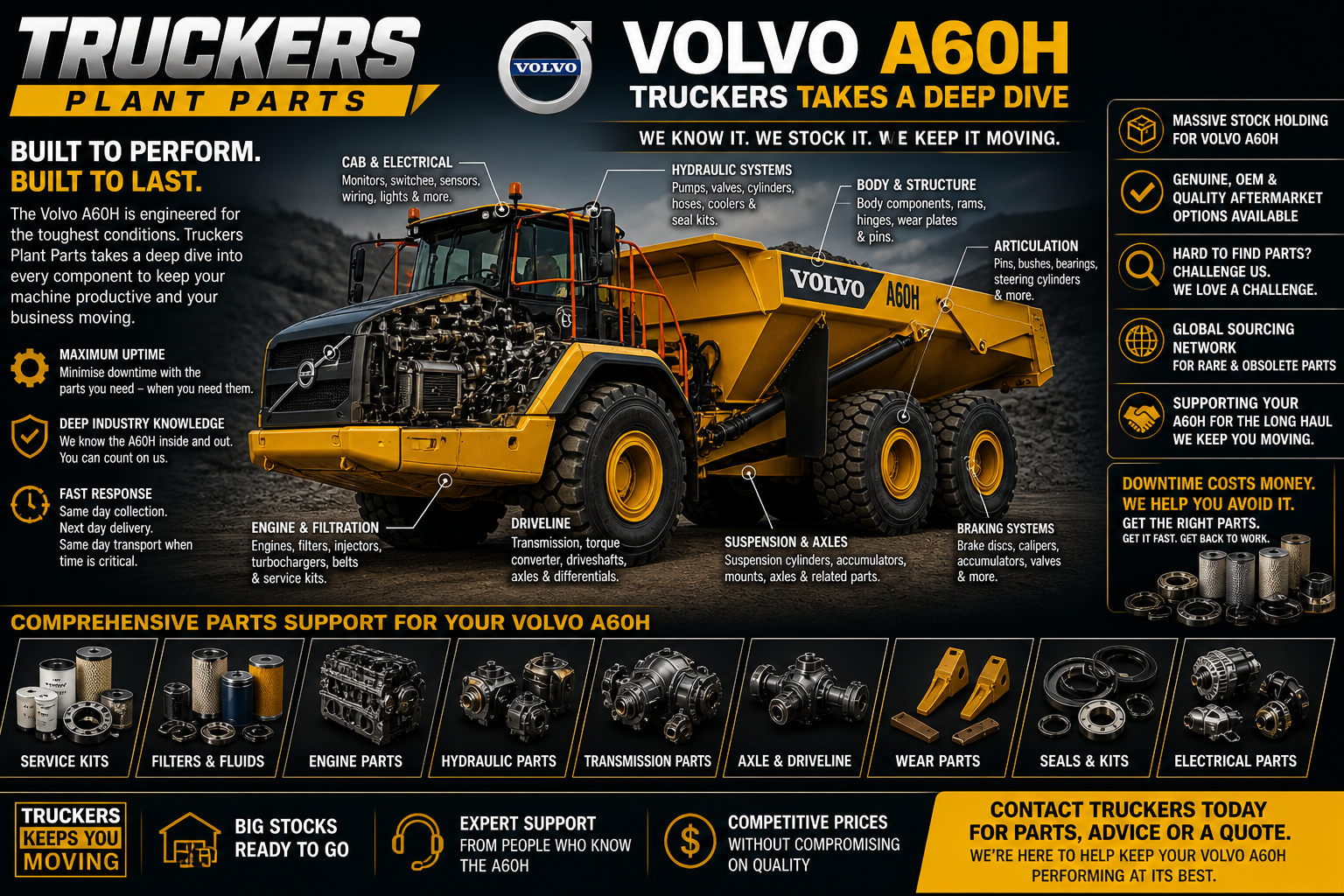
Volvo A60 Articulated Hauler – The Biggest 6×6 ADT In The Industry And How It Compares Against Every Serious Rival In Heavy Haulage
The Volvo A60 occupies a unique position in the heavy equipment industry because it sits at the absolute top end of articulated dump truck production while still retaining the core strengths that made Volvo the dominant force in articulated hauling in the first place. In simple terms, the A60 is not merely a larger articulated dump truck. It is Volvo’s attempt to push the articulated hauler concept to the absolute limit before operators are forced to move into rigid-frame mining trucks.
That distinction matters enormously.
For decades, articulated dump trucks traditionally operated in payload classes well below rigid mining trucks, serving quarrying, earthmoving, infrastructure, forestry, mining support, pipeline work, bulk excavation, and severe off-road hauling applications where flexibility, traction, and terrain capability mattered more than outright payload size. Volvo essentially created and perfected the articulated hauler segment, and over time competitors such as Caterpillar, Bell, Komatsu, John Deere, and others followed into the market.
But the A60 changes the conversation entirely.
At over 60 tonnes payload capacity, 630 horsepower, and a gross machine weight exceeding 217,000 lbs, the Volvo A60 enters territory traditionally dominated by rigid-frame quarry and mining haul trucks while still retaining true articulated 6×6 mobility and off-road capability.
That is what makes this machine so important.
It effectively bridges the gap between conventional articulated dump trucks and smaller rigid mining trucks.
And right now, there are very few machines capable of doing that successfully.
Volvo markets the A60 as the largest 6×6 articulated hauler in the industry, and in practical terms that claim is accurate. The machine sits above the Volvo A45 and pushes beyond the size envelope many operators traditionally associate with articulated hauling. Yet despite its massive scale, Volvo engineered the A60 around maintaining the key strengths articulated haulers are famous for: traction, flotation, maneuverability, rough terrain capability, operator control, and all-weather hauling performance.
This becomes especially important when comparing the A60 against its closest rivals.
The most direct competitors include the Bell B60E, Caterpillar 745, Komatsu HM400 and HM500 series, Deere 460E-II, and in some situations smaller rigid quarry trucks from manufacturers such as Caterpillar, Komatsu, Liebherr, and Hitachi.
But interestingly, none of those machines match the A60 perfectly.
That alone tells you how unusual this truck really is.
How Does It Stack Up Against The Rest
The Bell B60E comes closest philosophically because Bell also attempted to push articulated hauling beyond conventional payload limits. The B60E offers strong payload capability and excellent off-road mobility, particularly within mining support and earthmoving sectors. Bell has long maintained a reputation for robust articulated truck engineering, and many operators appreciate the simplicity and durability of Bell driveline systems.
However, the Volvo A60 generally exceeds the Bell B60E in overall refinement, integrated technology, operator environment sophistication, fuel optimisation systems, transmission intelligence, and total systems integration. Volvo’s decades-long obsession with articulated driveline refinement becomes extremely apparent in the A60. The truck feels less like a giant articulated dump truck and more like an integrated intelligent hauling platform.
That matters significantly in high-hour production environments.
The Caterpillar 745 sits below the A60 in payload but remains one of the strongest rivals because Caterpillar has enormous global support infrastructure and strong quarrying penetration. Caterpillar machines are famous for ruggedness and aggressive loading capability. Many operators appreciate Cat’s straightforward approach to heavy equipment engineering and the strength of the dealer network.
But the Volvo A60 generally surpasses the Cat 745 in payload capacity, ride sophistication, fuel efficiency technology, cab refinement, and overall operator comfort. Volvo’s active hydraulic suspension system, hydro-mechanical steering, Volvo Dynamic Drive systems, integrated Co-Pilot interface, and intelligent terrain optimisation technologies create a more refined hauling experience overall.
The Komatsu HM400 and HM500 trucks remain respected within mining support and severe-duty earthmoving applications. Komatsu has traditionally engineered strong and dependable articulated trucks with robust driveline systems and good durability. However, Komatsu’s articulated truck range has never quite achieved the same market dominance or engineering refinement as Volvo within the articulated hauling sector itself.
Volvo’s experience advantage here becomes very difficult to ignore.
Because Volvo did not simply enter articulated hauling.
Volvo practically defined it.
That accumulated experience shows throughout the A60 platform.
One of the most important areas where the A60 separates itself from competitors is the driveline system.
Volvo engineered the truck around a completely new transmission and axle package capable of utilising full engine power across all gears. This is critical because massive articulated dump trucks can easily become inefficient if driveline systems cannot effectively transfer available torque to the ground under varying terrain conditions.
The Volvo D16J engine itself is an enormous powerplant. Producing approximately 630 horsepower and over 2,183 lb-ft of torque from a 16.1-litre six-cylinder platform, the engine delivers tremendous low-end pulling power designed specifically for high-payload hauling under severe off-road conditions.
The torque characteristics are particularly important.
Maximum torque arrives at just 980 RPM, meaning the truck develops huge pulling power extremely low in the rev range. That improves fuel efficiency while also maintaining traction and driveline smoothness under heavy load.
Volvo pairs this engine with the PT3209 fully automatic planetary transmission featuring nine forward gears, three reverse gears, integrated lock-up functionality, dynamic gear selection logic, and predictive traction management systems.
This is where the A60 becomes extremely sophisticated compared with older articulated truck designs.
Traditional articulated trucks relied heavily on brute mechanical traction and operator judgement. The A60 instead continuously manages traction, gear selection, terrain response, differential locking, and driveline optimisation automatically through integrated electronic systems.
Features such as Volvo Dynamic Drive, Terrain Memory, OptiShift, automatic traction control, predictive gear management, and intelligent drive combinations allow the machine to adapt dynamically to changing terrain conditions.
The Terrain Memory system is especially interesting because the truck actually identifies slippery road sections and remembers them, automatically optimising traction systems during future passes through the same area.
That level of intelligence simply did not exist on older articulated haulers.
And it dramatically affects productivity.
Because in severe off-road hauling, momentum is everything.
Losing traction costs fuel, time, tyre life, driveline stress, and overall cycle efficiency.
The A60 is therefore engineered not simply to haul heavier loads, but to maintain productive momentum across poor terrain where rigid-frame trucks would struggle badly.
This becomes one of the biggest differences between the A60 and rigid quarry trucks.
Rigid trucks dominate in smooth, prepared haul-road environments where maximum payload and high-speed efficiency matter most. But once conditions become soft, steep, muddy, uneven, slippery, or unstable, articulated trucks regain major advantages.
The A60 pushes those advantages into payload territory previously unreachable for articulated designs.
That is why the machine has become so attractive within large earthmoving, mining support, heavy infrastructure, and severe-duty quarry applications where operators need rigid-truck-like payloads but cannot rely on rigid haul-road conditions continuously.
The suspension system contributes enormously to this capability.
Volvo’s active hydraulic front suspension allows the A60 to maintain higher hauling speeds across rough terrain while improving ride quality, stability, traction, and operator comfort. Combined with the all-terrain bogie setup and hydro-mechanical steering, the truck remains remarkably stable for such a large articulated platform.
Stability matters hugely on trucks this size.
Because once payloads exceed 60 tonnes, the consequences of instability become very serious.
Volvo therefore engineered outstanding tipping stability into the chassis and suspension system. The machine’s heavy-duty box-type frames, robot-welded high-strength steel construction, reinforced axles, fully floating axle shafts, planetary hub reductions, and maintenance-free rotating hitch system all contribute toward maintaining structural integrity under enormous stress.
Compared with many rivals, Volvo tends to prioritise total operational refinement rather than pure brute-force engineering alone.
That philosophy continues strongly throughout the A60.
The operator environment is another major differentiator.
Older articulated dump trucks were often loud, physically demanding, vibration-heavy environments where operators simply endured long shifts. The A60 instead feels closer to a modern premium industrial vehicle.
The redesigned cab incorporates integrated Volvo Co-Pilot systems, dynamic digital instrument displays, ergonomic controls, improved storage, better visibility, reduced noise levels, and enhanced operator ergonomics throughout.
The two-screen interface system centralises machine management intelligently while maintaining easy readability. Camera systems, climate control, machine diagnostics, telematics, onboard weighing systems, and operational data integrate directly into the operator environment rather than feeling like aftermarket add-ons.
Visibility is also excellent considering the size of the machine.
Volvo redesigned hood geometry, cab panels, mirror systems, camera integration, and wiper coverage specifically to improve operator awareness in difficult site conditions.
This matters because large articulated haulers often operate within congested infrastructure projects, quarry operations, and active loading environments where visibility becomes critically important for both productivity and safety.
Fuel efficiency represents another major area where Volvo pushes aggressively.
Volvo claims the A60 delivers up to 15% greater fuel efficiency and 5% higher productivity compared with the previous generation. Those are enormous gains at this scale because fuel consumption becomes one of the single largest operational costs on high-hour articulated hauling fleets.
Machines of this size burn huge volumes of fuel daily.
Even small percentage improvements dramatically affect operational profitability across thousands of annual operating hours.
The A60 achieves these gains through combined optimisation across the engine, transmission, traction systems, suspension systems, dynamic gear selection, lock-up functionality, and predictive terrain management.
Competitors are also improving fuel efficiency constantly, but Volvo’s integrated systems approach remains particularly advanced within articulated hauling.
Maintenance and uptime remain another area where the A60 demonstrates Volvo’s maturity within this sector.
Large articulated trucks generate huge maintenance costs over long operational lifecycles. Volvo therefore focused heavily on service simplification, access improvements, extended maintenance intervals, grouped service points, electronic diagnostics, remote monitoring, and proactive service management.
The 250-hour greasing intervals and 1,000-hour engine service intervals are particularly impressive for machinery operating under such severe conditions.
The electrically operated hood systems, grouped filters, accessible maintenance points, remote monitoring systems, enhanced electrical service centres, and integrated diagnostics all reduce downtime and simplify servicing operations significantly.
Truckers Plant Parts support the Volvo A60 and wider Volvo articulated hauler range extensively with OEM, OEM-equivalent, and quality aftermarket solutions covering engines, transmissions, axles, hydraulics, suspension systems, cooling systems, braking systems, articulation joints, electrical systems, driveline components, body systems, wear parts, filters, service kits, and emergency VOR support.
Because machines like the A60 operate within industries where downtime becomes enormously expensive extremely quickly.
One immobilised A60 can affect entire quarry loading operations, mining support schedules, earthmoving contracts, or infrastructure production timelines immediately.
And repairing a machine of this scale requires real expertise.
Ultimately, what makes the Volvo A60 so important is not merely its size.
It is the fact Volvo successfully scaled articulated hauling into a completely new operational category without sacrificing the very characteristics that made articulated trucks valuable in the first place.
The A60 remains genuinely capable off-road.
It remains highly maneuverable for its size.
It retains exceptional traction.
It maintains ride quality.
It delivers intelligent driveline management.
It provides excellent operator refinement.
It offers outstanding stability.
And it does all this while hauling payloads approaching rigid mining truck territory.
That combination is extraordinarily difficult to achieve successfully.
Many operators may initially focus purely on the truck’s headline size and payload figures. But the real achievement lies in how effectively Volvo preserved articulated truck DNA while scaling the platform upward into an entirely different productivity class.
That is why the Volvo A60 currently stands as one of the most technically impressive articulated dump trucks ever produced.
Not simply because it is bigger.
But because it manages to be bigger without losing what made articulated hauling great in the first place.
Volvo A60 Articulated Hauler FAQ – The Biggest 6×6 ADT In The Industry Explained In Detail
1. What is the Volvo A60?
The Volvo A60 is the largest 6×6 articulated dump truck currently produced in the heavy equipment industry.
2. What type of machine is the A60?
It is a heavy-duty articulated hauler designed for quarrying, mining support, earthmoving, infrastructure, and severe off-road hauling applications.
3. Why is the Volvo A60 important?
The A60 pushes articulated dump truck payload capacity into territory traditionally occupied by smaller rigid mining trucks.
4. What payload capacity does the Volvo A60 have?
The machine carries approximately 60.6 short tons or 121,250 lbs.
5. How much horsepower does the A60 produce?
The Volvo A60 produces approximately 630 horsepower.
6. What engine powers the A60?
The machine uses a Volvo D16J engine.
7. How large is the Volvo D16J engine?
The engine is a 16.1-litre six-cylinder diesel platform.
8. How much torque does the A60 produce?
The truck generates approximately 2,183 lb-ft of torque.
9. Why is torque important in articulated dump trucks?
Torque provides pulling power under heavy load conditions and difficult terrain.
10. At what RPM does maximum torque occur?
Maximum torque occurs at approximately 980 RPM.
11. Why is low-RPM torque valuable?
Low-RPM torque improves fuel efficiency and off-road traction under heavy loads.
12. What transmission does the Volvo A60 use?
The truck uses the Volvo PT3209 fully automatic planetary transmission.
13. How many gears does the transmission have?
The transmission features nine forward gears and three reverse gears.
14. What makes the A60 transmission special?
The transmission allows full engine power utilisation across all gears.
15. What is OptiShift?
OptiShift is Volvo’s intelligent driveline optimisation system designed to improve fuel efficiency and productivity.
16. What does OptiShift improve?
It improves directional changes, fuel economy, driveline efficiency, and hauling productivity.
17. What is Volvo Dynamic Drive?
Volvo Dynamic Drive is a predictive gear and driveline management system.
18. What does Volvo Dynamic Drive do?
It adapts gear selection dynamically to terrain and operating conditions.
19. What is Terrain Memory?
Terrain Memory identifies and remembers slippery road sections to optimise traction automatically.
20. Why is Terrain Memory useful?
It improves traction and reduces wheel spin in difficult conditions.
21. What traction systems does the A60 use?
The machine uses automatic traction control and 100% differential locks.
22. Why are differential locks important?
Differential locks improve traction in mud, loose material, and poor ground conditions.
23. What axle system does the A60 use?
The machine uses heavy-duty Volvo-designed axles with planetary hub reductions.
24. Why are reinforced axles important?
Reinforced axles withstand massive loads, torque, and stress during severe-duty hauling.
25. What suspension system does the A60 use?
The A60 uses active hydraulic front suspension.
26. Why is active hydraulic suspension valuable?
It improves ride quality, stability, traction, and hauling speed across rough terrain.
27. What is the A60’s maximum speed?
The machine reaches approximately 35.4 mph.
28. Why is speed important in articulated hauling?
Faster haul cycles improve production efficiency and reduce cost per tonne.
29. What industries use the Volvo A60?
Quarrying, mining support, infrastructure, earthmoving, aggregates, forestry, and severe off-road hauling industries use the A60.
30. Why is the A60 popular in quarrying?
It combines high payloads with excellent off-road mobility and traction.
31. Why is the A60 valuable in mining support?
It performs effectively where rigid trucks struggle on poor terrain.
32. What makes articulated dump trucks different from rigid trucks?
Articulated trucks offer superior off-road flexibility, traction, and maneuverability.
33. What are the A60’s biggest rivals?
The Bell B60E, Caterpillar 745, Komatsu HM400/HM500, and Deere 460E-II are major rivals.
34. Which competitor comes closest to the A60 philosophically?
The Bell B60E comes closest in terms of large articulated hauling design.
35. How does the A60 compare with the Bell B60E?
The Volvo generally offers greater refinement, technology integration, and operator comfort.
36. How does the A60 compare with the Caterpillar 745?
The A60 exceeds the Cat 745 in payload capacity and advanced driveline technology.
37. How does the A60 compare with Komatsu articulated trucks?
Volvo generally leads in articulated hauling refinement and integrated systems.
38. Why does Volvo dominate articulated hauling?
Volvo pioneered and refined articulated dump truck technology for decades.
39. Why is the A60 considered unique?
It bridges the gap between traditional articulated haulers and rigid mining trucks.
40. What body volume does the A60 offer?
The truck offers approximately 43.9 yd³ heaped capacity.
41. Why is body volume important?
Larger body volume improves hauling productivity per cycle.
42. What gross machine weight does the A60 reach?
The machine exceeds approximately 217,700 lbs fully loaded.
43. Why is machine stability important at this size?
Payload instability can become extremely dangerous at high weights.
44. What steering system does the A60 use?
The truck uses hydro-mechanical articulated steering.
45. Why is articulated steering important?
It improves maneuverability and terrain adaptability.
46. How many steering cylinders does the A60 use?
The machine uses two double-acting steering cylinders.
47. What braking system does the A60 use?
The A60 uses fully hydraulic wet disc brakes on all wheels.
48. Why are wet brakes important?
Wet brakes provide cooling, durability, and reliable stopping power.
49. What retarder systems are fitted?
The truck uses Volvo Engine Brake systems and downhill speed control.
50. Why are retarders important on articulated trucks?
Retarders reduce brake wear and improve downhill control.
51. What is downhill speed control?
A system designed to maintain safe speeds on steep descents automatically.
52. What is hill assist?
Hill assist helps prevent rollback during hill starts.
53. What is the Load and Dump Brake system?
A patented Volvo system designed to improve stability during loading and dumping operations.
54. Why is dumping stability important?
Large payloads create major balance and rollover risks during tipping.
55. What tipping angle does the A60 achieve?
The machine reaches approximately 70 degrees tipping angle.
56. How quickly does the body tip?
Tipping time is approximately 13 seconds with load.
57. Why is fast tipping important?
It reduces cycle times and improves production efficiency.
58. What cab systems does the A60 use?
The machine uses Volvo Co-Pilot and dynamic digital instrument systems.
59. What is Volvo Co-Pilot?
Volvo Co-Pilot is an integrated operator interface and machine management system.
60. Why is Volvo Co-Pilot important?
It centralises machine information, diagnostics, cameras, and controls.
61. How many screens are inside the cab?
The A60 uses two major display systems.
62. Why is operator comfort important?
Long hauling shifts create fatigue which affects productivity and safety.
63. What comfort features does the A60 include?
Climate control, ergonomic controls, air suspension seating, improved storage, and reduced noise levels are included.
64. Why is visibility important on articulated trucks?
Large haul trucks operate in busy and potentially hazardous environments.
65. What visibility improvements does the A60 include?
Redesigned hood geometry, cameras, mirrors, wider wiper coverage, and improved sightlines are included.
66. What camera systems are available?
Front, rear, and entrance cameras are available.
67. Why are cameras important?
They improve operator awareness and site safety.
68. What telematics system does Volvo use?
The A60 uses Volvo CareTrack systems.
69. Why are telematics useful?
Telematics monitor machine performance, fuel usage, fault codes, and service intervals remotely.
70. What is Haul Assist?
Haul Assist is Volvo’s productivity and payload management system.
71. What does On-Board Weighing do?
It helps operators monitor payloads accurately.
72. Why is payload accuracy important?
Incorrect loading affects tyre life, fuel efficiency, and machine wear.
73. What service intervals does the A60 offer?
The machine offers up to 1,000-hour engine service intervals.
74. What greasing intervals does the machine offer?
Greasing intervals reach approximately 250 hours.
75. Why are long service intervals valuable?
They reduce downtime and maintenance costs.
76. Why is service access important?
Easy maintenance access reduces repair time and labour costs.
77. What service features improve accessibility?
Electrically operated hood systems, grouped service points, and accessible filters improve servicing.
78. Why are articulated haulers expensive to maintain?
Large driveline systems, tyres, hydraulics, and severe-duty operation create high wear.
79. What hydraulic systems does the A60 use?
The machine uses multiple variable displacement piston pumps.
80. Why are hydraulics important on articulated trucks?
Hydraulics power steering, tipping systems, suspension, braking, and machine functions.
81. What hydraulic components commonly require maintenance?
Pumps, hoses, cylinders, accumulators, filters, valves, and cooling systems commonly require servicing.
82. What cooling systems are fitted?
Engine cooling, hydraulic cooling, and brake cooling systems are integrated throughout the truck.
83. Why are cooling systems critical?
Heavy hauling generates enormous heat continuously.
84. What fuel tank capacity does the A60 have?
The machine carries approximately 750 litres of fuel.
85. Why does the A60 require large fuel capacity?
Large articulated haulers consume significant fuel during continuous production hauling.
86. What tyres does the A60 use?
The machine commonly uses 33.25R29 tyre configurations.
87. Why are tyre systems important?
Tyres affect traction, flotation, ride quality, stability, and operating cost.
88. What makes the A60 good off-road?
The driveline, suspension, articulation, traction systems, and weight distribution all improve off-road capability.
89. Why are articulated trucks better than rigid trucks in soft terrain?
Articulated trucks maintain better traction and flexibility over uneven ground.
90. What frame design does the A60 use?
The machine uses heavy-duty robot-welded high-strength steel box frames.
91. Why are strong frames important?
Large payloads create enormous structural stress during operation.
92. What is the rotating hitch system?
A maintenance-free sealed articulation hitch system using tapered roller bearings.
93. Why is the hitch system important?
The articulation hitch is central to truck stability and movement.
94. What maintenance costs does Volvo claim to reduce?
Volvo claims up to 5% lower service costs over 12,000 operating hours.
95. Why are uptime improvements valuable?
Downtime on machines this size becomes extremely expensive very quickly.
96. Does Truckers Plant Parts support the Volvo A60?
Yes. Truckers support the A60 extensively with OEM, OEM-equivalent, and quality aftermarket parts.
97. What parts are commonly supported for the A60?
Engines, transmissions, axles, hydraulics, suspension systems, brakes, cooling systems, electrical systems, articulation systems, filters, and wear parts are heavily supported.
98. Why is rapid parts support important for the A60?
A stopped A60 can affect entire quarry, mining, or earthmoving operations immediately.
99. Why is the A60 considered one of the most advanced articulated trucks ever built?
Because it combines huge payload capacity with advanced driveline intelligence, operator refinement, fuel efficiency, and true off-road capability.
100. What best describes the Volvo A60 overall?
The Volvo A60 is the largest and most technologically advanced 6×6 articulated hauler currently in production, combining massive payload capability, intelligent driveline systems, exceptional off-road mobility, operator comfort, fuel efficiency, and Volvo’s decades of articulated hauling expertise into one of the most capable heavy hauling machines ever built.