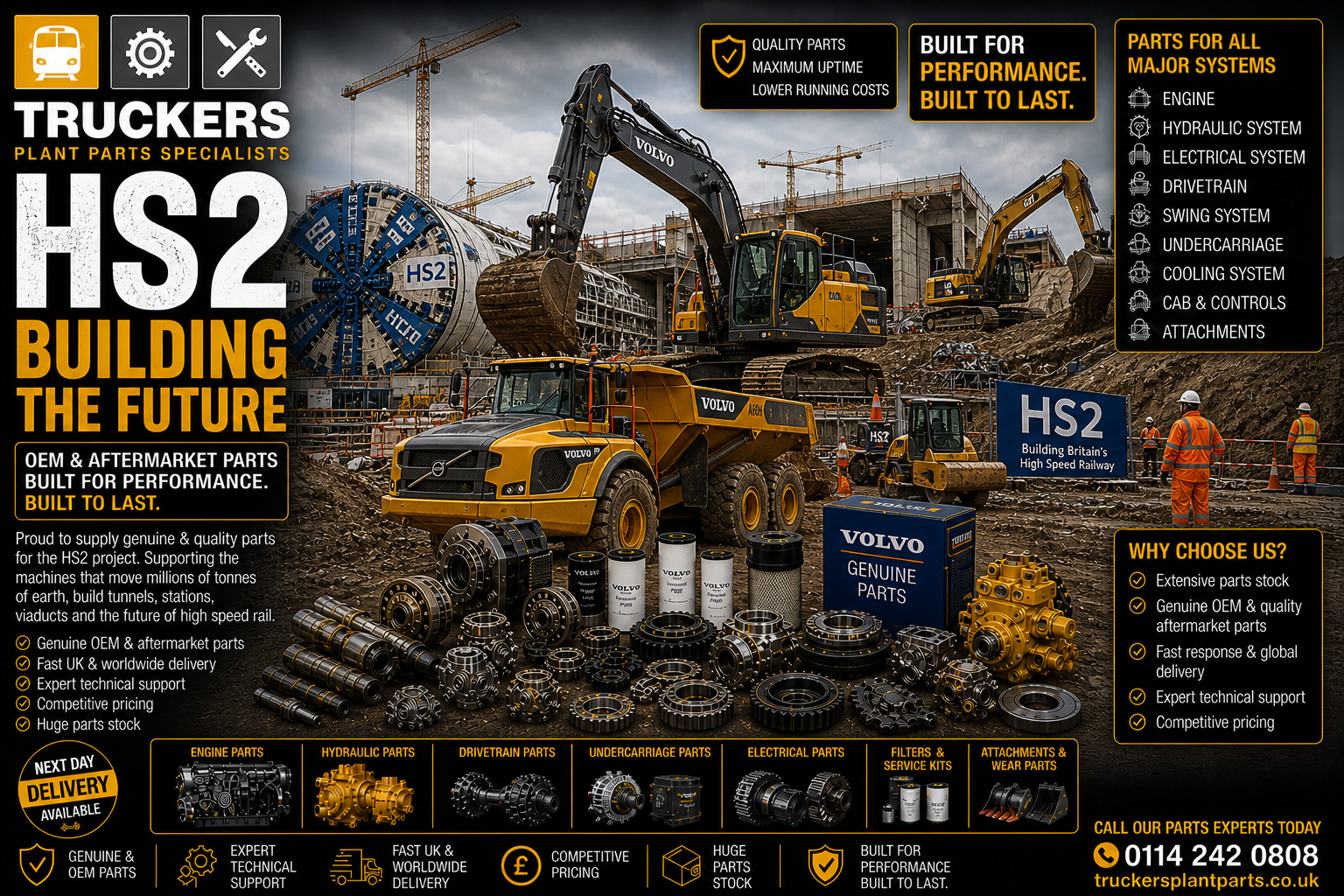
HS2 Construction Project and the Massive Fleet of Plant Machinery Powering Britain’s Largest Infrastructure Build
HS2 Ltd has become one of the most ambitious and technically demanding civil engineering programmes ever undertaken in the United Kingdom. Stretching across huge sections of England and involving some of the largest excavation, tunnelling, concrete, logistics and infrastructure operations seen in Europe for decades, HS2 is not simply a railway project. It is effectively a moving industrial ecosystem built around heavy construction plant, advanced engineering systems, precision logistics and around-the-clock civil engineering activity.
Despite political debate, redesigns and scaling back certain phases of the wider network, the remaining core route between London and Birmingham still represents one of the largest active infrastructure construction zones in Europe. The project cuts through urban environments, countryside, river valleys, road networks and densely populated transport corridors, requiring a staggering range of specialist machinery and highly coordinated construction methods.
Across the route, entire landscapes have been reshaped using fleets of articulated dump trucks, crawler excavators, bulldozers, crushers, piling rigs, mobile cranes, tunnel boring machines, telehandlers, rail engineering systems and concrete production facilities. Few projects in modern British history have demanded such a vast combination of earthmoving capability, geotechnical engineering and heavy equipment deployment all operating simultaneously over hundreds of miles.
At locations such as Old Oak Common in West London, the Chiltern tunnel system, Delta Junction near Birmingham and the new Curzon Street station development, HS2 has evolved into a showcase of modern heavy construction technology. Massive earthworks, deep excavations, bridge launches, tunnel drives and station builds continue to generate demand for some of the most advanced construction machinery in the world.
One of the defining characteristics of HS2 is the sheer quantity of bulk earthmoving required. Millions of tonnes of soil, rock, clay and spoil have needed to be excavated, transported, processed and reused. This has made articulated dump trucks one of the most visible and essential machine categories on the project.
Large articulated haulers from manufacturers such as Volvo Construction Equipment, Caterpillar Inc., Komatsu Ltd. and Bell Equipment have been heavily utilised throughout the route. Machines in the 30-tonne to 60-tonne payload category are ideal for moving spoil from deep cuttings, tunnel shafts and excavation zones to processing and redistribution areas.
The constant movement of material across HS2 sites has created an operational environment more comparable to a large quarry or open-cast mining operation than a traditional railway project. Haul roads, temporary bridges, fuelling systems and maintenance compounds have become essential infrastructure in their own right. Fleet uptime is critical because delays in material movement can quickly impact tunnel operations, piling sequences and concrete placement schedules further down the chain.
Crawler excavators form another core component of HS2 construction activity. Machines ranging from compact utility excavators through to massive 90-tonne and 100-tonne class mining-style excavators have been used across the route. These machines perform everything from bulk excavation and trenching to precision grading, demolition preparation and tunnel portal works.
High-reach excavators equipped with specialist hydraulic attachments have also played important roles in urban sections of the project where demolition and structural removal were required before construction could begin. Hydraulic breakers, shears, grapples and pulverisers have been extensively deployed in preparation works surrounding station developments and transport corridor modifications.
The tunnelling operations on HS2 are among the most technically impressive aspects of the project. The Chiltern tunnels alone represent one of the UK’s largest tunnel boring operations ever attempted. Giant tunnel boring machines have excavated through chalk and mixed geology beneath environmentally sensitive areas while maintaining strict precision tolerances.
These tunnel boring machines are effectively underground factories. Some stretch well over one hundred metres in length and weigh thousands of tonnes once fully assembled. They incorporate conveyor systems, hydraulic thrust cylinders, cutting heads, slurry systems, ventilation equipment, electrical systems and segment installation mechanisms all integrated into a single continuously operating machine.
Supporting the tunnel boring operations is an enormous network of auxiliary plant and engineering equipment. Ventilation fans, grout batching systems, dewatering pumps, spoil conveyors, crawler cranes and concrete segment logistics systems all work in unison to maintain continuous excavation progress. The scale of coordination required resembles large-scale industrial manufacturing more than conventional construction.
Piling rigs are another major category of heavy equipment seen throughout HS2 construction sites. Because high-speed rail infrastructure demands exceptional stability and alignment precision, extensive ground engineering has been necessary along large portions of the route. Viaducts, retaining walls, bridges and station structures all require deep foundation systems capable of handling huge structural loads.
Rotary piling rigs from manufacturers such as Liebherr Group and Bauer AG have been deployed to install deep bored piles into varying ground conditions. Some pile foundations extend many metres below ground level and require highly specialised drilling tools, casing systems and reinforcement installation techniques.
At viaduct sections and bridge crossings, piling activity often operates around the clock. Concrete pumps, rebar cages, bentonite systems and support cranes all work alongside piling rigs in tightly managed sequences. Delays in foundation work can impact multiple downstream construction activities, making reliability and precision absolutely essential.
Concrete production and batching operations have also become fundamental to HS2 construction logistics. The amount of concrete required for tunnels, stations, retaining walls, bridges and viaducts is extraordinary. Entire on-site batching facilities have been developed to ensure continuous supply and quality control.
Concrete mixer fleets move continuously across active construction zones while high-capacity pumps deliver concrete into heavily reinforced structures. In some sections, massive continuous pours have required highly detailed planning involving night operations, temperature monitoring and specialist curing systems.
Tower cranes and crawler cranes dominate many of the larger station developments and structural engineering areas. At sites such as Old Oak Common and Birmingham Curzon Street, large cranes handle structural steel, precast concrete components, tunnel sections, mechanical systems and reinforcement cages.
Some crawler cranes operating on HS2 are capable of lifting hundreds of tonnes and are used for major bridge launches and heavy structural assembly operations. The logistics behind crane mobilisation alone can require multiple heavy haulage vehicles and extensive ground preparation.
Rail systems engineering forms another highly specialised layer of the project. Once the major civils phase progresses, dedicated rail infrastructure machinery becomes increasingly important. Track laying trains, ballast handling systems, overhead line installation equipment and precision alignment machinery all become central to final route delivery.
Unlike conventional rail projects, HS2 requires extremely high tolerances because trains will operate at exceptionally high speeds. Even minor deviations in track geometry or foundation settlement can have major operational implications. This drives the need for advanced laser-guided surveying systems, automated measurement technologies and precision engineering equipment.
Environmental engineering has also become a significant operational component of HS2. Dust suppression units, water treatment systems, acoustic barriers, emissions monitoring equipment and ecological mitigation machinery are now common features across active work zones. Sustainability targets and environmental scrutiny have forced contractors to increasingly adopt hybrid machinery, electric equipment and low-emission technologies wherever feasible.
Fuel management and machinery servicing represent massive logistical undertakings on their own. Large mobile refuelling fleets operate across dispersed construction compounds while dedicated maintenance teams manage preventative servicing schedules for hundreds of machines simultaneously. Keeping fleets operational in difficult site conditions is a constant engineering challenge.
Temporary works infrastructure across HS2 is almost equivalent to constructing multiple smaller towns. Site compounds include haul roads, drainage systems, substations, worker accommodation areas, concrete yards, fabrication workshops, storage depots and vehicle maintenance facilities. In many locations, entirely new access roads and logistics corridors had to be created simply to support the machinery required for the main works.
Technology integration has become increasingly important throughout the project. Modern HS2 construction machinery often operates with GPS machine control, telematics systems, remote diagnostics and digital fleet monitoring. Contractors use real-time performance tracking to monitor fuel efficiency, idle time, machine utilisation and maintenance requirements.
Drone surveying, 3D modelling and digital twin systems are also heavily integrated into planning and execution processes. This allows engineers to coordinate excavation volumes, structural tolerances and machinery deployment with far greater accuracy than traditional methods.
The project has also driven significant demand throughout the UK plant hire and machinery supply industries. Equipment suppliers, spare parts distributors, tyre manufacturers, hydraulic specialists and heavy haulage firms have all benefited from the sustained machinery demand generated by HS2.
For many heavy equipment manufacturers, HS2 has become one of the most important showcase projects in Europe. The visibility of large fleets operating in challenging conditions provides valuable demonstration opportunities for machinery performance, fuel efficiency and durability under extreme workloads.
From giant articulated dump trucks hauling spoil across temporary haul roads to tunnel boring machines carving beneath the countryside, HS2 represents one of the clearest modern examples of how large-scale infrastructure depends on the coordination of heavy construction machinery at an almost industrial scale. The railway itself may ultimately transport passengers at high speed, but behind every section of completed track lies an enormous story of excavation, engineering, logistics and some of the most powerful construction plant ever assembled in the United Kingdom.
HS2 Construction Project & Heavy Plant Machinery FAQ
1. What is HS2 and why is it such a major construction project?
HS2 Ltd is the UK’s flagship high-speed rail infrastructure project designed to improve transport capacity, reduce journey times and modernise the national rail network between London and Birmingham, with wider connectivity benefits across Britain. The scale of civil engineering involved makes it one of the largest infrastructure developments in Europe. Massive tunnels, viaducts, stations, embankments, cuttings and utility diversions have transformed HS2 into a huge multi-year heavy construction operation involving thousands of workers and vast fleets of machinery operating simultaneously across multiple counties.
2. Why is HS2 important for the UK construction and plant industry?
HS2 has created enormous demand for construction contractors, plant hire firms, machinery suppliers, parts distributors, heavy haulage companies and engineering specialists. The project requires continuous operation of excavators, articulated dump trucks, piling rigs, tunnel boring machines, crushers, cranes and support equipment. This has generated billions of pounds of work throughout the construction supply chain while also accelerating demand for skilled operators, engineers and heavy plant maintenance services.
3. What types of heavy machinery are used on HS2?
HS2 uses almost every category of modern heavy construction equipment imaginable. Major machinery includes articulated dump trucks, crawler excavators, wheeled excavators, bulldozers, piling rigs, tunnel boring machines, concrete batching plants, crawler cranes, telehandlers, compaction rollers, crushing and screening equipment, lifting systems, generators, pumps, rail engineering vehicles and specialist tunnelling support systems. Many sites resemble large-scale mining or quarrying operations because of the sheer volume of earthmoving involved.
4. Why are articulated dump trucks so important on HS2?
Articulated dump trucks are essential because HS2 involves moving millions of tonnes of spoil, clay, rock and excavated material. These machines transport material between excavation areas, processing zones, stockpiles and redistribution points. Their off-road capability makes them ideal for muddy, uneven and constantly changing site conditions. Large fleets of articulated haulers operate continuously on haul roads throughout the project to maintain material flow and keep excavation schedules on track.
5. Which articulated dump truck brands are commonly seen on HS2?
Major manufacturers visible on large UK infrastructure projects include Volvo Construction Equipment, Caterpillar Inc., Bell Equipment and Komatsu Ltd.. Machines in the 30-tonne to 60-tonne payload category are particularly suited to large earthmoving projects like HS2 where reliability, fuel efficiency and uptime are critical.
6. What role do excavators play on HS2?
Excavators are among the most heavily used machines across the HS2 route. They are used for bulk excavation, trenching, grading, loading articulated dump trucks, demolition, utility works, tunnel preparation and structural support operations. Different sizes are used depending on the task, from compact urban excavators to massive 90-tonne crawler excavators working on deep cuttings and tunnel access zones.
7. What are tunnel boring machines and how are they used on HS2?
Tunnel boring machines are giant engineering systems designed to excavate tunnels underground while simultaneously installing structural tunnel linings. HS2 uses some of the largest tunnel boring machines ever deployed in the UK, particularly within the Chiltern tunnels. These machines cut through rock and clay using rotating cutter heads while conveyor systems remove spoil and hydraulic systems install concrete tunnel segments behind the excavation face.
8. Why are the HS2 tunnels such a major engineering challenge?
The tunnels pass through varying geology, environmentally sensitive regions and densely populated areas. Engineers must maintain precise alignment while controlling groundwater, pressure, vibration and settlement. Tunnel boring operations require huge support systems including ventilation, dewatering, concrete segment logistics, spoil removal and advanced monitoring technology to ensure safe and accurate progress underground.
9. What are piling rigs used for on HS2?
Piling rigs create deep foundations for bridges, viaducts, retaining walls and stations. High-speed rail infrastructure requires extremely stable foundations because of the speeds trains will eventually travel. Massive bored piles are drilled deep into the ground before being reinforced and filled with concrete to support heavy structures and maintain long-term stability.
10. Why does HS2 require so much concrete?
The project includes enormous quantities of tunnels, retaining walls, station structures, bridge piers, viaducts and drainage systems. All of these require massive volumes of reinforced concrete. Some HS2 concrete pours involve continuous operations over extended periods using dedicated batching plants and specialist pumping systems to maintain structural integrity and construction schedules.
11. What are the largest active HS2 construction areas?
Major construction hotspots include Old Oak Common in London, Euston, the Chiltern tunnel systems, Birmingham Curzon Street station and Delta Junction near Birmingham. Each location involves different forms of engineering including tunnelling, station construction, viaduct assembly, bridge works and large-scale earthmoving operations.
12. How does HS2 compare to mining or quarry operations?
Many HS2 sections operate similarly to large quarry or mining environments because of the amount of material being excavated and transported. Temporary haul roads, crusher systems, earthmoving fleets and material processing operations are common across major sections of the route. Some areas move millions of tonnes of spoil during construction phases.
13. What types of cranes are used on HS2?
Tower cranes, mobile cranes and giant crawler cranes are all heavily used across HS2 sites. Cranes lift structural steel, tunnel components, reinforcement cages, bridge sections and heavy machinery. Some crawler cranes used on viaduct construction and bridge launches are capable of lifting hundreds of tonnes in a single operation.
14. How important is machinery reliability on HS2?
Reliability is absolutely critical because delays to key equipment can impact entire construction sequences. If articulated dump trucks stop moving spoil, excavators and tunnelling operations may also slow down. If piling rigs fail, bridge and viaduct schedules can quickly fall behind. This is why preventative maintenance, genuine spare parts and fast-response engineering support are so important throughout the project.
15. What types of replacement parts are heavily used on HS2 machinery?
Commonly used parts include hydraulic pumps, slew rings, undercarriage components, filters, engine parts, transmission systems, cooling systems, electrical sensors, wear plates, bucket teeth, final drives, bearings, seals, hoses and braking components. The harsh operating conditions on large infrastructure projects create significant wear on heavy machinery.
16. Why are undercarriage parts so important on crawler machinery?
Crawler excavators, bulldozers and crawler cranes operate in mud, rock and abrasive conditions for long periods. Tracks, rollers, sprockets and idlers experience constant wear under extremely heavy loads. Maintaining undercarriage systems is essential for machine stability, traction and reliability on difficult terrain.
17. How does HS2 affect the UK plant hire market?
HS2 has increased demand for heavy equipment across the UK construction industry. Large portions of the national plant fleet have been committed to infrastructure projects, increasing demand for excavators, dump trucks, telehandlers and specialist machinery. This has also boosted demand for plant servicing, spare parts and technical support.
18. What role do crushers and screening plants play on HS2?
Crushing and screening equipment processes excavated material so it can be reused within construction works. Recycled aggregate may be used in haul roads, embankments and structural fill applications. This reduces waste movement and lowers the environmental impact of the project.
19. Why is fuel management such a major part of HS2 operations?
Large fleets of heavy machinery consume enormous amounts of diesel every day. Dedicated fuelling infrastructure, mobile refuelling units and fuel monitoring systems are necessary to keep operations running efficiently. Fuel logistics alone represent a major operational challenge on projects of this size.
20. How advanced is the technology used on HS2 machinery?
Modern HS2 machinery often incorporates GPS machine control, telematics systems, remote diagnostics, fleet monitoring software and automated surveying technologies. Digital systems help contractors improve fuel efficiency, monitor machine health, reduce downtime and improve excavation accuracy.
21. What environmental measures are used on HS2 construction sites?
Environmental controls include dust suppression systems, emissions monitoring, noise barriers, water treatment facilities, ecological protection zones and low-emission machinery where possible. Sustainability requirements have increased interest in electric and hybrid construction equipment on some parts of the project.
22. Why are tunnel support systems so complex?
Tunnel operations require ventilation, lighting, drainage, emergency access, spoil handling and concrete lining systems all operating together underground. The tunnel boring machine itself is only one part of a much larger engineering ecosystem supporting safe excavation progress.
23. What is Delta Junction on HS2?
Delta Junction is a major rail intersection near Birmingham where routes connect into the wider HS2 network. Construction there involves complex earthworks, bridges, embankments and rail infrastructure requiring extensive use of excavators, cranes and piling systems.
24. How does HS2 impact construction machinery suppliers?
Large infrastructure projects create long-term demand for machinery sales, plant hire, spare parts, maintenance contracts and engineering services. Suppliers capable of supporting heavy fleets with fast parts availability and technical expertise become extremely important to contractors working on major civils projects.
25. Why is HS2 considered one of Europe’s biggest construction projects?
The combination of tunnels, viaducts, stations, earthworks, bridges, logistics systems and engineering complexity places HS2 among the largest infrastructure programmes currently underway in Europe. Few projects require such a large concentration of heavy machinery, civil engineering expertise and coordinated construction activity over such a wide geographical area.