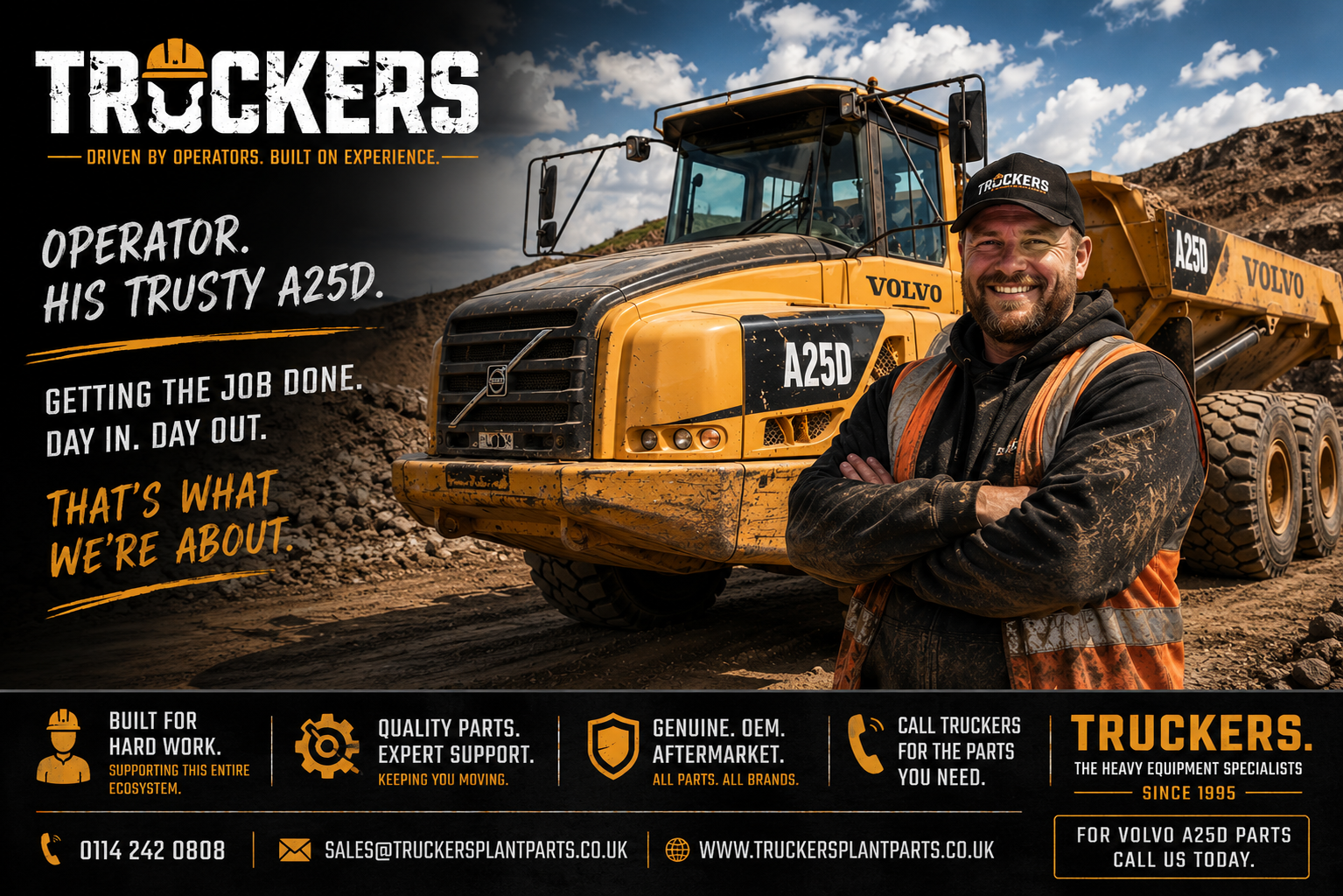
The Volvo A25D is now an ageing articulated dump truck by modern standards, but don’t let its age fool you. Spend a day behind the wheel and it quickly becomes obvious why so many are still earning a living around the world. There are countless A25Ds moving rock, muck, aggregates, overburden and construction materials every single day, and many operators would happily climb into one tomorrow morning without a second thought.
For many drivers, the A25D represents one of Volvo’s biggest evolutionary leaps. Coming from the earlier A25C and especially the older Volvo BM machines, the D-series felt like stepping into a completely different generation of truck.
The cab was quieter, visibility improved, the controls became far more refined and the entire machine simply felt more planted and confidence inspiring. It was easier to spend a long shift in, easier to control on rough ground and generally less tiring to operate.
The difference between an A25C and an A25D is immediately noticeable.
The difference between an A25D and many later models… perhaps not quite as much.
That might sound surprising until you actually compare them.
A Huge Improvement Over The A25C
Drivers coming from an A25C generally noticed improvements everywhere.
The suspension felt more composed.
The steering was more predictable.
Noise levels dropped.
The driving position improved.
The transmission became smoother.
Visibility around the machine was better.
Everything simply felt more modern.
Volvo had refined almost every aspect of the operator’s environment without fundamentally changing what made their articulated haulers so successful.
The result was a truck that inspired confidence.
Even today the A25D never feels crude or agricultural. Instead it feels like a properly engineered machine designed by people who understood that operator comfort directly affects productivity.
Still Feels Surprisingly Modern
One of the biggest compliments you can pay an older machine is that it doesn’t feel old.
That is exactly how many operators describe the A25D.
Yes, later models introduced updated displays, more electronics, revised interiors and improved diagnostics, but climb into a tidy A25D and it still feels entirely capable of completing a full production shift.
The basic driving experience remains familiar.
You still sit high with excellent visibility.
The articulation behaves predictably.
The suspension absorbs rough haul roads well.
The automatic transmission works as expected.
The truck remains balanced, stable and confidence inspiring.
Many experienced operators would argue that if the machine is mechanically sound, there is very little the A25D cannot still do.
Are The A25E, A25F And A25G Huge Steps Forward?
For the operator…
Not really.
That isn’t to say they aren’t better machines.
They certainly are.
However, the improvements become increasingly evolutionary rather than revolutionary.
Most drivers moving from a D to an E quickly feel at home.
Move from an E into an F and again everything feels familiar.
Jump into a G and, while the interior is more modern and technology has advanced, it still feels unmistakably like a Volvo articulated hauler.
The fundamentals never changed because Volvo had already got so much right.
The seating position remains similar.
Visibility remains excellent.
The machine balance is familiar.
The articulation characteristics remain predictable.
Controls continue to feel intuitive.
For an experienced operator, there is no dramatic learning curve.
Where The Later Trucks Really Improve
While the operator experience changed only gradually, owners and fleet managers benefited much more significantly.
Later machines introduced improvements including:
Greater fuel efficiency.
Lower emissions.
Improved onboard diagnostics.
Enhanced electronic monitoring.
Longer service intervals.
Better fault reporting.
Reduced downtime.
Improved fleet management capability.
Lower lifetime operating costs.
These aren’t always things the driver notices during a day’s work, but they matter enormously to businesses running multiple trucks.
A fleet owner may save thousands of pounds annually through reduced fuel burn and maintenance improvements, while the operator may simply think, “This drives much like my old D.”
That is actually a compliment to the A25D.
When Does It Become A Really Big Step Forward?
The genuinely noticeable jump for most operators comes later.
Many drivers point towards the H-Series as being where Volvo made another major leap forward.
The H models introduced a significantly more modern cab environment, updated electronic systems, improved visibility refinements, enhanced driver assistance features and further reductions in noise and vibration.
Everything feels more contemporary.
The machine becomes more intelligent as well as more comfortable.
That isn’t to say the G isn’t an improvement—it certainly is—but the progression from D to E to F to G is relatively smooth.
The jump from D directly into an H is where many operators immediately notice a larger generational difference.
Reliability Still Wins Respect
One reason the A25D remains popular is simple.
It works.
Provided maintenance has been carried out properly, these trucks have earned a reputation for reliability, durability and straightforward servicing.
Most technicians understand them.
Parts availability remains strong.
Independent repair specialists know the machines well.
Owners know what they’re buying.
There are very few surprises.
In demanding environments, simplicity often becomes an advantage.
Less electronic complexity can mean quicker fault finding and less downtime.
Many operators actually appreciate this.
Comfort That Still Holds Up
Long shifts are where the A25D continues to impress.
The seating position is comfortable.
The suspension takes much of the punishment out of rough haul roads.
The controls are light enough for extended operation.
Visibility around the front articulation and body remains excellent.
Even after thousands of operating hours, a well-maintained cab still provides a pleasant working environment.
That says a great deal about Volvo’s original engineering.
Final Verdict
The Volvo A25D occupies a particularly important place in the evolution of Volvo articulated dump trucks.
It represents one of the biggest generational improvements over its predecessors, particularly the A25C and earlier Volvo BM machines, while also laying down the blueprint that Volvo would continue refining through the A25E, A25F and A25G.
For drivers, the later trucks undoubtedly offer improvements, but they are generally refinements rather than transformations. Better fuel economy, improved diagnostics, lower emissions and easier fleet management are major advantages for owners and maintenance teams, yet behind the wheel the A25D still delivers a driving experience that feels remarkably capable even by today’s standards.
If you’re buying purely as an operator, a well-maintained A25D remains an enjoyable, productive and dependable articulated hauler that still earns its place on modern worksites. It may be getting older, but it continues to prove that good engineering doesn’t become obsolete simply because newer models exist.
That is perhaps the greatest compliment any working machine can receive.
FAQ: Volvo A25D Driver & Operator Review
1. Is the Volvo A25D still a good articulated dump truck?
Yes, it remains a productive and reliable ADT when properly maintained.
2. Is the A25D outdated?
It is an older machine, but it still performs well in many modern applications.
3. Why is the A25D still popular?
Its reliability, simplicity and operator-friendly design have stood the test of time.
4. Is the A25D comfortable to drive?
Yes, it offers a comfortable cab even by today’s standards.
5. Is the suspension good?
Yes, the suspension provides a comfortable ride over rough haul roads.
6. Is visibility good?
Excellent visibility is one of the truck’s strengths.
7. Does the cab feel spacious?
Yes, there is plenty of room for most operators.
8. Are the controls easy to learn?
Yes, most operators adapt quickly.
9. Is the steering predictable?
Very much so, making the truck confidence inspiring.
10. Is the automatic transmission smooth?
Yes, especially compared to earlier models.
11. Is the A25D a big improvement over the A25C?
Absolutely, it represents one of Volvo’s biggest generational improvements.
12. What improved over the A25C?
Comfort, visibility, refinement, transmission and overall driving experience.
13. Is it much better than Volvo BM models?
Yes, it feels considerably more modern.
14. Does it still feel modern?
Surprisingly yes.
15. Is it easy to spend long shifts in?
Yes, fatigue levels are relatively low.
16. Is the seat comfortable?
Yes, particularly on well-maintained machines.
17. Is cab noise acceptable?
Yes, it is quieter than many earlier ADTs.
18. Is heating effective?
Generally yes.
19. Is ventilation good?
Yes, for a machine of its age.
20. Does it inspire confidence?
Very much so.
21. Is articulation smooth?
Yes, Volvo’s articulation system remains excellent.
22. Is stability good?
Excellent on properly operated haul roads.
23. Does it climb well?
Yes, it has impressive hill-climbing ability.
24. Is traction good?
Very good in difficult ground conditions.
25. Is it suitable for quarry work?
Absolutely.
26. Can it work on construction sites?
Yes.
27. Is it suitable for mining?
Yes, on appropriate sized operations.
28. Does it perform well in mud?
Yes, particularly with good tyres.
29. Is it productive?
Very productive.
30. Does it carry a useful payload?
Yes, around the 25-tonne class it remains competitive.
31. Is loading straightforward?
Yes, it matches well with many excavators and loaders.
32. Does it handle rough ground well?
Very well.
33. Does it ride better loaded?
Yes, like most articulated dump trucks.
34. Is reversing easy?
Good mirrors and visibility help considerably.
35. Is manoeuvrability good?
Excellent for its size.
36. Is it easy to service?
Generally yes.
37. Is access for maintenance reasonable?
Most routine servicing is straightforward.
38. Are parts widely available?
Yes.
39. Are aftermarket parts available?
Very widely.
40. Are used parts available?
Yes, thanks to the large number produced.
41. Are repairs generally straightforward?
Compared with newer machines, yes.
42. Is diagnostic equipment simple?
Much simpler than the latest generations.
43. Is reliability good?
Excellent when maintained properly.
44. Does the engine have a good reputation?
Yes.
45. Is fuel economy reasonable?
Yes, although later models improved further.
46. Does the A25E feel dramatically different?
Not dramatically.
47. Is the A25F a huge leap?
Not from the operator’s seat.
48. Is the A25G vastly superior?
It is better, but not transformational for drivers.
49. Why don’t later models feel dramatically different?
Because Volvo got the fundamentals right with the A25D.
50. Is the driving position similar across D, E, F and G?
Yes.
51. Are the controls familiar?
Very much so.
52. Does the steering feel similar?
Yes.
53. Is articulation behaviour similar?
Yes.
54. Is overall handling familiar?
Absolutely.
55. Would an experienced A25D operator adapt quickly to a G?
Usually within minutes.
56. Where do E, F and G improve most?
Efficiency and ownership costs.
57. Do later models burn less fuel?
Generally yes.
58. Are emissions improved?
Yes.
59. Are electronics more advanced?
Significantly.
60. Is fault diagnosis easier?
Yes.
61. Are service intervals improved?
Generally yes.
62. Do fleet managers benefit?
Very much so.
63. Do owners save money?
Often through lower operating costs.
64. Does downtime reduce?
Usually yes.
65. Is maintenance planning easier?
Yes.
66. Do later trucks offer better monitoring?
Yes.
67. Does telematics improve fleet management?
Absolutely.
68. Do operators notice these improvements?
Often less than owners do.
69. Does the A25D still feel capable?
Very capable.
70. Can it still keep pace?
In many applications, yes.
71. Is productivity still competitive?
Yes, depending on the job.
72. Would many operators still choose one?
Certainly.
73. Is it forgiving to inexperienced operators?
Yes.
74. Is it enjoyable to drive?
Most operators would say yes.
75. Does it cope well with uneven ground?
Very well.
76. Is body stability good?
Yes.
77. Is braking confidence inspiring?
Yes, when properly maintained.
78. Does it have strong engine performance?
Yes.
79. Is acceleration acceptable?
Good for its class.
80. Is it easy to position for loading?
Yes.
81. Does it unload smoothly?
Yes.
82. Does it handle side slopes well?
Within recommended operating limits.
83. Does operator confidence increase with experience?
Definitely.
84. Is the machine well balanced?
Very much so.
85. Is the chassis robust?
Yes.
86. Does the articulation joint last well?
With proper maintenance it does.
87. Is the drivetrain durable?
It has an excellent reputation.
88. Is it suitable for owner-operators?
Very much so.
89. Can independent workshops maintain it?
Yes.
90. Is technical knowledge widely available?
Yes.
91. Is resale demand still good?
Good examples remain desirable.
92. Does the A25D have a loyal following?
Absolutely.
93. What is its greatest strength?
Reliability combined with operator comfort.
94. What is its biggest weakness?
Age and older technology compared with current models.
95. Does age stop it earning money?
Not at all.
96. At what point is there a major operator upgrade?
Most operators point to the A25H.
97. Why is the A25H a bigger step forward?
It introduced a much more modern cab, technology and operator environment.
98. Should owners automatically replace an A25D with a newer model?
Not necessarily if the existing truck remains reliable and economical.
99. Would you still recommend buying a well-maintained A25D?
Yes, it remains one of Volvo’s most respected articulated dump trucks.
100. What is the overall verdict on the Volvo A25D?
The Volvo A25D remains one of the finest older articulated dump trucks ever built. It marked one of the biggest advances over the A25C and earlier Volvo BM machines, while laying the foundation for the A25E, A25F and A25G. Later generations undoubtedly brought improvements in efficiency, diagnostics and ownership costs, but from the driver’s seat the differences are evolutionary rather than revolutionary. For many operators, the A25D still delivers everything they need: comfort, confidence, reliability and productivity, proving that great engineering never truly goes out of date.