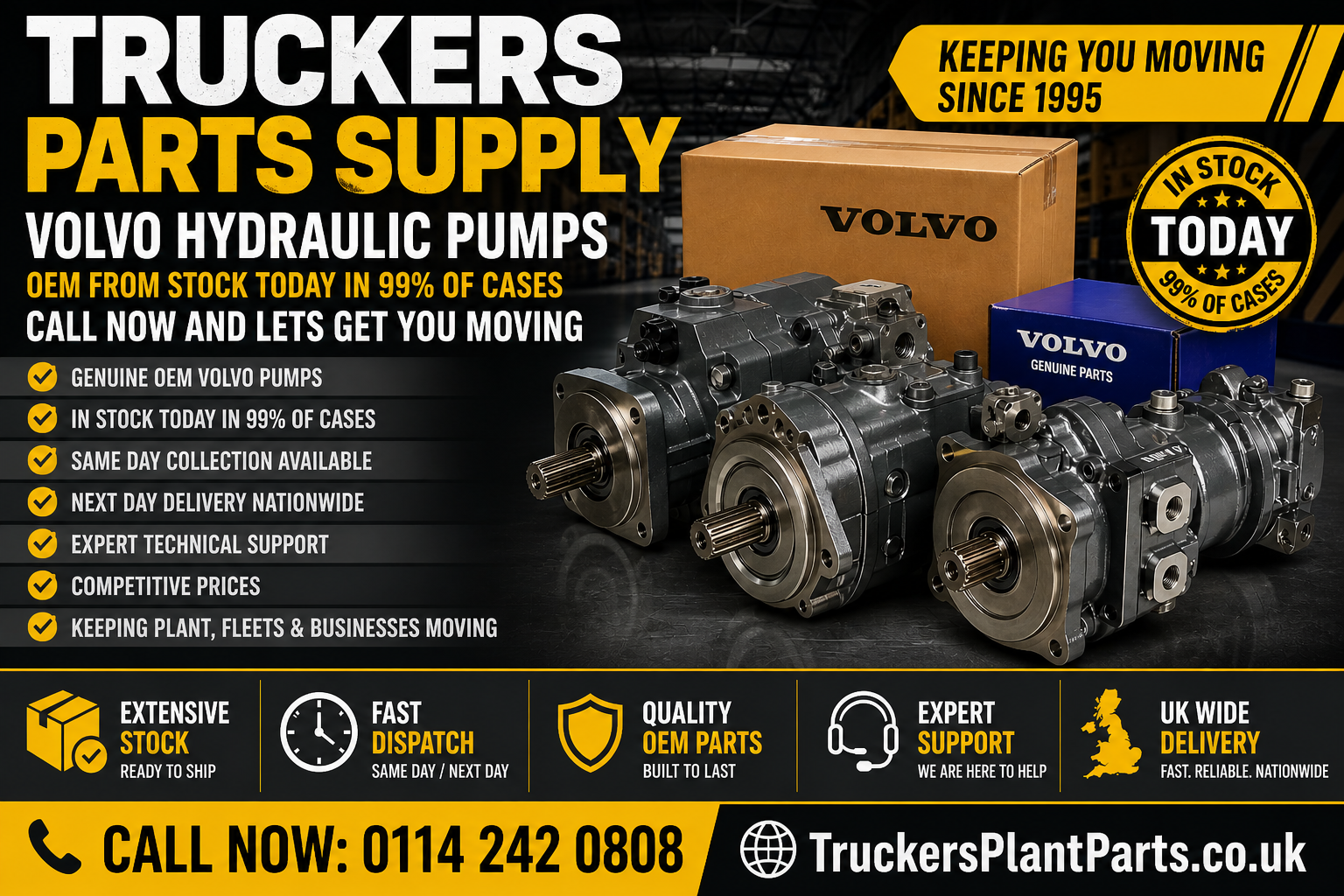
Volvo Hydraulic Pumps Supplied From Stock Today – OEM Volvo Hydraulic Pump Supply From Truckers Plant Parts
Volvo hydraulic pumps are among the most critical components fitted to Volvo construction equipment. Whether the machine is a crawler excavator, wheeled excavator, demolition excavator, wheel loader, articulated dump truck, rigid hauler, material handler, compactor, compact excavator, or compact track loader, the hydraulic pump is at the heart of the machine’s working performance. When the hydraulic pump is healthy, the machine has power, response, control, speed, precision, and productivity. When the hydraulic pump begins to fail, the entire machine can quickly become slow, weak, erratic, overheated, or completely unusable.
That is why fast access to the correct Volvo hydraulic pump matters so much.
Truckers Plant Parts supply OEM Volvo hydraulic pumps from stock today in the vast majority of cases, helping operators, contractors, plant hire fleets, quarry managers, demolition companies, recycling operators, civil engineering firms, and workshop engineers get critical Volvo machinery moving again quickly. In many situations, hydraulic pump failure means the machine is effectively VOR. It may still start, it may still idle, and it may still look ready for work, but without correct hydraulic pressure and flow, it cannot dig, lift, steer, slew, travel, tip, load, grab, crush, break, sort, or handle material properly.
When a Volvo hydraulic pump fails, production can stop immediately.
A Volvo EC220 excavator with weak pump output cannot trench efficiently. A Volvo EC380E demolition excavator with hydraulic pressure loss cannot safely operate heavy pulverisers or shears. A Volvo EC950F quarry excavator with hydraulic pump problems cannot load haulers productively. A Volvo L220H wheel loader with hydraulic weakness cannot lift, crowd, or handle high-volume material properly. A Volvo A30D or A40D articulated hauler with hydraulic system failure may lose steering, tipping, braking assistance, or suspension-related functionality. A Volvo EW240E material handler with poor hydraulic flow cannot operate grapples, rotators, elevated cab systems, or loading cycles effectively.
Hydraulic pumps are not optional components.
They are production components.
In the heavy plant industry, downtime is rarely isolated. One failed hydraulic pump can stop far more than one machine. If the failed machine is the primary loading excavator, dump trucks wait. If the wheel loader feeding a crusher loses hydraulic performance, the crusher may stop. If the material handler in a recycling yard loses hydraulic power, processing slows immediately. If a demolition machine loses pump pressure, the attachment becomes unusable and the site sequence may be delayed.
This is exactly why Truckers Plant Parts focus so heavily on rapid OEM Volvo hydraulic pump supply.
The goal is simple: call now, identify the correct pump, confirm availability, dispatch quickly, and get your machine moving again.
Volvo hydraulic pump systems vary significantly across models, years, machine generations, engine platforms, hydraulic configurations, auxiliary circuits, emissions stages, and attachment setups. This means correct identification is absolutely essential. Guessing a pump part number can waste valuable time, create fitting problems, delay repairs, and extend downtime unnecessarily.
Truckers can assist with parts identification using the Volvo machine model, serial number, pump part number, casting number, pump data plate, photos of the existing pump, hydraulic circuit details, and machine application. This is especially important on machines with multiple hydraulic pump options, revised supersession numbers, updated OEM pump assemblies, or region-specific specifications.
Volvo crawler excavators are one of the most common hydraulic pump supply categories. Machines such as the EC140, EC160, EC180, EC210, EC220, EC230, EC240, EC250, EC300, EC350, EC380, EC480, EC530, EC750, and EC950 depend heavily on high-performance hydraulic pumps to power digging, lifting, slewing, travelling, attachment circuits, boom functions, arm functions, bucket control, and auxiliary hydraulics.
On excavators, the main hydraulic pump is one of the hardest working components on the machine. It must constantly deliver controlled hydraulic flow under changing load conditions while responding smoothly to operator input. Modern Volvo excavators often use electronically controlled hydraulic systems, meaning pump control, engine management, joystick input, valve block response, pressure sensors, and machine ECUs all work together to deliver the correct hydraulic performance.
When the pump begins to wear internally, the symptoms can appear gradually.
Operators may notice slower cycle times, weak digging power, reduced travel performance, poor slew response, overheating hydraulic oil, abnormal pump noise, pressure instability, machine warnings, poor attachment performance, jerky controls, or loss of multifunction ability. In severe cases, the pump may fail completely, sending contamination through the hydraulic system and creating a much larger repair problem.
That is why early diagnosis matters.
A hydraulic pump showing signs of failure should not be ignored. Continuing to run a failing pump can increase contamination, damage valve blocks, score cylinders, damage hydraulic motors, affect travel systems, reduce attachment performance, and dramatically increase the final repair cost. Replacing the pump early with the correct OEM Volvo hydraulic pump can prevent secondary damage and reduce downtime.
Volvo demolition excavators place even greater demand on hydraulic pumps. Machines such as the EC380E HR, EC480E HR, and EC750E HR operate large hydraulic attachments including shears, crushers, pulverisers, breakers, grapples, and high-reach demolition tooling. These applications demand sustained hydraulic flow, high pressure, heat control, and continuous pump reliability.
Demolition hydraulic systems are exposed to violent vibration, impact loading, contamination, dust, heat, and extreme duty cycles. A hydraulic pump on a demolition machine does not have an easy life. It may spend long shifts powering high-flow attachments under constant pressure while working in highly contaminated environments. Pump quality therefore matters enormously.
Truckers Plant Parts can supply OEM Volvo hydraulic pumps for demolition equipment where availability allows, helping demolition contractors avoid extended downtime when high-reach or attachment-driven machines suffer pump failure.
Volvo wheel loaders also rely heavily on hydraulic pump performance. Machines such as the L60, L70, L90, L110, L120, L150, L180, L190, L220, L260, and larger production loaders use hydraulic systems for loader arm operation, bucket functions, steering systems, attachment control, ride control, cooling fan systems, brake-related systems, and auxiliary functions.
A Volvo wheel loader with weak hydraulics quickly loses productivity. Loading cycles slow down. Lift speed drops. Bucket response becomes poor. Steering may feel heavy or inconsistent. Attachments may not function properly. In high-production quarry, recycling, waste handling, and port environments, this can immediately reduce site throughput.
For wheel loaders, correct hydraulic pump specification is especially important because machines may have different hydraulic configurations depending on loader size, attachment setup, auxiliary circuits, market specification, and production generation.
Volvo articulated dump trucks and haulers also require reliable hydraulic pump systems. Although many people focus on the engine, transmission, axles, and driveline when discussing ADTs, hydraulics remain essential for steering, tipping, brake-related systems, suspension-related functions, cooling fan operation, and body control. On machines such as the A25D, A25E, A25F, A25G, A30D, A30E, A30F, A30G, A35D, A35E, A35F, A35G, A40D, A40E, A40F, A40G, A45G, and A60H, hydraulic reliability directly affects safe and productive operation.
A failed pump on an articulated hauler can create serious operational problems. Steering response may be affected. Tipping performance may become slow or impossible. Brake support systems may suffer. Suspension or auxiliary hydraulic functions may be compromised. In a loaded hauler working on gradients, quarry roads, or poor ground conditions, hydraulic reliability is not just about productivity. It is also about operational safety.
This is why Truckers support hydraulic pump supply across Volvo hauler generations, including older D-Series machines and newer electronically controlled G and H-Series models.
Volvo wheeled excavators and material handlers form another important hydraulic pump category. Machines such as EW160, EW180, EW200, EW220, EW240, EWR150, EWR170, and material handling variants rely on hydraulic pumps for digging, lifting, slewing, steering, stabilisers, outriggers, elevated cabs, grapples, rotators, and road-travel machine systems. Recycling and scrap handling applications can be extremely demanding because the machine often works continuously with hydraulic attachments and repeated lifting cycles.
A weak pump on a material handler can quickly reduce yard productivity. Grab control becomes slow. Rotation power drops. Boom functions weaken. Lift cycles become inefficient. If the machine is central to loading, sorting, or feeding processing equipment, downtime becomes expensive immediately.
Truckers can help source OEM hydraulic pumps for Volvo material handlers and wheeled excavators, including difficult-to-source or less common pump configurations.
Compact Volvo excavators and mini excavators also depend on hydraulic pump health. Machines such as the EC18, ECR18, EC20, EC25, EC27, EC35, EC37, ECR40, ECR50, and similar compact models may be smaller, but the hydraulic pump is still central to machine performance. Compact excavators are often used in plant hire, utilities, landscaping, groundwork, restricted access construction, drainage, and civil engineering jobs where reliability matters.
A mini excavator with a weak hydraulic pump may become slow, frustrating, inefficient, and unsuitable for hire or contract work. For plant hire companies especially, fast pump replacement can be the difference between keeping a machine earning and losing hire days.
Truckers support compact Volvo hydraulic pump requirements with OEM and high-quality replacement options depending on machine model and availability.
The quality of the hydraulic pump matters as much as availability.
Poor-quality pumps can create pressure instability, premature wear, contamination, leakage, overheating, poor control response, and repeat failures. In some cases, a low-quality pump can fail quickly and send metal contamination throughout the hydraulic system, damaging valves, motors, cylinders, coolers, and filters. That is why OEM hydraulic pumps remain the preferred option for many operators, especially when the machine is production-critical.
Truckers Plant Parts can supply OEM Volvo hydraulic pumps from stock today in 99% of cases where stock and application allow, giving customers confidence that the replacement pump is built to the correct specification for the machine. OEM supply helps protect hydraulic performance, fitment accuracy, pressure response, durability, and long-term reliability.
Where OEM is not the best commercial option, Truckers can also discuss OEM-equivalent, rebuilt, or quality aftermarket hydraulic pump solutions depending on the machine, budget, application, urgency, and availability. Some older machines may benefit from rebuilt or alternative supply routes where genuine new stock is limited or where budget control is important.
The important point is that customers have options.
For urgent VOR situations, speed matters most. For planned maintenance, cost and lifecycle may be more important. For high-value demolition, quarry, or production machines, OEM may be the best route. For older machines working lighter duties, a quality alternative may be practical. Truckers can help operators choose the most suitable option based on the real-world requirement.
When requesting a Volvo hydraulic pump, customers should provide as much information as possible. The machine model, serial number, existing pump part number, data plate details, photographs, application type, urgency level, and delivery location can all help speed up identification and supply. If the machine is down, photos of the failed pump, pipework arrangement, mounting points, and any visible casting numbers may help avoid delays.
Hydraulic pump replacement should also be handled correctly. Before fitting a new pump, the system should be inspected for contamination, failed hoses, blocked filters, damaged coolers, poor oil condition, valve block contamination, and secondary component damage. Simply fitting a new pump into a contaminated system can destroy the replacement pump quickly.
A proper hydraulic pump repair should include oil condition checks, filter replacement, inspection of suction lines, return lines, case drain lines, hydraulic tank condition, cooler cleanliness, flushing where required, pressure testing, and correct commissioning. This protects the new pump and helps restore full machine performance.
Truckers Plant Parts understand the urgency of hydraulic pump failures because they understand the industries these machines operate in. Quarrying, demolition, construction, recycling, civil engineering, landfill, infrastructure, mining support, and plant hire all depend on machines working reliably. When hydraulics fail, productivity stops.
That is why Truckers focuses on fast response, correct identification, OEM stock availability, practical technical support, and rapid dispatch.
Call now and let Truckers help get you moving.
Volvo Hydraulic Pumps FAQ – OEM Hydraulic Pump Supply, Failure Symptoms, Parts Support & Emergency Replacement
1. What is a Volvo hydraulic pump?
A Volvo hydraulic pump is a critical component that generates hydraulic oil flow and pressure for machine functions.
2. Why is the hydraulic pump important?
It powers essential systems such as digging, lifting, steering, tipping, slewing, travelling, braking support, and attachments.
3. What happens if a Volvo hydraulic pump fails?
The machine may become slow, weak, unsafe, unproductive, or completely unusable.
4. Can Truckers supply Volvo hydraulic pumps?
Yes. Truckers Plant Parts can supply Volvo hydraulic pumps, including OEM options.
5. Can Truckers supply OEM Volvo hydraulic pumps from stock today?
Yes. In the vast majority of cases, OEM Volvo hydraulic pumps can be supplied from stock today depending on model and availability.
6. What does OEM mean?
OEM means Original Equipment Manufacturer, meaning the part is built to the original manufacturer specification.
7. Why choose an OEM Volvo hydraulic pump?
OEM pumps provide correct fitment, pressure performance, durability, and machine compatibility.
8. Are aftermarket hydraulic pumps available?
Yes. OEM-equivalent, rebuilt, and quality aftermarket options may also be available.
9. When is aftermarket suitable?
Aftermarket may suit older machines, budget-sensitive repairs, or less critical applications.
10. When is OEM best?
OEM is often best for production-critical machines, high-value equipment, and demanding applications.
11. What Volvo machines use hydraulic pumps?
Excavators, wheel loaders, articulated haulers, rigid haulers, demolition excavators, material handlers, compact machines, and wheeled excavators all use hydraulic pumps.
12. Which Volvo excavators use hydraulic pumps?
EC140, EC160, EC180, EC210, EC220, EC230, EC240, EC250, EC300, EC350, EC380, EC480, EC530, EC750, EC950 and many more.
13. Which Volvo wheel loaders use hydraulic pumps?
L60, L70, L90, L110, L120, L150, L180, L190, L220, L260 and other Volvo loaders use hydraulic pumps.
14. Which Volvo ADTs use hydraulic pumps?
A25, A30, A35, A40, A45, and A60 Volvo articulated haulers all use hydraulic pump systems.
15. Which Volvo demolition machines use hydraulic pumps?
EC380E HR, EC480E HR, EC750E HR and other Volvo demolition excavators use high-demand hydraulic pump systems.
16. Which Volvo wheeled excavators use hydraulic pumps?
EW160, EW180, EW200, EW220, EW240, EWR150, EWR170 and related models use hydraulic pumps.
17. Which Volvo compact excavators use hydraulic pumps?
EC18, ECR18, EC20, EC25, EC27, EC35, EC37, ECR40, ECR50 and similar compact machines use hydraulic pumps.
18. What are signs of hydraulic pump failure?
Slow movements, weak power, overheating oil, noise, pressure loss, warning lights, poor attachment performance, and jerky controls.
19. Can a failing pump cause slow cycle times?
Yes. Slow cycle times are one of the most common symptoms.
20. Can a failing pump cause weak digging power?
Yes. Reduced pressure or flow can make digging weak.
21. Can a failing pump affect travel speed?
Yes. Travel motors may receive insufficient hydraulic flow.
22. Can a failing pump affect slew performance?
Yes. Slew movement may become slow, weak, or inconsistent.
23. Can a failing pump affect attachments?
Yes. Breakers, shears, grabs, couplers, tiltrotators, and grapples may perform poorly.
24. Can hydraulic pump failure cause overheating?
Yes. Internal leakage and inefficiency can increase hydraulic oil temperature.
25. Can hydraulic pump failure create noise?
Yes. Whining, grinding, or cavitation sounds may indicate pump problems.
26. What is pump cavitation?
Cavitation occurs when the pump is starved of oil or air enters the system.
27. Why is cavitation dangerous?
It can destroy internal pump components quickly.
28. What causes hydraulic pump failure?
Contamination, oil starvation, overheating, wear, incorrect oil, blocked filters, poor servicing, and age.
29. Why is hydraulic contamination dangerous?
Contamination damages pumps, valves, motors, cylinders, and precision components.
30. Can a failed pump contaminate the whole system?
Yes. Metal debris can spread through the hydraulic system.
31. Should the system be cleaned after pump failure?
Yes. Inspection, flushing, filter replacement, and oil checks may be required.
32. What should be checked before fitting a new pump?
Oil condition, filters, suction lines, return lines, case drain, hydraulic tank, cooler, and contamination levels.
33. Why replace filters when changing a pump?
Filters may contain contamination from the failed pump.
34. Should hydraulic oil be replaced?
Often yes, especially if contamination is present.
35. Why is hydraulic oil quality important?
Correct oil protects pumps and hydraulic components under pressure and heat.
36. Can wrong oil damage a pump?
Yes. Wrong viscosity or specification can cause wear, overheating, or poor performance.
37. What information is needed to order a Volvo hydraulic pump?
Machine model, serial number, pump part number, pump data plate, photos, and urgency level.
38. Why is the machine serial number important?
Hydraulic pump specifications can vary by machine build and generation.
39. Why is the pump data plate useful?
It confirms pump model, part number, and specification.
40. Can photos help identify the correct pump?
Yes. Photos of the pump and pipework can speed up identification.
41. Can Truckers help identify unknown pumps?
Yes. Truckers can assist using machine details, photos, and part references.
42. Are hydraulic pumps model-specific?
Yes. Pumps vary by model, serial range, pressure rating, and hydraulic configuration.
43. Can the wrong pump damage a machine?
Yes. Incorrect pump specification can cause poor performance or system damage.
44. Are Volvo excavator hydraulic pumps high pressure?
Yes. Excavator pumps operate under high pressure and variable load conditions.
45. Why are demolition pumps especially stressed?
Demolition attachments demand sustained high flow and pressure.
46. Why are material handler pumps heavily used?
Material handlers work continuously with grabs, rotators, and lifting cycles.
47. Why are wheel loader pumps important?
They power lift, bucket, steering, and attachment systems.
48. Why are ADT hydraulic pumps important?
They support steering, tipping, braking assistance, and body control systems.
49. Can a hydraulic pump failure immobilise an ADT?
Yes. Steering or tipping issues can make the truck unusable.
50. Can a hydraulic pump failure stop a wheel loader?
Yes. Weak lift or steering can stop loader productivity.
51. Can a hydraulic pump failure stop a demolition excavator?
Yes. Without hydraulic power, demolition attachments cannot work.
52. Why is fast pump supply important?
Machine downtime can become extremely expensive quickly.
53. Does Truckers offer same-day collection?
Yes. Stocked hydraulic pumps may be available for same-day collection.
54. Does Truckers offer next-day delivery?
Yes. Next-day delivery is available for many hydraulic pumps.
55. Can urgent transport be arranged?
Yes. Dedicated transport can be arranged when downtime is critical.
56. What does VOR mean?
VOR means Vehicle Off Road, where a machine is down and needs urgent repair.
57. Why is hydraulic pump VOR serious?
Because the machine may be unable to perform its main work functions.
58. Can Truckers support emergency hydraulic pump failures?
Yes. Truckers can help source and dispatch pumps urgently.
59. Are rebuilt hydraulic pumps available?
Yes. Rebuilt options may be available depending on model and stock.
60. Are exchange hydraulic pumps available?
Exchange options may be available for selected pumps.
61. Why choose a rebuilt pump?
Rebuilt pumps may offer cost savings while restoring performance.
62. Why choose a new OEM pump?
A new OEM pump provides maximum confidence, specification accuracy, and durability.
63. Can Truckers supply hydraulic pump seal kits?
Yes. Seal kits and related hydraulic repair components may be supplied.
64. Can Truckers supply hydraulic hoses too?
Yes. Hydraulic hoses and fittings can be supported.
65. Can Truckers supply hydraulic filters?
Yes. Hydraulic filters are available for Volvo machines.
66. Can Truckers supply hydraulic oil?
Yes. Suitable hydraulic oils and service fluids can be supplied.
67. Can Truckers supply pump mounting parts?
Yes. Mounting hardware, couplings, seals, and related parts may be supplied.
68. Can Truckers supply valve blocks?
Yes. Main control valves and hydraulic valve components can be supported.
69. Can Truckers supply cylinders?
Yes. Hydraulic cylinders and seal kits can be supported.
70. Can Truckers support final drives and travel motors?
Yes. Travel motors and final drive systems are also supported.
71. What happens if a new pump is fitted without flushing?
Contamination may destroy the replacement pump quickly.
72. Why is commissioning important?
Correct commissioning ensures the pump operates safely and correctly after installation.
73. Should pressures be checked after fitting?
Yes. System pressure testing helps confirm correct operation.
74. Should case drain flow be checked?
Yes. Excessive case drain can indicate internal leakage or installation issues.
75. What is case drain flow?
It is leakage flow returned from hydraulic components to protect internal pressure balance.
76. Why inspect suction lines?
Air leaks or restrictions can starve the pump and cause cavitation.
77. Why inspect the hydraulic cooler?
Cooler contamination or blockage can cause overheating and damage.
78. Why inspect the hydraulic tank?
Debris or contamination in the tank can damage the new pump.
79. Why inspect return lines?
Return restrictions can create pressure problems and overheating.
80. Why inspect attachment circuits?
Attachment contamination can feed debris back into the main hydraulic system.
81. Can poor maintenance shorten pump life?
Yes. Poor oil, dirty filters, overheating, and contamination reduce pump life.
82. How can pump life be extended?
Use correct oil, replace filters, monitor temperatures, inspect hoses, and maintain cleanliness.
83. Why is cleanliness essential when fitting pumps?
Hydraulic systems are highly sensitive to contamination.
84. Can operators detect pump problems early?
Yes. Slower operation, noise, heat, and weak performance are warning signs.
85. Should warning signs be ignored?
No. Early intervention can prevent major hydraulic damage.
86. Why is pump failure expensive?
The pump itself is expensive and secondary contamination can damage other systems.
87. Can a hydraulic pump affect fuel consumption?
Yes. Inefficient pumps can increase engine load and fuel burn.
88. Can pump wear affect operator control?
Yes. Controls may become slow, jerky, or inconsistent.
89. Can pump failure affect safety?
Yes. Steering, lifting, braking support, or attachment control may be affected.
90. Why use Truckers for Volvo hydraulic pumps?
Truckers offer fast supply, OEM options, stock availability, technical identification, and emergency support.
91. Can Truckers support older Volvo pumps?
Yes. Older and obsolete hydraulic pump requirements can often be sourced.
92. Can Truckers support newer Volvo pumps?
Yes. Current and modern Volvo hydraulic pump requirements can be supported.
93. Can Truckers support mixed fleet hydraulic parts?
Yes. Hydraulic parts for other heavy equipment manufacturers may also be supported.
94. Does Truckers only supply pumps?
No. Truckers supply complete heavy equipment parts across many categories.
95. Why call immediately when a pump fails?
Fast identification and dispatch reduce downtime.
96. What should I say when calling?
Provide machine model, serial number, pump details, symptoms, and urgency.
97. Can Truckers help if I do not know the part number?
Yes. Identification support is available.
98. Why is 99% stock availability valuable?
It means many customers can receive OEM Volvo hydraulic pumps rapidly without long delays.
99. What does “let’s get you moving” mean?
It means restoring machine productivity as quickly as possible.
100. What best describes Truckers Volvo hydraulic pump support?
Truckers Plant Parts provide rapid OEM Volvo hydraulic pump supply, technical identification, emergency dispatch, same-day collection, next-day delivery, and quality hydraulic support for Volvo excavators, loaders, haulers, demolition machines, material handlers, compact equipment, and mixed heavy plant fleets where downtime is costly and fast action matters.