Volvo L220H Wheel Loader: Everything You Need To Know About Volvo’s High-Production Quarry & Material Handling Giant
Volvo L220H Wheel Loader Overview
The Volvo L220H is a large production wheel loader built for heavy-duty industries including quarrying, aggregates, recycling, ports, waste handling, mining support, and bulk material loading. Designed by Volvo Construction Equipment, the L220H combines high loading power, fuel efficiency, operator comfort, and long-term durability.
Part of Volvo’s advanced H-Series range, the L220H improves on earlier G-Series machines with better fuel economy, stronger productivity, upgraded transmission systems, and improved operator technology. Volvo states the machine can deliver up to 15% greater fuel efficiency and up to 10% higher productivity compared with older models.
Key Volvo L220H Specifications
| Specification | Details |
|---|---|
| Operating Weight | Approx. 71,140 lbs |
| Straight Tipping Load | Approx. 54,800 lbs |
| Engine | Volvo D13J |
| Engine Power | 367 hp |
| Torque | 1,645 lb-ft |
| Bucket Capacity | Approx. 8 yd³ |
| Transmission | Volvo HTL 310 Powershift |
| Emissions Standard | Tier 4 Final / Stage IV |
| Tyres | Michelin XHA 2 |
The Volvo L220H wheel loader represents one of the most capable and productive loading machines in the modern heavy equipment industry. Built by Volvo Construction Equipment for high-volume quarrying, aggregate production, mining support, recycling operations, ports, bulk material handling, and severe-duty industrial loading applications, the L220H combines massive loading capability with intelligent fuel-saving systems, advanced driveline technology, operator-focused ergonomics, and the legendary durability that has become closely associated with Volvo wheel loaders across the world.
Positioned within Volvo’s highly respected H-Series wheel loader range, the L220H was designed as a direct evolution of the earlier G-Series machines, but with significant improvements in fuel efficiency, transmission performance, productivity, serviceability, and operator control systems. Volvo developed the H-Series platform specifically to meet growing demands from operators who needed more production capability while simultaneously reducing fuel consumption, lowering operating costs, and improving uptime.
The result is a machine capable of moving enormous volumes of material every day while maintaining the smooth hydraulic performance, operator comfort, and reliability expected from a premium production loader.
The Volvo L220H sits firmly within the large-production loader category. With an operating weight of approximately 71,140 lbs and a straight tipping load of 54,800 lbs, the machine is engineered for aggressive loading cycles and continuous material movement in some of the harshest operating environments imaginable. Quarry operations, bulk stockyards, recycling centres, aggregate processing plants, and port operations all demand machines capable of operating continuously under heavy load conditions, and the L220H was specifically engineered for those environments.
At the heart of the machine is Volvo’s D13J engine, a 12.8-litre six-cylinder diesel platform producing approximately 367 horsepower and an impressive 1,645 lb-ft of torque. This engine was designed to deliver strong low-end pulling power while maintaining excellent fuel efficiency during heavy production loading. Unlike smaller loaders that may spend much of their time in intermittent loading applications, the L220H is intended for sustained production work where torque delivery, hydraulic response, and driveline durability become absolutely critical.
The D13J engine incorporates advanced emissions technology including cooled exhaust gas recirculation and a diesel particulate filter system to comply with Tier 4 Final and Stage IV emissions standards. Volvo engineered these systems carefully to reduce emissions while maintaining strong engine response and fuel economy under heavy-duty operating conditions.
One of the defining features of the Volvo L220H is its second-generation OptiShift technology. OptiShift represents Volvo’s intelligent driveline optimisation system designed to reduce fuel consumption and improve machine responsiveness during loading cycles. The system integrates lock-up torque converter functionality, reverse-by-braking systems, revised gearing, and transmission intelligence to optimise power delivery during bucket loading and transport operations.
Volvo claims the L220H achieves up to 15% greater fuel efficiency compared with earlier G-Series loaders, which is a major advantage in industries where machines often operate continuously for thousands of hours annually. Fuel represents one of the single largest operational costs for quarry and aggregate businesses, so improvements in fuel efficiency directly affect profitability.
The transmission system itself was upgraded significantly on the H-Series platform. The L220H features Volvo’s HTL 310 powershift transmission, revised converter technology, and updated gear ratios designed to improve acceleration, reduce cycle times, and maximise material movement efficiency. These updates were specifically engineered to boost productivity by up to 10% compared with previous models.
In real-world applications, the L220H is commonly used in rehandling operations where continuous loading efficiency matters more than almost anything else. The machine’s large bucket capacities, strong breakout force, and rapid hydraulic response allow operators to move huge quantities of aggregate, rock, sand, recycled materials, timber products, waste, or industrial bulk materials quickly and efficiently.
The bucket breakout force of approximately 48,350 lbf gives the L220H substantial digging capability when working in compacted stockpiles or dense material environments. Combined with Volvo’s Torque Parallel loader linkage system, the machine maintains excellent lift performance and breakout power throughout the lift cycle while also providing strong visibility and attachment control.
The Torque Parallel linkage geometry is an important part of what gives Volvo wheel loaders their reputation for smooth and controllable loading characteristics. Unlike some loader designs that prioritise pure breakout force at the expense of operator feel, Volvo engineers focused heavily on balancing lifting power, bucket control, stability, and hydraulic smoothness. This makes the L220H especially effective in applications requiring precise bucket placement and controlled material handling.
Hydraulics are one of the strongest aspects of modern Volvo wheel loaders, and the L220H benefits from advanced load-sensing hydraulic systems designed to provide flow only when required. Load-sensing hydraulics improve efficiency by reducing unnecessary hydraulic pump demand, lowering parasitic losses, and helping reduce fuel consumption during operation.
The hydraulic system also contributes heavily to the machine’s smooth operational feel. Operators often praise Volvo wheel loaders for their refined hydraulic response, precise control, and low-effort operation during repetitive loading cycles. In high-production environments where operators spend entire shifts loading trucks or managing stockpiles, operator fatigue becomes a major productivity factor. Smooth hydraulics and responsive controls help reduce fatigue significantly.
Operator comfort has always been a major priority for Volvo, and the L220H reflects that philosophy strongly. The machine features a spacious, ergonomically designed cab with excellent visibility, intuitive controls, reduced vibration, low noise levels, and carefully designed seating positions intended to improve comfort during long shifts.
The visibility from the L220H cab is especially important given the size of the machine. Large wheel loaders operating in quarries, stockyards, and industrial facilities must maintain excellent visibility around the bucket, articulation area, rear counterweight, and surrounding site traffic. Volvo engineered the cab layout and glazing carefully to maximise visibility while maintaining structural protection and operator safety.
The machine also includes Volvo’s easy-to-use electro-hydraulic control systems which provide smooth loader operation and reduced operator input effort. Modern H-Series loaders increasingly integrate electronic control systems into hydraulic operation, improving responsiveness while allowing the machine to intelligently manage hydraulic demand and power distribution.
Serviceability is another major strength of the Volvo L220H platform. Volvo recognised that large production loaders operate in industries where downtime is extremely expensive, so simplifying maintenance access became a major design priority. The machine includes wide-opening service panels, accessible filter locations, grouped service points, electronically controlled engine hood systems, and intelligently designed maintenance layouts intended to reduce servicing time and improve workshop efficiency.
Routine maintenance tasks such as checking hydraulic oil, engine fluids, filters, cooling systems, and driveline components are designed to be completed more quickly and safely than on many older-generation loaders. This contributes directly to increased uptime and reduced maintenance costs over the life of the machine.
The cooling systems on the L220H were also designed specifically for severe-duty environments. Quarrying and bulk handling operations often create huge amounts of airborne dust, heat, and debris, all of which place enormous strain on cooling systems. Volvo engineered the H-Series cooling package to maintain stable operating temperatures even under extreme production loading conditions.
The optional ride control system available on the L220H helps improve operator comfort and machine stability during transport operations by dampening bucket movement when travelling across rough surfaces. This is especially useful in quarry haul roads and large stockyard environments where uneven terrain can otherwise reduce transport speeds and increase material spillage.
The machine’s Michelin XHA 2 tyre configuration reflects its focus on heavy-duty production loading. These tyres are specifically engineered for durability, traction, load carrying capability, and resistance to harsh quarry and aggregate environments.
The Volvo L220H is also increasingly integrated with Volvo’s intelligent machine technologies including Load Assist systems, CareTrack telematics, fuel monitoring systems, and machine productivity tracking tools. Modern fleet operators increasingly rely on telematics systems to monitor machine performance, fuel usage, service intervals, idle time, and operational efficiency. These technologies allow fleet managers to optimise machine usage and reduce unnecessary operating costs.
In quarry operations specifically, the L220H is often paired with articulated dump trucks, crushers, conveyors, and screening systems as part of integrated production operations. The machine’s primary role in these environments is maintaining continuous material flow. Any downtime affecting a machine like the L220H can impact entire site production schedules.
That is why parts support and servicing are so important for machines in this category. Components such as hydraulic pumps, transmission systems, cooling packages, axles, differentials, articulation joints, bucket linkages, sensors, and braking systems all operate under extremely heavy loads continuously. High-production wheel loaders require consistent servicing and reliable component support to maintain uptime.
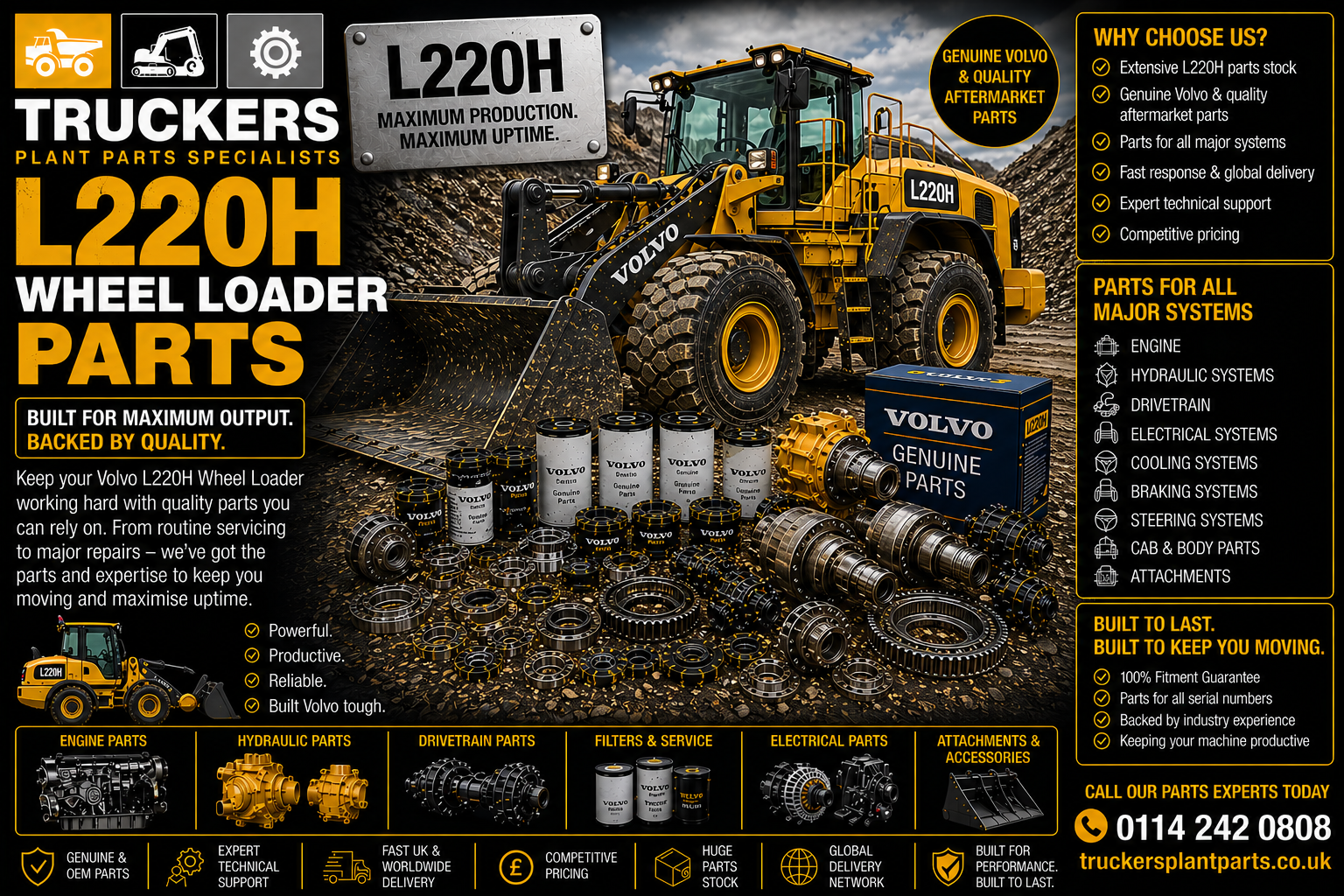
Truckers Plant Parts support the Volvo L220H with OEM and aftermarket parts covering engine systems, hydraulic systems, drivetrain components, filtration systems, electrical systems, cab components, cooling systems, steering systems, articulation joints, bucket wear parts, and servicing items. Because the L220H often operates in VOR-critical industries where downtime is financially damaging, rapid parts availability and technical support are essential.
The L220H also demonstrates Volvo’s broader philosophy around wheel loader engineering. Rather than focusing solely on raw lifting capability, Volvo engineers emphasise total operational efficiency. Fuel economy, operator comfort, visibility, serviceability, hydraulic smoothness, driveline optimisation, and machine intelligence are all integrated together to improve long-term productivity.
This is one reason Volvo wheel loaders maintain such a strong reputation globally. Operators often describe them as refined, controllable, efficient, and extremely durable machines capable of handling demanding production environments for thousands of operating hours.
The Volvo L220H therefore occupies an important position within the heavy equipment market. It is not simply a large wheel loader — it is a highly optimised production machine engineered for industries where efficiency, uptime, reliability, and operational performance directly affect profitability every single day.
Whether operating in aggregates, recycling, industrial handling, ports, mining support, or quarry production, the L220H was designed around one central objective: moving as much material as possible, as efficiently as possible, with minimal downtime and maximum productivity.
Built For High Production Work
The L220H is designed for continuous loading operations where uptime and productivity are critical.
Typical applications include:
- Quarry loading
- Aggregate production
- Recycling operations
- Waste transfer sites
- Bulk material handling
- Port operations
- Industrial stockyards
- Mining support work
The machine is engineered to handle heavy loading cycles all day while maintaining fuel efficiency and operator comfort.
Powerful Volvo D13J Engine
The L220H uses Volvo’s 12.8-litre D13J engine producing 367 horsepower. The engine is designed to provide:
- Strong low-end torque
- Excellent fuel efficiency
- Reliable performance under heavy loads
- Reduced emissions
- Smooth power delivery
The engine uses advanced emissions technology including:
- Cooled exhaust gas recirculation
- Diesel particulate filter system
- Tier 4 Final / Stage IV compliance
OptiShift Fuel Saving Technology
One of the biggest upgrades on the H-Series loaders is Volvo’s second-generation OptiShift system.
Benefits include:
- Reduced fuel consumption
- Faster machine response
- Smoother gear changes
- Improved loading cycles
- Lower driveline stress
The system combines:
- Lock-up torque converter
- Reverse-by-braking technology
- Intelligent transmission management
- Optimised gear ratios
This helps reduce operating costs significantly in high-hour production environments.
Excellent Hydraulic Performance
The L220H uses advanced load-sensing hydraulics which only provide hydraulic flow when needed.
Advantages include:
- Better fuel efficiency
- Faster hydraulic response
- Reduced operator fatigue
- Smooth bucket control
- Improved lifting precision
Volvo wheel loaders are well known for smooth hydraulic operation and precise machine control.
Torque Parallel Loader Linkage
The L220H uses Volvo’s Torque Parallel linkage system which provides:
- Strong breakout force
- Excellent visibility
- Stable lifting performance
- Smooth bucket movement
- Improved attachment control
The bucket breakout force is approximately 48,350 lbf, giving the machine excellent digging and loading capability.
Comfortable Operator Cab
Volvo designed the L220H cab for long production shifts with:
- Excellent visibility
- Ergonomic controls
- Low noise levels
- Reduced vibration
- Comfortable seating
- Easy-to-use electro-hydraulic controls
The spacious cab layout helps reduce fatigue during long working days.
Easy Service Access
The L220H is designed for fast and simple maintenance.
Features include:
- Wide-opening engine hood
- Ground-level service access
- Easy filter access
- Grouped maintenance points
- Simplified daily inspections
This helps reduce downtime and improve servicing efficiency.
Intelligent Volvo Technology
Modern L220H loaders can include:
- Volvo Load Assist
- CareTrack telematics
- Fuel monitoring systems
- Productivity tracking
- Electro-hydraulic controls
- Operator coaching systems
These technologies help improve efficiency and monitor machine performance.
Common Volvo L220H Parts Supported
Truckers Plant Parts support OEM and aftermarket parts for:
- Engines
- Hydraulic pumps
- Transmissions
- Axles & differentials
- Steering systems
- Cooling systems
- Brakes
- Electrical systems
- Sensors & ECUs
- Bucket wear parts
- Filters & servicing kits
- Cab components
- Articulation joints
Why The Volvo L220H Is Popular
Operators and fleet owners value the L220H because it offers:
- High production capability
- Excellent fuel efficiency
- Strong reliability
- Smooth operation
- Comfortable cab
- Advanced technology
- Easy servicing
- Long-term durability
The machine is widely regarded as one of the leading production wheel loaders in the heavy equipment industry.
Final Thoughts
The Volvo L220H is built for businesses that need maximum productivity with minimum downtime. Whether working in quarries, recycling plants, ports, aggregates, or industrial material handling, the L220H delivers strong loading performance, excellent fuel economy, and long-term reliability in demanding environments.
It is a wheel loader designed to move serious amounts of material efficiently while keeping operators comfortable and operating costs under control.
Volvo L220H Wheel Loader FAQ: Complete Buyer, Operator & Parts Support Guide
1. What is the Volvo L220H wheel loader?
The Volvo L220H is a large production wheel loader designed for demanding material handling work in quarries, aggregate plants, recycling sites, ports, waste facilities, industrial yards, mining support operations, and bulk loading environments. It is part of Volvo’s H-Series wheel loader range and is built for operators who need strong loading power, high uptime, fuel efficiency, excellent cab comfort, and long-term durability.
2. What type of work is the Volvo L220H best suited for?
The Volvo L220H is best suited for high-volume loading work where the machine is expected to operate for long periods under heavy load. It is commonly used for loading aggregates, rock, sand, gravel, recycled material, timber products, waste, minerals, and other bulk materials. It is particularly well suited to quarry loading, stockpile management, rehandling work, crusher feeding, port handling, and industrial material movement.
3. Is the Volvo L220H a quarry wheel loader?
Yes, the Volvo L220H is widely used as a quarry wheel loader because it has the size, power, hydraulic performance, tipping load, bucket capacity, and driveline strength needed for demanding quarry environments. Its large operating weight, strong breakout force, and efficient H-Series technology make it a strong choice for aggregate loading, primary material movement, and continuous production work.
4. What engine does the Volvo L220H use?
The Volvo L220H uses the Volvo D13J engine, a 12.8-litre diesel engine designed for heavy-duty loading applications. It delivers strong low-end torque, smooth power delivery, and fuel-efficient operation. This engine is well suited to continuous production environments because it provides the pulling power needed for aggressive bucket loading while maintaining efficiency during long operating shifts.
5. How much power does the Volvo L220H have?
The Volvo L220H produces approximately 367 horsepower, or 274 kW gross power, depending on specification and market configuration. This level of power places it firmly in the large wheel loader class and gives it the strength needed for heavy quarry, aggregate, recycling, and industrial loading applications.
6. How much torque does the Volvo L220H produce?
The Volvo L220H produces approximately 1,645 lb-ft of torque, equal to around 2,231 Nm. Torque is extremely important in a production wheel loader because it affects the machine’s ability to push into material, maintain traction, climb stockpiles, load heavy buckets, and sustain productive cycles under load.
7. What is the operating weight of the Volvo L220H?
The Volvo L220H has an operating weight of approximately 71,140 lbs, or around 32,260 kg. This substantial operating weight helps provide the stability, traction, and loading strength needed for high-production loading work.
8. What is the bucket capacity of the Volvo L220H?
The Volvo L220H is commonly listed with an 8 yd³ heaped bucket capacity, equivalent to approximately 6.3 m³. Actual bucket size can vary depending on application, material density, bucket type, edge configuration, and site requirements.
9. What is the tipping load of the Volvo L220H?
The Volvo L220H has a straight tipping load of approximately 54,800 lbs and a full-turn tipping load of approximately 47,860 lbs. These figures are important because they show how much load the machine can safely manage while maintaining stability during loading, turning, and carrying operations.
10. What is the breakout force of the Volvo L220H?
The Volvo L220H has a bucket breakout force of approximately 48,350 lbf. Breakout force is the force used to penetrate and lift material from a pile, making it especially important in quarrying, compacted aggregate, dense recycled material, and heavy rehandling applications.
11. What transmission does the Volvo L220H use?
The Volvo L220H uses a Volvo HTL 310 powershift transmission. This transmission is designed to provide smooth shifting, strong driveline performance, efficient power transfer, and productive loading cycles in severe-duty environments.
12. What is Volvo OptiShift on the L220H?
Volvo OptiShift is a driveline optimisation system designed to reduce fuel consumption and improve machine productivity. On the L220H, second-generation OptiShift helps manage power delivery using technologies such as lock-up torque converter functionality, intelligent gear management, revised gear ratios, and reverse-by-braking operation.
13. Why is OptiShift important?
OptiShift is important because it helps reduce unnecessary fuel use and driveline stress during repetitive loading cycles. In high-hour quarry or industrial environments, even a modest improvement in fuel economy can produce significant savings over the lifetime of the machine.
14. How fuel efficient is the Volvo L220H?
Volvo states that the L220H can achieve up to 15% greater fuel efficiency compared with the earlier G-Series equivalent. Actual fuel usage depends on site conditions, operator technique, material density, bucket size, haul distance, tyre selection, idle time, and service condition.
15. Can the Volvo L220H improve productivity compared with older models?
Yes. Volvo states that the L220H can improve productivity by up to 10% compared with earlier models, supported by upgrades such as a new transmission, new converter, revised gear ratios, improved hydraulics, and better driveline efficiency.
16. What is Torque Parallel linkage?
Torque Parallel linkage is Volvo’s loader arm geometry system designed to combine strong breakout force with smooth parallel lift performance. It helps improve bucket control, lifting stability, attachment handling, and visibility during loading and carrying operations.
17. Why does Torque Parallel linkage matter?
Torque Parallel linkage matters because a wheel loader must not only lift material but control it accurately. The system helps provide strong digging force while maintaining predictable bucket movement, making it useful for loading trucks, handling attachments, working with forks, and operating in confined production yards.
18. Does the Volvo L220H have load-sensing hydraulics?
Yes, the Volvo L220H uses load-sensing hydraulics. This type of hydraulic system provides oil flow according to demand rather than constantly producing maximum flow. This improves fuel efficiency, reduces heat build-up, lowers unnecessary hydraulic load, and gives smoother operation.
19. Why are load-sensing hydraulics useful?
Load-sensing hydraulics are useful because they improve control and efficiency. The system responds to the operator’s input and supplies hydraulic flow only when required, helping the machine use less fuel while still delivering fast, precise bucket and loader arm movement.
20. Is the Volvo L220H comfortable to operate?
Yes, operator comfort is one of the major strengths of Volvo wheel loaders. The L220H cab is designed for long working shifts with good visibility, low noise, reduced vibration, ergonomic controls, comfortable seating, and easy-to-use electro-hydraulic operation.
21. Why is operator comfort important on a production loader?
Operator comfort directly affects productivity. In quarrying, recycling, port handling, and aggregate loading, operators may spend many hours repeating loading cycles. A comfortable cab helps reduce fatigue, improve concentration, maintain cycle consistency, and support safer operation.
22. Does the Volvo L220H have good visibility?
Yes, the L220H is designed with strong visibility around the bucket, loader arms, articulation area, rear of the machine, and worksite surroundings. Good visibility is especially important on a large wheel loader because these machines often operate around trucks, stockpiles, conveyors, pedestrians, crushers, and other mobile plant.
23. What is the ride control system on the Volvo L220H?
Ride control is an optional system that helps dampen bucket movement when the loader travels across uneven ground. It improves comfort, reduces material spillage, protects the machine, and allows smoother travel on rough quarry roads or stockyard surfaces.
24. What tyres does the Volvo L220H use?
The Volvo L220H is commonly specified with 30 R25 tyres, with Michelin XHA 2 listed in the supplied specification. Tyre choice may vary depending on site application, ground conditions, wear requirements, traction needs, and customer preference.
25. What emissions standard does the Volvo L220H meet?
The Volvo L220H is listed with Tier 4 Final / Stage IV emissions compliance. It uses emissions technologies such as cooled exhaust gas recirculation and diesel particulate filtration to reduce emissions while maintaining engine performance.
26. What industries use the Volvo L220H?
The Volvo L220H is used in quarrying, aggregates, mining support, recycling, waste handling, construction, bulk material handling, ports, timber handling, industrial yards, civil engineering projects, and heavy-duty loading operations.
27. Is the Volvo L220H suitable for recycling operations?
Yes, the L220H can be used in recycling operations, especially where high-volume material handling is required. With the right bucket, guards, tyres, filtration, and maintenance setup, it can handle recycled aggregates, scrap handling support, waste streams, construction waste, and bulk rehandling work.
28. Is the Volvo L220H suitable for waste handling?
Yes, the L220H can be suitable for waste handling when configured correctly. Waste applications often require specialist guarding, cooling protection, puncture-resistant tyres, cab filtration, and attachments designed for bulky or irregular materials.
29. Is the Volvo L220H used in ports?
Yes, large wheel loaders such as the L220H are commonly used in ports and bulk terminals for handling aggregates, salt, grain, timber, minerals, biomass, and other bulk materials. Its loading capacity and stability make it suitable for high-throughput handling work.
30. How important is servicing on a Volvo L220H?
Servicing is critical. A large production loader operates under heavy load and often works for long hours every day. Regular servicing protects the engine, transmission, hydraulics, cooling system, brakes, axles, articulation joint, tyres, and electrical systems. Poor maintenance can quickly lead to expensive downtime.
31. What parts commonly need replacing on a Volvo L220H?
Common parts include filters, oils, belts, hoses, brake components, hydraulic seals, pins, bushes, bucket teeth, cutting edges, sensors, electrical components, cooling parts, articulation bearings, transmission components, axle parts, and driveline seals.
32. What hydraulic parts are used on the Volvo L220H?
Hydraulic parts may include pumps, control valves, hoses, cylinders, seals, filters, hydraulic coolers, accumulators, sensors, couplings, hydraulic oil, and electro-hydraulic control components. These parts are central to loader performance.
33. What driveline parts are important on the Volvo L220H?
Important driveline parts include the transmission, torque converter, axles, differentials, drive shafts, universal joints, planetary gears, seals, bearings, and braking components. These systems transfer engine power to the wheels and must withstand heavy loading cycles.
34. What engine parts may be required for the L220H?
Engine parts can include filters, gaskets, injectors, turbochargers, belts, sensors, cooling system parts, exhaust aftertreatment components, oil pumps, water pumps, and service kits. Correct parts selection is essential because the D13J engine is a sophisticated heavy-duty diesel platform.
35. What electrical parts are commonly needed?
Electrical parts may include alternators, starters, sensors, relays, wiring harnesses, switches, control modules, lighting, dashboard components, cameras, display units, and diagnostic-related components. Modern wheel loaders rely heavily on electrical systems.
36. What cab parts are available for the Volvo L220H?
Cab parts can include glass, mirrors, seats, door locks, handles, wiper motors, heater components, air conditioning components, switches, joysticks, display panels, floor mats, lights, and operator comfort components.
37. What wear parts are used on the Volvo L220H?
Wear parts include bucket teeth, cutting edges, side cutters, wear plates, pins, bushes, bucket linkage parts, quick coupler components, and attachment wear components. These parts are especially important in quarry and aggregate work where abrasive materials accelerate wear.
38. Why are correct filters important?
Correct filters protect the engine, hydraulics, transmission, fuel system, and cab environment. Using poor-quality filters can allow contamination into critical systems, causing premature wear, reduced efficiency, component failure, and expensive downtime.
39. Can Truckers Plant Parts supply L220H filters?
Yes, Truckers Plant Parts can support filter requirements for the Volvo L220H, including engine oil filters, fuel filters, hydraulic filters, transmission filters, air filters, cab filters, and service kits depending on availability and machine specification.
40. Can Truckers Plant Parts support Volvo L220H hydraulic pumps?
Yes, Truckers Plant Parts can support hydraulic pump requirements for Volvo L220H machines, including replacement pumps, repair solutions, seals, related hydraulic components, and technical parts identification where required.
41. Can Truckers Plant Parts support Volvo L220H transmission parts?
Yes, Truckers Plant Parts can support transmission-related parts such as torque converter components, seals, bearings, transmission filters, control components, and replacement or rebuilt units depending on availability and customer requirements.
42. Can Truckers Plant Parts support Volvo L220H axle parts?
Yes, Truckers Plant Parts can support axle and driveline components including planetary parts, differential parts, seals, bearings, brake components, shafts, and related hardware.
43. Can Truckers Plant Parts help with VOR situations?
Yes, VOR support is a key part of the service offering. When a Volvo L220H is Vehicle Off Road, the priority is to identify the required part quickly, explore available sourcing options, and help reduce downtime wherever possible.
44. Why is VOR support important for the L220H?
VOR support is important because the L220H is usually a production-critical machine. If it stops, loading operations can slow down or stop entirely. In quarrying, recycling, ports, and industrial handling, downtime can cost far more than the replacement part itself.
45. What does VOR mean?
VOR stands for Vehicle Off Road. In heavy equipment, it means the machine is down, unusable, or unable to perform its job because of a fault, failure, or missing part. A VOR situation usually requires urgent support.
46. Are OEM parts available for the Volvo L220H?
OEM parts may be available depending on stock, part type, machine serial number, and supply route. OEM parts are designed to match the manufacturer’s original specification and are often preferred for critical systems.
47. Are aftermarket parts available for the Volvo L220H?
Yes, quality aftermarket parts may be available for many L220H systems. Aftermarket options can offer strong value, faster availability, and practical repair solutions, especially for routine service items, wear parts, and selected replacement components.
48. Should I use OEM or aftermarket parts?
The best choice depends on the component, application, urgency, budget, and machine condition. OEM parts are often preferred for critical precision systems, while quality aftermarket parts can be suitable for many service, wear, cab, filtration, and maintenance applications.
49. Why is the machine serial number important when ordering parts?
The serial number is essential because parts can vary by production year, region, specification, emissions system, hydraulic configuration, axle type, and factory updates. Supplying the correct serial number helps avoid wrong parts, delays, and unnecessary downtime.
50. What information should I provide when requesting Volvo L220H parts?
You should provide the machine model, serial number, part number if known, photos of the failed component, application details, urgency level, and delivery location. For hydraulic, electrical, or driveline components, additional identification plates or casting numbers may also help.
51. What makes the L220H different from the L180H?
The L220H is larger and more powerful than the L180H. It is designed for heavier production work, higher loading capacity, larger bucket sizes, and more demanding quarry or industrial operations. The L180H is also a capable production loader, but the L220H sits higher in Volvo’s large loader range.
52. What makes the L220H different from the L150H?
The L220H is significantly larger than the L150H and is intended for higher-volume loading applications. It offers greater operating weight, higher tipping load, more engine power, and larger bucket capacity, making it better suited to large quarry and bulk handling environments.
53. What makes the L220H different from the L260H?
The L260H is larger again and sits above the L220H in Volvo’s loader range. The L220H offers strong production capability while remaining more versatile for sites where an L260H may be too large or where a balance of output, manoeuvrability, and operating cost is required.
54. Is the Volvo L220H good for loading articulated dump trucks?
Yes, the L220H is well suited for loading articulated dump trucks, particularly in quarrying, aggregates, and earthmoving operations. Its bucket capacity, tipping load, hydraulic performance, and power make it effective for maintaining productive loading cycles.
55. Is the Volvo L220H good for feeding crushers?
Yes, the L220H can be used for crusher feeding, particularly when configured with the correct bucket and site setup. Consistent crusher feed is important for production efficiency, and the L220H has the size and power required for this type of work.
56. How does the L220H help reduce operating costs?
The L220H helps reduce operating costs through fuel-saving technology, efficient hydraulics, improved transmission performance, easy servicing, strong component durability, and intelligent machine monitoring. Good maintenance and correct parts support further reduce lifetime ownership costs.
57. What maintenance areas should owners watch closely?
Owners should closely monitor hydraulic oil condition, engine service intervals, transmission oil, axle oils, brake condition, cooling system cleanliness, air filtration, tyre wear, articulation joint wear, bucket linkage wear, electrical faults, and aftertreatment system health.
58. Why is cooling system maintenance important?
Cooling system maintenance is vital because quarry and industrial environments create dust, debris, and heat. Blocked cooling packs, damaged radiators, worn fans, or poor coolant condition can cause overheating, reduced performance, and expensive engine or hydraulic damage.
59. Why are articulation joints important on large wheel loaders?
The articulation joint is one of the most important structural areas on a wheel loader. It allows the machine to steer and carry load forces through the frame. Wear in this area can affect steering, stability, safety, tyre wear, and long-term frame performance.
60. What are signs of articulation joint wear?
Signs can include knocking noises, excessive movement, uneven tyre wear, steering looseness, visible play, grease contamination, or abnormal handling. Any suspected articulation wear should be inspected promptly.
61. What are signs of hydraulic problems on the L220H?
Hydraulic problems may show as slow bucket movement, weak lifting power, overheating oil, noisy pumps, jerky operation, leaks, warning lights, poor steering response, or reduced attachment performance.
62. What are signs of transmission problems?
Transmission problems may include harsh shifting, slipping, delayed gear engagement, overheating, warning lights, abnormal noise, reduced pushing power, or contamination in the transmission oil.
63. What are signs of brake system problems?
Brake issues may include reduced braking performance, warning lights, overheating, unusual noises, fluid contamination, pulling to one side, or excessive wear. Brake faults should always be treated seriously because of machine size and operating weight.
64. Why is oil quality important?
Oil quality is crucial because it protects expensive systems such as the engine, transmission, hydraulics, axles, and brakes. Poor oil quality, wrong viscosity, or contamination can cause premature wear and major component failure.
65. What happens if the wrong oil is used?
Using the wrong oil can cause poor lubrication, overheating, pressure issues, seal damage, component wear, reduced efficiency, and major mechanical failure. Always follow the correct specification for the machine and operating conditions.
66. Why are grease points important?
Grease points protect pins, bushes, loader linkages, articulation joints, steering components, and moving structures. Poor greasing causes accelerated wear, excessive play, expensive repair bills, and avoidable downtime.
67. What attachments can the Volvo L220H use?
The L220H can use a range of attachments depending on configuration, including rehandling buckets, rock buckets, light material buckets, forks, grapples, high-tip buckets, snow attachments, quick couplers, and specialist handling attachments.
68. Why is bucket selection important?
Bucket selection affects productivity, fuel use, stability, breakout force, cycle time, tyre wear, and machine stress. A bucket that is too large for material density can overload the loader, while a poorly matched bucket reduces efficiency.
69. What does rehandling mean?
Rehandling refers to moving already loosened or processed material from one location to another, such as loading stockpiled aggregate into trucks or feeding material into processing equipment.
70. Is the L220H suitable for hard digging?
The L220H has strong breakout force and can handle demanding bucket work, but hard digging depends on bucket type, material density, ground conditions, tyre setup, and operator technique. For severe rock extraction, correct bucket and edge configuration are essential.
71. Why is machine balance important?
Machine balance affects safety, stability, tyre wear, fuel efficiency, lifting performance, and operator confidence. The L220H’s frame, counterweight, loader arms, and bucket geometry are designed to maintain stability under heavy loading.
72. What is full-turn tipping load?
Full-turn tipping load is the load at which the machine would begin to tip when fully articulated. It is a key stability measurement because wheel loaders often lift, turn, and carry material simultaneously.
73. What is straight tipping load?
Straight tipping load is the load at which the machine would begin to tip when the loader is straight. This figure is usually higher than full-turn tipping load because the machine is most stable when not articulated.
74. Why is breakout force different from tipping load?
Breakout force measures digging and bucket penetration strength. Tipping load measures stability under load. Both are important, but they describe different parts of wheel loader performance.
75. How does the L220H support productivity?
The L220H supports productivity through high bucket capacity, strong engine torque, fast hydraulic response, efficient transmission, good visibility, operator comfort, easy servicing, and intelligent machine systems that help reduce fuel use and downtime.
76. How does the L220H support fuel efficiency?
The machine supports fuel efficiency through OptiShift, load-sensing hydraulics, intelligent powertrain management, efficient engine design, improved gear ratios, and reduced driveline losses.
77. How does operator technique affect fuel use?
Operator technique can have a major effect on fuel use. Smooth bucket loading, reduced wheel spin, correct approach angles, efficient haul routes, reduced idle time, and proper work mode selection all help lower fuel consumption.
78. Why is tyre management important?
Tyres are expensive and critical to loader performance. Poor tyre management can increase fuel use, reduce traction, create instability, cause premature wear, and increase downtime. Quarry tyres must be checked regularly for cuts, pressure, wear, and sidewall damage.
79. What does “maximum uptime” mean?
Maximum uptime means keeping the machine available for work as much as possible. It requires good maintenance, correct parts, rapid repairs, operator care, daily inspections, and fast support when problems arise.
80. Why is downtime expensive on the L220H?
Downtime is expensive because the L220H is usually part of a production chain. If it stops, trucks may wait, crushers may slow, operators may stand idle, and output may fall. The cost of downtime often exceeds the cost of the failed part.
81. How can Truckers Plant Parts help reduce downtime?
Truckers Plant Parts can help reduce downtime by assisting with correct parts identification, supplying OEM and aftermarket parts, supporting urgent VOR requirements, advising on part categories, and helping operators source components quickly.
82. Does Truckers Plant Parts support older Volvo loaders too?
Yes, Truckers Plant Parts can support a wide range of Volvo wheel loaders, including older and newer models. Availability depends on the component, machine age, serial number, and supply route.
83. Which Volvo wheel loader models are commonly supported?
Commonly supported models include L20H, L30H, L45H, L60H, L70H, L90H, L110H, L120H, L150H, L180H, L190H, L220H, L260H, and selected older Volvo loader models depending on parts availability.
84. Can Truckers Plant Parts support export customers?
Yes, support can include UK and worldwide delivery depending on part availability, shipping requirements, destination, urgency, and export logistics.
85. Can Truckers Plant Parts help identify unknown parts?
Yes, parts identification can often be supported using machine details, serial numbers, part numbers, photos, casting numbers, data plates, and application information.
86. Why should operators avoid guessing part numbers?
Guessing part numbers can lead to wrong parts, wasted time, return delays, additional freight costs, and longer downtime. Large Volvo loaders can have specification differences, so proper identification is essential.
87. Are L220H parts expensive?
Some parts can be expensive, especially major components such as transmissions, hydraulic pumps, axles, control modules, cooling packages, and driveline assemblies. However, the cost must be compared with the cost of downtime and lost production.
88. Is it worth using cheaper parts?
Cheaper parts may not always be cheaper in the long run. Poor-quality parts can fail quickly, cause secondary damage, reduce performance, and increase downtime. Quality aftermarket parts can be a good option, but they should be selected carefully.
89. What is the best way to extend L220H component life?
The best way to extend component life is through correct servicing, clean fluids, correct filters, proper greasing, daily inspections, operator training, correct bucket selection, careful loading technique, and early repair of small faults before they become major failures.
90. What daily checks should be done?
Daily checks should include fluid levels, leaks, tyres, bucket wear, pins and bushes, filters, warning lights, cooling pack cleanliness, lights, mirrors, brakes, steering, hydraulic hoses, and visible structural damage.
91. Why are daily inspections important?
Daily inspections catch problems early before they cause breakdowns. A small leak, worn hose, loose bolt, or damaged tyre can become a major failure if ignored during production work.
92. What makes the L220H a high-production loader?
Its engine power, operating weight, tipping load, bucket capacity, hydraulic performance, driveline optimisation, operator comfort, and H-Series technology all combine to make it a high-production machine.
93. Is the Volvo L220H easy to service?
The L220H is designed with serviceability in mind. Wide-opening panels, grouped service points, accessible filters, and maintenance-focused engineering help make servicing more efficient than on many older machines.
94. What is CareTrack?
CareTrack is Volvo’s telematics system used to monitor machine location, operating hours, fuel use, service needs, idle time, warnings, and utilisation. It helps fleet managers make better decisions and reduce avoidable downtime.
95. What is Load Assist?
Load Assist is Volvo’s machine technology platform that can support productivity, weighing, operator guidance, and improved loading efficiency depending on machine configuration and available options.
96. Why does the L220H suit severe-duty environments?
The L220H suits severe-duty environments because it combines heavy-duty structure, powerful driveline, strong hydraulics, good cooling, robust tyres, high stability, comfortable cab, and service-focused design.
97. How does the L220H compare with smaller loaders?
Compared with smaller loaders, the L220H offers greater capacity, higher tipping load, stronger engine power, larger bucket options, and more production capability. Smaller loaders may be more manoeuvrable or economical for lighter duties, but the L220H is built for higher output.
98. What should I do if my L220H breaks down?
Stop the machine safely, identify warning codes if available, inspect for visible issues, record the machine serial number, take photos of the failed component, and contact a parts specialist such as Truckers Plant Parts with as much detail as possible.
99. Why choose Truckers Plant Parts for Volvo L220H parts?
Truckers Plant Parts understand heavy equipment downtime and support Volvo L220H owners with OEM and aftermarket parts, technical knowledge, parts identification, urgent VOR support, and a focus on keeping machines working rather than simply selling components.
100. What is the main reason the Volvo L220H remains popular?
The main reason the Volvo L220H remains popular is that it delivers a strong balance of production power, efficiency, comfort, reliability, and serviceability. It is built for serious material movement and designed to help operators move more material with less waste, less downtime, and greater control.