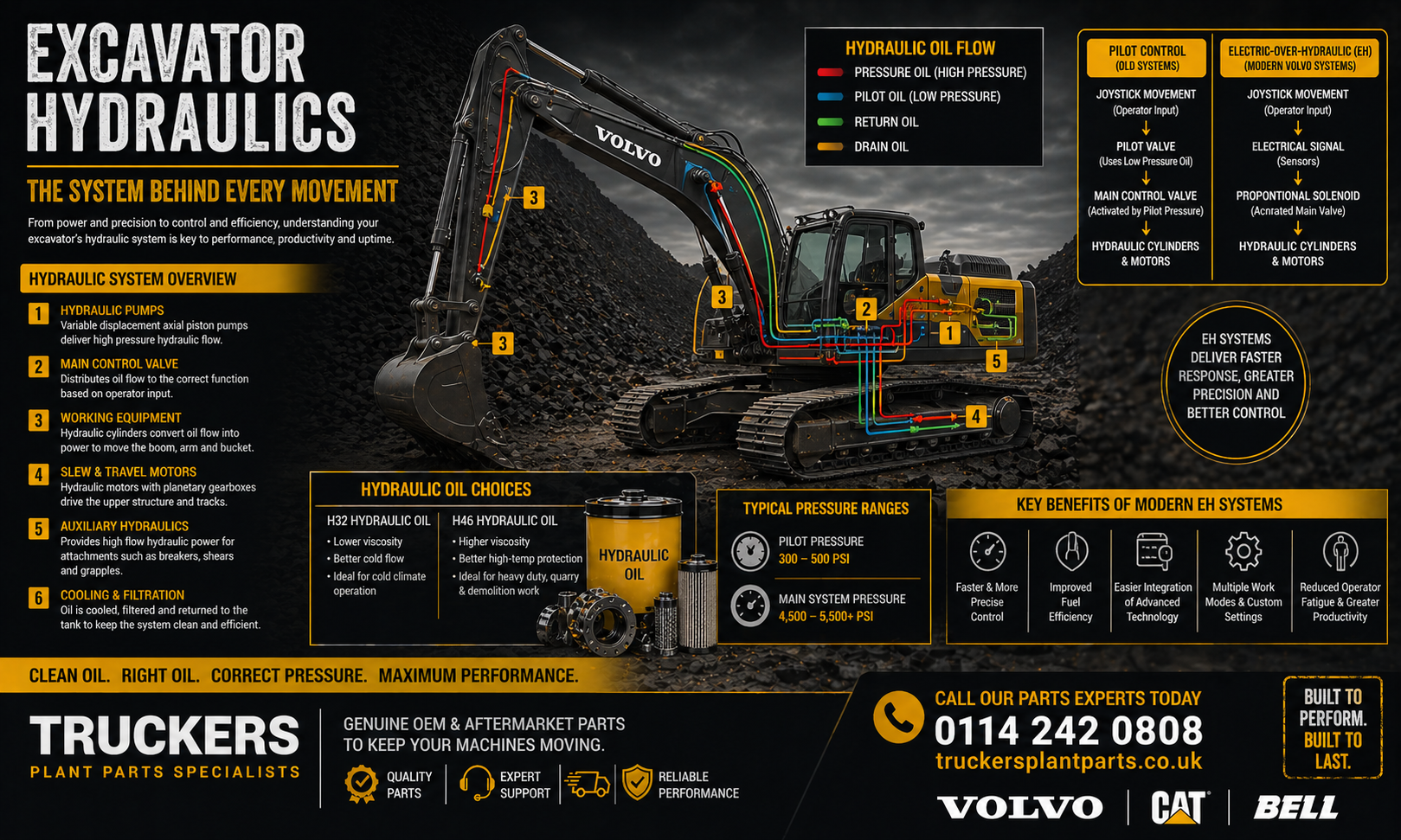
Hydraulics are the invisible force behind almost every movement an excavator makes. From lifting heavy demolition attachments to precisely grading a trench with millimetre accuracy, the hydraulic system is what transforms engine power into usable working force. While excavators may appear externally similar over the decades, the technology controlling their hydraulics has evolved enormously — and understanding those changes is critical for operators, fleet owners, plant engineers, and maintenance teams alike.
Modern excavators from manufacturers such as Volvo Construction Equipment, Caterpillar, Komatsu and Hitachi Construction Machinery now use advanced electro-hydraulic systems capable of delivering levels of precision and efficiency that older pilot-controlled machines simply could not achieve. Yet despite all the technological advances, the core principles remain the same: hydraulic pressure, hydraulic flow, oil viscosity, valve control, and fluid cleanliness still determine how efficiently an excavator performs.
The biggest misunderstanding many people have about excavator hydraulics is assuming all hydraulic systems operate identically. In reality, there are major differences between older hydraulic excavators and modern EH-controlled systems, differences in oil specification such as H32 versus H46 hydraulic oil, and major differences between mineral-based hydraulic systems and modern low-viscosity hydraulic fluids.
Older excavators relied heavily on purely hydraulic pilot systems. In these machines, moving a joystick physically directed low-pressure pilot oil through small control valves which then activated larger spool valves inside the main valve block. This hydraulic pilot pressure controlled the flow of high-pressure hydraulic oil that ultimately moved the boom, dipper, bucket, slew motor, and travel motors. These systems were relatively simple, rugged, and reliable. Many older operators still appreciate pilot-control machines because they often feel smoother and more progressive in their response.
Machines from the 1980s, 1990s, and early 2000s commonly used these traditional pilot systems. Operators became extremely familiar with the feel of them. The hydraulic response was naturally dampened slightly because the system relied on fluid pressure signals rather than electronic signals. This produced a smoother, less aggressive machine response that many experienced operators still prefer for certain applications.
However, these older systems also had limitations. Hydraulic pilot controls introduced lag into the system because oil must physically travel through pilot circuits before activating the main valves. As machine technology evolved, manufacturers needed more precision, faster reaction times, improved fuel economy, and the ability to integrate intelligent machine control systems. That is where electric-over-hydraulic technology completely changed excavator design.
Modern EH excavators use electronic joystick inputs rather than relying entirely on pilot oil pressure. Instead of pilot oil activating the main valve block directly, electronic signals are sent to proportional solenoids that control the hydraulic valves. The result is dramatically improved responsiveness and accuracy.
This is why operators transitioning from older machines into newer excavators often describe EH-controlled excavators as feeling “jerky” or overly sensitive initially. The machine reacts much faster because electrical signals move almost instantaneously compared to hydraulic pilot pressure. Once operators adapt, many realise the precision available with EH systems is far superior, especially in grading, lifting, demolition, and attachment work.
EH systems also allow manufacturers to introduce multiple work modes, machine customisation settings, and intelligent hydraulic optimisation systems. Modern Volvo excavators, for example, allow operators to select hydraulic responsiveness profiles such as Soft, Normal, or Active modes. This fundamentally changes how quickly the excavator responds to joystick input.
Older excavators were often dependent on engine RPM for hydraulic performance. Operators would increase throttle aggressively to gain faster boom and arm speeds because hydraulic pumps were mechanically linked to engine speed. In contrast, modern EH systems intelligently manage hydraulic flow electronically, meaning machines can remain responsive even at lower engine speeds. This dramatically improves fuel efficiency and reduces unnecessary engine wear.
The integration of advanced technology is another enormous difference between old and new hydraulic systems. Features such as machine guidance, semi-autonomous digging systems, intelligent grading systems, payload monitoring, attachment recognition, and hydraulic automation all rely heavily on EH architecture. Retrofitting these technologies onto old pilot-only systems is possible in some cases but is far more complicated and expensive.
Another major area often misunderstood is hydraulic oil itself. Hydraulic oil is not simply “oil.” Its viscosity, additive package, temperature stability, anti-wear characteristics, and compatibility with seals and pumps are critical to excavator reliability.
Two of the most commonly referenced hydraulic oil grades in construction equipment are H32 and H46 hydraulic oils. These numbers refer primarily to viscosity grades under ISO standards. H32 hydraulic oil is thinner and flows more easily at lower temperatures, while H46 hydraulic oil is thicker and better suited for higher operating temperatures or heavier-duty systems.
H32 hydraulic oil is commonly used in colder climates or in systems where fast cold-start lubrication is important. Because the oil is thinner, it reaches hydraulic components more quickly during startup and reduces cold-weather resistance. This helps reduce cavitation risks and improves responsiveness in low-temperature conditions.
H46 hydraulic oil, by comparison, provides greater film strength under heavy loads and high operating temperatures. In warmer climates or severe-duty applications such as quarrying, demolition, or mining, H46 often offers superior protection because it maintains viscosity better under heat stress.
The choice between H32 and H46 is not simply about preference. Using the wrong hydraulic oil can dramatically affect excavator performance and component lifespan. Oil that is too thick can increase pump strain, reduce efficiency, slow machine response, and create cold-start pressure issues. Oil that is too thin can reduce lubrication, increase internal leakage, reduce hydraulic efficiency, and accelerate wear inside pumps, motors, and valve blocks.
Modern excavators are increasingly designed around tighter tolerances and higher-pressure hydraulic systems than older machines. This means oil cleanliness and viscosity accuracy are more important than ever before. EH systems especially depend on extremely clean hydraulic oil because proportional control valves and solenoids are far less tolerant of contamination than older pilot systems.
Another distinction worth understanding is the difference between mineral hydraulic oils and lighter modern hydraulic systems. Traditional mineral hydraulic oils were once the industry standard. These oils were petroleum-based and relatively simple in formulation. They provided acceptable lubrication and pressure transfer characteristics but lacked the advanced additive technology available today.
Modern hydraulic fluids often include advanced anti-wear additives, oxidation inhibitors, anti-foam technology, corrosion protection, water separation capability, and enhanced temperature stability. Some modern hydraulic systems also use low-viscosity hydraulic oils designed specifically to improve fuel efficiency by reducing internal hydraulic drag.
Light hydraulic oils are increasingly used in modern excavators because reducing parasitic losses inside hydraulic pumps contributes directly to fuel savings. Manufacturers are under enormous pressure to reduce emissions and improve efficiency, so every component of the hydraulic system is now engineered around energy optimisation.
That said, not all machines should automatically switch to low-viscosity hydraulic oils. Older excavators designed around thicker mineral hydraulic oils may experience increased leakage or reduced hydraulic pressure retention if lighter oils are used incorrectly. Seal compatibility, pump tolerances, and operating environment must all be considered carefully.
Hydraulic contamination remains one of the biggest causes of excavator failure regardless of whether the machine uses old pilot controls or modern EH technology. Tiny particles of dirt, metal, or water contamination can destroy hydraulic pumps costing tens of thousands of pounds. This is why modern maintenance practices place such heavy emphasis on oil sampling, filtration, breather systems, and scheduled hydraulic servicing.
Heat management is another critical factor in excavator hydraulics. Hydraulic systems generate enormous heat during operation because fluid movement under pressure naturally creates friction and energy loss. Modern excavators therefore use sophisticated cooling systems to maintain hydraulic oil within an optimal operating temperature range.
Excessive hydraulic heat can rapidly degrade oil, damage seals, reduce lubrication effectiveness, and accelerate wear. Cold hydraulic oil creates different problems by reducing flow efficiency and increasing pressure spikes. This is why hydraulic oil viscosity selection must always consider the machine’s operating climate and application.
Demolition excavators place particularly high demands on hydraulic systems. Machines operating pulverisers, shears, crushers, or high-reach demolition booms experience enormous hydraulic loads continuously. In these applications, hydraulic oil quality, filtration, and temperature stability become absolutely critical to uptime.
Similarly, modern excavator attachments have increased hydraulic complexity dramatically. Rotating grabs, tiltrotators, hydraulic breakers, variable-flow attachments, and intelligent couplers all place additional demands on machine hydraulics. EH systems are especially advantageous here because attachment settings and flow rates can be electronically customised precisely.
The future of excavator hydraulics is likely to involve even deeper integration between electronics and hydraulics. Electro-hydraulic systems are already evolving toward semi-autonomous and fully autonomous machine operation. Machine learning, intelligent pump management, and predictive diagnostics are increasingly becoming part of modern excavator architecture.
Hybrid hydraulic systems may also become more common as manufacturers seek greater fuel efficiency. Some newer concepts already use hydraulic accumulators and energy recovery systems to capture and reuse hydraulic energy that would previously have been wasted as heat.
Despite all the advances in excavator hydraulics, the fundamentals still matter most. Hydraulic pressure creates force. Hydraulic flow creates speed. Oil quality protects components. Cleanliness determines reliability. Understanding these principles remains essential whether operating a thirty-year-old pilot-controlled excavator or a brand-new EH-controlled intelligent machine.
For operators transitioning from older excavators into modern EH-controlled machines, patience and adaptation are important. The responsiveness may initially feel unfamiliar, but once mastered, the precision, efficiency, and control available from modern hydraulic systems far surpass what older technology could offer.
Hydraulic systems are ultimately the heart of the excavator. Engines provide power, but hydraulics convert that power into usable motion. From older mineral-oil pilot systems to modern electro-hydraulic excavators using advanced low-viscosity fluids and intelligent controls, excavator hydraulics continue evolving rapidly — and understanding that evolution is essential for anyone serious about heavy equipment ownership, operation, servicing, or fleet management.